(Click on image to enlarge)
RAMSAY IN C19 NEWSPAPER ACCOUNTS
[PB: It was noticed even in the C19 that it was [blown up, fanned] by newspapers around the world. As the NY ? put it
When was the earliest newspaper report mentioning his name?
[PB: It was noticed even in the C19 that it was [blown up, fanned] by newspapers around the world. As the NY ? put it
When was the earliest newspaper report mentioning his name?
[Find the Punch passage, 24 February 1855, that the Morning Star attacked.]
The Leicester Chronicle, Saturday 10 March 1866, quoted at some length a letter from Jamaica [with evidence that rebutted] Punch magazine's "facetious" article about the events in Jamaica, some of the worst of which involved Ramsay:
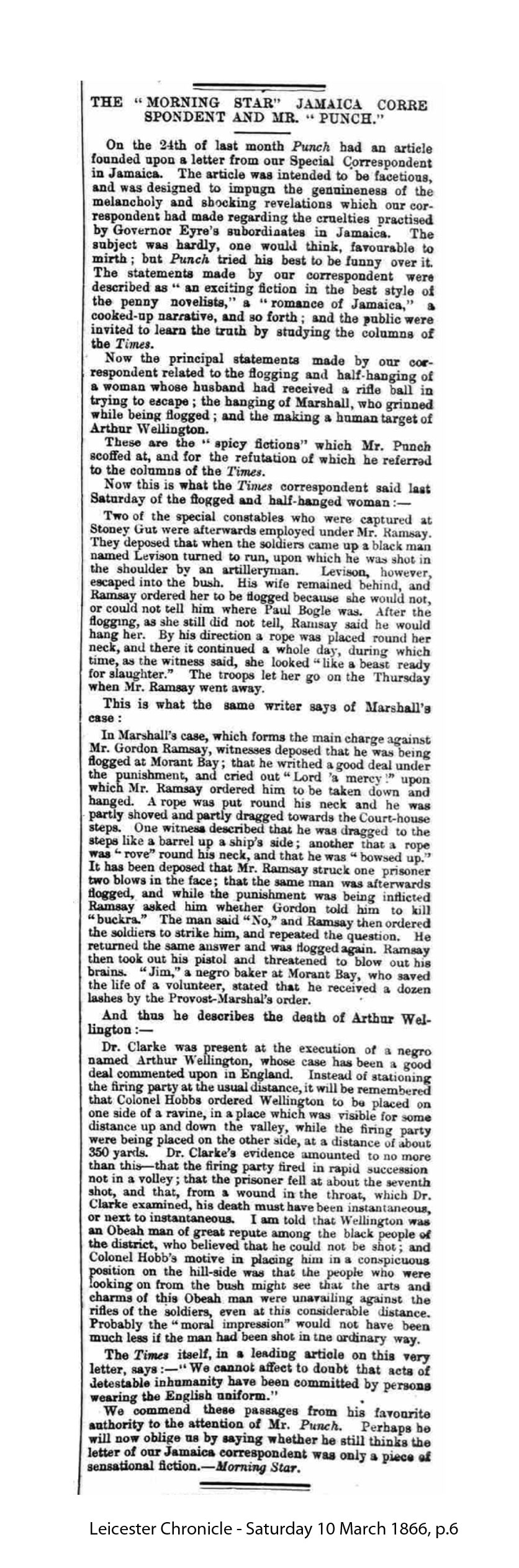
THE "MORNING STAR" JAMAICA CORRESPONDENT AND MR. "PUNCH."
On the 24th of last month Punch had an article founded upon a letter from our Special Correspondent in Jamaica. The article was intended to be facetious, and was designed to impugn the genuineness of the melancholy and shocking revelations which our correspondent had made regarding the cruelties practised by Governor Eyre's subordinates in Jamaica. The subject was hardly, one would think, favourable to mirth; but Punch tried his best to be funny over it. The statements made by our correspondent were described as "an exciting fiction in the best style of the penny novelists," a "romance of Jamaica," a cooked-up narrative, and so forth; and the public were invited to learn the truth by studying the columns of the Times.
Now the principal statements made by our correspondent related to the flogging and half-hanging of a woman whose husband had received a rifle ball in trying to escape; the hanging of Marshall, who grinned while being flogged; and the making a human target of Arthur Wellington.
These are the "spicy fictions" which Mr. Punch scoffed at, and for the refutation of which he referred to the columns of the Times.
Now this is what the Times correspondent said last Saturday of the flogged and half-hanged woman:
Two of the special constables who were captured at Stoney Gut were afterwards employed under Mr. Ramsay. They deposed that when the soldiers came up a black man named Levison turned to run, upon which he waa shot in the shoulder by an artilleryman. Levison, however, escaped into the bush. His wife remained behind, and Ramsay ordered her to be flogged because she would not, or could not tell him where Paul Bogle was. After the flogging, as she still did not tell, Ramsay said he would hang her. By his direction a rope was placed round her neck, and there it continued a whole day, during which time, as the witness said, she looked "like a beast ready for slaughter." The troops let her go on the Thursday when Mr. Ramsay went away.
This is what the same writer says of Marshall's case:
In Marshall's case, which forms the main charge against Mr. Gordon Ramsay, witnesses deposed that he was being flogged at Morant Bay; that he writhed a good deal under the punishment, and cried out "Lord 'a mercy!" upon which Mr. Ramsay ordered him to be taken down and hanged. A rope was put round his neck and he was partly shoved and partly dragged towards the Court-house steps. One witness described that he was dragged to the steps like a barrel up a ship's side; another that a rope was "rove" round his neck, and that he was "bowsed up." It has been deposed that Mr. Ramsay struck one prisoner two blows in the face; that the same man was afterwards flogged, and while the punishment was being inflicted Ramsay asked him whether Gordon told him to kill "buckra" [i.e. white people]. The man said "No," and Ramsay then ordered the soldiers to strike him, and repeated the question. He returned the same answer and was flogged again. Ramsay then took out his pistol and threatened to blow out his brains. "Jim," a negro baker at Morant Bay, who saved the life of a volunteer, stated that he received a dozen lashes by the Provost-Marshal's order.
And thus he describes the death of Arthur Wellington:
Dr. Clarke was present at the execution of a negro named Arthur Wellington, whose case has been a good deal commented upon in England. Instead of stationing the firing party at the usual distance, it will be remembered that Colonel Hobbs ordered Wellington to be placed on one side of a ravine, in a place which was visible for some distance up and down the valley, while the firing party were being placed on the other side, at a distance of about 350 yards. Dr. Clarke's evidence amounted to no more than this — that the firing party fired in rapid succession not in a volley; that the prisoner fell at about the seventh shot, and that, from a wound in the throat, which Dr. Clarke examined, his death must have been instantaneous, or next to instantaneous. I am told that Wellington was an Obeah man of great repute among the black people of the district, who believed that he could not be shot; and Colonel Hobbs's motive in placing him in a conspicuous position on the hill-side was that the people who were looking on from the bush might see that the arts and charms of this Obeah man were unavailing against the rifles of the soldiers, even at this considerable distance. Probably the "moral impression" would not have been much less if the man had been shot in the ordinary way.
The Times itself, in a leading article on this very letter, says: "We cannot affect to doubt that acts of detestable inhumanity have been committed by persons wearing the EngUsh uniform."
We commend these passages from his favourite authority to the attention of Mr. Punch. Perhaps he will now oblige us by saying whether he still thinks the letter of our Jamaica correspondent was only a piece of sensational fiction. — Morning Star.
[Source: Leicester Chronicle, Saturday 10 March 1866, p.6. Online in the British Newspaper Archive here (accessed 6.2.2017).]
There was a brief mention of GDR in an article in the Liverpool Mercury, 17 March 1866
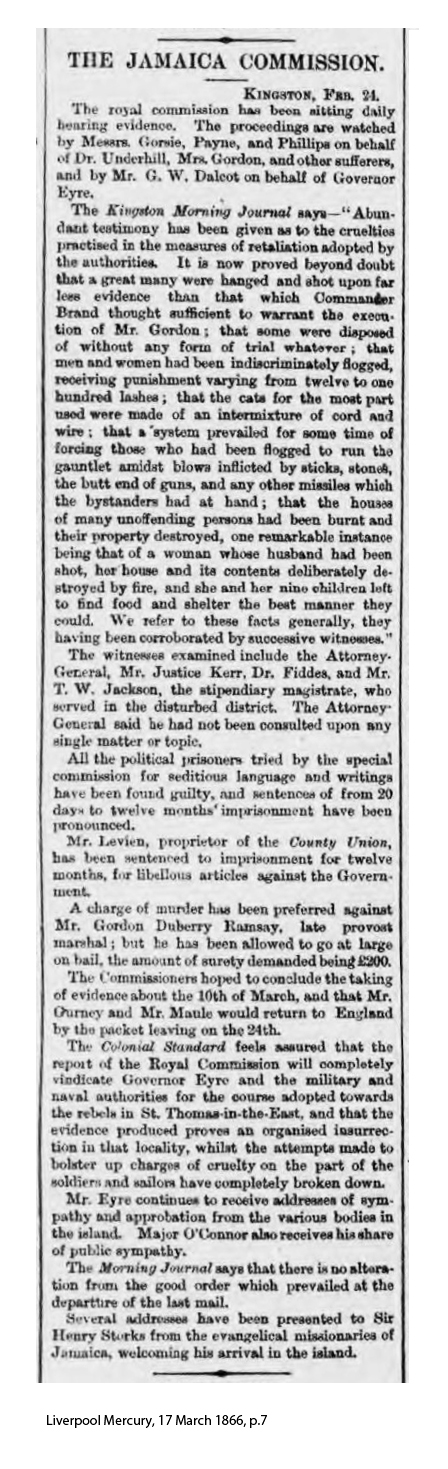
[NEEDS EDIT]
THE JAMAICA COMMISSION.
KINGSTON, Jan. 24. The royal commission has been sitting daily hearing evidence. The proceedings are watched by Messrs. Gorsie, Payne, and Phillips on behalf of Dr. Underhill, Mrs. Gordon, and other sufferers, and by Mr. G. W. Dalcot on behalf of Governor Eyre.
The Kingston Morning Journal says - "Abundant testimony has been given as to the cruelties practised in the measures of retaliation adopted by the authorities. It is now proved beyond doubt that a great many were hanged and shot upon far less evidence than that which Commander Brand thought sufficient to warrant the execution of Mr. Gordon; that some were disposed of without any form of trial whatever; that men and women had been indiscriminately flogged, receiving punishment varying from twelve to one hundred lashes; that the cats for the most part used were made of an intermixture of cord and wire; that a system prevailed for some time of forcing those who had been flogged to run the gauntlet amidst blows inflicted by sticks, stones, the butt end of guns, and any other missiles which the bystanders had at hand; that the houses of many unoffending persons had been burnt and their property destroyed, one remarkable instance being that of a woman whose husband had been shot, her house and its contents deliberately destroyed by fire, and she and her nine children left to find food and shelter the best manner they could. We refer to these facts generally, they having been corroborated by successive witnesses."
The witnesses examined include the Attorney-General, Mr. Justice Kerr, Dr. Fiddes, and Mr. T. W. Jackson, the stipendiary magistrate, who served in the disturbed district. The Attorney-General said he had not been consulted upon any single matter or topic.
All the political prisoners tried by the special commission for seditious language and writings have been found guilty, and sentences of from 20 days to twelve months' imprisonment bare been pronounced.
Mr. Levien, proprietor of the County Union, has been sentenced to imprisonment for twelve months, for libellous articles against the Government.
A charge of murder has been preferred against Mr. Gordon Duberry Ramsay, late provost-marshal; but he has been allowed to go at large on bail, the amount of surety demanded being £200.The Commissioners hoped to conclude the taking of evidence about the 10th of March, and that Mr. Gurney and Mr. Maule would return to England by the packet leaving on the 24th.
The Colonial Standard feels assured that the report of the Royal Commission will completely vindicate Governor Eyre and the military and naval authorities for the course adopted towards the rebels in St. Thomas-in-the-East, and that the evidence produced proves an organised insurrection in that locality, whilst the attempts made to bolster up charges of cruelty on the part of the soldiers and sailors have completely broken down.
Mr. Eyre continues to receive addresses of sympathy and approbation from the various bodies in the island. Major O'Connor also receives his share of public sympathy.
The Morning Journal says that there is no alteration from the good order which prevailed at the departure of the last mail.
Several addresses have been presented to Sir Henry Storks from the evangelical missionaries of Jamaica, welcoming his arrival in the island.
http://www.britishnewspaperarchive.co.uk/viewer/bl/0000081/18660317/026/0007
Similar articles appeared within a few days in e.g. the Sheffield Independent, and at greater length here in the Sheffield Daily Telegraph, Monday 19 March 1866, where GDR is named in a number of subheads, which suggests his name was already well known to readers:

[NEEDS EDIT]
THE OUTBREAK IN JAMAICA.
The following extracts are from the letter of the Times' Special Commissioner:
VISITING SCENES OF THE REBELLION.
Spanish Town, Feb. 24. — During the past fortnight the Royal Commissioners have continued their inquiry into the "nature, circumstances, and origin" of the disturbances at Morant Bay with unremitting diligence. On the 15th they went to Morant Bay, and thence to Stoney Gut, so as to gain a better knowledge of the district in which the rebellion, if rebellion it can be called, originated. I have described the chief incidents of this visit in a separate letter. His Excellency only allowed one day for the trip, and sat again in the afternoon the day following. In fact, the work of taking evidence seemed at one time to become more formidable as it proceeded; the greater the number of witnesses examined, the more remained be examined. After some 150 persons had been heard Mr. Gorrie and Mr. Horne Payne intimated, behalf their clients, that they would have about witnesses to call in proof of excesses committed by magistrates, officers, soldiers, or Volunteers. Mr. Gurney suggested that it was idle to call every witness who had suffered, or who alleged that he had suffered. There must be a selection of typical cases, including, of course, the strongest that could be presented. Sir Henry Storks said he had instructed the Government engineer to go to the district traversed by the military, and send in a return of the number of houses burnt or destroyed, so that it would be unnecessary to submit evidence upon this point. Mr. Gurney observed that there would be difficulty in ascertaining the exact number of lives taken under sentence of court-martial; but the danger was now lest the notes should be encumbered with needless evidence. Mr. Horne Payne said that a large number of persons had been flogged without trial. How could the Commissioners ascertain the number without hearing each particular case? Again, there were very many instances in which property was alleged to have been stolen by the soldiers.
THE REPORTING STAFF.
Three short-hand writers from England — Mr. Barnett end Mr. Barnett, jun., of Chancery-lane, and Mr. Dunning, of Liverpool — are kept busily employed in taking the evidence for the Government, and their notes are printed here as soon transcribed for use by the Commissioners and the parties. In spite of praiseworthy intentions on the part of his excellency and the other Commissioners to keep out irrelevant matter, the volume of evidence when completed will be found a bulky and a costly one; for printing in this country, like most other luxuries, is expensive.
THE ARREST OF RAMSAY.
The chief event in colony since my last, outside the Royal Commission, has been the arrest, upon a charge of murder, of Mr. Gordon Duberry Ramsay, who acted as Provost-Marshal of Morant Bay during martial law. The murder with which he is charged, as may be easily conceived, is that of Marshall, hung by his orders because the prisoner ground his teeth while being "catted" in the Bay. I believe there is no truth in the statement that Marshall had ever been ordered for execution by sentence of court-martial, and was being flogged in mistake. The man was hung by Mr. Ramsay because he used menacing gestures and language while tied to the gun, but Captain Ford and Lake, a summary of whose evidence accompanies this letter, negative strongly the statement that Marshall used any threat whatever. It was upon a sworn information by Mr. Lake that Mr. Ramsay was arrested upon warrant last Tuesday. He was at once taken before Dr. Land, magistrate in Spanish Town, who, under the peculiar circumstances of the case, admitted him to bail, himself in £4OO and two sureties to the amount of £2OO each. The peculiar circumstances" e the existence the Act of Indemnity, which, it was pleaded, covers the acts of the Provost-Marshal done in the execution of his duty.
THE COURT-MARTIAL.
Mr. Lake, newspaper reporter, was present at the court-martial upon Gordon, and took notes of the evidence. He said that the prisoner's defence lasted over an hour, and that the President was careful in taking down every word he uttered. Gordon made his statement sentence by sentence, so that the President could follow him, and this was the reason the defence lasted so long. Gordon was subjected to a great many indignities. Witness saw him at the police station, with his arms tied, lying on a blanket. Some sailors came and said, "Who is this _____ son of a _____? Is he white man or a Frenchman?" Holding cat before his face they said, "Would you like to have a taste of this, old boy? You will soon catch it. We are getting ready. You will not have long to remain here." The trial began at two or three o'clock, and lasted fully four hours and a half. Mr. Gurney asked the witness whether he considered that Gordon had a patient trial? Witness said he did not. Gordon was interrupted in the latter portion of his speech by the President, who said, "That closes your defence?" to which Gordon replied that he had not yet finished. Mr. Manle asked whether Gordon was allowed to cross-examine all the witnesses. Yes, he was. - Mr. Maule: was not interrupted in that?" - Witness: "No." Mr. Manle: Then, your reason for believing that he had not a patient trial was that he was interrupted by the President as yon state? Witness: It was. - Mr. Mattie: When Gordon resumed his address was not interrupted' - Witness: No, he was not. - Mr. Gurney: Is it true he had a very patient trial? - Witness: It is matter of opinion; I do not think so, - Mr. Gurney: Did you not state at the time that bad very patient trial, that he was allowed to cross-examine all the witnesses, and, above all, was allowed time to prepare his defence? Witness: I do not feel bound by my letters as they appear print. - Mr. Gurney: What we ask is whether it was what yon stated at that time? - Witness: I may have stated it, bu? I will not be bound by the statement. My opinion then was that Gordon had very patient trial. I have since formed a different opinion." - Mr Gurney: What h«s induced you to alter that opinion?" - Witness: I think some patience might have been exercised in allowing him to call Dr. Major as to the cause of his absence from the vestry on the 11th of October. He did not ask that Dr. Major should be called, but simply said that Dr. Major, if called, could speak to his state of health at the time, and the President replied that Dr. Major was not in the Bay." - Mr. Gurney: Did he ask for any postponement?" - Witness: "He did not. Dr. Major was in the Bay the day after the execution." Mr. Gordon, the witness afterwards added, had no coat on at the time of his trial. He had on pantaloons and vest, with a blanket thrown over him.
EVIDENCE BEFORE THE REBELLION.
A somewhat remarkable conversation with Gordon, occurring a few weeks before the rebellion, was detailed by Mr. J. B. Ford, manager of the Jamaica Bank, now incorporated with the Colonial Back. Gordon was in the habit of chatting freely with Mr. Ford, who on this occasion, referring to a speech delivered Gordon at Vere, asked him how it was that he made the people discontented with their condition when they had really no ground for discontent. Gordon said they had great many wrongs, and he was bound to see them redressed. Witness asked him how he could say that the Custodes were the most wicked and scoundrelly of men. He said the greater part of them were so. Witness replied that his habit of speaking ill of them before the people was a very dangerous one; it was like putting a fire-stick imo a barrel of gunpowder. Mr. Ford added, Suppose, now, that the people were such fools as to rise in rebellion; do you think that, even if they succeeded in cutdng all our throats, England would not avenge us amply?" Gordon replied, You are quite mistaken there. All the power of the great Napoleon could not put down the rising in Hayti, for nearly all the French troops died of the diseases of the country." But, Gordon," Mr. Ford replied, a very powerfully organised rebellion arose in India some years since, and here and there it was successful; but it was soon put down; English power was vindicated; and to it would be' here." Gordon said, India is rot at all case in point, for India is country, and the English troops could overrun it and conquer it without difficulty. But this country is a hilly one, and before the English troops could reach the people in the mountains they would die of disease ." Gordon rose to go soon afterwards, and said, course, this is mere abstract talk;" but Mr. Ford was so impressed by it that when he got home he mentioned the conversation to his family, and said it seemed to him a serious matt; r. This was about three weeks before the 11th of October. On the Saturday after the outbreak witness saw Gordon again, who said, among other things, he was sorry for his friend Mr. Hire; that he (Gordon) was a peace loving man, and the witness must not think he had had to do with any bloodthirsty intentions. He added, They accuse me having been absent from this vestry meeting with intention and foreknowledge of what was going to happen. Now, you know, from my having been here every morning, that I have been too ill to go down." Mr. Ford, continuing his evidence, said this was fact; Gordon certainly seemed too ill to go to Morant Bay.
ANIMUS AGAINST GORDON.
An incident in the early history of the outbreak has been brought forward to show the animus of the authorities against G. W. Gordon, even then, before any proof of his complicity could have been forthcoming, Mr. Kelly Smith, editor of the defunct JVatchmo'A, stated that on night of October 12, in going past Head-quarters c-hons-', the residence of the General, where ft Privy Council had been held, he Uflttd voices, f anil Colonel Hunt said, We will proclaim martial law to-morrow, and make that fellow, G. W. Gordon, skedaddle." Sereral vohes exclaimed, "We will him." This conversation took place outside the house, as they were stepping into their carriages, and witness spoke posffive'y t» his recognition, besides Colonel Hunt, of Mr. Westmorland, Mr. Hosack, and Captain O'Connor, son of Major General O'Connor, But it appears that Captain O'Connor was not then in the island. another of the political prisoners, confirmed this statement, hut did not mention Captain O'Connor present. Joseph Smith, a nephew of Mr. Gordon, but who has not been speaking terms with him of late years, deposed that on the 17th of October he heard Colonel Hunt, referring to his uncle, say to Captain Astwood, a volunteer officer, I wish to God, Astwood, I had caught that at Morant Bay; the tallest tree there would not have been high enough to hang him on."' And the following day he heard Lieut. Brand say, I had the pleasure of hanging the first rebel at Port Morant, and nothing would give me greater pleasure than to have the hanging of this son of ." Lieut. Brand was the president of the court-martial which afterwards tried and condemned Mr. Gordon to be hanged.
RAMSAY'S ATROCITIES.
I now proceed to give a few the painful stories told by some of the negro witnesses, premising that though some of them may be true, all must be taken with certain reservation. Alexander Grey, a peddler, said that he saw 53 people flogged and 11 men hanged in one village. The people flogged got lashes each, except one man, who received 100. Those flogged cried out, whereupon the officer in command ordered them to be gagged with stones. woman named Polly Livingstone, of Stony Gat, said that her husband was shot by the white soldiers, but made his escape into the bush, thongh wounded, and lived for a week afterwards. The soldiers came into her cottage and asked for him, and, as they could not find him, they teok her to Paul Bogle's chapel and flogged her. They tied her round the neck with the lamp cord, and half hanged her, so that she felt her eyes half shoot out of her head. This was because she did not tell where her husband was. Afterwards the rope was slacked, she dropped down, and she tied up outside the chapel in rain from the Wednesday morning till the Thursday evening, when she was let go. Next Sunday she was taken some constables, and tried by court-martial at Morant Bay, and sentenced to be hanged, but Mr. Ramsay said she had got enough ill-treatment at Stony Gut, and begged her off from this punishment. The soldiers stole her wedding ring. James Stuart, a free settler at St. Thomas-in-the-East, said that on the 21st October the Maroons came down, burning houses as they came along, and he saw them shoot three men and a woman — old people, who were in their houses at the time. The Mareons called one man, Trevithick, out of his house, and as became out they shot him. They burnt witness's house and took away his clothes; his seven children ran into the bush.
George Clark, an intelligent negro, vestry man for the parish, and brother of Samuel Clark who was hung at Morant Bay, told the following story: — He lives about a mile from Stony Gut, and is married to a daughter of Paul Bogle, so that his connexions probably exposed him to some suspicion at the period of the outbreak. He was taken to the Bay in custody, and stated that, as he was asking questions of some men who had charged him, he received several strokes from a cat. This was in the presence of Ramsay, the Provost-Marshal, who snatched the shirt studs from his bosom and pocketed them, saying that they could not belong to a nigger. Witness saw James Marshall flogged upon a gun-wheel in the square. At the 23th lash Marshall cried out, "Lord mercy!" upon which Ramsay ordered him to be hung. All the prisoners were brought out to see him executed, and Ramsay called out to thorn, "Look upon him, you brutes, you thieves; the whole of you will be hung like him!" Witness was tried before court-martial, the members of which were Mr. Espent, Mr. Hutchins, and Mr. Lewis. Before his trial, and when he was under the shed among the other prisoners, Ramsay took hold of him and called out, "Will anybody give evidence against this brute?" Two men thereupon came forward to give evidence against him. The Court asked Ramsay whether that was all the evidence, to which Ramsay replied that some other persons had promised to come forward, but had not done so. The Court told witness that if he had any evidence to produce he was to ask Ramsay to send for it. Witness accordingly asked Ramsay to send for persons whom he named. The first time he made this request Ramsay said, "If you open your mouth to me, you brute, I'll shoot you; how dare you?" Witness was afterwards talking to constable named Williams, of St. Thomas-in-the-East, who could have spoken to his character; but Ramsay interposed, and said, "Who is allowing this man to talk Give him a dozen!" and he received ten lashes accordingly. Witness saw George William Gordon brought on shore in custody. Gordon was speaking to old man among the prisoners, upon which Ramsay said, you see him speaking to anybody, blow out his brains!" Ramsay afterwards said to Gordon, showing him the gallows, upon which man was hanging, "There is one of your friends; you will be hung like him." This was before Gordon had been tried. Ramsay called out to the prisoners, "Who can give evidence against George William Gordon? Anybody who can will save his life and be rewarded." As he said so a boy named John Anderson came forward, and said to Ramsy that he had seen Gordon come up to Stony Gat, and had heard him say that the white men should have been dead long ago. Another young man came forward, and these two persons left together with Ramsay. Witness saw Gordon on the gallows; he gave his spectacles and hat to one of the marines. The charge against witness was for preventing the warrants from being executed at Stony Gut; but the charge was not read to him before the court-martial, nor was he called upon to plead or asked whether he was guilty or not guily. He was kept in custody up to the expiration of martial law, and then discharged, Ramsay saying to him, "You must not be seen in a vestry, or in a public meeting, or Morant Bay." Upon this he gave witness a pass. On going home witness found that his cottage was burnt down, and his provisions were dug up. His brother, Samuel Clarke, who was hung, was flogged when he was brought in custody; only hour elapsed between his sentence and execution. a man did not give sufficient evidence, he was taken down and received a dozen lashes. One men treated in this way afterwards gave evidence against three men who were hung. Two persons who thus gave evidence were afterwards themselves hung; and a third would have been hung too but for the intervention of an officer. One man, named Panlon, was forced to give evidence against his own son; and both were afterwards flogged and hung.
__________
The following is from the Daily News correspondent:
THE ATROCITIES AT LEITH HALL.
One of the most extraordinary stories which has been given in evidence was told by a man named Collins, of Kingston, of the proceedings at Leith Hall, where a black drummer of a West Indian regiment appears to have been entrusted with absolute authority, and to have acted as accuser, judge, and executioner. The first thing that was heard of this individual was at Morant Point, where he hanged man and flogged a woman. There appears at first to have been some doubt about hanging the man, but Philip said that letter had come directing that, as he could not walk to Morant Bay, he should be hanged, and be was accordinglv run tree in the presence Mr. Peter Espent, a joucg gentleman residing in the neighbourhood. The rope slipped, and it was not until Mr. had fired his pistol,and Phillips had discharged his rifle at him that the expired. Leith ball, while the detachment of the was there, cumber of people were flogged without any trial. A married man was brought in. Phillips said that supposed he was a rebel, and he was at once shot. Soon afterwards the Gth marched to Bath, and Phillips was left in sole command Leith-hall. How fxercised his authority may be judged from the circumstance that a man having been left his charge with directions from Lieu'enant Adcock that should cot be hanged, because there was not sufficient evidence against him, almost as soon as the lieutenant's back was turned he had the man brought out and executed him. When Lieutenant Adcock returned he inquired for this man, and was told that he had been hanged. He ordered Philips [to?] Morant Bay, but the drummer did not obey his orders for three or four days; and no evidence has yet been given that he received any punishment for his murderous disobedience. During his administration of aftairs at Leith Hall the coons brought iu man whom they said was Obeah man, but against whom, as far Collins's evidence went, they brought no charge of complicity in the rebellion. He was tried by a Maroon, his brother giving evidence against him, and was ordered to be shot. He and three others who were tried in the same manner were executed the same evening. It seems that it was not only at Morant Bay that prisoners who bad been flogged were compelled run the gauntlet. At Lehh Hall the soldiers, as Collins said, the direction their officers, provided themselves with stones, and when the men who had been flogged were released, pelted them so severely that many of them tumbled down. A considerable number of women were flagged. Philips said that this was clone order of Lieutenant Adcock, but Captain Ashwood denied that any such orders were given that officer.
CRUELTIES TO A BAPTIST MINISTER.
The Rev. Edwin Palmer, a black minister, who ia connected with the Baptist society in London, described with great force and minuteness the harsh treatment to which prisoners were subjected after their arrest and on their way Morant Bay. He stated that he was arrested in Kiogst on the 20th October, without being informed what offence he was charged, and was confined for two hours in the city cage, after which he was removed to the barracks and shut in a dark cell. Next morning he was removed Up Park Camp. An officer asked him what caused him to come there, but as he had not been told with what he was charged he could not inform him. He was then handed over to the provost-sergeant, who after threatening to cut off his hair locked him in a cell. The same afternoon he and others were marched through the streets Kingston, under the guard of a large detachment of soldiers, to the Ordnance-wharf, and there his hands were tied behind him so tightly as bring tears into his eyes.
In that condition he was compelled to enter boat which was to convey him to the Aboukir (the guard ship at Port Royalj. He was always afraid to enter a boat even when his hands were loose, but their being tied made it much worse. When he got board the Aboukir he was by order the placed in irons, and his hands were then untied. The captain said to the men who were on guard, "If any of the prisoners attempt to escape blow out their brains. Don't care about their lives any more than about cats' lives." Another officer, whose rank he did not know, asked him what he was, and upon his replying, "A Baptist," said, "Well, because you are a Baptist I will hang you for that." He got the fever, and the doctor (Dr. Ryan) told him that eighteen inches of rope would be the best medicine could get.
He was on the Aboukir about twelve days. The prisoners slept upon the bare deck, and were exposed to the rain, bnt they were well fed, receiving beef, bread, and soda water. After had been in irons for three days, the captain ordered that they should be taken off, and that he should have an airing upon deck. When he took this exercise a rope was tied round neck, and the man who guarded him held the rope in one hand and a drawn sword in the other. When he had to fulfil any call of nature he was always attended a guard with leaded gun.
On the 2nd November he and others were removed to the Cordelia and to Morant Bay. The officers of the Cordelia taunted the prisoners, saying to them, "You will be hanged, you rascals." On the same day he was landed at Morant Bay; and on his way to the police station, the gallows were shown to him. and he was told by the soldiers and Maroons that he would be hanged on the following day. At the station, Provost-Marshal Ramsay inquired the names of the prisoners, and directed two of them, Goldson and Samuel Clarke, to be flogged. He then said to the others, "Lie down there, you fellows, on the floor," and they had to do so. No beds were supplied to them. He remained at the station about twelve days, and was on the 14th November, after the expiration of martial law, removed to the district prison, from which he was afterwards discharged by habeas corpus.
EXTORTING A CONFESSION.
A curious illustration of the measures which were adopted to extract confessions from suspected persons, and of the eagerness which was displayed by many of those who were engaged in the vindication of law and order — " to connect the late Mr. Gordon with the disturbances, has been supplied by the evidence of a Mr. jwler, who is inspector of police for the parishes of Pert Royal and St. Andrew's. On the 30th October a black mft, named Edward Spence, was brougnt into the station at Half Tree, which is the latter parish, on a charge of attempting to pass a sentry without answering his challenge. Mr. Dewier bad this unfortunate man under examination for about five hours, in the course of which time be told five or six different stories as to where came from, how he bad come, and what was his business in St. Andrew's. All these stories Mr. Dowler entirely disbelieved, and at last, as he said, losing all patience, he directed a sergeant who was standing by with riding whip in his hand to give him a cut across the shoulders. The sergeant gave Spence three blows with his whip, and tbe prisoner, anxious, no doubt, to avoid a repetition of the punishment, then made tbe following statement: — He said that he was intimate with Paul Bogle, and also with Mr. Gordon, who was caded their protector — that is, I presume,' was called so by the negroes. He attendef meetings at Paul Bogie's previous to the outbreak Morant Bay, an! had heard the subject of their wrongs discussed there. He knew that something was on foot, but at that time he did not know exactly what it was. On the 9th of October word came to m that he was to attend a meeting at Paul Bogle's. The word tbat came was Colour for colour. — " He went to the meeting, which was attended by a great many people whom he knew, and at which it was decided to meet the next day, or the day after, at Morant Bay. On the following day (the lOlh), word came to him and others that they were to go to Morant Bay, and that those who had guns were to take them with them, and those who had onlf cutlasses were to go aimed with them. He was averse from going, but his wife told him that he must as they were going to share the white-men's land, and that this was the second time that he had been asked to go. He went down to Morant Bay, but when the firing began he was frightened, and ran away. Although he had doubted the veracity of every one the stories that Spence had previously fold him, and although this tale had been extracted from bira only by the ication of actual violence, the inspector once accepted it as the truth, reduced it to writing, and depatched the man to Up Park Camp. He was afterwards sent to Morant Bay, where he was ultimately executed charge of being concerned in the disturbances. In consequence of the pressure our spece, extracts from the special correspondents of the Lonion Telegraph and Star stand over till to morrow.
Sheffield Daily Telegraph, Monday 19 March 1866.
http://www.britishnewspaperarchive.co.uk/viewer/bl/0000250/18660319/063/0003

[PB: This needs a LOT of editing.
THE JAMAICA MASSACRES.
The news from Jamaica fully bears out all that has been said by those speakers and journals who strongly condemned the repressive measures adopted by Governor Eyre and the British authorities during the hideous carnival of massacre whole followed the outbreak at Morant Bay Court House.
The conduct of Provost Marshal Ramsay does, indeed, like the horrors of the French Revolution, seem to defy exaggeration. The most diseased and fiendish imaginaton can go no further in the way atrocity than this wretch is now proved to have gone in actual fact. But one might have expected that men of education, men who in this country are commonly called "officers and gentlemen," even if their passions led them on to revel in slaughter, would at all events have abstained from wilful falsehood as a means of exaggerating the enormity of their atrocities.
Such, however, seems to have been the passions roused for the moment that British officers and soldiers emulated the fanaticism of the early Mussulmans, and imagined they were earning admiration and reward by every additional slaughter they perpetrated. Hence then seems to have been a tendency on behalf of some, not only to claim the merit of the crimes of which they were actually guilty, but a somewhat dishonest desire to appropriate the glory of acts of brutality perpetrated by other delinquents.
Among the agents whom the excellent Governor sent out in a judicial capacity was a maniac of the name of General Jackson, who seems to his functions of legal adviser to the colonels in the same temperate and judicious manner that Judge Jeffreys conducted the business of the bloody circuit. It was this worthy who bethought him of the ingenious device of seizing upon a lad somewhat imaginatively designated "Paul Bogle's valet," and with a rope attached to his stirrup and pistol presented to the head, forcing him to accuse any person, and a sufficient number of persons, to gratify his own bloodthirsty cravings.
It might have been thought that in a proceeding like this, the undivided glory would have been left to the real perpetrator. Smaller discoveries inventions it may be safe to pirate, but who could imagine the boldness and mendacity ready to filch the merit of this strikingly novel style of judicial procedure from its real author? Such, however, was the genius of Colonel Hobbs, who in the first published despatch claims this mode of dealing with Paul Bogle's "valet" as his own sole and undivided discovery and merit.
The appearance of General Jackson in the witness box was the first opportunity we had of assigning the glory to the person to whom it was due. But if we are obliged by a regard to accuracy to rob Colonel Hobbs of this title to distinction, we must hasten to assure him that on that account he will not be the less thought of. His own claim to the distinction, though it proves that his word is not entitled to much credit, proves that he was at all events quite capable of such an act wickedness and barbarity.
These causes of exaggeration unquestionably ought to be taken into account in estimating the real number of lives sacrificed, of houses burnt, of cruel torture inflicted on helpless women and tender children. But, with all this, sufficient remains to prove that underneath exaggeration and misstatement lies a stratum of solid reality thick enough and black enough to disgrace our country in the eyes of the whole civilized world.
We leave out of account, if need be, the atrocities of Ramsay, a fiend whose unparalleled wickedness and cruelty will, we trust, ere long lead him to the ignominious end he so richly deserves. But it must be remembered that the appalling cruelties of this wretch were committed under the eyes of "officers and gentlemen" both of the army and navy, magistrates of the district, the Attorney-General, and others, who can hardly with decency pretend that this head-policeman could hold them in such mortal terror as to deprive them of the common instincts of humanity and the common feelings of self-respect.
Mr. Kirkland, the magistrate of Bath, was surely not bound to obey the brute when he awoke him midnight and told him to come to the prison that he might flog without investigation and with his own hands fifteen prisoners who were lying in confinement, and some of them awaiting a trial — a mock trial — for their lives. The terror of the district could hardly have prevented Mr. Kirkland, had he been so inclined, from kicking the vulgar intruder who proposed such a violation of law and justice out of his house, and teaching him lesson which even his insolence could not easily forget.
It is natural for men who have taken part in cruelties to try to shelter themselves behind the broad shoulder of this greatest offender. But powerful as Ramsay was, we do not believe that the magistrates and naval and military officers who now profess that their worst acts were done under compulsion were the abject cowards they pretend. This same Kirkland has given us a specimen of his real character in admitting that under his direction women were flogged, men were flogged with wire cats, and that the prisoners whom sent to the whipping-post or the gallows were not permitted to call evidence in their defence, because they "never should have got through the cases if every person wag allowed to call witnesses."
Besides, if the officers had been in terror of Mr Ramsay, they had ample means of complaining of his conduct at head-quarters, and yet, as far as we know, not single complaint was lodged against him.
Even Mr. Eyre has rendered himself accomplice after the fact, if not, part of the time, an accomplice before the fact, in these barbarities; for Mr. Lake's accounts, which he himself commended for their fidelity, were reported in the Colonial Standard as regularly as the proceedings of the London police-court in the Times and Daily News, and from these he had an early opportunity of learning what was going on. He must have known that Marshall had been hanged for writhing while he was flogged; that Captain Ford shot a man because he found him eight miles away from home and wounded; that Ramsay seized hold of men and women wherever found them, and ordered them to be hanged or shot as best suited the caprice of the moment; and yet Ramsay was left to carry out his savage plans, and Captain Ford and Colonel Hobbs. and their other rivals in cruelty, were allowed for weeks to go on unchecked in their brutal career of bloodshed and torture.
Governor Eyre, therefore, is as much responsible for these enormities as Ramsay or General Jackson. They are the instruments of misrule, but it was under his direction, and with his knowledge, that this misrule was allowed to continue. Even if, by a singular perversion of judgment, he may have imagined that the tigers whom he set upon the inhabitants were just and humane men — which is just about as likely as that Queen Mary supposed Bonner to be a lover of toleration, or that Philip II believed Alva t be averse to capital punishment — he must soon have been undeceived, and his power to put an end to the horrors which were passing under his eyes. Yet not a sign was given.
For week after week the swift work of massacre and torture were allowed to go on, involving the young, the innocent and the guilt, in one horrible and awful doom, and yet the brutal soldiers and sailors were permitted to mock the agonies of the dying, and so revel in the sufferings of the living without a single word of remonstrance, without one single order to secure decency, if not justice, on the part of a Governor who had been held up in this country as the very model of a humane and chivalrous gentleman!
After the appalling details which have been published, we trust the British Government will not enter into a partnership of guilt with Governor Eyre and Provost Marshall Ramsay by sanctioning the bill of indemnity passed by the Jamaica Legislature. The members of the Legislature were for the most part willing abettors of these crimes, and it would be just as reasonable to allow a murderer to pass a bill of indemnity for himself as to allow the indemnity of the Jamaica Legislature to cover the outrages which have been inflicted by the Governor and his subordinates. The case is one that cries for justice, and if the British Government deny the justice which is due, they will render themselves accomplices in the most revolting crimes of modern days. — Leeds Mercury.
PB: Jan 2017: I have tried to find out more about the information in this brief article, found online:
1866: Gordon Ramsay uses indecent language to newspaperman
In late 1866 a newspaper in colonial Jamaica reported an incident in its own offices. The incident involved Gordon Ramsay, a high ranking British military officer. This Gordon Ramsay had a well earned reputation for heavy handedness and brutality. During his tenure as provost-marshall of Morant Bay, hundreds of civilians were tortured or executed by troops under Ramsay's command. Ramsay was later sent to court martial for murder but was eventually acquitted on a technicality. According to the newspaper report, Ramsay entered its offices objecting to its coverage of his military service:
"...He thereupon became violent, both in manner and speech, and used language both offensive and indecent to Mr Robert Jordan... He was ordered out of the place but positively refused to go, and shortly after assaulted Mr Jordan who, in return, struck him with a ruler..."
Ramsay was eventually escorted from the premises but continued his tirade:
He swears to murder someone in our office. It would, perhaps, not be the first murder that he has committed..."
Morning Journal, Kingston, Jamaica, November 10th 1866.
[Source: alphahistory.com/pastpeculiar/1866-gordon-ramsay-indecent-language (accessed ).]
What could the Morning Journal have written about his military service that so enraged him? I have not been able to find copies of this paper, though they must exist. Do I have any clippings from other newspaper that cover this same event? Incidentally, why did Alpha History write this article? Contact them?
The West Kent Guardian, Saturday 10 May 1851, remarks:
Black Editors. — Two of the leading newspapers in the British West Indies — the Morning Journal, in Jamaica, and the West Indian, in Barbadoes — are owned and edited by gentleman of colour. The proprietors and editors of these journals are, moreover, distinguished members of the legislatures of their respective colonies.
This is the nearest, but there is no reference to GDR's military service. Notice the ironic tone.
Kentish Chronicle, Saturday 08 December 1866:
GORDON RAMSAY AGAIN.
Quite a scene was created in our office yesterday by the notorious Gordon Ramsay, who, in a state of inebriation, sought to bring us to account for opinions which, from time to time, we have found it necessary to express in reference to his share in "the hellish saturnalia of martial law." He first demanded a copy of the Journal of a back date, and was told that there was not one to be had; he thereupon became violent in both manner and speech, and used language both offensive and indecent to Mr. Robert Jordon, who happened to be the party addressed.
He was ordered out of the place, but he positively refused to go, and shortly after assaulted Mr. Jordon, who, in return, struck him with a ruler. We are afraid the hero of Morant got the worst of it. With considerable difficulty he was removed to some place in the neighbourhood, whence was conducted to the railway terminus, and despatched to Spanish Town. He swears to murder some one in our office. It would, perhaps, not be the first murder that has committed, and it is not improbable that he will be haunted by the blood upon his hands until he does commit himself again, and then meets his just retribution. No wonder he talks lightly of murdering, seeing that he can only count upon a jury with fellow feeling enough to ensure his acquittal. — Morning Journal (Kingston, Jamaica), Nov. 10.
[Source: Kentish Chronicle, Saturday 08 December 1866. Also Usk Observer, etc.]
[PB: I'm puzzled. The Morning Journal is described by Semmel as "the organ of the planters' party" (p.37), yet it was openly hostile to Eyre and, here, to Ramsay. (As was the Jamaica Guardian, even before the events of October 1865.) Try to explain?]/p>
What could account for the improvement in public attitudes to GDR?
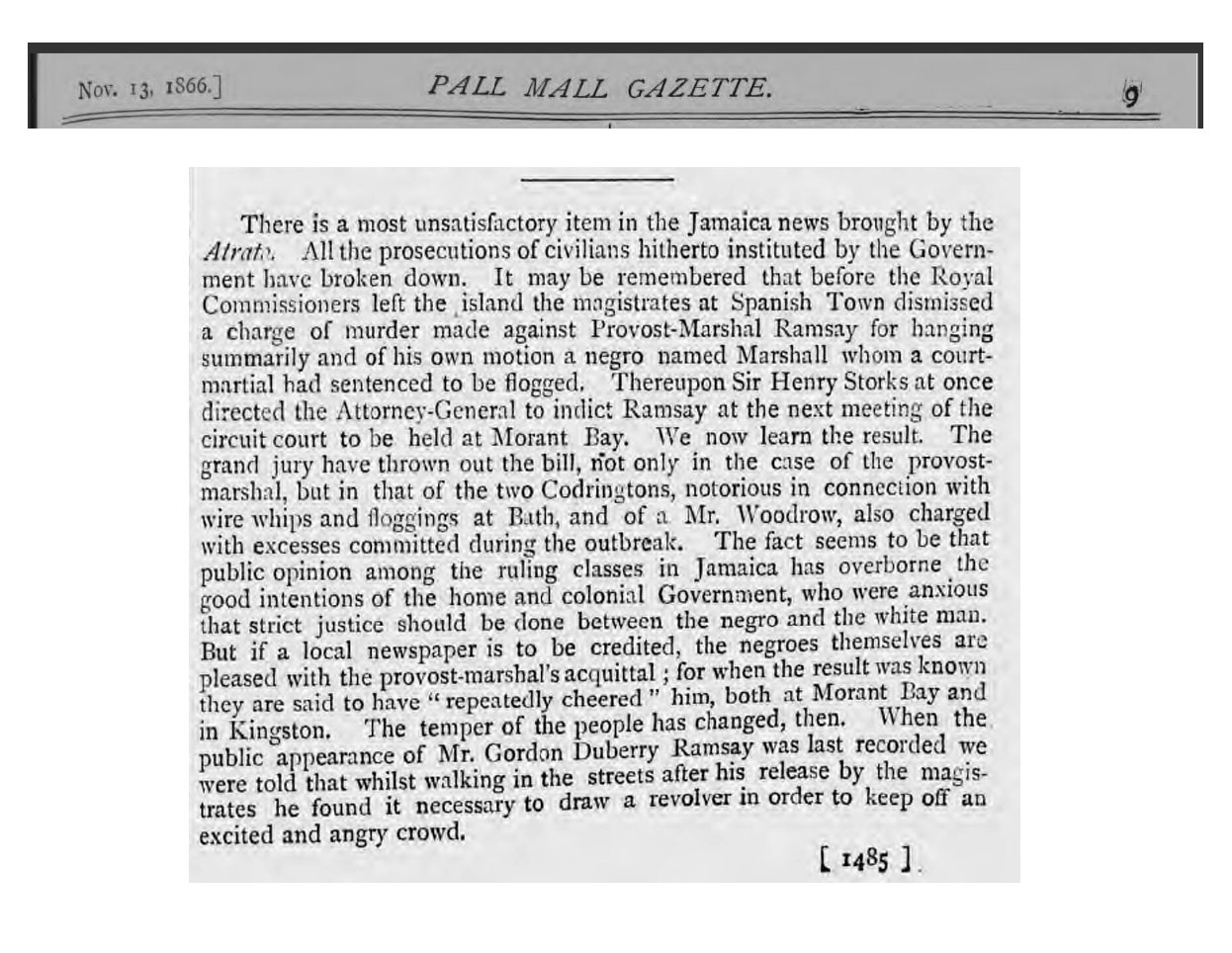
Pall Mall Gazette, 13 November 1866.
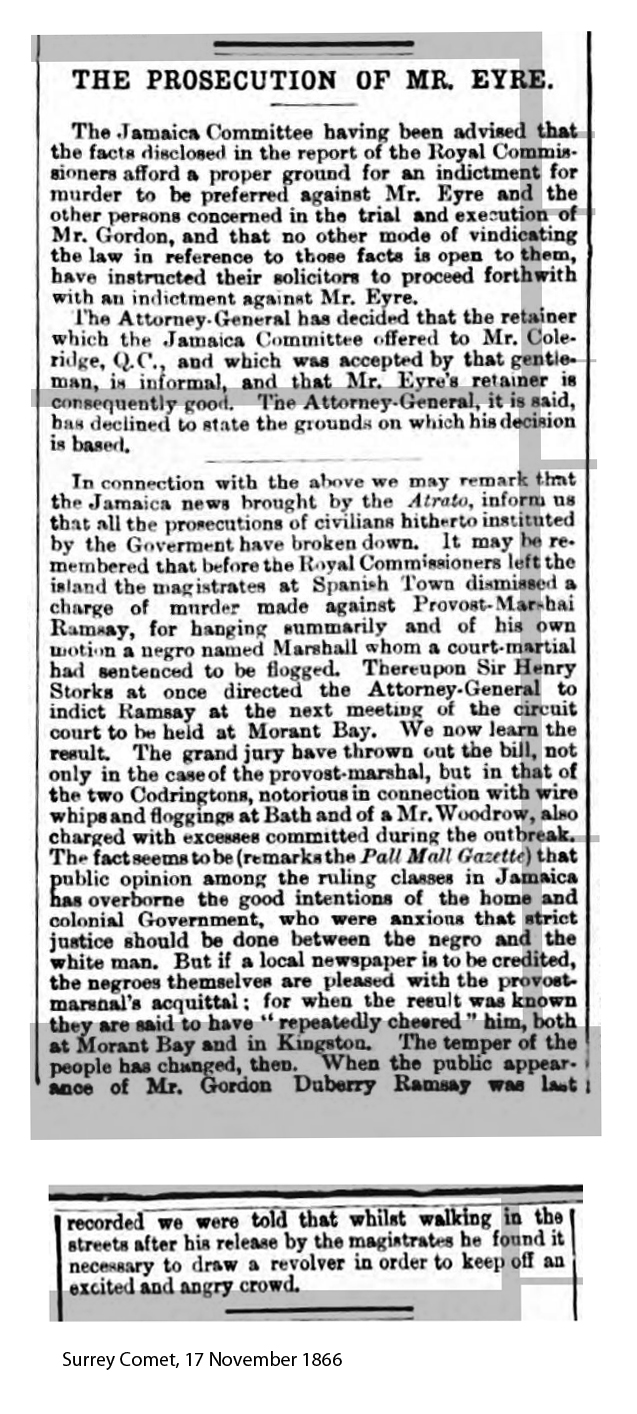
Surrey Comet, Saturday 17 November 1866:
THE PROSECUTION OF MR. EYRE.
The Jamaica Committee having been advised that the facts disclosed in the report of the Royal Commission afford a proper ground for indictment for murder to preferred against Mr. Eyre and the other persons concerned in the trial and execution of Mr. Gordon, and that no other mode of vindicating the law in reference to those facte is open to them, have instructed their solicitors to proceed forthwith with indictment against Mr. Eyre.
The Attorney-General has decided that the retainer which the Jamaica Committee offered to Mr. Coleridge, Q.C., and which was accepted by that gentleman, is informal, and that Mr. Eyre's retainer is consequently good. The Attorney-General, it is said, has declined state the grounds on which his decision is based.
In connection with the above we may remark thut the Jamaica news brought the Atrato, inform us that all the prosecutions of civilians hitherto instituted by the Government have broken down. It may remembered that before the Commissioners left the island the magistrates at Spanish Town dismissed a charge of murder made against Provost-Marshal Ramsay, for hanging summarily and of his own motion a negro named Marshall whom a court-martial had sentenced to be flogged. Thereupon Sir Henry Storks at once directed the Attorney-General to indict Ramsay at the next meeting of the circuit court held at Morant Bay. We now learn the result. The grand jury have thrown out the bill, not only in the case of the provost-marshal, but in that of the two Codringtons, notorious in connection with wire whips and floggings at Bath and of a Mr. Woodrow, also charged with excesses committed during the outbreak.
The fact seems to be (remarks the Pall Mall Gazette) that public opinion among the ruling classes in Jamaica has overborne the good intentions of the home and colonial Government, who were anxious that strict justice should be done between the negro and the white man. But if a local newspaper is to credited, the negroes themselves are pleased with the provost-marshal's acquittal; for when the result was known they are said to have "repeatedly cheered" him, both at Mor&nt Bay and in Kingston. The temper of the people has changed, then. When the public appearance of Mr. Gordon Duberry Ramsay was last recorded we were told that whilst walking in the after his release by the magistrates he found it necessary to draw a revolver in order to keep off excited and angry crowd.
[Source: Surrey Comet, Saturday 17 November 1866, http://www.britishnewspaperarchive.co.uk/viewer/bl/0000684/18661117/011/0002 (accessed 9.1.2017).]
Almost identical articles in e.g.
Kentish Independent — Saturday 17 November 1866 (http://www.britishnewspaperarchive.co.uk/viewer/bl/0001017/18661117/035/0002)
Watford Observer — Saturday 17 November 1866 (http://www.britishnewspaperarchive.co.uk/viewer/bl/0000615/18661117/023/0002)
The Enniscorthy News, and County of Wexford Advertiser, 17 November 1866
Croydon's Weekly Standard, Buckinghamshire, England 17 November 1866
Walsall Free Press and General Advertiser, 17 November 1866
Leamington Advertiser, and Beck's List of Visitors, 15 November 1866
London Daily News 14 November 1866
The last reference to GDR I can find on the BNA:
Globe, Friday 07 June 1867
[PB: Needs edit.]
The Affairs of Jamaica. — The Earl of Carnarvon, on November IG, 1866, replying a despatch from Sir F. Grant, containing a report of the proceedings at the opening of the Circuit Court at Morant Bay on the 18th of October, which it appears that the grand jury, direct opposition to the charge of the judge, Mr. Justice Ker, ignored the bill against Gordon Duberry Ramsay, the late provost marshal, daring martial law, for the murder of George Marshall, wrote:
"There can be no doubt that the coarse of justice has been grievously defeated in this case. I have no alternative but to regard as a refusal on the part of the grand jury allow any judicial inquiry into charges of an unusually grave nature, which in the interesta both of humanity and the public good imperatively required an impartial investigation. But the further intimation that such conduct is no other than is to be anticipated from every grand jury that can be formed in Jamaica, imparts to the case serious significance regards the reforms required in the system under which justice is administered. [It?] is the duty of her Majesty's Government consider very carefully this state of aflaira; and I have requested you to furnish me at the earliest date with full report of the practical working of the grand jury system in the colony. Meanwhile, under the circumstances which you have stated, and which make it clear that no other result can be anticipated from further prosecution of Mr. Ramsay at any subsequent assizes, and that the continuance of criminal proceedings would only tend to keep alive those feelings of irritation in the colony which it is earnest wish see replaced as soon as possible by healthier and safer objects of interest, I do not consider that it would be for the public advantage attempt to carry this question further."
In a subsequent despatch, dated Jan. 31, 1867, the Earl of Carnarvon wrote
"I have read your despatch of the 24th December, and the depositions taken in the case of the persons with tbe deepest regret, both tbe unwarranted acta cruelty, which, upon tbe face of tbe depositions appear to have been committed by some of the parties accused, and at the evidence which those papers contain of political prepossessions by which unhappily the grand jurors have allowed their minds to be influenced in tbe discharge of their judicial duties. I feel myself, however, unable to require those measures be adopted, which, under ordinary circumstances, I should have unhesitatingly directed, with a view to the adequate punishment of persons chargeable with signal inhumanity. There is nothing in your despatch tbe 24th December to give me any hope that a better feeling exists in the minds of that olasa of persons from whom a grand jury would be selected, and I feel myself therefore still precluded from instructing yon take any further steps in tbe prosecution of these accused persons. At tbe same time if tbe local feeling has undergone any change, or if anything has occurred, which in your judgment makes it more probable that fair and impartial investigation could be obtained the cases of these persons, you are of coarse at liberty to proceed."
http://www.britishnewspaperarchive.co.uk/viewer/bl/0001652/18670607/026/0001