IN PROGRESS - NOT FOR PUBLICATION
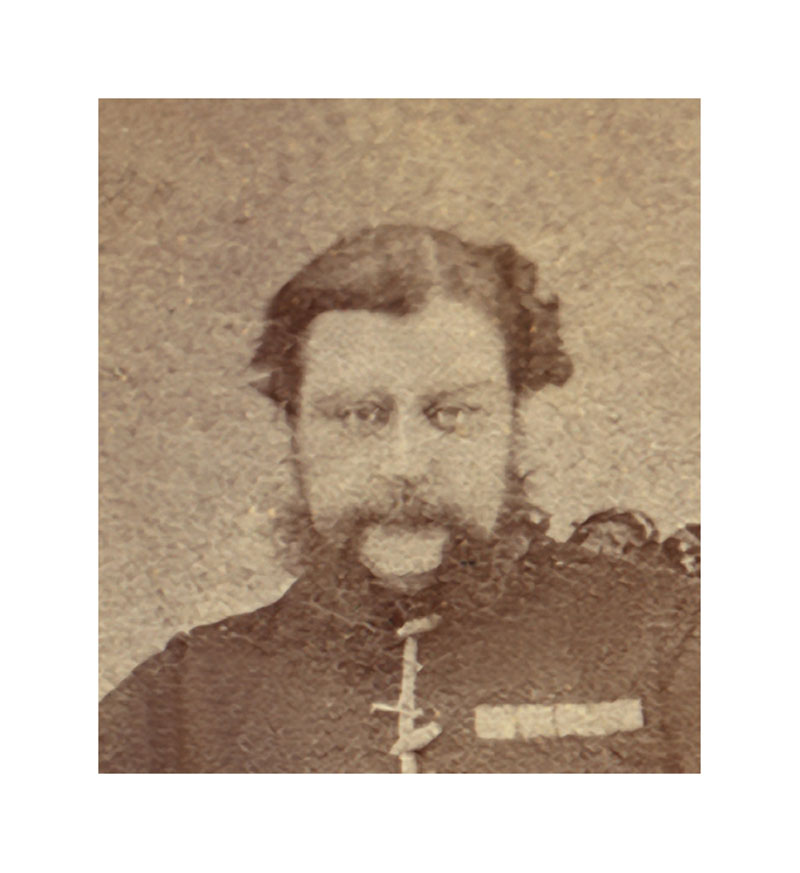

William Waterson III [i.e. 1215 William Waterson's son] was born at Canterbury 2 March 1858, and obviously he's the elder of the two children visible in the photograph. I suppose he'd have been approximately seven when that photograph was taken. Incidentally, I've never understood why the mother's not in that photograph; she was living at the time. Maybe there was originally a complementary photograph of her and the children but, if so, it seems no longer to exist.
Anyway, I assume that William Waterson III spent the first ten years of his life moving around with the family, attached to his father's regiment. That would mean: Birmingham, Coventry and Manchester, then Ireland 1860-65 with stations at Dublin, Cahir (where brother Charles was born in 1862), Newbridge and Dundalk. After that it was Edinburgh and York and then back to Canterbury where father William Waterson II was discharged 14 January 1868 with a £5 gratuity and a pension of 2/6d a day. After that, the family moved, initially to Bath (the North Somerset Yeomanry connection) then to London, Lambeth to be precise, my belief being that William Waterson II was employed at that time in the recently formed Corps Of Commissionaires.
Shortly afterwards, the mother died and younger brother, Charles Waterson, was packed off to the Royal Military Asylum at Chelsea. Not long after that, on 7 February 1871, William Waterson II died of a heart attack in Cockspur Street, just off Trafalgar Square, leaving the two boys pretty much on their own as far as I can see.
It's at this time we get the first direct sighting of William Waterson III in the records. This is in the 1871 census, taken 2 April, which shows him aged 14 lodging with a family surname of 'Harris' in Romney Street, Westminster. He was employed as a telegraph boy, but he didn't stick with that for long.
On 26 August 1871 he enlisted in his father's old regiment, the 4th Hussars, at St George's Barracks. Two days later he joined the regimental depot at Canterbury and stayed there until he was 18, at which point he was despatched to join the main body of the regiment, which at that time was stationed in India. He first appears on the regimental muster roll during the March quarter of 1876, at Rawalpindi. Two years later the regiment moved to Muttra, thence to Deolali, eventually leaving for home and arriving at Portsmouth 10 January 1879. The next station was Shorncliffe, where in August 1879 he was reunited with younger brother Charles who had meanwhile been training as a musician at Kneller Hall, Twickenham, today's Army School Of Music. From there the regiment moved to Aldershot, and this is where William Waterson III decided to bail out; he is recorded in the muster roll as having deserted 27 December 1880.
He didn't hang about. On 6 Jan 1881 he is recorded as enlisting in the Royal Marine Artillery at Tower Hill, except, for obvious reasons, he didn't use his own name - he changed the surname to 'Austin', which was his mother's maiden name of course. From there he was sent to the Royal Marine recruit depot at Walmer, and that's where it all went wrong. After a surprisingly short time he was identified as bogus and court martialled for 'fraudulent enlistment'.
The paperwork relating to this episode is pretty extensive, and a bit repetitive, but I'll attach my favourite bit - this is William Waterson/Austin's 'confession', which he's obligingly signed in both names! [CIMG1699] On 18 February 1881 he was sentenced to 43 days' imprisonment with hard labour.

Walmer 24th January 1881"D" Coy Pte William Austin RM, who enlisted at Tower Hill January 1881, states:
I am a deserter from the 4th Hussars. I enlisted for the 4th Hussars at St Georges Barracks Westminster 26 August 1871, and I deserted at Aldershot 27 Sept 1880.
My regimental number was 1257 name William Waterson, troop "B".
[Signed] William Austen, William Waterson
Witness Hy Smith Sergt
Surrendered P at large [?]/p>
So you think: 'Surely he's not going to...?' And the answer is: 'Yes, he did.' On 3 June 1881 he attested for the Royal Artillery at Woolwich, as William Austin again, and got away with it this time. After a couple of years at Woolwich with the depot brigade, he was sent back out to India where he remained until 1895. At that point he was about crocked so they sent him back to UK where he hung around for a few more years until finally being discharged from 10th Battery RFA at Aldershot 18 December 1901 as 'medically unfit' with a pension of 1/3d per day. The paperwork states: '[He] has been a clerk and writes a fine hand'. The pension records also expand on what it was precisely that made him 'medically unfit'. It turns out he sustained a rupture whilst assisting in manhandling the guns across the Chenab River in north western India.
It all goes quiet then until the time of the 1911 census. I assumed he would have stuck with the alias, firstly out of habit, and secondly of course because that's the name the army pension was payable to. Sure enough, he's in the census as William Austin at a place called Bruce House in London's West End, next to Drury Lane Theatre, a so-called 'model lodging house' built in 1906 and run by the London County Council. I'll attach an article [Bruce House (1), Bruce House (2)] which I found about the establishment in the Penny Illustrated Paper. It was written in 1911, so it's exactly contemporary with our man William Austin/Waterson.
To try and extend the story further, I decided to have a look at electoral register entries for Bruce House, very much a long-shot given that he wouldn't have been eligible to vote until 1918, and Bruce House didn't sound like the sort of establishment you'd want to stay long at. However, he's on the register for 1919, 1920 and 1921. At that time there were two editions of the electoral register each year, a Spring one and an Autumn one - he's present Spring 1921 and absent Autumn 1921. So what happened? Did he die, or just move somewhere else? I don't know.
I checked the deaths index for 1921 and found a 'William Austin' registered in the June quarter 1921 at Canterbury, exactly the right age (63), and thought I'd scored a direct hit. When I got the certificate though, it turned out to be the wrong person. There is the tricky question of course as to which name his death would have been registered under. Obviously someone who didn't know the history, a friend say, or an official of some kind, would report the surname as 'Austin'. A family member might have felt inclined to 'put the record straight' and register the correct surname. This is 'work in progress'. I'd love to hear from anyone who can tell me how the story ends.
Aside from the question of what happened after 1921, I'm left with a couple more questions. Firstly: why did he desert from the 4th Hussars in 1880? His subsequent history clearly shows he had nothing against service life per se. I'm attaching a page from the Aldershot Military Gazette, 20 Nov 1880, that may offer a clue (the piece straddles columns four and five). It's a story about the theft of a watch that was in the possession of 'Private Waterson, 4th Hussars', although this could of course be either brother. Two soldiers, William Gurvin and Reuben Bridland, received three weeks hard labour each for the offence. A third, John Burk(e), was acquitted. My theory of course is that Gurvin and Bridland may have been 'out to get' Waterson for testifying against them, and that was why he decided to disappear at short notice. Or then again it might have been something else altogether.
The other question is: do I possess a photograph of William Waterson III as an adult? Unfortunately, virtually none of the family photographs in my possession have any words with them, and there certainly isn't one that identifies him by name. I have a hunch about the one I've attached though, a most intriguing and ambiguous-looking image to my mind [img656]. I suspect the middle-aged party with the pipe may be our man. My grounds for thinking this are flimsy in the extreme, and amount to:
1. The date of the photograph I would estimate at about 1910, say plus or minus ten years, so the corresponding age range for someone born in 1858 would be 42-62. This looks about right for the gent with the pipe would you think?
2. Although photographed with the group, he appears not to be an integral part of it - the other people look like friends rather than relatives. You don't get the impression for example that either of the two women is his wife, so that seems okay for someone who never married and seems to have been a fairly 'rootless' sort of a person.
3. The big moustache the chap in the pic has suggests, to me anyway, 'ex-military'. What do you think?
4. The women are dressed up, over-dressed even. I'm guessing the event was a marriage. The blokes seem 'flash', especially the one with the cigar, who looks like he might have imbibed a drink or two prior to the photographing. This all adds up, for me anyway, to a sort-of 'London' vibe - which fits with the Bruce House connection.
5. Just to stretch the Bruce House thing to its absolute limit: at the bottom of the first column on page two of the Penny Illustrated Paper article, various regular categories of resident are described, including "...a weak, decrepit and disabled old derelict of what was once a 'defender of empire'. Could this be our man? Again, at the top of page one of the article, there's a sequence of sketches of what they refer to as 'Bruce House types'. The bloke third from the left, is that him? Does that look like the chap with the pipe in the photograph?
