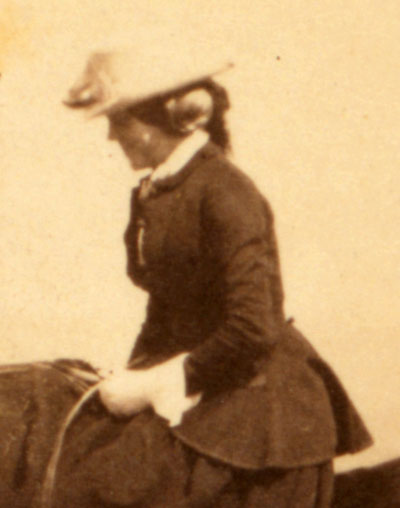
Duberly [née Locke], Frances Isabella [Fanny] (1829 - 1902), diarist, was born on 27 September 1829 at Rowdeford House, Devizes, Wiltshire, the youngest of the eight children of Sir Wadham Locke, a banker in Devizes, and his wife, Anna Maria Selina Powell. Her father died when she was six, her mother when she was eight. Her upbringing owed much to her eldest sister, Selina; she received a sound education at a boarding-school in High Wycombe, Buckinghamshire, and became a skilled horsewoman. In 1846 she met a 24-year-old lieutenant, Henry Duberly (1822 - 1891), at a family wedding; they married at New Alresford, Hampshire, four years later, on 21 February 1850.
In February 1854 Fanny accompanied her husband when his regiment, the 8th hussars, sailed to Constantinople on the eve of the Crimean War. She ignored orders from the commander, Lord Raglan, excluding wives from the war zone and remained with the hussars at Varna and in the Crimea longer than any other woman, in her last months sharing her husband's hut in the light brigade lines. Although she missed the battle of the Alma and saw only the aftermath of the battle of Inkerman, she witnessed the cavalry charges at Balaklava and the assault on Malakhov, experienced the winter privations, and rode into Sevastopol soon after it fell.
Fanny recorded these events daily. She possessed a ready pen, eyes perceptive to detail, youthful self-confidence, and an incisive style softened by candid pathos. Anonymous extracts from her letters home were leaked to the London press, encouraging her to ask her sister Selina's husband, Francis Marx, to edit her journal for publication. He toned down suspected indiscretions and the book reads less vividly than her letters (now held in the British Library), but a convincing realism survived the excisions and the Journal Kept during the Russian War sold well at Christmas 1855. Readers who anticipated a more heroic romanticism were, however, left uneasy, while Queen Victoria was offended by Fanny's ingenuous wilfulness. The queen had already declined an optimistically proffered dedication, and in May 1856 she snubbed Mrs Duberly when the hussars were inspected on returning to Portsmouth. Fanny was never appreciated as much in England as she had been in the Crimea, notably by the French chasseurs d'Afrique.
After two years in Ireland the 8th hussars sailed for India, in October 1857, with Fanny again accompanying her husband. She kept a journal covering the next twelve months and chronicling a march across Rajputana, during which she was in the saddle for 1800 miles. By this time, however, she was writing self-consciously and with mounting weariness; the earlier spontaneity had gone. Campaigning Experiences in Central India and Rajputana during the Suppression of the Mutiny appeared in July 1859 but was less successful than her earlier book.
At Balaklava, Fanny 'prayed that [she] might wear out [her] life and not rust it out' (Journal Kept during the Russian War, 102). However, she was denied this hope. The hussars returned from India in 1864; thereafter she remained the dutiful wife of a serving officer in dull garrison towns until Henry retired, as a lieutenant-colonel, in 1881. The Duberlys purchased St Clair, a villa in The Park, Cheltenham, Gloucestershire. Henry died there in 1891; Fanny outlived him by almost twelve years. She died at St Clair on 19 November 1902.
Alan Palmer
E. E. P. Tisdall, Mrs Duberly's campaigns (1963)
A. W. Palmer, The banner of battle: the story of the Crimean War (1987)
m. cert.
d. cert.
BL, letters to F. Marx and Mrs F. Marx, Add. MS 47218
R. Fenton, photograph, 1855, NAM
£8828 9s. 3d.: administration with will, 21 April 1903, CGPLA Eng. & Wales
[Source: http://www.oxforddnb.com/view/article/46353/46353?docPos=33 (accessed date)]