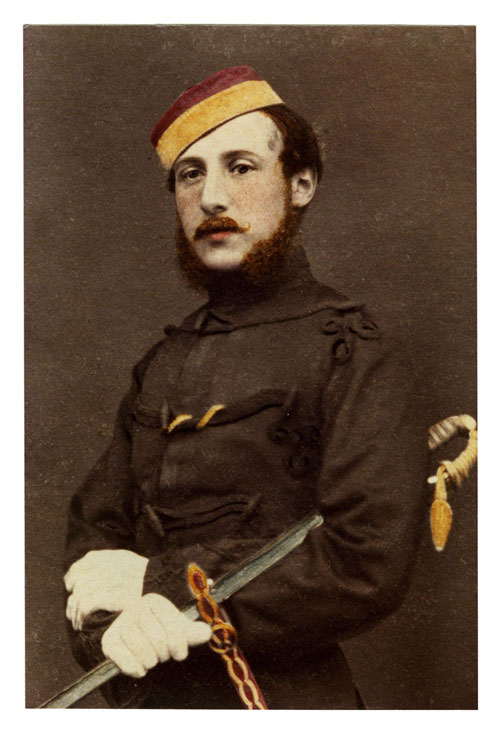
Born at Bakewell, Derbyshire, on the 8th of December 1833, the son of Charles Anthony, of Bridge Street, Bakewell, and his wife Mary. His father was a blacksmith.
From information kindly provided by Mr. Hodgkinson, of Bakewell, it is now known that Paul Anthony was baptised at the Bakewell Parish Church of All Saints on the 6th of January 1834.
The Derbyshire Directory also confirms his father was in business in Bridge Street. His parents do not appear to have married at Bakewell.
1841 Census
High Peake, Bakewell.
Chas Anthony, aged 45, Smith.
Mary Anthony, 25.
Paul Anthony, 7.
1851 Census
55, Chalton Street, St Pancras.
Paul Anthony, aged 18, unmarried, Veterinary Student, born St Pancras, Middlesex [sic].
Qualified at the Royal Veterinary College, Camden Town, London, on the 11th of May 1853.
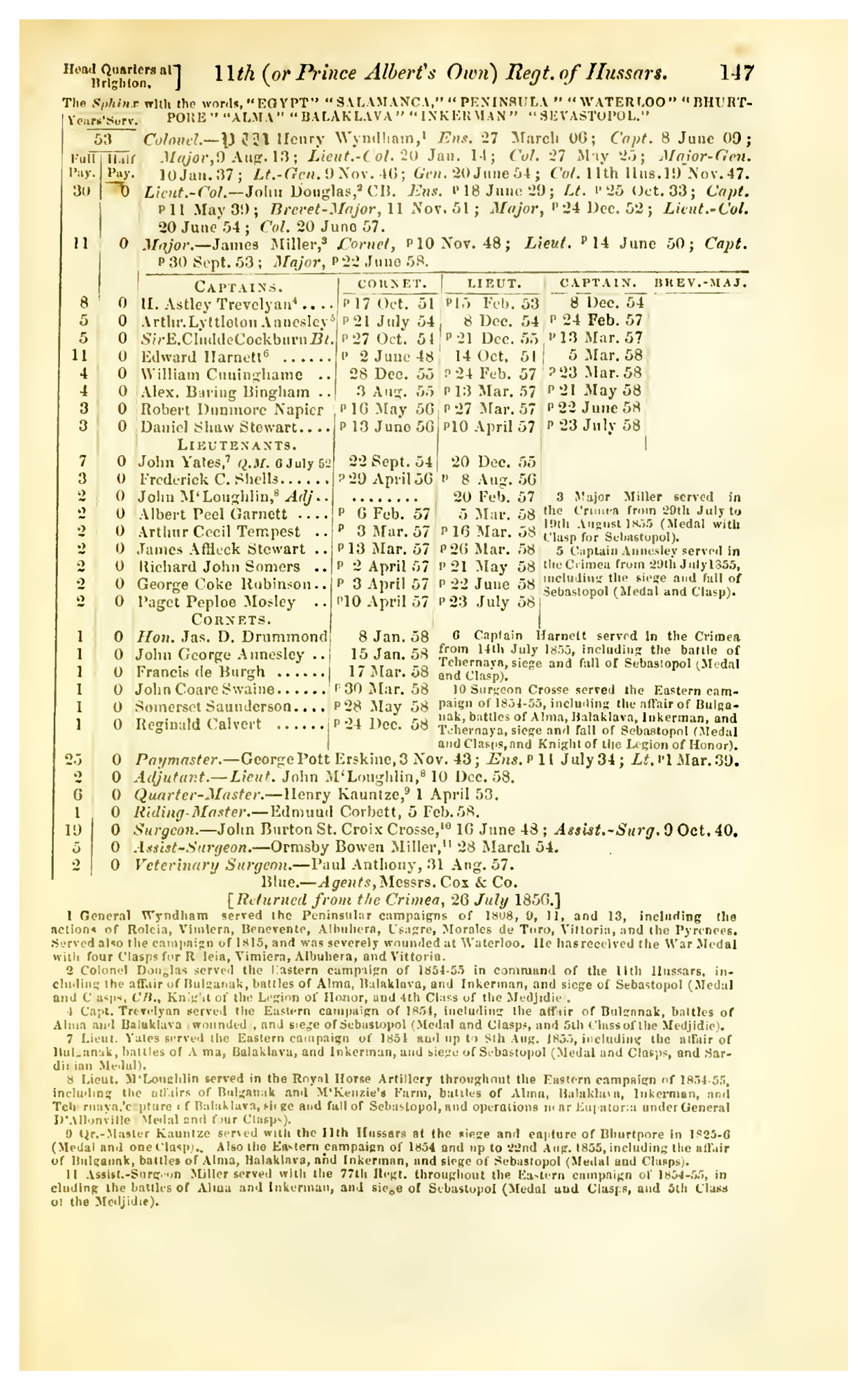
Probationary Veterinary Surgeon in the 11th Hussars: 19th of April 1854.
[To:] Officer Commanding 11th Hussars, Hounslow.
"Horse Guards,4th of June 1857.
Sir, – It having been the practice for some time past for the Veterinary Surgeons of the 11th Hussars to communicate with this Department on the destruction of horses and an instance of the kind having again occurred I am directed by the General Commanding-in-Chief to return the enclosed letter and to desire that you will intimate to Mr Anthony that he is not at liberty to communicate with Headquarters excepting through the Officer Commanding the Regiment to which he is attached.
I have, etc. etc.,
W. F. Forster, DAG."
Veterinary Surgeon, 11th Hussars: 31st of August 1857.
1861 Census
Hulme Cavalry Barracks, Manchester.
Vet Surgeon Anthony, unmarried, aged 27, Full Pay, born Bakewell, Derbyshire.
However, he also appears elsewhere on the same night:
1861 Census
Back Lane, Carrington, Bowden, Cheshire.
Paul Anthony, visitor, unmarried, aged 27, Surgeon, born Bakewell, Derbyshire.
Did someone cover for him at the Barracks?
For details of an earlier General Court-martial, held at Dublin on the 21st and 22nd of May 1861, see below.
He was also court-martialled at Dublin in May 1862, for:
"Conduct un-becoming to the character of an officer and a gentleman... By calling a brother-officer a cur and a liar and striking him a blow in the face."
Clearly attempts were made by the Advocate General's Office to avoid holding a Court-martial, but it went ahead anyway.
Letter from the Advocate General's Office, dated the 13th of May 1862:
"Sir – I have the honour to acknowledge the receipt of your letter of the 12th. inst. transmitting the charges preferred against Veterinary Surgeon Paul Anthony, 11th Hussars, and requesting my opinion as to whether they are in a fit state for investigation before a General Court-martial. It appears to me that the charges as now altered appear to be in a fit state to appear before a General Court-martial.
P.S. This case seems to be as clear as possible and as the prisoner appears to have already admitted the facts and apologised for his conduct he will most probably plead guilty. Under these circumstances I take the liberty of suggesting for your consideration whether or not it may be possible to save the scandal of a Court-martial by adopting some course, which while it vindicates discipline and propriety may at the same time render such a trial unnecessary.
I do not feel myself competent to specify any such course more particularly, nor if I were asked to do so could I undertake to explain my meaning more in detail. But I should be glad to think that consistently within the main tenets of good order and military discipline, a Court-martial could, in this case, somehow be avoided.
I am, etc. etc.,
S.C. Denison.
An argument having started in the Officers' Mess over the disputed ownership of a horse taking part in local race meetings, it would appear that Anthony had received great provocation from his opponent, who contemptuously called him a "stud-groom," and that "he had never owned a horse in the regiment, those passed as being his in reality the property of another officer."
The horse in question did in fact belong to Anthony, so it would seem to have been something of a put-up affair to get rid of him, possibly because his social background was not up to that of his fellow officers. He admitted in his defence that he ought to have placed a restraint on his feelings, but said, "It was no easy matter under such provocation."
Those speaking in his favour all said that for the periods they had known him he "had always demeaned himself as a gentleman", but this was of little avail, however, and when the findings were promulgated they were that he should be "Dismissed from the Service".
He was removed from the Army List on the 22nd of June 1862. The court-martial proceedings were fully reported in the "Irish Times" between the 22nd of May and the 22nd of June 1862.
See newspaper reports of the 1862 court martial here...
Veterinary Surgeon Anthony served the Eastern campaign from the 6th of August 1855, including the Siege and Fall of Sebastopol.
Entitled to the Crimean medal with clasp for Sebastopol and the Turkish medal
Death registered
Paul Anthony, aged 32, June Quarter 1866, Bakewell.
His death certificate shows that he died, aged 32 years, on the 16th of June 1866 after a three-month illness from "Fungus Haematodis". A Joseph Sharratt was in attendance and the informant of his death.
[PB: CHECK THIS. According to EJB, "Fungus Haematodis" meant "consequent upon eating poisonous fungi" but this could be wrong. According to medical dictionaries consulted, Fungus Haematodes are soft, bleeding malignant tumors, i.e. soft cancers named after the shapes they adopt, so cannot be caused by poisoning.]
His will, however, states that he was formerly of Rotherham, Yorkshire, and died at Bakewell, Derbyshire, leaving his estate (of under £600) to his mother, Mary, she being the sole Executrix. This is borne out by an extract from the Doncaster Chronicle, 22nd of June 1866:
"Death – On Sunday the 17th inst. at Bakewell, Mr. Paul Anthony, Veterinary Surgeon, late of Rotherham, Yorkshire. Aged 32 years."
Mr. Hodgkinson, of Bakewell, has provided further information about Paul Anthony's burial.
Both Paul Anthony and his parents were buried in Bakewell Cemetery (opened circa 1860, in what is now known as Yeld Road Cemetery). The graves are both in Plot Number 104, Section 6, and there are two gravestones.
Paul Anthony's gravestone for bears the inscription:
"In memory of Paul Anthony, who died June 16th 1866 in his 32nd year. 'In my hand no price I bring, Simply to thy Cross I cling'"
That for his parents shows:
"In the memory of Charles Anthony, who died August 6th 1859, in his 65th year. 'Father, thy will be done.' Also of Mary, his relict, who fell asleep in Jesus February 16th 1879 in the 67th year of her age. 'The Master is come and calleth for thee.'"
There would appear to have been no reference made to his military service.
See also:
However, there were no references to Paul Antony when these sites were visited in 2016.
Another General Court-martial for "neglect of duty" has now been found. This was held at Dublin on the 21st and 22nd of May 1861 and led to a "severe reprimand":
Court-martial
Charge – For neglect of duty in the following instances, First – For failing to keep the Principal Veterinary Surgeon informed of the state of the horses of the regiment by supplying him with the usual returns and with special reports more particularly required by reason of the existence of Glanders in the regiment.
Second – In not having complied with the regulations relating to his books by reason of which they are all in long arrears thus rendering it impossible to be known whether his treatment has been effective.
Third – Without paying such attention to the duties of the forge as to prevent deviations from the Regulations in the system of shoeing.
Fourth – In having kept the Young Horse stable crowded to the full whilst Strangles was profuse and Catarrh and nasal discharge affected some of the horses.
Fifth – In not having made such examination of the Glandular disease as would have made him aware of the state of the horses as found on the eve of the departure from Manchester.
Sixth – In not having complied with Clause Seven of the Regulations relating to the three horses left behind which have since been destroyed from Glanders.
Opinion. – The Court having carefully weighed and considered the evidence, together with what the prisoner has urged in his defence are of the opinion that the prisoner, Veterinary Surgeon Paul Anthony, 11th Hussars, is Guilty of the charge in the First instance, Guilty of the charge in the Second instance, Guilty of the charge in the Third instance, Not Guilty of the charge in the Fourth instance and Not Guilty of the charge in the Fifth instance and Guilty of the charge in the Sixth instance.
The Court having found the prisoner Guilty of the charges found against him in the First instance, Guilty in the Second and Third instances but Not Guilty in the Fourth and Fifth instances and Guilty in the Sixth instance, all which being in the breach of the Articles of War, do now sentence him, the prisoner, Veterinary Surgeon Anthony, 11th Hussars, to be severely reprimanded.
Further: The Judge Advocate-General having humbly submitted to Her Majesty seeking to approve and confirm the findings and sentence of the Court."
"Horse Guards,
22nd July 1861
Sir, Having had the honour to lay before Her Majesty the proceedings of the General Court-martial held at Dublin on the 21st and 22nd of May 1861 of the trial of Veterinary Surgeon Paul Anthony, 11th Hussars, who was arraigned on the under mentioned Charges [here are detailed the charges] on which charges the court came to the following decision, [here are detailed the findings and sentence] I have to acquaint you that Her Majesty is pleased to approve the findings and sentence of the Court, and to command that the prisoner be severely reprimanded in the presence of the Officers of the regiment and then be released from arrest.
You will therefore be pleased to forward by Her Majesty's command that this has been carried into effect and to further forward to the Military Secretary for my information the day on which the sentence was made known to Veterinary Surgeon Paul Anthony, 11th Hussars.
(Signed) General the Rt. Hon. Sir George Brown."
A note about the ambiguous positions of vets and surgeons as officers
From the "History of the Army Veterinary Corps":
"A veterinary surgeon of the day was classed as a Cornet for the first ten years of his service and only after twenty years could he be classed as a Captain. He was put on a par with these ranks only "for the purpose of allotting quarters, and for no other purpose." In 1850 a writer had no hesitation in stating that "the rag, tag and bob-tail set of men in regimental service were not worthy of rank", and even if the veterinary surgeon is a gentleman by extraction, education and bearing, he mingles with the officers of the regiment only after painful restrictions [...]
By contrast an Assistant Regimental Surgeon became a properly commissioned Lieutenant on appointment. In 1859 the "Wilkinson" report graded Veterinary Officers by relative rank and as the Veterinary Surgeon of the Regiment, he ranked as a Lieutenant. But there was one important thing which relative rank failed to do. It gave no military protection to the officer himself.
Anthony's case is referred to in an "Article on Military Law," published in the United Services Journal of 1862 [...]. If the Veterinary Surgeon in this case had actual rank, then the trouble would never have arisen. Relative rank gave him no protection whatever against the grossest insults and knowing this, he very improperly took the law into his own hands."