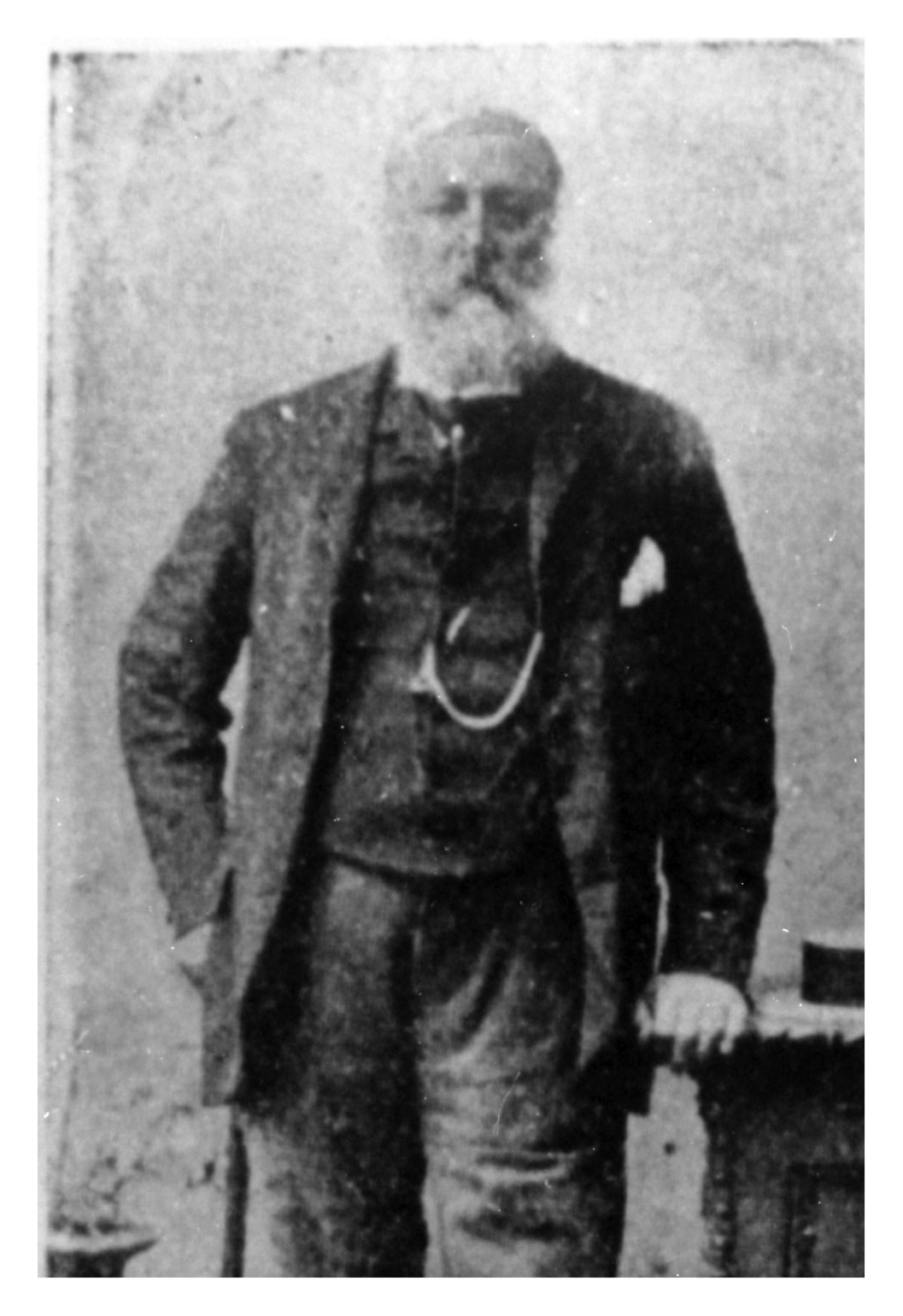
(Click on image to enlarge)
1201, Private Frederick Henry CHESHIRE — 8th Hussars
Birth & early life
Born in the parish of All Saints, Exeter, c.1831.
Enlistment
Enlisted at Hounslow on the 20th of November 1851.
Age: 20.
Height: 5' 8".
Trade: Groom.
Appearance: Dark complexion. Hazel eyes. Dk. brown hair.
Service
Embarked for the Crimea aboard the H.T. "Shooting Star" on the 25th of April 1854.
Wounded in action at Balaclava, sent to Scutari on the 5th of November, and invalided from there to Malta on the 4th of December 1854.
Invalided from Malta to England.
Discharge & pension
Discharged from Chatham Invalid Depot on the 15th of March 1855:
"Disabled by lameness from a gun-shot wound of the left leg incurred at Balaclava on the 25th October 1854.
Ball entered the left leg over the fibula, which is slightly injured, and emerged at lower part of calf a little higher up on the inside of the leg. — A small piece of bone came away a short while ago."
Served 3 years 334 days.
In Turkey and the Crimea: 7 months.
Aged 24 years on discharge.
Conduct: "good". Not in possession of any Good Conduct badges.
Awarded a pension of 8d. per day on discharge, and this was increased to 10d per day from the 19th of November 1871.
On the 8th of June 1876, Colonel (by then Major-General) de Salis, wrote a letter to the Pension's Board in which he said that "the man's leg has now been amputated, and asking for an increase in pension."
A reply was sent which stated- "Cannot grant increase..."
Following a further exchange of letters between General de Salis and the Secretary of State for War up to the 19th of June 1877 he was granted an increase to 1/- per day as a "Royal Bounty for Gallant Conduct" from the 19th of June 1877.
Following a further Medical Board (no date shown) he was granted a further increase to 24d.
The date of his increase of pension to 24d was the 7th of August 1902. The last entry states, "The man is on the list of Balaclava survivors — 1907."
He was living in Salisbury in 1856, and he also at some time lived at Newcombe Terrace, Heavitree, Exeter.
Medals
Entitled to the Crimean medal with clasps for Alma, Balaclava and Sebastopol.
Further detailed medal information archived.
Commemorations
Member of the Balaclava Commemoration Society in 1879.
Signed the Loyal Address to the Queen in 1887.
Attended the Annual Dinners in 1879-99 and 1908.
He was also a pensioner of the Roberts Fund.
Death & burial
Died at Exeter on the 16th of February 1912.
See copy of a short obituary notice taken from the Devon and Exeter Gazette for the 17th of February 1912 and also a copy of his funeral taken from another local newspaper, in the 8th Hussar file.
Buried in the churchyard of All Saint's Church, Whipton, Exeter. The grave also contains his wife, Eliza, who died on the 27th of March 1912 and his eldest son, Frederick Henry.
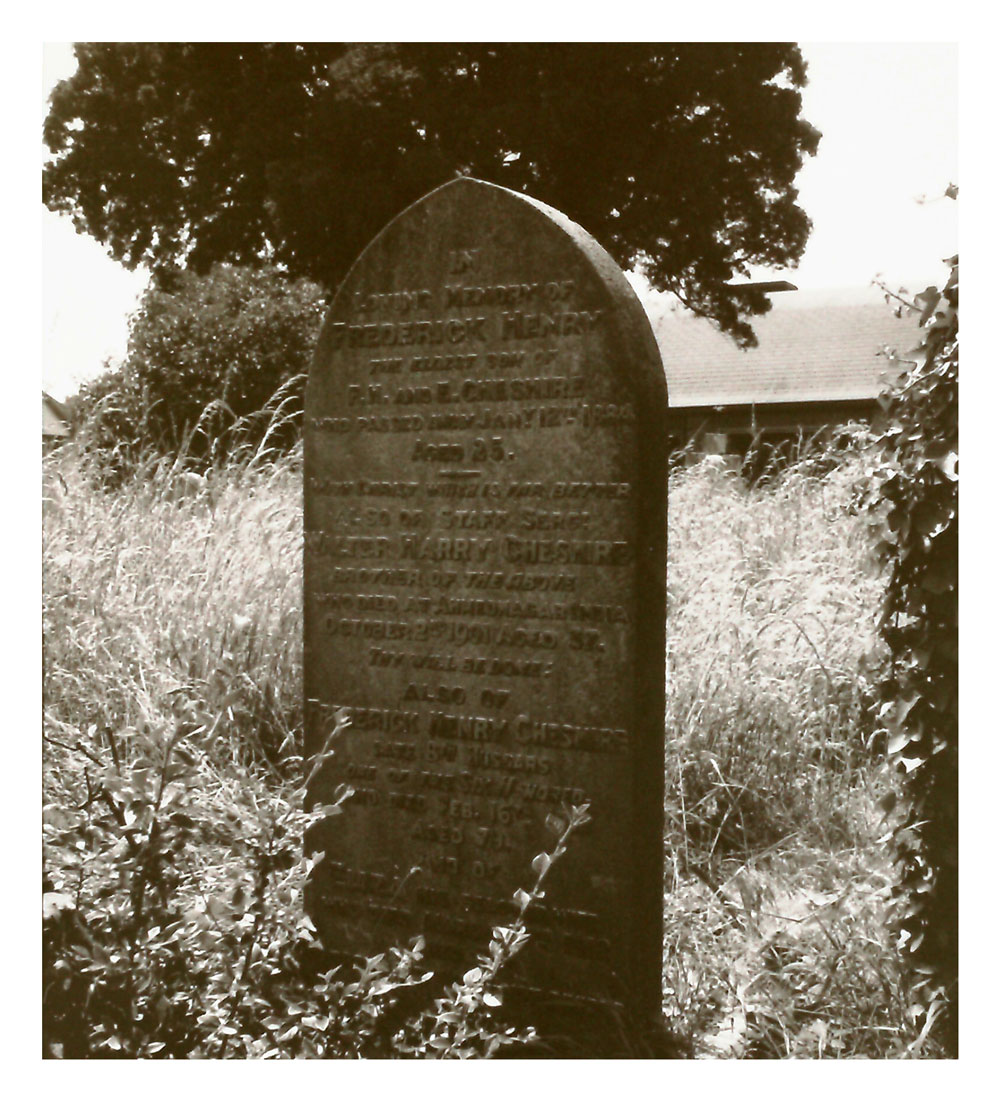
(photo EJB, 1980s?)
(Click on image to enlarge)
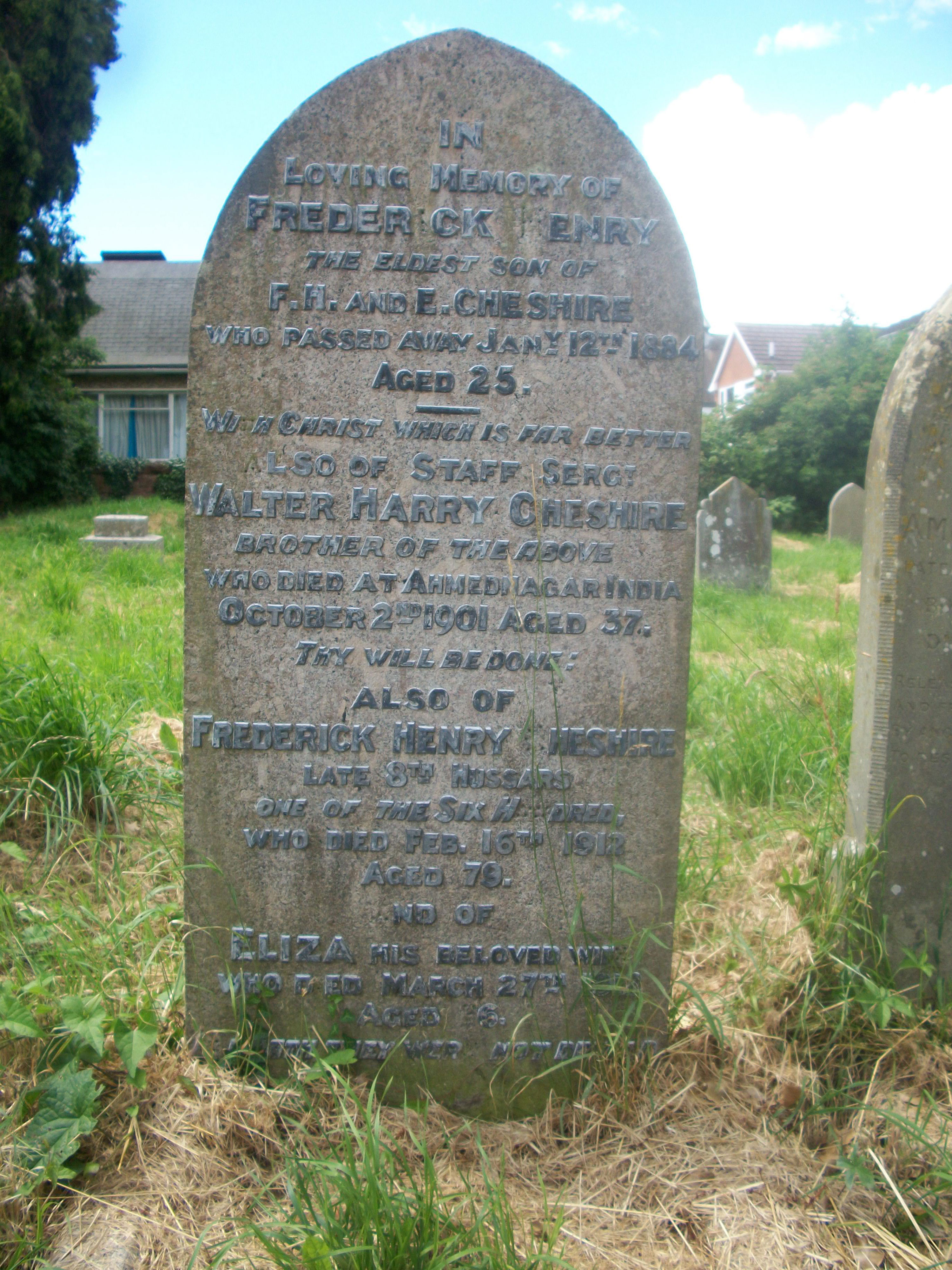
Photograph of Frederick Cheshire's headstone, by Robbie Pearson, 2018?
(Click on image to enlarge)
The inscription on the gravestone reads:
"In loving memory of Frederick Henry, the eldest son of F.H. and E. Cheshire, who passed away January 12th 1882, aged 25 years.
Also of Staff-Sergeant Walter Henry Cheshire, brother of the above, who died at Ahmednugger, India, October 2nd 1901, aged 37.
Also of Frederick Henry Cheshire, late 8th Hussars. — One of the Six Hundred. — who died February the 16th 1912, and of Eliza, his beloved wife, who died 27th of March 1912, aged 76 years."
[1980s?] The grave has obviously been untended for many years and has a large rose bush growing on it. (There is a photograph in the 8th Hussar file.)
[PB, Jan 2014: It seems that things have greatly improved:
See the photograph of Cheshire's grave on the "Graves and Cemeteries of Exeter — a history and photo essay" section of the Exeter Memories website (appears to date from 2012). Se also Rbbie Pearson's photograph of 2018?
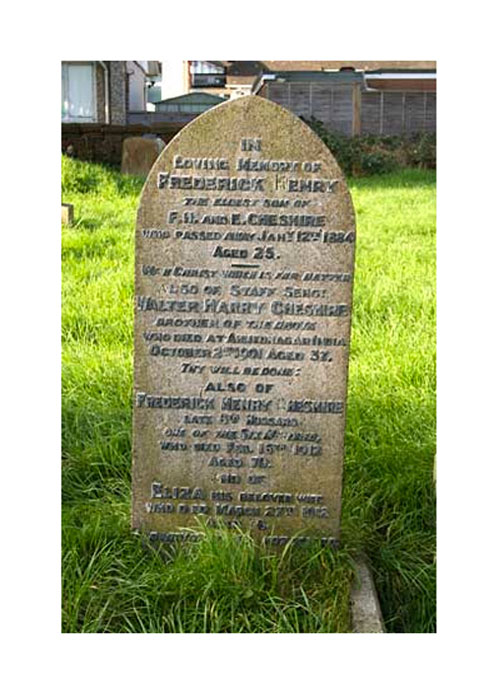
Frederick Henry Cheshire's grave, All Saints Churchyard, Whipton, Exeter.
(Click on image to enlarge)
The caption reads:
Lt Frederick Henry Cheshire was born in Whipton in 1833. He was a member of the 8th Hussars who made that fateful charge at Balaclava on the 27th April 1854, when he lost a leg in the action. The Light Brigade consisted of the 8th and 11th Hussars, 4th and 13th Light Dragoons and the 17th Lancers, under the command of Major General the Earl of Cardigan. The action was a disaster and 118 men were killed, 127 wounded, and 362 horses lost.
[PB: How strange. Why "Lt"? I can't see any reference to him as Lieutenant on his headstone. How/why did it get added? See Further information below.]
Likenesses
(Click on image to enlarge)
There is a copy of a photograph of Frederick Cheshire in the 8th Hussar file.
Further information
In 1980 the steel engraving of Lord Cardigan presented to him by Lady Cardigan was donated to the Regimental Museum of the 4th/8th Hussars by his late granddaughter, a Mrs. Vowles. This is now known [1988] to be in the Regimental Section of the Combined Services Museum in the Wish Tower at Eastbourne, Sussex.
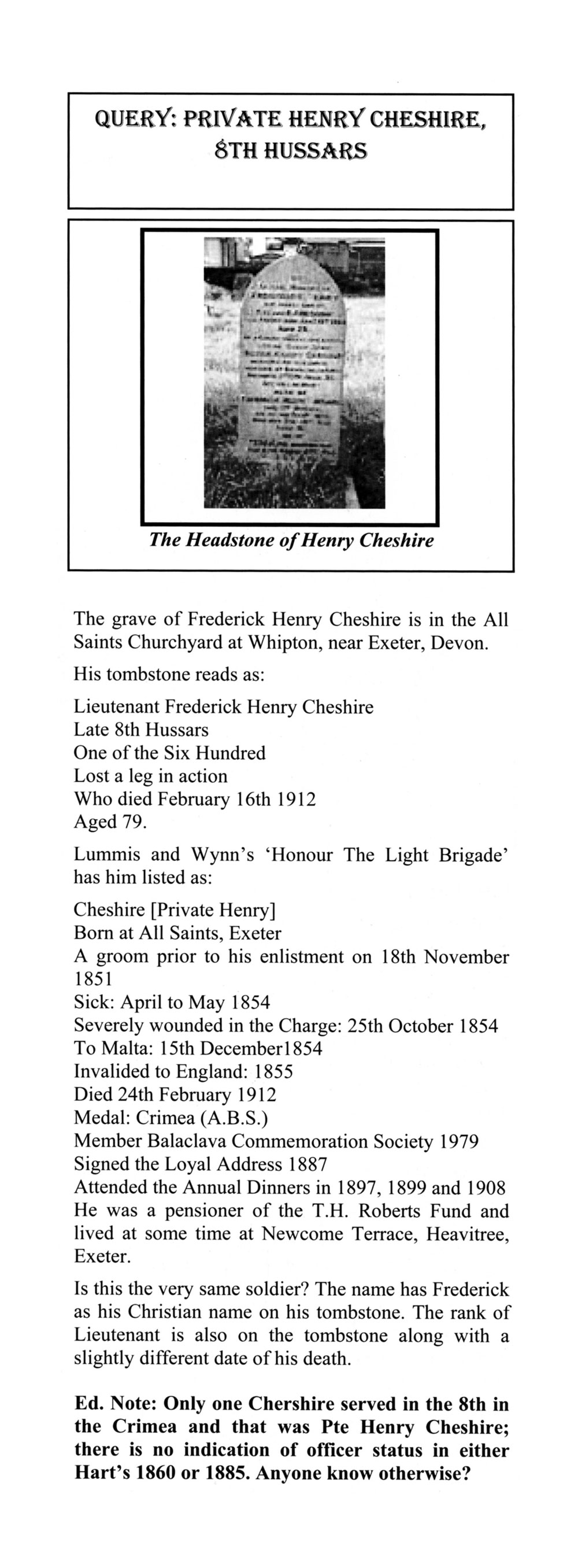
"Lieutenant" Cheshire?
[PB, 2014?]: There was a brief enquiry about FC (with a photo of his grave) in the War Correspondent in October 2007. A question about him as a Lieutenant? However, I can't see any reference to him as Lieutenant on his headstone — only on the Exeter Cemeteries website. Follow this up.]
(Click on image to enlarge)
[PB, December 2017: How very odd. There is a detailed discussion of FC's claimed status as a Lieutenant in "Remembering the Charge of the Light Brigade: Its Commemoration, War Memorials and Memory", Gavin Hughes and Jonathan Trigg (2008) (which incidentally refers to the EJBA). They argue that FC (or his family) have inflated his status. Yet I can see no evidence. So where did this claim start?]
It is clear that participation in the action at Balaklava was something which was considered of great acclaim until long after the event, and many memorials reveal the desire of former soldiers and their families to record their glory in battle. This is evidenced by the regular inclusion of references to the event on the later graves of survivors.
The family gravestone of Lt Frederick Henry Cheshire in Whipton records that he was "LATE 8TH HUSSARS ONE OF THE SIX HUNDRED" (emphasis in the original). This is intriguing on a number of levels. Cheshire is not one of the officers listed as being with the 8th Hussars on 25 October; they were famously under-strength at the time and he may have been sick, but here he is actively listed as a 'charger'.
At the CLB, there were four Lieutenants (Clutterbuck, Fitzgibbon (see above), Heneage and Philips) and two Cornets (Clowes and Mussenden) involved. In checking Hart's Army List for the years 1853, 1855 and 1861, no record of such an officer could be found. Neither could any mention of this officer be recovered from Rev. Robert Murray's (2004: 724) official Regimental History of the 8th Hussars and List of its Officers for the Crimean War. However, using the extremely thorough EJ Boys Archive (aka 'Lives of the Light Brigade') conserved by Roy Mills & Philip Boys for the CWRS, one Private Henry Cheshire [No. 1201] 8th Hussars is discovered.
This highlights a classic issue with memorialisation of the CLB; identifying men and officers from the purely physical monumental evidence, which can be misleading, and then reconciling this with known historical records. Men on memorials can be 'aggrandised' in death, with their participation in events — or organisations — built up for the sake of their family or their memory. Sometimes, the memorials can be misleading to give the impression to the viewer that the subject had a higher status; in this case, being an officer involved in the CLB when he was historically recorded as no such thing during this period. (pp.50 — 51).
[Text version here.]
Roy Dutton, Forgotten Heroes, p.86:
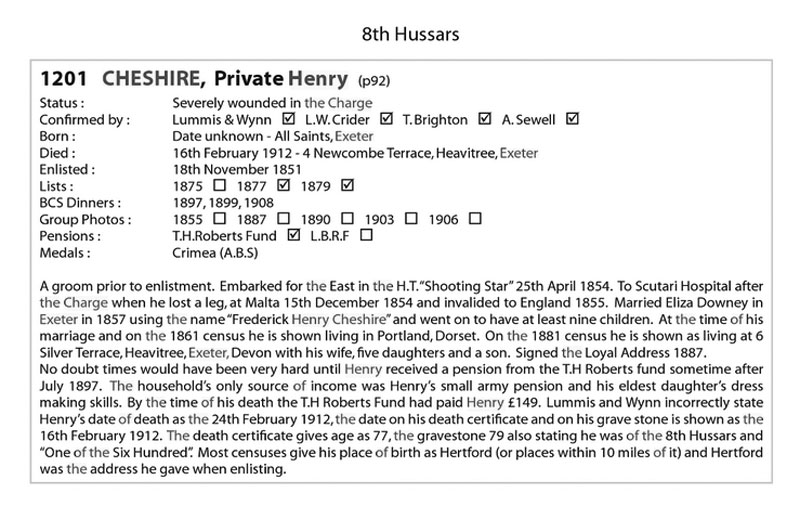
[CHECK & ADD INFO.]
(Click on image to enlarge)
References & acknowledgements
In March 2018 the EJBA was contacted by Robbie Pearson. The editors are very grateful to him for sending us his photograph of Frederick Cheshire's gravestone, shown above.