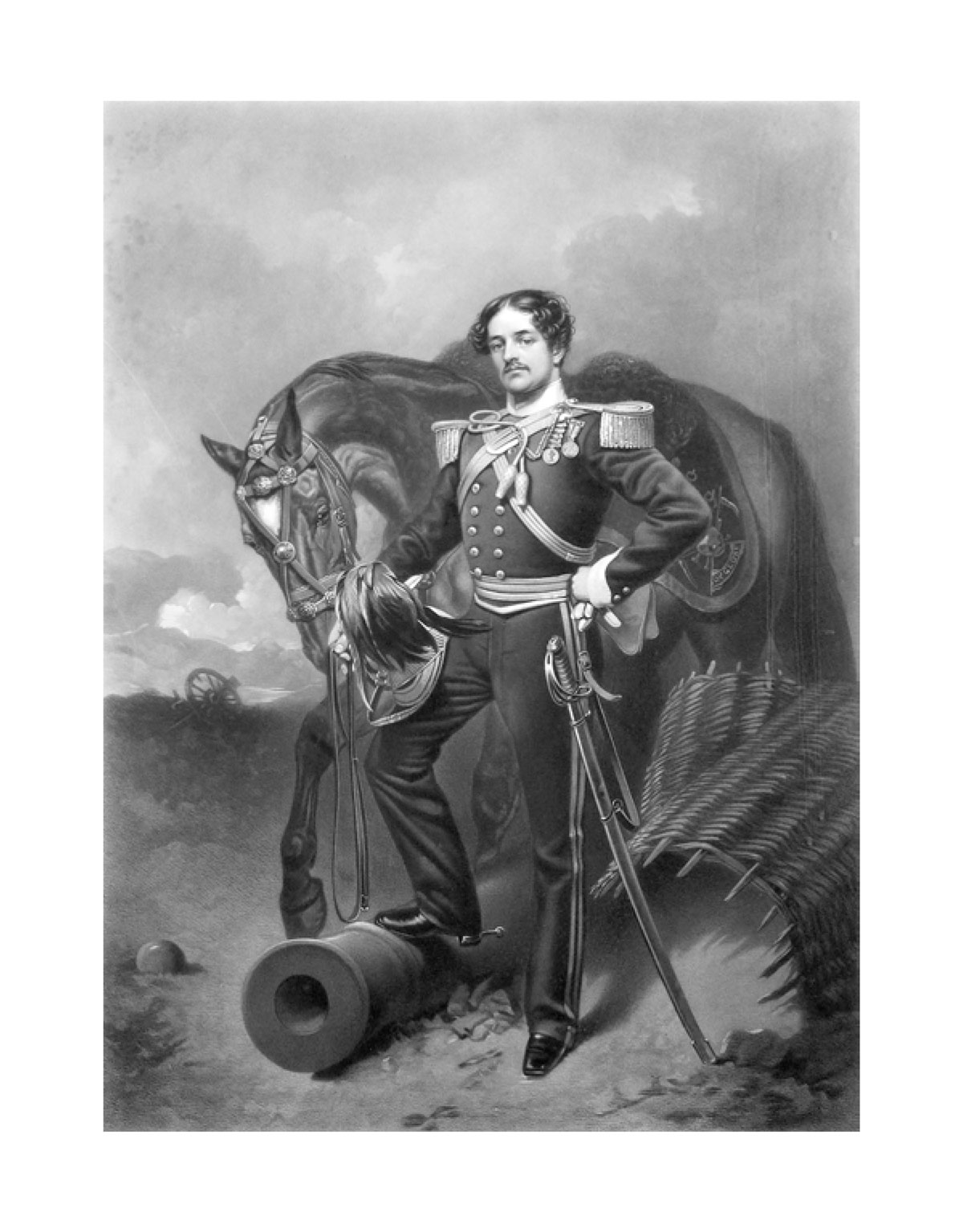
Born at Earlston on the 20th of October 1830, the son of Sir John Gordon, Bart, and his second wife, Mary, the daughter of William Irving Esq., of Gribton, Hollywood, Dumfriesshire.
He succeeded his father as the sixth Baronet in January 1843, also claiming the titles of Viscount Kenmure and Lord Lochinvar. He later became Deputy-Lieutenant of Kircudbrightshire.
Educated at Cheltenham College: August 1846 — June 1848.
Cornet in the 17th Lancers: 14th of June 1850.
Lieutenant, 17th Lancers: 18th of July 1851.
PB: Commanded E Troop on the left in the Charge, 25th October 1854. Severely wounded in the head but was able to ride back.
J. H. Settle, ANECDOTES OF SOLDIERS IN PEACE AND WAR (London: Methuen & Co., 1905), pp 237ff:
"Lieutenant Sir William Gordon, who greatly distinguished himself in personal combats in Central India in 1858, is still (1894) an active man, although the doctors said, on the 25th October, he was 'their only patient with his head off,' so terribly had he been hacked by a crowd of Russians into which he had penetrated. He used to make but little of his escape, but we learnt that after being knocked out of the saddle he lay on his horse's neck, trying to keep the blood from his eyes. Eventually, without sword or pistol, he turned back, and, unable to regain his stirrups although a perfect horseman, rode at a walk up the valley. He found between himself and our Heavy Brigade a regiment of Russian cavalry facing up the valley. He was now joined by two or three men, and he made for the squadron interval. The nearest Russians, hearing him approach, looked back, and by closing outwards to bar his passage, left sufficient opening in the squadron, through which Gordon passed at a canter. He was followed and summoned to surrender, and refusing, would have been cut down had not his pursuer been shot."
Captain, 17th Lancers: 26th of October 1854.
Brevet-Major, 17th Lancers: 7th of December 1858.
Major, 17th Lancers: 1st of July 1859.

Lieut-Colonel William Gordon. Engraving. Image supplied by Russ Lines 5.4.2019. No further info.
Second-Lieutenant-Colonel: 10th of June 1862.
Retired, by the sale of his commission, on the 18th of March 1864.
Sir William Gordon served the Eastern campaign of 1854, including the battle of Balaclava (wounded, and horse shot) and the Siege of Sebastopol. (Medal and Clasps.) Knight of the Legion of Honour and the 5th Class Order of the Medjidie.
Left sick on board ship on the 17th of September 1854.
Rode in command of "E" Troop during the Charge. After passing through the Russian battery unharmed, he had pursued the retreating Russian cavalry, only to then receive five sabre wounds in the head. So badly was he wounded that the doctors had said "he was the only one of their patients with his head off."
From the 1st of July 1855 he was employed on the Staff of General Lawrenson, commanding the Heavy Brigade.
The muster rolls for the period July-September 1858 show him as being "On Field Service" in India during the whole of this period.
Served in the campaign of 1858-59 in Central India and commanded a squadron in the affairs of Rajghur, Mungrowlie, Sindwahoe, Khatere and Zerapore. (Twice mentioned in despatches; Brevet of Major, and the Indian Mutiny Medal.)
Extract from a dispatch of the time:
"Major General Michel speaks in the highest terms of the conduct of Sir William Gordon during the combat at Mungrowlee in October last. The jungle was so thick that a column of the enemy without being perceived got entirely into the rear of our support, when luckily perceiving this I ordered Sir William Gordon with a troop of the 17th Lancers to disperse them. He charged and did so and cut up between one and two hundred.
I solicit to bring this officer's services prominently to the notice of His Excellency, and the squadron under his command, who did their duty admirably."
Entitled to the Crimean medal with clasps for Balaclava and Sebastopol, the Turkish Medal, Chevalier (Knight) of the Legion of Honour (5th Class), Order of the Medjidie, 5th Class, and the Indian Mutiny medal (without clasp.)
1992: His medals have been on loan to the National Army Museum. Because of an ever-increasing number of medals being donated or purchased by the Museum and the unlikelihood of ever being able to display them all, it is believed that shortly all such items "on loan" will be returned to their owners.
Also on loan are a Stable-Jacket, Pouch-Belt, "Pathfinder" Cup and Bullet. Whether all these items formerly belonged to William Gordon is not known, but the "bullet" could be that known to have been at Earlston and that which killed, or injured, depending on the story to be believed, his horse during the Charge.
1992: it is also now known that "Pathfinder" was his charger during the Crimean campaign, and the Cup was the Sultan's Cup which was presented to Sir William Gordon when riding Pathfinder (and winning) in a race in Constantinople in June of 1856. This item was returned to the owner in January 1978.
In 1998 various of his possessions were offered at auction, including an original printed copy of the Balaclava Commemoration Society's Rules and Roll of Survivors, the inside cover with presentation inscription to "Sir Willm. Gordon, late Lieutenant, 17th Lancers," gilt titles, leather bound, together with several inserts, including a pencil sketch of "A Private of the 17th Lancers halting on the line of march", signed and dated "M.G.G. April 24th 1868.".
[PB, October 2016: His medals came up for auction at Wallis and Wallis, October 12, 2016.]
Lot 151
Miniature medals: a contemporary group worn by Lt. Colonel Sir William Gordon, Bt, 17th Lancers who charged with the Light Brigade
Description: Miniature medals: a contemporary group worn by Lt. Colonel Sir William Gordon, Bt, 17th Lancers who charged with the Light Brigade, comprising five: Crimea, 2 clasps Balaklava, Sebastopol; Turkish Order of Medjidie and France Legion of Honour, both in silver with gold and enamel centres; Turkish Crimea Sardinian issue (these four mounted as a group on a buckle bar); Indian Mutiny with clasp Central India, with ribbon buckle (all un-named) Very Fine and contained within a silver cheroot case (Hallmarked 1848), approx 3_" x 3_", the lid of which is engraved with the crest and motto of Sir William's family. Plate 3
Note: Lt Colonel Sir William Gordon Bt, born October 1830 and educated at Cheltenham College, he entered the 17th Lancers in 1850 as Cornet. He was promoted Lieutenant in 1851 and Charged with the Light Brigade at Balaklava during which occasion he received 5 sabre wounds to the head. The skill of his surgeon in reconstructing part of his skull, and who described his patient as 'with his head off', is borne out by the fact that he was able to continue his military career seeing service in the Indian Mutiny campaign. Retired from military life in 1864, he died in 1906.
Estimate £1,500 — £2,000
1871 Census
Earlston House, Borgue, Kirkudbright.
William Gordon, 40, Baronet, born Tongueland.
Mary G. Gordon, born Edinburgh.
His sister and six servants were also shown.
1881 Census
Earlston House, Borgue, Kirkudbright.
William Gordon, 50, Baronet, born Tongueland.
Mary G. Gordon, 37, born Edinburgh.
Eight Domestic Servants are shown, including a Butler and a Lady's Maid.
1891 Census
Earlston House, Borgue, Kirkudbright.
William Gordon, 60, Baronet, born Tongueland.
Mary G. Gordon, 47, born Edinburgh.
A visitor and 7 servants are also shown.
Died at Earlston, Kircudbrightshire, on the 12th of May 1906, aged 75 years.
Extracts from the "Kircudbrightshire Advertiser" for the 18th of May 1906:
"Death of Sir William Gordon, Bart., of Earslton
A Crimean Hero — It is with profound regret that we have to announce the death of Sir William Gordon, Bart., of Earlston, which took place at his residence on Saturday evening, after a very short illness.
Sir William had been confined indoors for only a week, and during his last illness — an affection of the heart — he was attended by Dr. Reid, of Kirkudbright.
Sir William was the sixth baronet of his famous family, being descended from the Gordons of Galloway, the "Chief" of whom — Viscount Kenmure — was executed for the prominent part played by him in the "Fifteen" and several other members of whom suffered in the Covenanting times for their adherence to the cause of the Covenanters.
Among the first members of the family who made a considerable figure in Scottish history, is Adam de Gordon, who was one of the chief commanders sent by Alexander II to accompany Louis, King of France, in his expedition to the Holy Land in 1270.
His grandson, Adam de Gordon, was one of the greatest men of his time, being both friend and companion to Sir William Wallace, having assisted the patriot in his expedition to Galloway in 1291, and was made keeper of the castle of Wigtown, which they had wrested from the English. He was slain at the battle of Halidon Hill in 1333.
From his eldest son, Alexander, descended the Gordons of the North, afterwards raised to the peerage as the Dukes of Gordon; and from his second son, William de Gordon, is sprung the family of Lochinvar. One of the Gordons of Lochinvar fell at Flodden, and another at Pinkie.
Sir William Gordon, who was born in 1830, was the eldest son of Sir John Gordon, Bart., by his second wife, Mary, the eldest daughter of William Irving of Gribton, Dumfrieshire, and member of a family of distinguished and famous lineage.
In his twentieth year, after the usual preliminary training, Sir William followed the example of many of his family, and entered the Army, becoming a Cornet in the 17th Lancers, known as the old "Death or Glory Boys". This famous regiment, whose badge is the death's head, with the motto "Or Glory" was raised in honour of General Wolfe in 1759.
Sir William early evinced skill in horsemanship, and within a few months of joining the Army won the Regimental Challenge Cup. In 1851 Sir William was gazetted Lieutenant. The period was that of the Crimean struggle, and it was not long till the Lancers, who had not seen active service since they had been with General Wolfe in Canada [sic] were now required to break their long peace and take up the lance in war once more.
On the outbreak of hostilities with Russia they were ordered to the front, and in September of 1854, they landed in the Crimea. After some arduous campaigning they came with the Army to Balaclava, and here, on the 25th of October, they proved the mettle of which they were made by the part they played in the famous conflict known historically as the "Charge of the Light Brigade."
The "Valley of Death" was three-quarters of a mile in length, and the charge was against twelve guns in position backed by a mass of Russian cavalry, and with Russian batteries and riflemen to right and left of them.
Sir William, who was with his Lancers, passed scatheless through the death-dealing battery, but when he returned from the wild pursuit of the panic-stricken enemy, he had five sabre-wounds, one in the head. Hardly able to keep in the saddle, he lay on his horse's neck, trying to keep the blood out of his eyes, and rode back down the valley at a walk. The recovered Russian cavalry tried to intercept him, but he succeeded in escaping through an opening in the squadron.
His horse was shot through the shoulders, and died soon afterwards. The bullet which killed the gallant beast is preserved at Earlston.
For his gallantry in this great exploit the Lieutenant was promoted to Captain on the day following.
The winters of 1854-55 which were bitterly rigorous, were spent by Sir William with his regiment in the Crimea and where the severest hardships were experienced.
In 1856, Sir William returned home, and in October of 1857, left with his regiment to aid in the suppression of the Indian Mutiny.
Sir William's first undertaking in respect of this vast and tragic insurrection was to join in the hunt after Tantia Topee — the De Wet of the Mutiny, and a most daring and dangerous rebel. The chase covered over five thousand miles, and at the close of it Sir William was handsomely complimented for the splendid manner in which he had managed it, men and horses arriving, largely through his scrupulous care of both, in perfect condition.
At Rajghur, Topee's force of some 8,000 men with 27 guns, retreating before the British advance, was set upon by the 17th Lancers and the native cavalry under the command of Sir William Gordon. For five miles the pursuit continued, and the valour of the cavalry was rewarded by the capture of his entire artillery.
At Mungrowlee the British rear was suddenly attacked by a force of the enemy who, after doing some murder, escaped into the jungle. But, writes an historian:
'Sir Willam Gordon espied some of their heads in the thicket and ordered his troops to pursue at the gallop. Every one of the forty-three troopers composing the squadron killed two rebels each, and Sir William himself, going at breakneck speed, killed four with his own sword and knocked down many more with his horse's chest. A rebel who was about to fire at his back was cut to pieces , many prisoners were taken and Tantia's six guns were captured...'
[PB: see record of 1034 James Cope, 17th Lancers. Also the extensive — and explicit — manuscript account about the hunt for Tantia Topee by 1177 James Wightman, 17LD.]
Of the exploit the General commanding wrote in one of his despatches:
'I desire to bring Sir William Gordon's services very prominently to the notice of his Excellency, and those of the squadron under his command, who did their duty admirably.'
At Sindwahoe, at Kurai, at Baroda, Sir William Gordon, with his dashing cavalry, had heavy, fatiguing and sanguinary encounters with the enemy, whom they overcame with valour and fury, although the opposing forces vastly outnumbered them. As strong evidence of Sir William's pursuit, he, with his squadron of the 17th Lancers, covered no less that 230 miles.
After Tantia Topee was caught and hung, and Sir William had returned to his headquarters, General Michel sent a letter through his A.A.G., Captain Chapman, (now General Chapman, lately commanding the troops in Scotland) which was ordered to be read on parade.
The General expressed "his strong approbation of the conduct of the squadron commanded by Sir William Gordon, which alone had accompanied the Mhow column throughout the whole of the late operations in the field. Not withstanding the most severe service in the worst weather, this squadron, due to the unremitting attention of Sir William Gordon, is almost as efficient as the day it left Mhow.
The Major General has remarked that this officer's care has extended to the comfort of his men, the care of the baggage-animals and even to the well-being of the camp-followers, His leadership in the field was as gallant as was his unremitting zeal, and in gallantry his officers and men emulated his example."
In several of his Indian undertakings Sir William had with him Sir Evelyn Wood, since recognised as one of the finest soldiers in the British Army, and at that time a cavalry subaltern. In 1858, about a year after his arrival in India, Sir William was rewarded for his gallantry with the rank of Brevet-Major, and his brilliant work was brought to Lord Canning's favourable notice. In 1862 he was gazetted Lieutenant-Colonel, and he finally retired from the Army in 1864. His other distinctions are: the medal and clasps for Balaclava and Sebastopol, the Knighthood of the French Legion of Honour 5th Class, Order of the Medjidie, 5th Class, the Turkish medal and the Medal for India.
After his fourteen years of arduous military life, Sir William retired to Earlston, his Stewartry estate, where he soon became known for his quiet unostentatious activities in local affairs, as in his military capacity. He was a Deputy Lieutenant of the Stewartry, a Commissioner of Supply and a Justice of the Peace.
While stationed in Dublin, shortly after his return from the Crimea, some of his friends and admirers in the Stewartry presented him with his portrait, painted by the Hon. Henry Graves. This painting of him with his favourite charger was subscribed for at a cost of £300. At the same time he was given the freedom of the burgh of Kirkcudbright. On the occasion of the fiftieth anniversary of the famous Balaclava charge the opportunity was taken of showing to Sir William the high esteem and honour in which he was held.
A public banquet was held in Kirkudbright, at which Sir William was the principal guest, when, in the presence of a large and distinguished assemblage, he was presented with a magnificent solid silver trophy, representing a 17th Lancer charging a Russian gun and gunners. Sir Mark James McTaggert Stewart, Bart., late M.P. for the Stewartry, in making this presentation had spoken in eloquent language of Sir William's obedience to the call of his duty regardless of self, with a high aim and lofty purpose in life, and kindness to both man and beast...
Sir Evelyn Wood, in a note regretting his absence, referred to Sir William as being one of the bravest soldiers he had met in a long period of service, and one who had taught him much of which he had found of use to him. In accepting the above gift, Sir William, with his usual characteristic simplicity, said that "he had only done his duty."
Sir William, in politics, was a Conservative. He is survived by a widow, the sister of the present Sir William Maxwell, of Cardoness.
The Funeral
Yesterday afternoon the mortal remains of Sir William Gordon were committed to their last resting place in the family burial ground in Borgue churchyard. There was a large attendance of all classes, many people coming from long distances. The military element was represented by the Artillery Volunteers from Kirkudbright, and there were a number of old soldiers present, this testifying their respect to the deceased officer, who had taken so prominent a part in some of the most soul-stirring episodes in the history of the British Army. [Then follows a long list of relatives, friends, and other mourners.]
As the hour approached, a detachment of the 4th Ayr and Galloway Volunteer Artillery, under the command of Captain Nicholson, arrived from Kirkudbright, and formed up in front of the mansion house. At two o'clock a religious service was held in the hall of Earlston House. The coffin rested in the centre, covered by a Union Jack, and surrounded by a large number of beautiful wreaths. The service, which was a most impressive nature, was opened by the Revd. W.J. Pennell, minister of the parish, giving out the 23rd Psalm. Then followed the reading of the lessons by the other officiating clergy. The Revd. W.J. Pennell then offered up a most impressive prayer, in the course of which he prayed for the widow, the sister, relatives and friends of their late departed brother. They thanked God for that good disciple of Christ, for his devotion to duty in every part of life, for his bravery as a soldier, for his kindly heart, for his sterling straight-forward character, for his charity to the needy, for his interest in every mission to the sick and suffering; for manly confession of faith; for his zeal in God's house, and for his regular attendance on God's ordinances; for the faith in which he lived; for the resignation with which he met his sufferings; and the peace with which he died. The service was closed by the singing of the last hymn which Sir William had repeated, "Rock of Ages," and the benediction, pronounced by the Revd. Mr. Gordon.
The coffin was then removed to the hearse and the funeral cortege left the grounds. The road to the church-yard was lined with all the children attending the Borgue Academy, in which the deceased baronet took the greatest interest. The coffin was then carried shoulder-high into the church by six gunners from the Volunteers. There was a large congregation inside the church, the coffin being laid on trestles, still covered with the Union Jack, in front of the pulpit. Several of the hymns beloved by the late Sir William Gordon were sung, and the service closed with the singing of "Now the labourer's task is o'er," followed by the benediction. The coffin was then carried from the church by the bearer party to the mausoleum built by Sir William, and only finished a few months ago. The committal service was conducted by the Revd. Mr. Pennel, the benediction again closing the solemn service. [Then follows a list of wreath-senders.]
The coffin, which was of polished oak, with heavy brass mountings, bore the inscription: 'Lieutenant-Colonel Sir William Gordon, Bart., of Earlston. Born 20th October 1830 — Died May 12th 1906.'
Pulpit References
Sir William was an elder in Borgue Parish Church, at which there was a large congregation on Sunday forenoon. The Revd. W.J. Pennell occupied the pulpit, and made feeling reference in prayer to the sad event.
At the close of his sermon in Borgue United Free Church, the Revd. J.B. Atholl Gordon said that he felt he could not close that day without referring to that which lay so heavily on all their hearts — the great loss and sorrow that had fallen upon their parish in the death of Sir William Gordon, which took place the previous night.
A few days ago he was out amongst them, now they would see him no more. They could not yet realise how great was their loss. There was no one like Sir William, as they so affectionately called him. They did not know what they would do without him. This was not the place to speak of his great kindness to himself personally, except to say that ever since he came to Borgue he had been a most true neighbour and kind friend.
But, on the more public side of life, he expressed the feeling of them all when he said that they were all proud of him as a national hero, whose historic fame cast a lustre on their parish. They revered his simple yet very earnest and devoted goodness, they respected his prominent integrity and uprightness of his life. They deeply appreciated his most constant and generous interest in all that was good for the parish, and indeed of a much wider district; and they all loved him for his unfailing and genial kindliness and goodness of heart, for his ready sympathy, his wise help and for his staunch friendship...
'He was a man, take him for all in all,
We shall not look upon his like again.'
He leaves behind him a gracious and tender memory. He leaves behind him a noble record of a good life well lived; and now, having served his country and his God, he has entered into rest, and we can only say — Father, in the gracious keeping, 'Leave we now the servant sleeping'."
PB: It seems the following requires further attention — the account in Brigadier Turner's 1995 article is very different from EJB's earlier speculations.]
He married twice.
His first wife was Catherine, the 2nd daughter of John Page, Esq., of Galway, her grandfather being Joseph Page, the Surveyor-General of Customs in Ireland, and widow of P.J. Joyce, of Co. Galway, on the 21st of February 1857.
Catherine died on the 17th of January 1864. Their only child, a daughter, died in infancy.
It is possible that neither died in India. No trace of his first wife's death can be found in the Madras Province Ecclesiastical burial records — or indeed that of their infant daughter for either her baptism or burial — held in the India Office.
William Gordon had gone on a month's leave to Bombay during May-June of 1863 and may have taken his wife there to see her embark for England. The musters for January-March 1864 show him as "On Leave" and "Retired from the Service", no actual date of his leaving the Regiment — or India — being shown.
His wife may have died in Ireland, being of Irish ancestry, after her return from India, but not in Scotland, otherwise she would have most likely to have been buried in the Borgue Kirkyard.
He then married, on the 23rd of August 1866, Mary Grace, the daughter of Sir William Maxwell, Bart. and his wife Mary, of Cardoness.
A tombstone [known to still exist in 1988] in the Parade Ground Cemetery Parish of St. John's, at Secunderbad, India, bears the inscription:
"Sacred to the memory of the infant daughter of Sir William Gordon, H.M. 17th Lancers. Died 23rd June 1860, A.D.
"Sweet babe, how short thy stay.
How soon thy journey is over, thy spirit fled away, to visit earth no more.
Thy spirit found a nearer road than thousands to the blessed abode."
His second wife, Mary Grace, was later buried with him in Borgne Kirkyard. The memorial stone erected to them bears the inscription:
"Sacred to the memory of Lieutenant-Colonel Sir William Gordon, Bart., of Earlston.
One of the Six Hundred in the Charge of the Light Brigade at Balaclava. Oct. 25th 1854.
Born 20th October 1830- Died 12th of May 1906.
'Let those that love God be as the sun when he goeth forth in the night. Christ the first fruit. Afterwards they that are Christ's in heaven.'
Also of his wife, Mary Grace, eldest daughter of Sir William Maxwell Bart., of Cardoness. Born 24th April 1843 — Died 26th February 1923.
'God is Love.'"At the very top of the stone are carved his coat of arms and just below, on the right-hand side, are the words, "17th Lancers."
In 1995 an article by Brigadier J.W. Turner appeared in The Vedette, the Regimental Journal of the Queen's Royal Lancers (17th/21st), stating that WG's first wife was the second daughter of a John Page, who had been Sir William's batman at some time, and that the marriage had been kept secret until WG admitted to it when in India. He also said that Catherine Gordon had died in India in 1864.
A photograph of his mausoleum also appeared with the article, and was said to have been already built at the time of his death, and that because of structural decay over the years the regiment had arranged for this to be renovated. This photograph confirms that he and second his wife were indeed buried in a mausoleum and not in a grave in the Kirkyard as at first believed.
Enquiry of the Regiment brought the information that in 1993 a Mr. R.W. Rainsford-Hannay (a great-nephew by marriage of Sir William) wrote to the Regimental Trust asking for assistance in repairing the roof of the mausoleum. This was constructed of large sandstone slabs slotted into each other and the whole in imminent danger of collapsing as some of the slabs were beginning to break up and the cost of repair was estimated at just over six thousand pounds.
He was the only person connected with him living locally, the other being a Miss Winifred Shand (and also a great-niece) now living in Edinburgh, she being 90 years of age and he 81. Although both were willing to contribute they had approached the local authority who refused to do so, saying that it was not considered their property or responsibility. (The present 10th Baronet is a third-generation Australian farmer who was officially the owner of the building and unwilling, and possibly unable, to contribute.)
An application to "Historic Scotland" had brought the response that they would be prepared to find a proportion of the cost provided some funds came from other sources.
From the "White Lancer and Vedette" [unknown date]:
"The Balaclava letter
Reprinted below is the text of a letter written by Sir William Gordon to his mother five days after the battle of Balaclava. The original letter was given to the Regiment in 1937. It appears that shortly after that date it was put into a bank for safe-keeping and its very existence forgotten. It came to light early in 1972 when the bank asked the regiment to redeem the various papers they were holding on their behalf. After being suitably mounted it was put on display in the Museum at Belvoir Castle.
Australia Steamer,
Oct. 30th 1854.
My Dearest Mother,
In case you should see my name amongst the wounded, which I know would only give you unnecessary alarm — I take the earliest opportunity to write and say I only got few cracks on the head — which are of no consequence, and will in the course of a few days, be alright. I am now comfortably aboard the Australian steamer. What more can I wish for.
Indeed, what a lesson I have received to teach me to put my whole trust in God — for he in his unbounded mercy has allowed me to survive, and escape alive, after being exposed to the most dreadful fire British Cavalry ever advanced under.
I am afraid I have not time to give you a long account of the dreadful and unnecessary loss of life we have met with. I can only say it was thro' the stupidity of Lord Lucan and the cowardice of the Turks — (who, we were foolish enough to place confidence in) that the whole of the Light Cavalry Brigade have been "shot to pieces," not "cut to pieces" — five as fine Regiments who ever drew sword — who, I may say — are no more.
My own gallant regiment — sad to relate, only numbered 42 men the following morning — 3rd officers killed -5 badly wounded — with the exception of myself — the Colonel gone home sick — the Major dead of cholera, such is our case; But I am grieved to think that other regiments are nearly as bad, but I do not think any worse — but before I say more I must give you an account of the battle of Balaclava, as I suppose it will be called.
Out position where we had been encamped ever since our Infantry besieged Sebastopol has been about two miles in the rear of our Army to defend Balaclava and our shipping — our force consisting of the Light and Heavy Cavalry 2000 strong- one troop of Horse Artillery and about 4000 Turks — who were all strongly entrenched on the top of the hills, and we encamped in the valley acting only on the defensive -the Russian Army being too strong for us while engaged in besieging Sebastopol.
The Russian Army advanced at daybreak — we were under arms as usual two hours before daybreak, but before the Russians got within musket-shot of the Turkish batteries the brutes took up their Bag and Baggage and walked away — retiring behind us — nothing would induce them to fight.
All then was left to the Cavalry Brigade, and the one Troop of the Royal Horse Artillery — the Russians being in possession of our heights — we of course retired out of the range of the Batteries and made a stand a little further back.
The Russian cavalry advanced over a beautiful piece of ground, remember, at a walk, where we could have ridden them down, for they were terribly afraid of us — altho' we were then retiring slowly, every staff officer entreated Lord Lucan to allow us to charge at this time. But "No", the stubborn-headed strong stupid fellow would not allow us.
At this time a division of our Infantry appeared, which had been sent to support us from Sebastopol. The Russians retired immediately behind their own batteries — on the other side of the hill, and as they were retiring — in fact had got too far away, Lord Lucan gave the order for the Scots Greys and the 4th and 6th Dragoons to "Charge".
The Russians fled before them and those which came within reach of our Dragoons met with their reward, for they cut them down like nothing, but on account of Lord Lucan being dilatory in making up his mind — they got too far away to do them much harm.
The enemy, as I have said before, had retired over the heights where they had brought up their heavy guns and placed them on either side of the only valley which we could advance up. Besides these large guns there were two strong Russian field batteries below the heavy batteries and the Russian Cavalry 10,000 strong formed up in two lines across the valley, and a small body of Infantry to pepper us as we came to the charge.
Well, will you believe me — to the astonishment of all, Lord Lucan now ordered the Light Brigade to charge along the valley a full half-mile not even supported by the Heavy Brigade and exposed to this dreadful fire.
We, like Bulldogs who had been tied up all day — were only too glad to be let loose and off we went at a thundering gallop and cheering more like mad men — than men with common sense.
Excitement was great — fear was banished from every mind — on, on, we went, and fought as British soldiers always have done — every yard the shot and shell sent death into our ranks till we met them hand to hand and then British swords and pluck told well, for tho' our little band was small we rode through the first line and drove the second before us — but our numbers were too small to take the guns and the fire from the batteries on the hill too great, so no choice was left but to retire — and here closed the action.
The Russians remained in possession of two heights which they had taken from the Turks, but their Army, which was ten times our number, was driven back — the Division of Infantry which came to support us was not engaged.
Lord Raglan does not intend to take the heights until after Sebastopol falls, which town has proved to be beautifully fortified — and a much stronger place than we at first supposed, I have not the least doubt we shall take it in the end. But the loss of life will be great.
The siege operations of the French have been very bad — three of their magazines have been blown up, in consequence they were obliged to stop firing for three days — every one says we shall have to take it by assault.
The battle of the Alma I was a day too late for, which I regret tho' the cavalry had nothing to do — but a greater or more victorious victory could not have been for those engaged — I may repeat — No Generalship has been displayed. All was done by the bravery of our troops and main force.
All think Lord Lucan will be sent home, and I can assure you — we all thoroughly hope so — for a greater ass never stepped.
You would all be sorry to hear of poor Adam Maitland — I went to his Regiment to see him — I found he was buried three days before; such is the lot of many fine young fellows — and many of my greatest friends. Two hundred wounded are on board this ship, amongst them are Nell White and Morris — so badly shot they cannot be put in a berth — the sight on deck is a sad one — men in every corner — groaning.
Lady [?] will be sorry to hear my gallant brown horse that carried me was also shot in the shoulder, but like a good one he carried his wounded master off the field. It was then a case of "Go it, ye cripples!" The bullet was taken out and he is doing all right [sic].
There are two Russian officers on board with their heads half split open and we hear too, that the Turkish officer who commanded the heights is to be shot for cowardice.
I must conclude now, dearest Mother.
With kindest love to Granny and all.
Your sincerely attached Son,
W. Gordon.
He received £266/2/11d, "in consideration of the severe wounds received by him in action".
1911 Census
Imperial Hotel, Torquay.
Mary Grace Gordon, aged 67, widow, Landed Proprietor, born Edinburgh.
In 1994 a Miss Shand, a great-niece aged 91 and a great niece (mentioned above), was present (although wheelchair-bound) at the ceremony marking the completion of the newly erected monument to the fallen at Balaclava [PB: where?] and said that she recalled meeting him when she was a child at the age of five and was carrying in her pocket the same watch that William Gordon had carried during the Charge.
This lady died in 1996.
Additional Census information for 1871-1901 kindly provided by Chris Poole.
[PB, 6.4.2019: Having been contacted by [?], who has acquired a Colt revolver which he believes was WG's, I created a separate page focusing on WG in India.]
[PB, 6.4.19: There appear to be 7 or 8 related images, including of the mausoleum, in the Officers' Photo Albums. CHECK & ADD:
[PB: In April 2019 the EJBA was contacted by Queensland-based Russ Lines about a Colt revolver he had recently bought. He also sent an image he had found of WG. I emailed the CrimeanWar group for further info.]
I have been contacted by Russ Lines in Queensland who has bought what certainly appears to be William Gordon's pistol, said to have been given to him soon after he was seriously wounded in the Charge, and presumably carried by him when he was in India with the 17th Lancers.
I have looked through a number of accounts of Gordon in action but have not found any record of his using a revolver (though plenty of his prodigious powers with a sabre, e.g. in James Wightman's memoir of the hunt for Tantia Topee).
My ignorance of weapons is profound. Were revolvers in general use in the Light Brigade?
The dealer who sold the Colt, Crimson Mist Military Antiques, has placed numerous photographs online here.