Home Search Index of men A-Z

LIVES OF THE LIGHT BRIGADE
The E.J. Boys Archive

Added 25.11.12. Links added 19.4.14. Minor edits 17.5.14. Info from Wendy Leahy added, 6.8.15, 27.3.16. New info. from Diane Oldman, 4.11.16.

IN PROGRESS — NOT FOR PUBLICATION

1485, Private John GRAY — 4th Light Dragoons

Birth & early life

Born at Chatham, Kent, on the 25th of November 1831, the son of William Gray, a painter, and his wife, Mary. He was christened on the 2nd of September 1832. (There is a copy of his baptismal certificate in the "Certificates" file.)

Enlistment

Enlisted at Rochester in the 57th Regiment of Foot on the 24th of November 1845.

No Regimental number was allocated as he did not join the regiment.

Age: 15 years.

Height: 5' 6".

Trade: None.

Appearance: Fresh complexion. Hazel eyes. Dk. brown hair.

Service

Appointed Drummer on the 1st of October 1849.

Transferred, as Private, to the 4th Light Dragoons on the 1st of May 1851, "to serve in the Regimental Band."

Marriage

John Richard Gray, Bachelor, and Isabella Kersey, Spinster, were married at the Register Office in Ipswich, Suffolk, on 25th December 1853 [PB: really, Christmas Day?]. Both were "of full age", and living in Orford Street, Ipswich [close to the barracks]. His "rank or profession" was given as Private in the 4th Light Dragoons and ___ [illeg?].

Their fathers were named as John Gray, Glazier, and Thomas Kersey, Cabinet Maker. Ellen Kersey and Martha Kersey [the bride's sisters] were witnesses.

They were married by James Ougham Frances, Registrar, and John E Sparrowe, Superintendent Registrar. [WL]

[Wendy Leahy noted: "A bit of a shame there was no male witness listed, as it would have been illuminating to see who his buddies were in the regiment."]

Slightly wounded at Balaclava during the Charge, 25th October 1854.

At Scutari from the 17th of November 1854 and sent to rejoin the regiment on the 3rd of February 1855.

Discharge & pension

Discharged from Dublin on the 13th of May 1861:

"Unfit for further service. He has for some considerable time suffered from varicose veins of the legs. The disease has not been aggravated by vice or intemperance."

Served 12 years 145 days, to count.

In Turkey and the Crimea: 1 year 10 months.

Conduct: "good".

In possession of two Good Conduct badges.

Aged 30 years 4 months on discharge.

Awarded a pension of 8d. per day for three years. A letter was sent, on the 29th of April 1877, telling him that "he had no claim to anything bar his discharge pension".

He said he was intending to live at 27, Norwich Road, Ipswich, after discharge.

Medals

Entitled to the Crimean medal with clasps for Alma, Balaclava, and Sebastopol.

Commemorations

Life after service

He was living in Chatham in 1864, but emigrated to Australia in 1867 and settled near Fremantle, where he died c.1891.

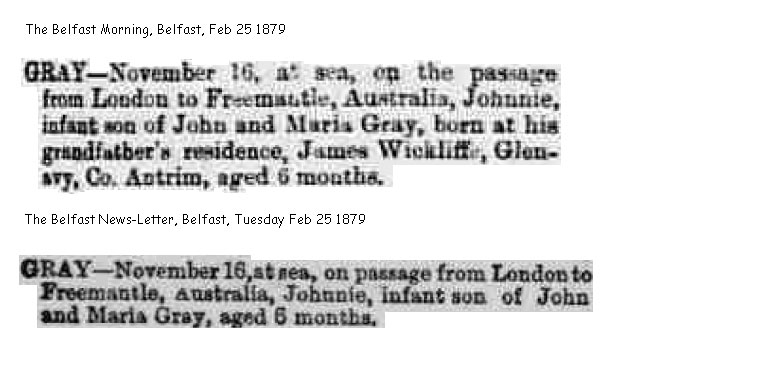
According to his great-granddaughter (who married an Englishman and is now [1980] living in the Midlands), he married a Maria Wickcliffe [spelling?] before going to Australia. A child of this marriage is believed to have died on board ship during the passage out.

Apparently, at some time or other a grant of land was made to "Maria Gray, wife of Warder Gray at Freemantle Prison." John Gray and Henry Dyson Naylor evidently worked there together at some period.

The Dictionary of Western Australian Immigrants merely shows him as:

John Richard Gray, son of James [sic] (painter) (Widower) mar. 2nd 7/9/1872 (Fremantle.) C/E.) Maria Wicckliffe, dau. of James, (Joiner). Fremantle, Warder 1872. (13 years' service.) C. of E.

In May 1856 Gray returned home to his relatively new bride: he had married Isabella Kersey in Ipswich, Suffolk at the end of 1853. The regiment was barracked there at the time, and Isabella was a local girl, daughter of Thomas and Rachel Kersey. The couple travelled with the regiment to various stations in England until Gray was discharged in Dublin in May 1861.

He was discharged 'unfit for further service' with a pension of eight pence per day for three years after serving 12 years and 171 days in the British Army. Gray's intended residence was 27, Norwich Road, Ipswich; if not the Kersey residence, it was close to it. Thomas Kersey, Isabella's father, operated a French polishing business in one of the many yards off Norwich Road.

The Prison Service

Gray joined the prison service and by July 1863 was an Assistant Warder at Chatham Prison. In March 1866 he applied for a position in Western Australia and was deemed suitable as he was given four months' advance salary and good conduct pay from 1st July. Gray, and presumably Isabella, boarded the Belgravia and arrived in Fremantle on 4th July. What happened to Isabella is a mystery. Did they bring any children to Western Australia? No death has been recorded for Isabella, nor births or deaths of any children of the couple.

Gray remained in the WA prison service supervising convicts on various public works. He appears to have been in the Albany area from 1868 to 1871 with mixed reports on his activities: he was accused of trafficking in kangaroo skins and in May 1869: Report by the Resident Magistrate in Albany for "repeatedly disobeying verbal and written orders about how the metal was to be laid on the road and a falsehood in stating that it was done as ordered. There was only 6 ins instead of 12 ins of metal and gravel spread ... having no one to send in his place I have no choice but to leave him where he is, but he is not to be trusted."

However in 1871 the resident magistrate records after a visit to one of the camps, I found both the sanitary and disciplinary condition of the men excellent...the huts were all clean and neat...I heard no complaints of the quality of the food." And the Road Board expressed their satisfaction with the way in which he had carried out work at the road party near Albany. In March 1872 the Albany Depot was closed and Gray returned to Fremantle with the last of the prisoners under police escort. (Barker: 87).

A Visit to Ireland?

In 1872 John Richard Gray married Maria Wickliffe. There is a record of the birth of John Lewis Gray in Tullynewtane, Antrim, Ireland on 16 May 1878: father John Richard Gray, mother: Maria Wickcliffe Gray. The last records of John Richard Gray in Barker's Dictionary (see sources) are over the entire period from August 1877 to October 1879.

Is this birth in Ireland some extraordinary coincidence, or did Maria Gray visit Ireland for some purpose? There are no marriage or death records in Western Australia for a John Lewis Gray thus we have to assume this child died in Ireland. [PB: see below.] Maria certainly returned to WA — if she had ever been to Ireland in the first place — because Elizabeth Minnie Gray was born in Fremantle 1879, married a Thomas Flintoff in 1902 providing John Richard Gray with two grandchildren.

Stop Thief

Gray's close proximity to the prisoners had its downside. In April 1872 the police reported finding Gray's watch in the possession of a ticket of leave man in Albany — it was returned to Gray. At North Fremantle in June 1872, two men were charged with unlawful possession of gold and jewelry belonging to Gray. Then in October 1873 the Gray's home in North Fremantle was robbed of a cash box containing watches and jewelry; and in February 1875 another break-in — this time the theft of wearing apparel. Fremantle Herald, 10 Oct 1873 Western Australian Times, 16 Feb 1875

John Richard Gray died on 24 Jun 1891 aged 60 from 'Paralysis Alcoholism (Acute)'. He was buried the following day in the Alma Street Cemetery. He had made a Will in favour of his wife Maria who was named executrix.

[Source: crimeanwar-veteranswa.com/stories/a-real-charger. See also DO's updated (November 2016) webpage on JG: crimeanwar-veteranswa.com/veterans-index/g-h/gray-john-richard.]


(Click on image to enlarge)

Death & burials

Died in Freemantle, Australia. on the 24th of June 1891, aged 60 years, from "Paralysis Alcoholism (Acute)." He was buried in the Freemantle Cemetery, (see report of his funeral taken from an unknown newspaper.)

Among those present was 1460 Henry Dyson Taylor, 13th Light Dragoons. The old cemetery in Alma Street, Freemantle, has now been levelled and a check of the Records of Burial shows that there is a gap in them of 24 years between the 31st of July 1875 and the 4th of March 1897, thus no trace of his grave can be found.

His great-grand-daughter, who married an Englishman, is now [1980] living in the Midlands.

Extract from the Colonial Military Gazette, August 1891:

Funeral of a Crimean Hero

John Richard Gray, a survivor of the Charge of the Light Brigade, was buried at Perth on the 25th of June. Gray rode in the charge with the 4th Light Dragoons and was a field trumpeter on that occasion. It was a wound received in the charge that initially caused the death of the old man.

The pall-bearers at his funeral were all old soldiers, viz; Corporal Barrett of the Fremantle Rifles and formerly of the 2nd Battalion Bengal European Regt., Corporal Naylor of the Fremantle Rifles and who was also a trumpeter [sic] in one of the other regiments during the charge, Gunner Healey of the Perth Artillery and formerly of the Royal Irish Dragoon Guards and Private Carrol, formerly of the 18th (Royal Irish) Regiment...

Information received from Mr. Broomhall, the author of The Enrolled Pensioners Force of Western Australia, shows that "John Gray was never an E.P.F. man. It is more than likely that he came out as a warder on one of the convict ships and I have only one entry for him."

Accession No.390 Battye Library of Perth, W.A. "John Richard Gray, late warder at Freemantle (Gaol) applies for increased pension."

The Governor, F. Napier Broome, wrote, "As a survivor of the immortal Charge of the Light Brigade, this officer has a claim to the greatest possible consideration."

Some time later, Broome wrote:

"He has a Chelsea pension of 5d. per day. Has 15 years' military service, November 1845 to April 1861, including the Crimea. Present at Alma and Balaclava, rode in the Charge of the Light Brigade in the 4th Light Dragoons, wounded and horse killed."

External links

JOHN GRAY

BORN: 1830/1831

AT: Chatham Kent

OCCUPATION[S]: No trade

RELIGION/DENOMINATION: Church of England

1st REGIMENT NO: 1485

ENLISTED: 21 11 1845 according to discharge

Honour the Light Brigade has 1851 which appears to be the year he transferred to the 4LD.

However this 1851 transfer entry is missing from the pay and muster rolls.

1Q/1851 enlistments end with No. 1484 and 2Q/1851 enlistments begin with No. 1486.

ATTESTED: 24 11 1845 Rochester, Kent

HEIGHT AT DISCHARGE: 5' 8"

DESCRIPTION AT ENLISTMENT: Brown hair, hazel eyes, fresh complexion

DESCRIPTION AT DISCHARGE: Dark brown hair, hazel eyes, fresh complexion, trade none, 30 and 4/12 Years

TROOP CAPTAIN: 1861: Captain C.A.G. Browne

RANK: 1851: Private

1855: Private

1858: Private

1861: Private

NOTES: 3Q/1858: Band member

COURT MARTIALS: None

GOOD CONDUCT BADGES: 2

MEDALS: Crimean, 4 clasps, and Turkish

CAMPAIGNS: Crimean War

OTHER DUTIES: Also served with 57th Foot: Drummer 1 year 7 months

Also served with 57th Foot: Private [under age] 9 years 9 months

25 10 1854: Slightly wounded at Balaklava

03 02 1855: From Scutari

TRANSFERRED FROM: 57 Foot 30 04 1851

TRANSFERRED TO: 4th Light Dragoons 01 05 1851

DISCHARGED TO OUT PENSION: 13 05 1861 Dublin

ADMITTED TO OUT PENSION: 21 05 1861 Ipswich

REGIMENTAL BOARD:

MEDICAL REASON:

NOTE: Kilmainham No Report 784 504-22/6/64

STATEMENT OF SERVICE: 57 Foot: Private from 24 11 1845 to 23 11 1848, total under age

57 Foot: Private 24 11 1848 to 30 09 1849, 311 days

57 Foot: Appointed Drummer, 01 10 1849 to 30 04 1851, total 1 year 212 days

Total service with 57 Foot: 2 years 158 days

4LD: Transferred, Private from 01 05 1851 to 31 03 1857, total 5 years, 335 days.

Entitled to 1 Ring, 24 11 1853 GCP

Forfeited 1 Ring 17 11 1854 GCP

Total Service allowed to 31 03 1857, 8 years 128 days.

4LD: Private from 01 04 1857 to 17 04 1861, total 4 years 17 days

Restored 1d G[ood][ C[onduct] Pay 12 06 1857

Good C[onduct] Pay at 2d from 12 06 1859.

Further Service from 18 04 1861 to 13 05 1861 when finally discharged, total 26 days

Total Service allowed to reckon to the day of final discharge 12 years 171 days.

The foregoing Report is hereby confirmed by me G. Brown, Lt. Col. Commanding 4 Regt. of Lt. Dragoons.

PENSION DISTRICT: 1861: Ipswich

1863: Chatham

1865: Chatham

PRÉCIS OF SERVICE ON DISCHARGE: Examined [by Pension Board] 13 05 1861

Private, 4 years 1 month

Under age 3 years

Total service 12 years 5 months 8 days

Pension claim 3 years

Turkey and Crimea 1 year 10 months

CHARACTER:

NOTES: [T]84504 C[on] fm AU

H57274 5d D[ischarge] P[ension] from 24 Nov 1880 Bd 4.10.87/11

[J]11701 Rest[oratio]n of old T.P. W.O. far___g A44 to W.O. 4 encl. Expl[ainin]g that there is no claim to anything but D[ischarge] P[ension] ___ P.31 ___ 29 04 188[7]

POST DISCHARGE OCCUPATION[S]: Intention to live 27 Norwich Road, Ipswich, Suffolk

DIED: 24 Jun 1891, near Fremantle, Australia, aged 60 years

BURIED: 25 Jun 1891, Alma Street Cemetery, Fremantle, Australia.

TNA SOURCES: WO/12/659

WO/12/663

WO/12/666

WO/23/52

WO/23/62

WO/97/1285/146

WO/118/32

OTHER SOURCES: Honour the Light Brigade

LINKS: http://findarticles.com/p/articles/mi_hb271/is_2_41/ai_n28816257/ [Links to EJB's Sabretache article.

[Source: shadowsoftime.co.nz/4ths/dragoong/gray6.html (accessed 6.8.2015)]

To be added...

Thanks for sending me your unpublished page on John Richard Gray. I know you will be reviewing at some point, so I will make the following comments on bits and pieces that I picked up on the current page:

1. Gray's first wife came to Western Australia with him, although to date no one has been able to locate her death or burial.

2. They arrived in WA in 1866, not 1867 (see website for details).

3. He was married to Maria Wickliffe, wife #2, in Fremantle NOT before he left England, as stated by the lady in the Midlands (see website for details).

4. The same lady is probably confusing the death of an infant at sea from England to Australia with the death of John Lewis, who did die at sea (the Belfast newspaper reports).

5. Gray was not buried in Alma Street which overlapped the existence of Skinner Street for a short time, but closed in 1855 for all internments except relatives of those already buried there.

6. Gray was buried in Skinner Street and probably didn't have a gravestone there. Had he done so, it would have been moved to Carrington Street, Fremantle (opened 1898/99) and his body re-interred. However, since his 2nd wife Maria was buried at Karrakatta (the major Perth Metropolitan Cemetery since c. 1900) and a gravestone for Gray and Maria is now there, it is likely he wasn't ever moved from Skinner Street and the gravestone at Karrakatta is simply a memorial inscription made after Maria was buried there. A good site for explaining cemeteries in Fremantle is at http://fremantlestuff.info.

I liked the surprise expressed about being married on Christmas Day. It was extremely common prior to the 20th century for the very practical reason that it was one of the days when both the parties were bound to have the day off.

And I believe that in many parishes, there was a convention that the ceremony was performed free!

Further information


New on the site Search Index of men G
For further information, or to express an interest in the project, please email the editors, Philip Boys & Roy Mills, via info@chargeofthelightbrigade.com