Commemorations
Member of the Balaclava Commemoration Society in 1879.
Signed the Loyal Address to the Queen in 1887.
Present at the Annual Dinners in 1897, 1911-11 [?], and 1913.
He was a pensioner of the Roberts Fund and was present at the Fleet Street offices of T.H. Roberts for the Jubilee celebration in June 1897.
[PB: He was interviewed with a number of others on the following day and is quoted in a rather tongue-in-cheek article, "The Balaclava Heroes", in the London Daily News, 25th of June 1897:]
JAMES OLLEY, WITH ONE EYE
The next hero — as, indeed, all the others — wore ordinary, unremarkable clothes. James Olley by name, he lives at Holt, in Norfolk, and has but one eye.
"Been a horse-trainer ever since the Crimea — a horse-trainer for gentlemen. I was in the 4th Light Dragoons, and got wounded in the Charge. Left eye shot out, sword cut across the forehead, lance wound on the ribs, another at the back of my neck, one on the foot."
It was the same with all of them. They felt certain I must want to hear about the fighting. I It was only polite to observe:
"You got tolerably knocked about then?"
"Yes, and it didn't end with the Crimea. I was kicked by a horse eight months ago — bone of the leg laid bare. Two years before had three ribs broken by a kick." Then rapidly back to the Crimea. "Had a horse shot under me — was invalided four months."
To make sure of changing the subject I inquired:
"What is the funniest thing that has ever happened to you in your life?"
"Riding in the Charge," came the instant answer.
I tried again, this time more successfully.
"What did you think of the show yesterday?"
"Oh, we had a tremendous reception, and as for Mr. Roberts, he's a real gentleman."
"How many of you were there? "
"There were seventy at the dinner on Monday."
"And some, I believe, are very badly off?"
The poor old fellow came very near to shedding tears.
"You may well say that. They told me — they told me! It's a pity, a great pity," and he sadly shook his head. "As for myself." he added, with some return to cheerfulness, "I mustn't grumble. I've a pension of 1s 2d. a day."
(See copy of this, and a photograph of him, in the 4th Hussar file.)
Present at the Coronation Procession of King George V in 1911, when he stood in line with other veterans in a place of honour in front of the troops. No other men of the regiment were known to have been there.
An account of Olley's life appeared in the Fakenham and Dereham Times in January 1888 and his portrait and short account of his experiences in the Charge appeared in the Answers magazine on the 25th of October 1912. (There are copies in the 4th Hussar file).
He also appears in several photographs, together with survivors from other regiments of the Brigade, taken early this century. (See copies in the 4th Hussar file.)
The report of his obituary notice and funeral appeared in the Fakenham and Dereham newspapers of the time and an article recalling him and written by the then owner of the house in which he died, in the Eastern Daily Press for the 24th of May 1976. (See copies of both in the 4th Hussar file.)
From the Army and Navy Gazette, January 1888:
"James Olley, late of "B" Troop of the 4th Hussars, of Knapton, in Norfolk, is in dire need. He has lost his left eye and has a long scarlet wound mark on his forehead — he is labouring under heart disease and has a wife and six [sic] children to support. He was in the Charge at Balaclava."
[PB, January 2015: In the same month, January 1888, Olley featured in an article in the radical Reynolds's Newspaper comparing the hardships of his life with the manifold comforts of "feather-bed generals" and others, which the newspaper styled "The Comfortable Classes". It concludes:
[W]e know that in all things concerning military matters the highest authorities are omnipotent. It is they that have fixed the rates of pensions and rewards allotted to all ranks in the service. And what are the results? Field-marshals, generals, colonels, and others of the higher grades are extravagantly rewarded, whilst the non-commissioned officers and privates, although far more deserving, are dealt with in the most stingy and parsimonious fashion.
At present there are hundreds of the former that never heard a shot fired in anger, and have spent the greatest portion of their lives at the card tables of the clubs, enjoying hundreds per annum as pensions, &c.; whilst the treatment of men who have really served their country, fought and bled for it, is exemplified in the following communication from Mr. H. Robinson, M.A., J.P., of Knapton Hall, North Walsham, Norfolk:
"May I ask for a small space in your valuable paper to set forth the claims of one of the ever-famous Light Brigade, by name James Olley, now residing in this parish? He had one horse shot under him in the charge, but directly caught another, and rode through the whole charge. He received four wounds, and had his left eye shot out.
He has a wife and six children, four of whom are under the age of ten, and utterly dependent upon him. His pension is only 8s. 2d. per week, and I have just seen a doctor's certificate stating that he is incapable of continuing his employment owing, I believe, to heart disease.
I trust I need only make the case known through your kind agency to obtain sufficient funds to enable him to end the rest of his days in peace and comfort. I may add I will gladly receive any donations on his behalf, and will do my best to see they are rightly applied."
Probably, if the privates enjoyed some parliamentary and governmental influences and powers, the pensions awarded a pack of feather-bed generals, &c., would be materially reduced, whereby those bestowed upon such really gallant and distinguished soldiers as poor James Olley could be greatly increased.
[Source: "The Comfortable Classes", Reynold's Newspaper, 8 January 1888. The article can be viewed here. A transcript is available here.]
From the Army and Navy Gazette, January 1896:
James Olley, late of the 4th Hussars, who was in the Balaclava Charge, is in bed after being severely kicked by a horse. He has been maintaining himself and his family by colt-breaking at Holt, Norfolk. He was formerly a Rough-Rider in the Regiment. Through his recent accident, he now seeks other work as a caretaker.
During the charge he received five wounds, lost an eye and also received a terrible sabre-cut. He saw the horse of Captain Nolan turn back to the camp with the dead body still in the saddle and also Lord Cardigan's horse jump the Russian guns. He went into action without any breakfast, being the man who, in the dawn on picket duty, galloped back to camp with the news of the Russian advance.
We will be glad to receive subscriptions from any old comrade-in-arms.
See the copy of the obituary report (and picture) from the North Herts Gazette, 26th of January 1978, of his only surviving daughter, Mrs. Nicholls, who died in Letchworth, Hertfordshire, at the age of 98.
Extract from a magazine article [unknown source]:
It would not have been unusual for people to see a middle-aged man walking the streets of Knapton with a placard around his neck, begging for aid. But once his identity was known and his participation in one of the most celebrated military events in recent history, things took a rapid and unusual course. Mr. H.M. Robinson, of Knapton Hall, landowner and Justice of the Peace, thundered in the Fakenham and Dereham Times of the 14th of January 1888, that "none of the gallant 600 should have to petition for the means of livelihood." He added that he would receive donations on behalf of Olley, whom it was intended "to put into some little business...
In the same article Olley told his story of the Charge:
"It was very queer going down the valley, a great deal worse than it was when I got to the guns. The first man that I happened with at the guns was a Russian gunner who attacked me with a ram-rod. I felled him at the muzzle of the gun he was protecting with a stroke of my sword. Just as I killed the gunner I saw several Russians dash at the Earl of Cardigan, who was near the breech of a big gun; but his horse brought him safely over the limber towards us. I never saw him again in the battle...
Whilst fighting at the guns, I received two lance wounds, one in the ribs and one in the neck, from behind. The Russian lancer who stabbed me was killed by a comrade and I struck down the other. In this cavalry encounter I was also wounded by a sabre-cut across the forehead by a Russian dragoon. He made cut 7 at me... I gave him point and then stabbed him; the sword fell from his hand and the point penetrated my foot...
When we were retiring we met some Russian lancers — we made a charge at them and they fled at the left incline and we rode past. Just after passing through the cavalry I got a ball from the Russian infantry on our left. It went through my left eye, passed through my nostrils and came out against my right eye. I did not know at the time that my eye was out. It was not painful at the time; afterwards the suffering was dreadful.
After being thus wounded I still kept in the saddle (he already had one horse shot under him but had managed to remount that of a fallen trooper) though blood was pouring from my mouth and nostrils as well as running from my forehead... When I came out of the battle the Paymaster did not recognise me. I was then blind."
Even allowing for some romanticising on the part of both raconteur and reporter, it was a gripping tale, and certainly helped to increase the flow of cash into Mr. Robinson's fund.
Olley further recalled how he was nursed by Florence Nightingale at Scutari (he was certainly taken there) and then, on his return to England, presented to Queen Victoria at Brompton Barracks, Chatham, in March 1856 when she visited the wounded there in company with Prince Albert and the Duke of Cambridge, who had commanded a division in the Crimea, and who had commented apparently upon Olley's "miraculous escape."
Her Majesty appears to have been quite overcome by the occasion, for she asked Olley whether "he would like to go back to the Crimea again." He had replied in suitably patriotic terms, and was pleased to receive, when he got back home. "a present of stockings, cuffs, scarves and mittens," from the Queen. Again, he must have been one of the prize occupants of the barracks, so all this is possible, even likely, with his five wounds and a lost eye, the scars of which he took to the grave.
And so, thirty-three years after he left the Army, James Olley, by now a local celebrity, came to Holt. He trained horses for the local gentry, including Lord Hastings and Sir Alfred Jodrell of Hatfield Hall and had his stables in Wansbrook Street, behind Hubbard's. He lived in three houses there at various times, one in Brick Lane, off Grove Street, along the Cromer Road, and for a while he ran one of the many inns in the town, "The Stores," and now (most inappropriately) known as "The Cottage Salon."
He does seem to have enjoyed his beer and was a regular at "The Bull," (now a baker's shop almost opposite the Cottage Salon) and, in a yard at the rear, would prove his considerable strength by throwing two 56 lb. weights over his shoulder a distance of 15 feet. This legendary exercise he could still perform at the age of seventy.
He had an aggressive nature and would return regularly from the annual fairs at Aldborough Green with plenty of bruises to testify to his pugilistic encounters behind the tents. But this fiery side to his nature was reserved for two-footed creatures only. He was a lover of animals and ruled his horses with kindness — as his obituary notice testifies.
Eventually he was forced, through illness, to give up his business and went to live in Blakeney in a little cottage in the High Street, which is still called "Alma Cottage" after one of the battles in the Crimea. He also christened his son by that name, and although he became a soldier for a while, Alma Olley was always known as "Wallam."
Later, "Old Balaclava", as he was known, moved on to Salthouse, where he came to be a churchwarden, most surprisingly, and then, via Lynn, back to the village of Elsing, where he lived in his own house, named "Balaclava Cottage", until his death. One of the very senior inhabitants, a Mr. Marshall, remembers him well, white-haired, and with a back as straight "as a rush," walking slowly to the "Mermaid Inn" for his evening pint. Others recall that he always wore his medals proudly on his coat. He certainly did so for the photographers...
Life after service
After his discharge he lived in various places in North Norfolk: Blakeney, Dalling, Holt (Bull Street), Salthouse, Knapton, Lyng and Elsing. He was twice married. The name of his first wife is unknown, but they had at least two children: Wallam, born in 1871, and Daisy Victoria, born in 1881.
His second wife was Nancy Cricks, whom he married between 1902 and 1906, and lived with at Salthouse and Elsing.
Towards the end of his life, by which time there were very few survivors of the Charge, he was feted throughout the world, as shown in this item from Sydney, Australia (1913):
(Click on image to enlarge)
FIFTEEN BALACLAVA SURVIVORS
Reduced by one by the recent death of Lord Tredegar, the following are now the survivors of the Charge of the Light Brigade:
Sir George Wombwell, 17th Lancers.
Major Phillips [8th Hussars]
Alderman Kilvert, 8th Hussars [actually, 11th Hussars]
J Mustard, 17th Lancers
T. Boxall, 4th Hussars [formerly 4th Light Dragoons]
J. Whitehead, 4th Hussars [formerly 4th Light Dragoons]
H. Wilsden, 4th Hussars [formerly 4th Light Dragoons]
J. Olley, 4th Hussars [formerly 4th Light Dragoons]
W.S.J. Fulton, 8th Hussars
J. Parkinson, 11th Hussars
T. Warr, 11th Hussars
G. Gibson, 13th Hussars [formerly 13th Light Dragoons]
E. Hughes, 13th Hussars [formerly 13th Light Dragoons]
W. Ellis, 11th Hussars
W.H. Pennington, 8th Hussars [actually, 11th Hussars]
[Source: Sunday Times (Sydney, NSW), 20 April 1913 http://trove.nla.gov.au/ndp/del/article/126459695 (accessed 15.2.2014) [PB].]
On the 13th of November 1997 a three-page folio, attributed to him, was sold at a Phillip's auction of books, manuscripts, etc. Evidently written under dictation (as it is in careful village school copperplate) with a flourished black-letter heading of "The Charge of the Light Brigade," signed at the end by Olley and subscribed by him with the date and address, "Holt, Norfolk, July 29th 1897".
The account begins with a description of how the writer had been on guard duty and on the morning of the battle had given the alarm that the Russians were advancing; then follows a brief description of the Charge of the Heavy Brigade.
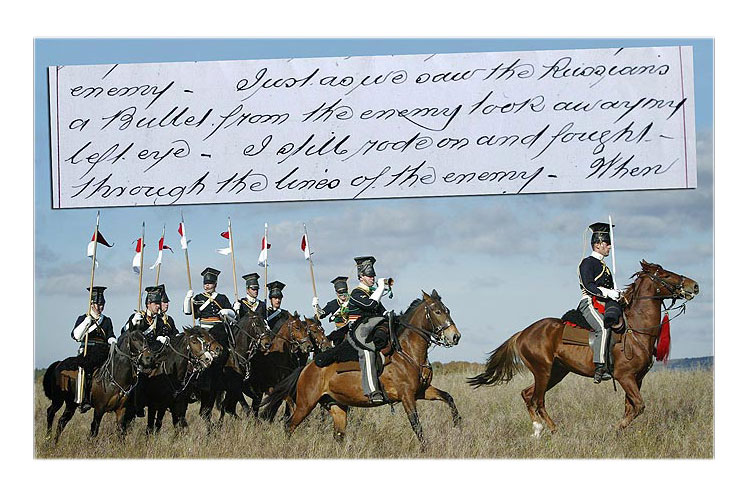
James Olley's acount, as seen in the Sun, ("Charge of the write brigade.", 4 November 2008.)
"Just as we saw the Russians a bullet from the enemy took away my left eye — I still rode on and fought through the lines of the enemy."
(Click on image to enlarge)
Extracts from the body of the document:
The Charge of the Light Brigade
[p.1. Transcribed by PB from the page image in article. It is hard to know whether marks between sentences or clauses are dashes or full stops.]
The night before the Battle, I was put on Guard — On the morning of the 25th October I was on outpost duty. At the break of day I was looking down from a point of one of the heights on the North side of the Hills, where the Turks had their Redoubts — I was surprised to see an army of Russians. I rode into the main body of the Guard and gave the alarm. 'We retired, leaving the Turks redoubt behind us, giving them an alarm at the time.
'We went and joined our Regiment which was lying on the Plains of Balacklava [sic] — Every man was called to his horse. All the Light Brigade were soon in their Saddles ready to do their duty or die — Order was given to advance and back up the Turks — We rode within a short distance of their Redoubts and sat by them until they left their Guns. We were ordered to retire — We left the Plain and retired to the back of the Hills, leaving Sir Colin Campbell with his Regiment, the "93rd Highlanders" on the Plain, and the "Scotch Greys". The Russians came down with a large body of Cavalry which were well received by Sir Colin Campbell and his men, who brought down many of the Russians, which caused them to retire for a short time, being joined
[According to other sources, the text continues:]
The Russians came down with a large body of cavalry, which were well received by Sir Colin Campbell and his men, who brought down many of the Russians ... they made another charge down the valley but was received by the heavy brigade and driven back with great loss.
We then received orders to take up our position at the mouth of the next Valley — After we had done so we could see the Russians forming up at the other end of the Valley.
After a time Captain Nolan brought orders to the Earl of Lucan — I was within ten paces from the Earl and his Staff when the order was brought in. "We may advance, but what can we do", said the Earl. "There is the Enemy and there are the Guns, cavalierly replied Nolan, pointing to the Russian Squadrons. The Earl of Lucan forwarded the Order by Captain Nolan to the Earl of Cardigan.
We got the order to advance down the Valley — we had not gone far before we received the order to charge and take the Guns, which were placed across the Valley — About halfway down the man that was riding next to me was shot and fell onto my right leg — a little farther on my Horse was shot down — I caught one of the horses which was coming back, without its rider, who had been shot out of his saddle.
I turned it round facing the enemy — I mounted and rode down to the Guns, when I was attacked by a Russian Gunner who I cut down with my Sword — I received a severe wound on my forehead which went through the Scull [sic] bone — the Man, I cut down — We cleared the Guns of the enemy — After a time we prepared to return when, to our surprise we found that we were surrounded by the enemy — Just as we saw the Russians a Bullet from the enemy took away my left eye — I still rode on and fought through the lines of the enemy — When we got through we rode into our encampment, what few were left of us..."
Olley's account was expected to reach £1500-£2500 but according to a BBC News report (Thursday 6 November 2008): "A wounded soldier's account of the doomed Charge of the Light Brigade has been auctioned for £4,500."
[PB: Chris Poole, who was at the auction, reported that the actual figure was £3900.]
OLLEY AUCTION CHRIS POOLE ARTICLE
Alerted by a phone call from Shropshire's intrepid Crimean reporters, Ian and Helen Smith, I attended the auction at Ludlow Racecourse after a two hour journey. Mullock's, the Auctioneers, informed me that it was a quieter day than normal, with about 25 people all told in the room including several handling telephone bids. They introduced me to Peter Olley from Stourbridge, a great grandson of the man himself, who had arrived hotfoot after several telephone tip-offs.
We both inspected the original document before the sale...it makes fascinating reading of October 25th 1854 including 'We cleared the guns of the enemy' and upon his return he was surrounded by Russians and a 'bullet from the enemy took away my left eye' but he still rode on. It was signed on July 29th 1897, Holt Norfolk and his signature is of copper plate.
This document would have been produced a month after he attended the T .H. Roberts Jubilee celebrations in London in June 1897, and there is no doubt his situation and that of some of the others that were there stimulated Roberts to initiate his Balaclava Relief Fund.
There was much interest in the document as Mullock's had informed several national newspapers including the Daily Mail and the Guardian. The proceedings commenced at 1 pm. with James Olley's sale being estimated for about 3 pm.
This was lot 289 out of a total of 345. Previously this article had come up for sale in 1997 and realised £600 (see Roy Dutton's Forgotten Heroes: The Charge of the Light Brigade, p. 60). This time the guide price was £1500-£2500, with the Auctioneer announcing that as there were many serious enquiries, the bids were to start at £1000.
The following two minutes raced by with lot 289 starting at 2.50pm. ...£1100, 12, l3, 14, 15 etc....23, 24, 25...31, 32, 33, and paused briefly at 37, then two quick bids and the gavel went down at 2.52 pm. on Thursday 6th November 2008 for £3900 to a private telephone buyer. There was lots of laughter with Peter Olley and myself suitably impressed...the Auctioneer putting the excellent price down to the 'Charge of the Light Brigade' in the national press and... a little piece of history was being made!
We all agreed that £3900 was a long way from a man begging in Knapton, Norfolk with a placard around his neck who was to receive £317-5 [?] shillings by the end of 1911 from the T. H. Roberts Fund.
[Source: Chris Pool, "James Olley, 4th Light Dragoons: Auction of Manuscript of his account of the Charge of the Light Brigade", War Correspondent January 2009.]
Charge of the Light Brigade survivor's medal turns up two miles from his last resting place
By Martin George
Eastern Daily Press, Friday, June 29, 2012 10.31 AM
He was Norfolk's last survivor of the most romanticised military disaster of the British Empire, but for three decades the medal he received from the Turkish sultan was believed lost.
Steve Loades, the great great grandson of James Olley has come forward with a medal Olley received for taking part in the Charge of the Light Brigade.
Now James Olley's insignia from the 1854 Charge of the Light Brigade, immortalised in poetry by Tennyson, has been rediscovered in the possession of his great-great grandson, just two miles from his final resting place in Elsing.
Olley was just 21 years old when a Russian gunner split his skull and a bullet claimed the sight in his right eye in the Battle of Balaclava, but despite his wounds he lived on for 66 years.
His story has fascinated amateur historian Steve Benson since he saw his name in a book about survivors more than three decades ago.
Olley had received two medals from the campaign, but Mr Benson believes they were separated after his death in 1920 and passed down different branches of the family.
He saw one, held by his grandson Charlie Loades in 1980 but since believed lost, while the other was auctioned in Ely in 2009.
However, after reading a story in the EDP in May, Charlie's grandson Steve Loades came forward to say the Turkish medal was safely in his possession in his home in Lyng, near the Elsing church where Olley lies buried in an unmarked grave.
Mr Loades said both his grandfather and father Al Loades, a Methodist minister, used to talk about the family link to the Crimea, but he was astonished by how much more Mr Benson had uncovered about his family history.
He said: "Charlie said he used to do a bit of pugilism in the back garden of the pub. I get the impression that he was a bit of a raconteur.
"I have a feeling he enjoyed the fame that was thrust upon him from a very young age.
"I think it was something that was quite central to his life. I often wonder if there was a bit of embellishment to his story telling."
In the decades after the Charge, Olley led an itinerant life that included spells in Elsing, Lyng, Salthouse and Blakeney, leaving behind a string of properties he christened Balaclava.
He even named his son Alma after the troop ship that took him home — much to the disgust of the young man, who preferred to be known as Wallam.
Mr Loades invited Mr Benson to his Lyng home, where a photo of Olley at the 1899 wedding of his daughter hangs in the hallway, and showed him the medal that had passed down four generations.
At a later meeting in the Mermaid Inn in Elsing, Olley's last watering hole, Mr Benson said: "I have been thinking there's almost a ghost sitting next to me here and that's the old boy.
"He is saying 'It's my story and before I start I want a pint'.
"Being in the place where he drank and spent his evenings when he was an old man with his great-great grandson sitting on the other side is fantastic."
Mr Loades said he was determined to pass the medal on to Olley's great-great-great grandchildren — Libby, seven, and Eddie, three.
He said: "It won't leave the family. It's in our ownership and will continue to be so. If I had my wish I would unite it with the other one."
If anyone has any further information about James Olley or his other medal, please contact stevebenson2@btinternet.com
[Source: Eastern Daily Press, 29 June 2012 (accessed 5.7.12).]