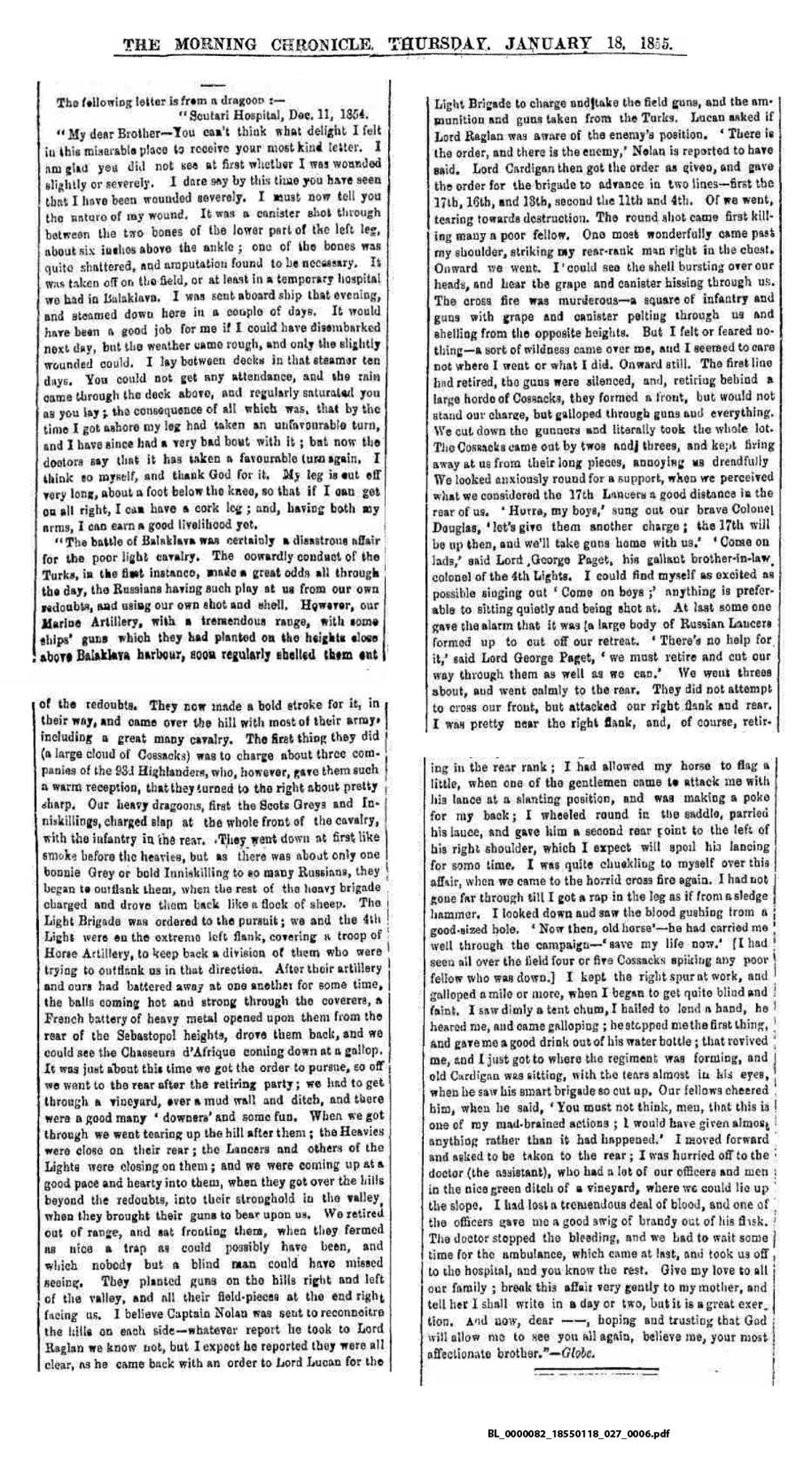
PB 22.10.14: I located this in the Morning Chronicle, 18 Jan 1855, some time ago, but now I find that Tony Margrave has already transcribed it (Newsletter 6, 2009) from the Times, 17 Jan 1855, as follows. I have checked his transcription against the Chronicle's version and mainly only altered the paragraphing, for readability. I've noted most of the differences but don't know if these are TM's errors or the Chronicle's. Note that the Chronicle credits "Globe". Another newspaper or a news agency?
Tony Margrave wrote:
Letter from a charger
I was catching up on some reading and came across the letter set out below in The Times, January 17, 1855 (I am a bit behind on reading the dailies!). The writer is unnamed & I had assumed from the heading that he was in the 4th or 13th Light Dragoons but apparently not. He lost a leg as a result of his wound at Balaklava, and so I also assumed he must have left the service & should not be too hard to identify.
Knowing that Douglas Austin has a keen interest in "the Charge" I copied the letter to him last week. He already knew of it and has kindly permitted me to say that he has identified the writer as "1441 James Charles Purves" of the 11th Hussars. Douglas is completing the draft of an article on Purves for submission to The War Correspondent and so you will hear again of our writer at a later date. Douglas says he has lots more about this man. A very sad story altogether I am told.
(FROM A DRAGOON)
Scutari hospital, Dec. 11, 1854.
"My dear Brother,
You can't think what delight I felt in this miserable place to receive Your most kind letter. I am glad you did not see at first whether I was wounded slightly or severely. I dare say by this time you have seen that I have been wounded severely. I must now tell you the nature of my wound. It was a canister shot through between the two bones of the lower part of the left leg, about six inches above the ankle; one of the bones was quite shattered, and amputation found to be necessary. It was taken off on the field, or at least in a temporary hospital we had in Balaklava.
"I was sent aboard ship that evening, I and steamed down here in a couple of days. It would have been a good job for me if I could have disembarked the next day, but the weather came on rough, and only the slightly wounded could move. I lay between decks in that steamer for 10 days. You could not get any attendance, and the rain came through the deck above, and regularly saturated you; the consequence of which was that by the time I got ashore my leg had taken an unfavourable turn, and I have since had a very bad bout with it, but now the doctors say it has taken a favourable turn! again. I think so myself, and thank God for it.
"My leg is cut off very long, about a foot below the knee, so that if I can get on all right I can have a cork leg; and having both my arms I can earn a good livelihood yet.
"The battle of Balaklava was certainly a disastrous affair for the poor Light Cavalry. The cowardly conduct of the Turks, in the first instance, made a great odds to us all through the day, the Russians having such play at us from our own redoubts and using our own shot and shell.
"However, our Marine Artillery, with a tremendous range, with some ships' guns which they had planted on the heights close-above Balaklava harbour, soon regularly shelled them out of the redoubts. They now made a bold stroke for it, in their way, and came over the hill with most of their army, including a great many cavalry. The first thing they did (a large cloud [crowd?] of Cossacks) was to charge about three companies of the 93d Highlanders, who, however, gave them such a warm reception that they turned to the right about pretty sharp.
"Our heavy Dragoons, first .the Scots Greys and and Inniskillings [TM has 'Enniskillens'], charged slap at the whole front of the cavalry, with the infantry in rear, They went down at first like reeds before our Heavies, but as there was only about one bonnie Gray or bold Inniskilling [TM: Enniskillen] to so many Russians, they began to outflank them, when the rest of the Heavy Brigade charged and drove them back like a flock of sheep. The Light Brigade was ordered to the pursuit; we and the 4th Light were on the extreme left flank, covering a troop of Horse Artillery, to keep back a division of them who were trying to outflank us in that direction.
"After their artillery and ours had battered away at each other for some time, the balls coming hot and strong through the coverers, a French battery of heavy metal opened on them from the rear of the Sebastopol heights, drove them back, and we could see the Chasseurs d'Afrique coming down at a gallop.
"It was just about this time we got the order to pursue, so off we went to the rear after the retiring party; we had to get through a vineyard, over a mud wall and ditch, and there were a good many "downers" and some fun. When we got through we went tearing up the hill after them. The Heavies were close on their rear. The Lancers and others of the Lights were closing on them, and we were coming up at a good pace and hearty [TM: nearly] into them, when they got over the hills beyond the redoubts, into their stronghold in the valley, when they brought their guns to bear upon us.
"We retired out of range, and sat fronting them, when they formed as nice a trap as could possibly have been, and which nobody but a blind man could have missed seeing. They planted guns on the hills right and left of the valley, and all their field pieces at the end right facing us. I believe Captain Nolan was sent to reconnoitre the hills on each side. Whatever report he took to Lord Raglan we know not, but I expect he reported they were all clear, as he came back with an order to Lord Lucan for the Light Brigade to charge and take the field guns, and the ammunition and guns taken from the Turks. [TM: Lord] Lucan asked if Lord Raglan was aware of the enemy's position? "There is the order, and there is the enemy, " Nolan is reported to have said. Lord Cardigan then got the order as given, and gave the order for the brigade to advance in two lines - first the 17th, 16th [sic - should be 8th?] [TM: 18th], and 13th, second the 11th and 4th.
"Off we went tearing towards destruction. The round shot came first, killing many a poor fellow. One most wonderfully came past my shoulder, striking my rear-rank man right in the chest. Onward we went. I could see the shell bursting over our heads and hear the grape and canister hissing through us. The cross fire was murderous a square of infantry and guns with grape and canister pelting through us and shelling from the opposite heights. But I felt or feared nothing - a sort of wildness came over me, and I seemed to care not [sic?] where I went or what I did. Onward still.[TM: end with '!']
"The first line had retired, the guns were silenced, and, retiring behind a large horde of Cossacks; they formed a front, but would not stand our charge, but galloped through gnus and everything. We cut down the gunners and literally took the whole lot. The Cossacks came out by twos and threes, and. kept firing away at us from their long pieces, annoying us dreadfully.
"We looked anxiously round for a support, when we perceived what we considered the 17th lancers a good distance in the rear of us. "Hurra, my boys" sung our brave Colonel Douglas, " let's give them another charge; the 17th will be up then, and we'll take guns home with, us. "Come on, lads, " said Lord George Paget, his gallant brother-in-law, Colonel of the 4th Light. I found myself as excited as possible, singing out, "Come one boys" anything is preferable to sitting quietly and being shot at. At last some one gave the alarm that it was a large I body of Russian Lancers, formed up to cut off our retreat. "There's no help for it, " said Lord George Paget, "we must retire, and cut our way through them as well as we can."
"We went threes about, and went calmly to the rear. They did not attempt to cross our front, but attacked our right flank and rear. I was pretty near the right flank, and of course, retiring in the rear rank; I had allowed my horse to flag a little, when one of the gentlemen came [TM:on] to attack me with his lance at a slanting position, and was making a poke for my bask; I wheeled round in the saddle, parried his lance, and gave him a second rear point to the left of his right shoulder, which I expect will spoil his lancing for some time.
"I was quite chucking to myself over this affair, when we came to the horrid cross fire again. I had not gone far through till I got a rap in the leg as if from a sledge hammer. I looked down and saw the blood gushing from a hood-sized [good-sized?] hole. "Now then, old horse" he had carried me well through the campaign "save my life now!" (I had seen all over the field four or five Cossacks spiking any poor fellow who was down.). I kept the right spur at work, and galloped a mill or more when I began to get quite blind and feint; I saw dimly a tent chum, I hailed to lend a hand, he heard me and came galloping, he stopped me the first thing, and gave me a good drink out of his water-bottle; that revived me, and I just go to where the regiment was forming and old Cardigan was sitting, with the tears almost in, his eyes, when he saw his smart brigade so cut up our fellows cheered him, when he said, "You must not think, men, this is one of my mad brained actions; I would have given almost anything rather than it had happened."
"I moved forward and asked to be taken to the rear; I was hurried off to the doctor (the assistant), who had a lot of our officers and men in the nice green ditch of a vineyard, where we could lie up the slope; I had lost a tremendous deal of blood, and one of the officers gave me a good swig at brandy out of his flask. The doctor stopped the bleeding, and we had to wait some time for the ambulances, which came at last and took us off to the hospital; and you know the rest.
"Give my love to all our family; break this affair very gently to my mother, and tell her I shall write in a day or two, but it is a great exertion and now, dear, hoping and trusting that God will allow me to see you again, believe me, [TM: I believe I am] your most affectionate brother. - Globe