Captain Edward TOMKINSON - 8th Hussars
Birth & early life
Born on the 11th of July 1835, the son of the Revd Henry Tomkinson of Reese Heath Hall, near Nantwich, Cheshire, Vicar of St Mary's, Acton, and his wife, Margaret, daughter of Shakspear Phillips, Esq.
His uncle, William Tomkinson (1790-1872), served in the Peninsula with the 16th Lancers (severely wounded at the battle of Drouro in 1809) and was also at Waterloo with the same regiment. His memoirs, "The Diary of a Cavalry Officer in the Peninsular War and Waterloo Campaign, 1805-1815", was edited and published by his son, James, in 1893 [?1895].
[PB: Available online in various formats at https://archive.org/details/cu31924024323663 (accessed 1.1.2014).]
Educated at Rugby School.
-
[PB: Jan 2014: See the Rugby School Register, listing entrants to the school with brief accounts of their achievements.]
[1837] Tomkinson Edward, son of the Rev. H. Tomkinson, Reeseheath, near Nantwich, aged 12, July 11 [House:] Bird.
[Footnote] Brigade Major of Light Cavalry. Lieutenant-Colonel, 1861. Formerly Captain 8th Royal Irish Hussars. Served throughout the Crimean War, including the Battles of Alma, Balaklava, and Inkerman,and the Siege of Sebastopol. Medal and four Clasps. Sardinian and Turkish Medals. His horse was killed under him at thaklava Charge, October 25, 1854. Died, May 14, 1870.
[Source: Rugby School Register, vol. 1, 1675 - 1849, p.200. London, Oxford, Cambridge 1881? 1889?. Available online in various formats at https://archive.org/details/rugbyschoolregis01rugbuoft (accessed 1.1.2014). Other family members are also listed. ]
PB: The following needs work...]
Tomkinson is mentioned as one of a catalogue of Rugbeian warriors in ? Minchin's Our public schools, their influence on English history; Charterhouse, Eton, Harrow, Merchant Taylors', Rugby, St. Paul's, Westminster, Winchester (1901), which was quoted in J.A. Mangan, The Games Ethic and Imperialism: Aspects of the Diffusion of an Ideal, Viking, 1986, p. 49. Excerpts published online at http://books.google.co.uk/books?id=BdT9AQAAQBAJ (accessed 1.1.2014)]
"...Rugby has reason to be proud of her soldiers...Out of some hundreds of brave men a few names only can be mentioned here: Admiral the Earl of Carysfort, the only Old Rugbeian who was present at both the victories of the Nile and of Trafalgar; General Sir Willoughby Cotton, who for forty years took part in almost all the fighting that was going on from Spain to the Punjaub, from Busaco to Chuznee; Sir George Hoste, RE, and Col. Trevor Wheler, both Waterloo heroes (to mention two only); A. H. Booth, Lieut, in the heroic 73rd, who went down in the Birkenhead on the 26th February, 1852; J. P. Basevi, who died on duty in Kashmir at an altitude of 16,000 feet, from the effects of the rarity of the atmosphere and from exposure; Sir Henry Wilmot, VC; H. A. Sarel, fourteen times mentioned in the despatches; General H. W. Adams, mortally wounded at Inkerman; Thomas Kettlewell of the Balaclava Charge, who served through the Crimea and Mutiny; Edward Tomkinson, J. P. Winter, and S. T. Williams, all Balaclava heroes... Haec mortalia tangunt. ["This human touch" ?]
Service
Cornet in the 8th Hussars: 12th of May 1843.
Lieutenant, 8th Hussars: 12th of April 1844.
1851 Census
Preston Cavalry Barracks, Steyning, Sussex
Edward Tomkinson, Officer, 26, unmarried, Lieutenant, born Nantwich.
Captain, 8th Hussars: 27th of June 1851.
Brevet-Major, 8th Hussars: 12th of December 1854.
Major, 8th Hussars: 3rd of April 1857
Major (Unattached) Serving at the Cavalry Depot, Canterbury, from the 17th of November 1857.
1861 Census
Cavalry, Northgate Barracks, Canterbury
E. Tomkinson, Commanding Officer, unmarried, 36, Major in the Army, born Rease Heath, Cheshire.
Lieutenant-Colonel: 15th of November 1861.
On to half-pay: 4th of December 1866. Became A.D.C. to Queen Victoria.
Campaign service
[PB, Jan 2013: Fanny Duberly mentions Tomkinson several times: pp. 8, 14, 21, 23, 30, 44, 47, 49, 95. Follow up.
For example, at Varna, en route to the Crimea:
Monday, 26th June 1854
On our way home, in the most impenetrable twilight, we passed by Captain Tomkinson's poor horse, which fell under him as he was returning from Varna.
There he lay stark and stiff, a white mass amid the dark shadows - as fine a fencer as ever strained upon a bit on a hunting morning; and, hark! the gallop and baying of the wild days, even now trooping over the hills to feed upon the almost palpitating heart! Ah! mournful sight, that he should lie there, so ghastly and so still...
Sunday, July 2nd
Captain Tomkinson returned today from Silistria, whither he had been sent to ascertain the best road for marching troops. He described the whole Russian force, although they have lately raised the siege of Silistria, as being still in sight of the town, and speaks much of their numerous field pieces [guns].
He brought back a Russian round shot, and told me he had seen two of the enemy, but lying cold and still. I hear the Turks are hardly to be restrained from mutilating their dead foes. If they can do so unseen, they will cut off three or four heads, and, stringing them together through the lips and cheeks, carry them over their shoulders, like a rope of onions...
[Source: Mrs. Duberly's War: Journal and Letters from the Crimea, 1854 - 1856. Edited by Christine Kelly. Oxford: Oxford University Press, 2007, pp.28-29.]
Major Tomkinson served in the Eastern campaign of 1854-55 with the 8th Hussars, including the battles of the Alma, Balaclava (horse killed), Inkerman and the siege and fall of Sebastopol. (Medal and four Clasps, Brevet-Major, Sardinian Medal and the 5th Class Order of the Medjidie.)
The citation for the Sardinian Medal stated, Brevet-Major Edward Tomkinson advanced with the Light Brigade at Balaclava and led the squadron he commanded with courage and steadiness; he had his horse shot under him; he was subsequently present at the battle of the Tchernya.
Commanded a squadron at Balaclava, and is said to have been disabled by the fall of his dying horse. Lummis and Wynn state that he was wounded, but the Regimental History states that he was unwounded, and he does not appear on any known casualty lists.
Medals
Entitled to the Crimean medal with clasps for Alma, Balaclava, Inkerman, and Sebastopol, the Turkish medal, the Sardinian War Medal and the Order of the Medjidie, 5th Class.
Commemorations
Life after service
Death & burial
Death registered
Edward Tomkinson, aged 44 years, June Quarter 1870, Marylebone.
Died at No. 24 Lower Seymour Street, Portman Square, London, on the 14th of May 1870, in his 45th year.
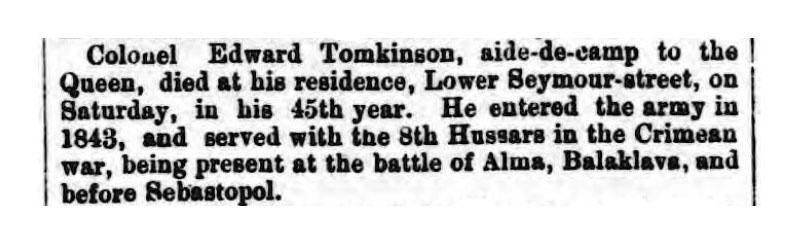
Portsmouth Times & Naval Gazette, Saturday 21st May 1870.
(Click on image to enlarge)
A marble memorial tablet was erected to his memory (placed high on the wall of the chancel) at Acton, Cheshire, bearing the inscription:
"In memory of Edward Tomkinson of Rease Heath, Born 11th of July 1825 - Died 14th May 1870.
He served in the 8th Hussars for 17 years and was with the regiment throughout the campaign of 1854-55 in Turkey and the Crimea.
'Surely I know that it shall be well with them that serve God.'"
He is believed to have been buried in the churchyard there but no trace can be found of any tombstone. There are several other tablet memorials in the church to members of his greater family, several of whom are actually buried in the church itself.
Extract from the Nantwich Guardian, 21st of May 1870:
"Death of Colonel Tomkinson
The funeral of Colonel Tomkinson of Reaseheath, near Nantwich, took place on Thursday.
Deceased departed this life on the previous Friday in London, the cause of his death being a long-standing tumour of the brain.
He was in the whole of the Crimean campaign and was one of the few who escaped with his life out of the Balaclava Charge.
He left the Army some three years ago after a service of some twenty years.
About 30th of his tenants headed the funeral procession and the rest of the mourners were principally relatives.
[A long list of mourners and wreath-senders follows.]
Deceased was born in 1825, and since his return to Nantwich has devoted himself as far as his health would permit to his duties as a magistrate and chairman of the Highways Board.
The funeral procession consisted of the tenantry, four mourning coaches and one private carriage."
In the churchyard of St Mary's at Acton, Cheshire, there is a kerbed area some 15 feet by 12 feet and surrounded by 10 feet high iron railings.
Although now covered with vegetation [1985] enquiry of a local man who was the sexton there for over 50 years revealed that he had always understood this to be the Tomkinson of Reaseheath family vault.
There was a large stone slab over the vault, which, he said, bore no markings whatever.
Failing to find any other memorial stone in the churchyard, it can only be assumed that the vault is Edward Tomkinson's burial place.
Confirmation from the parish registers proves that he was buried there on the 19th of May 1870, aged 44 years.
His place of abode was shown as Worleston, a village some one and a half miles north of Nantwich, and the burial service was taken by the Revd S. Redfern.
References & acknowledgements
Additional Census information for 1851 and 1861, registration of death, and newspaper cutting kindly provided by Chris Poole.