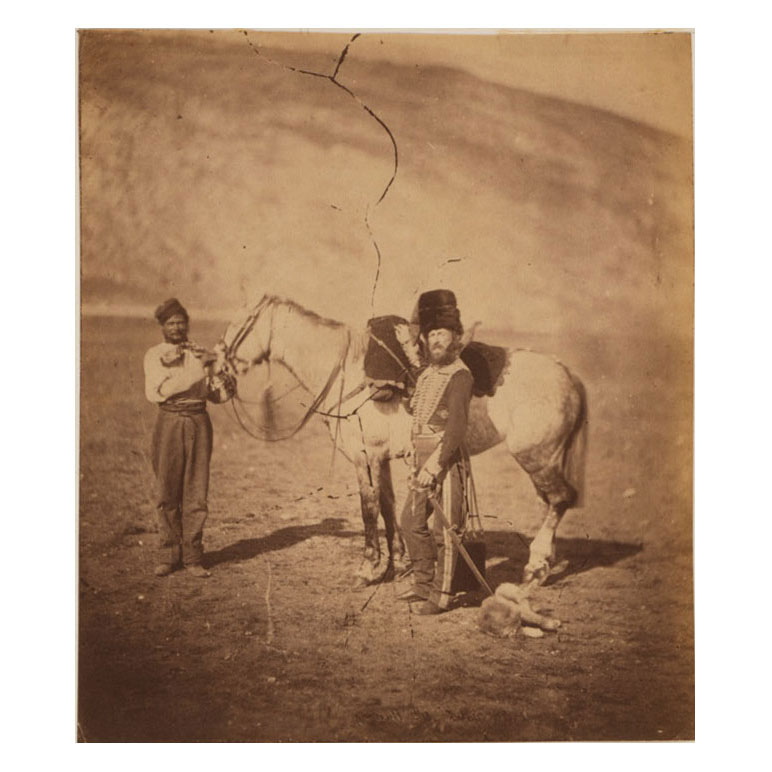
Cornet John Yates, 11th Hussars, with groom, horse and dog, photographed in the Crimea by Roger Fenton.
(Click on image to enlarge)
Cornet John YATES — 11th Hussars
Birth & early life
Born in the parish of St. George, Manchester, on the 23rd of May 1819.
Enlistment
Enlisted into the 17th Lancers on the 9th of October 1837 at the age of 18 years. His Regimental number was 451.
Height: 5' 9".
Trade: Toy-maker.
No other details are shown.
Service
From Private to Corporal: 3rd of March 1841.
Corporal to Sergeant: 24th of October 1845.
Appointed to Troop Sergeant Major: 19th of June 1848.
Promoted to Regimental Sergeant Major: 27th of February 1852.
Quartermaster in the 17th Lancers (by appointment) on the 6th of July 1852.
"Letter from Lord Hardinge to Lord Raglan relating to Qr. Mast. Yates, 17th Lancers, stating that the vacancy in the 11th Hussars had been filled. (Copied and original returned, as requested, August 29th 1854.)
Horse Guards,
8th of August 1854.
My Lord,
I have had the honour to lay before the General Commanding in Chief your Lordship's letter of the 23th ultimo with the enclosures from Major General the Earl of Lucan and Earl of Cardigan and the Commanding Officer of the 11th Hussars recommending Quarter Master Yates for the vacant Adjutancy of the 11th Hussars.
I am directed by Viscount Harding to say in reply that the Adjutant of the 11th Hussars who was the Senior Lieutenant of the Regiment having been promoted without purchase to the Troop which became vacant on the last Brevet, the then Senior Cornet was promoted in succession to his Lieutenancy.
This was done from a desire that the Regiment should benefit to the full extent of the Promotion which appeared open and in the full confidence that one of the Lieutenants would be recommended for the [?]. If this is not done there will now be in consequence a Supernumerary Lieutenant, the late Adjutant having been Supernumerary of that rank, and therefore the promotion of Lieutenant Dungate might be cancelled as well as that of the last appointed Cornet which would be a great inconvenience and disappointment to these Officers.
Under the circumstances it is therefore hoped that if no qualified Lieutenant is disposed to undertake permanently the office of Adjutant then one may be appointed to the duty till there may be a vacant Lieutenancy without purchase, when if he should not be disposed to continue in the situation, Lord Hardinge will be happy to give effect to the recommendation of Quarter Master Yates.
I have the Honour to be, my Lord,
Your Most Obedient Humble Servant
(Signed) C. Yorke.
[To] General The Right Honourable Lord Raglan, G.C.B.
Cornet in the 11th Hussars on the 22nd of September 1854.
Adjutant from the 10th of October, serving in that capacity until the 9th of December 1858, when he resigned the Adjutancy.
The June-July 1855 musters show him as "Sick on board ship" and to England on "Sick leave" from the 8th of August 1855.
Memo. sent to Cornet and Adjutant John Yates, 13 Old Cavendish Street, London, dated the 13th of February 1856:
"Your passage to Scutari has been arranged aboard the "Thames" (steamer) from Portsmouth on the 23rd of February 1856."
He was back in the Crimea by April 1856.
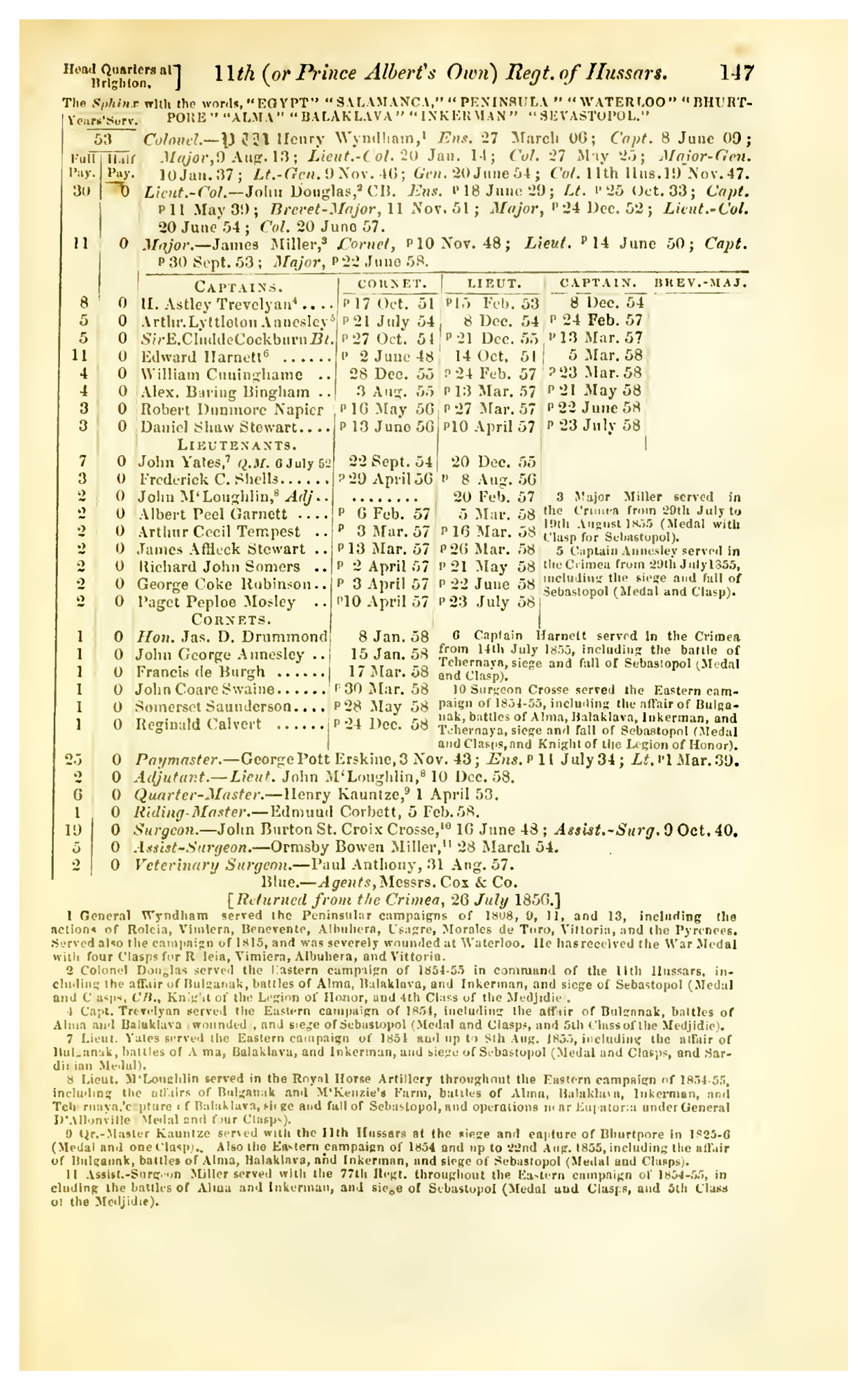
Hart's New Army List, 1859.
(Click on image to enlarge)
Lieutenant: 18th of October 1859.
Captain (Unattached list) and on to half-pay: 18th of October 1859.
Adjutant of the Cavalry Depot at Canterbury from the 25th of October 1859, until his death.
Marriage
On the 10th of February 1860, at Edgbaston Old Church, Birmingham, he married Frances Mary Yates, the only daughter of George Yates, Esq., of Edgbaston. He was then 40 years of age, and she 30.
[PB: A relative?]
Marriage registered
John Yates married Frances Margaret Yates, March Quarter 1860, Kings N[orton].
At the time of his marriage he was described as being the son of Joseph Yates. Both his and his wife's father were described as "Gentlemen".
1861 Census
Cavalry, Artillery and Northgate Barracks, Canterbury.
J. Yates, 42, Captain in the Army, born Birmingham.
F.M. Yates, 31, born Birmingham.
Two servants are also shown.
Medals
Entitled to the Crimean medal with clasps for Alma, Balaclava, Inkerman and Sebastopol, the Turkish Medal and the Sardinian War Medal.
The citation for the Sardinian Medal stated that "he was present in the Crimea from the commencement until August of 1855; was present at the battles of the Alma, Balaclava and Inkerman and behaved gallantly. Acted as Brigade-Major to Major-General the Earl of Cardigan at Balaclava, and for a fortnight previously."
One explanation for the statement in the citation for the Sardinian War Medal that "he was Brigade-Major to Lord Cardigan at Balaclava" could be that George Wynell Mayow had been away sick, and only returned to duty, unexpectedly, on the morning of the battle.
"Horse Guards,
13th July 1857.
Sir, — I am transmitting, by direction of HHR the General Commanding-in-Chief the accompanying Sardinian Medal which has been awarded to the officer named in the margin [Cornet and Adjutant John Yates] and I am directed to signify his Highness's desire that you will be pleased to present the same on parade as soon as practicable and with every formality which may tend to impress upon the recipient and upon his comrades the value of the decoration, the receipt of which you will be pleased to acknowledge, and should he have retired, resigned his commission, or is still serving, but not under your command, then the medal should be returned to this Department. This Grant will be published in Orders.
I have, &c. &c.,
W.A. Forster, DAG."
Further detailed medal information archived.
Commemorations
Life after service
1871 Census
43, Monument Lane, Edgbaston
George Yates, 64, Electro plater, employing 146 persons.
Frances M Yates, 60.
Frances M Yates [wife], 41, daughter, widow.
Two servants are also shown.
Death & burial
Death registered
John Yates, aged 42, September Quarter 1862, Canterbury.
Obituary notice from the "Kent Gazette" of the 22nd of July 1862:
"Died at Canterbury (the Cavalry Barracks) on July 19th, Captain Yates, 11th Light Dragoons, aged 42 years."
No funeral report can be found, but he was most probably buried in the Military portion of St. Gregory's churchyard at Canterbury, of which nothing but a few stones now remain, having been made (post WWII) into a children's playground.
The Cathedral Archives, which holds the registers for St. Gregory's, does not include that for the military extension. There was also another cemetery behind the "Royal Dragoon" public house in Military Road, now partly destroyed by road widening and having been made into a pub "garden." Here again only a few stones remain, none of which are legible. Both were in the area of the Barracks.
The burial records of the Canterbury Garrison Cemetery now in the PRO show him as being buried there, aged 42 years, the service being conducted by the Revd. W.T. Monks.
Further information
[1990] His great-great nephew, Mr. F. B. Yates, of Cossall Wood, Northampton, is convinced that his relative rode in the Charge. He also states that John Yates is buried somewhere in Canterbury and that his medals are in the possession of a distant cousin.
Although from this medal citation and certain other sources, including being listed in the Regimental History as having been present at Balaclava and taken part in the Charge, nothing can be found to support this, and it is known that George Wynell Mayow acted as Brigade-Major to Lord Cardigan at Balaclava.
William Henry Pennington of the 11th, in a letter written in June of 1912, wrote that:
"Yates was suffering from a temporary indisposition at the time of the Charge... He had, however, recovered in sufficient time to meet the returning survivors and upbraid them for their appearance. He was cut short by Lord Cardigan, who said they "deserved nothing but praise, they having done their duty."
Pennington, who did not like Yates, interpreted this remark to mean that he (Yates) had not done his, and further said he had always understood Yates had not ridden in the Charge..
Further contradictory evidence of his having actually taken part in either the battle of Balaclava or even of Inkerman comes from the "Memoirs" of R.S.M. George Loy Smith which were published (1987) under the title of 'A Victorian R.S.M.', Loy makes quite a number of references to Yates, commencing with:
"The Adjutancy was vacant, and unfortunately for us (the 11th) Colonel Douglas allowed Colonel Lawrenson of the 17th Lancers to persuade him that his Quartermaster would make us an excellent Adjutant — although at the time our two senior Sergeant-Majors were both eligible and both became Adjutants of other regiments during the next two years.
I have heard on good authority that Colonel Douglas afterwards deeply regretted this act. If he did not, I know the whole regiment did, for a worse rider, a worse drill, and a greater humbug never before held the rank of Adjutant in the British Army. The 17th might have been glad to get rid of him; they certainly got the laugh on us...
[During the Charge] It now became my particular duty (the Adjutant having remained behind when we received the order to attack (and the Regimental Sergeant Major's horse having been wounded) to note every word of command that the Colonel should give, as I considered the Adjutant's duty now devolved on me...
[At the battle of Inkerman] He names the officers present — including John Yates, as the regiment mounted... We now came under fire, the cannon-balls reaching us. It was then that one of the men, turning round looking to the rear, called out, "There goes Joey." All within hearing distance turned round to look when, in the distance, could be seen the Adjutant galloping back towards the encampment. This caused great amusement and laughter — he had only been with us a month and had made himself thoroughly obnoxious to everyone.
Even when those who had escaped at Balaclava were galloping back for their lives to the original position, he met then at the top of the valley, calling out, "Walk your horses. What are you galloping for? What are you afraid of? Colonel Douglas said, "Now, Mr. Yates, These men are not afraid of anything." He, it will be remembered, had remained behind when the Brigade was ordered to attack...
[After the battle of Inkerman] The new position we had taken up was out of the line of fire. It was now that Colonel Douglas called out the Adjutant, who had now rejoined us. He galloped out to the front. The Colonel addressed him, saying, "Where have you been, Mr. Yates? He then replied, "I have been to the camp." "Now, Mr. Yates," said the Colonel, "This is the second time this has happened, If it ever happens again I will report you to the General."
Thursday, 25th June 1855 — This morning, for the first time since leaving home, the troops turned out for squad drill under the Adjutant. We had on parade about 130, all the recruits being present. After we had been at drill for some little time practising increasing and diminishing the front, Colonel Douglas rode up to see how his new Adjutant was getting on. To his surprise and mortification he found that he was no good at drill. The fact was that he was making all sorts of mistakes in his instructions, and we were doing nothing but the most simple rudiments.
After looking on for some time and correcting the mistakes he was making, he then said in the hearing of all present. "It appears to me, Mr. Yates, that I shall have to drill the regiment myself." He then galloped away appearing much annoyed. Mr. Yates took care not to give the Colonel another opportunity of seeing him drill in the Crimea, for on the following day he went on the sick report and was shortly afterwards invalided home. Consequently his duties again devolved on me, as at the Charge of Balaclava."
In 1897, 1567 John Richardson of the 11th Hussars gave an interview to Spy magazine in which he said he was discharged for "misconduct". He then claimed that his troubles started following his return from a six-day "absence", and was called a scamp by the Adjutant.
He is said to have replied, "I am not like you — a coward. I saw you run from a mounted Cossack; and further, you never went down in the Charge."
If he is referring to John Yates, the latter was not in the regiment when the regiment was at Hulme Barracks in Manchester (they were there from June of 1860 to April of 1861), the Adjutant then being John McLoughlin.
Likenesses
[PB: We have numerous images in hand — to be uploaded.]
References & acknowledgements
Marriage and death registrations, and Census information for 1861 and 1871, kindly provided by Chris Poole.