"I may safely say that the crimes and outrages committed by this one man if divided amongst ten convicts, instead of being all accumulated upon one, would stamp each of the ten as desperadoes", Bishop of Perth, 1858.
Although not a member of the Light Brigade, George Woodcock is included here since in 1857 he was transported to Western Australia on the Nile alongside a number of Crimean veterans, including William Thistle and Charles Wilson, both 11th Hussars. Woodcock clearly played a significant part in fomenting unrest on board ship.
Another transportee was Edward Agar, who was involved in the Great Train Robbery, 1855, in which a very large amount of money on its way to pay soldiers in the Crimea was stolen between London and Paris.
The passengers (convicts, sailors, warders and their families et al) are listed here: members.iinet.net.au/~perthdps/convicts/con-wa21.html.
There is further information about the convicts, including their occupations, marital status, children, height, physical appearance, and distinguishing marks members.iinet.net.au/~perthdps/convicts/conwad21.htm.
Name: George Woodcock,
Reg.no.: 4729
Term: 10y
Age at time of trial: 28
Trial place: Derby
Trial date: 03 01 1854
Criminal offence: Felony
Comments: aka [MARSEN; MATTHEW; WILLIAMSON; JOHNSTON, George; SIMMOND, Alex]
Occupation: boot maker
M/S: W [widower?]
Child: none
Height: 5' 6 3/4"
Hair: light
Eyes: dark brown
Face: oval
Complexion: fair
Build: middling stout
Distinguishing marks: right eyebrow, cut tip of left, broken middle joint right forefinger.
Re: George Woodcock, the following is intriguing:
George Woodcock arrived at Fremantle aboard the ship Nile early in 1858. He lived in Albany for a time, had a big family and died in Perth in 1908. Does anyone have a photograph of George? Email: tam-mar@westnet.com.au.
[The West Australian, 30 Jan 2017, online at https://www.pressreader.com/australia/the-west-australian/20170130/282084866526388 (accessed 10.11.2017).
PB, 14 November 2017: I emailed tam-mar@westnet.com.au in the hope of discovering more about GW.
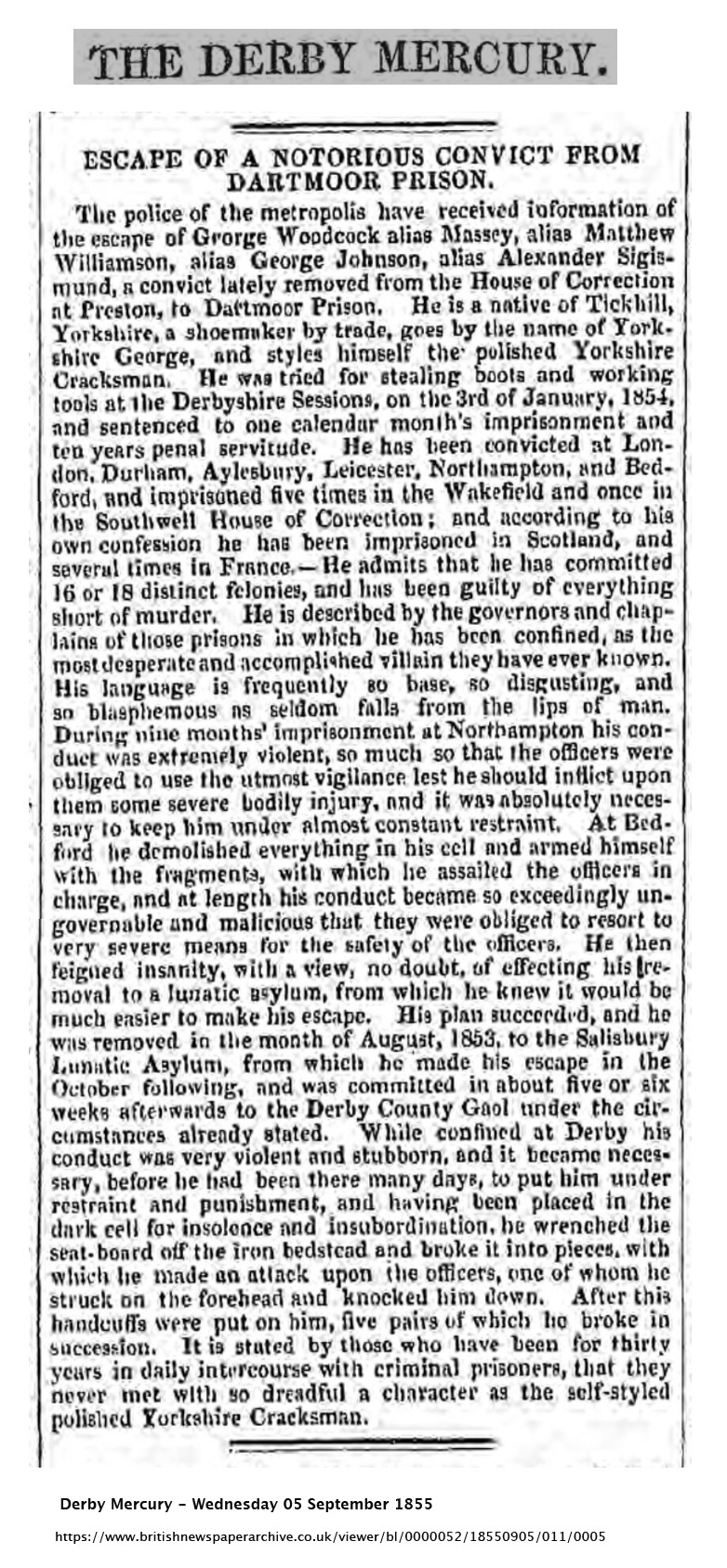
ESCAPE OF A NOTORIOUS CONVICT FROM DARTMOOR PRISON
The police of the metropolis have received information of the escape of George Woodcock alias Massey, alias Matthew Williamson, alias George Johnson, alias Alexander Sigismund, a convict lately removed from the House of Correction at Preston, to Dartmoor Prison.
He is a native of Tickhill, Yorkshire, a shoemaker by trade, goes by the name of Yorkshire George, and styles himself the polished Yorkshire Cracksman. He was tried for stealing boots and working tools at the Derbyshire Sessions, on the 3rd of January, 1854, and sentenced to one calendar month's imprisonment and ten years penal servitude.
He has been convicted at London, Durham, Aylesbury, Leicester, Northampton, and Bedford, and imprisoned five times in the Wakefield and once in the Southwell House of Correction; and according to his own confession he has been imprisoned in Scotland, and several times in France.
He admits that he has committed his 16 or 18 distinct felonies, and has been guilty of everything short of murder. He is described by the governors and chaplains of those prisons in which he has been confined, as the most desperate and accomplished villain they have ever known. His language is frequently so base, so disgusting, and so blasphemous as seldom falls from the lips of man.
During nine months' imprisonment at Northampton his conduct was extremely violent, so much so that the officers were obliged to use the utmost vigilance lest he should inflict upon one of them some severe bodily injury, and it was absolutely necessary to keep him under almost constant restraint.
At Bedford he demolished everything in his cell and armed himself with the fragments, with which he assailed the officers in charge, and at length his conduct become so exceedingly ungovernable and malicious that they were obliged to resort to very severe means for the safety of the officers.
He then feigned insanity, with a view, no doubt, of effecting his removal to a lunatic asylum, from which he knew it would be much easier to make his escape. His plan succeeded, and he was removed in the month of August, 1853, to the Salisbury Lunatic Asylum, from which he made his escape in the October following, and was committed in about five or six weeks afterwards to the Derby County Gaol under the circumstances already stated.
While confined at Derby his conduct was very violent and stubborn, and it became necessary, before he had been there many days, to put him under restraint and punishment, and having been placed in the dark cell for insolence and insubordination, he wrenched the seat-board off the iron bedstead and broke it into pieces, with which he made an attack upon the officers, one of whom he struck on tile forehead and knocked him down. After this handcuffs were put on him, five pairs of which he broke in succession.
It is stated by those who have been for thirty years in daily intercourse with criminal prisoners, that they never met with so dreadful a character as the self-styled polished Yorkshire Cracksman.
[Source: Derby Mercury, Wednesday 05 September 1855, britishnewspaperarchive.co.uk/viewer/bl/0000052/18550905/011/0005 (accessed 10.11.2017).]
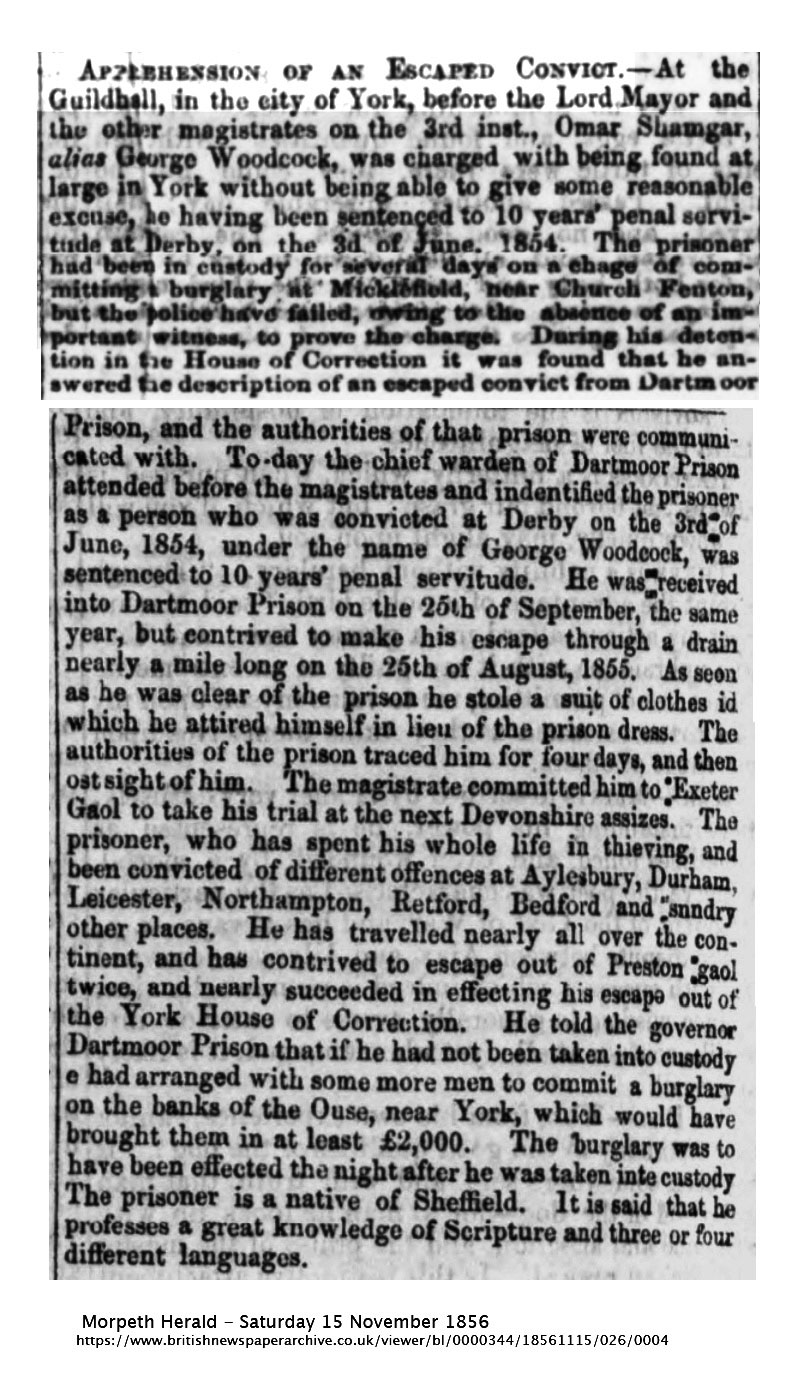
15 November 1856
APPREHENSION OF AN ESCAPED CONVICT
At the Guildhall, in the city of York, before the Lord Mayor and the other magistrates the 3rd inst., Omar Shamgar [PB:!], alias George Woodcock, was charged with being found at large in York without being able give some reasonable excuse, having been sentenced to 10 years' penal servitude at Derby, on the 3d of June, 1854. The prisoner had been in custody for several days on a charge of committing burglary at Micklefield, near Church Fenton, but the police have failed, to the absence of an important witness, to prove the charge.
During his detention in the House of Correction it was found that answered the description of an escaped convict from Dartmoor prison, and the authorities of that prison were communicated with.
To-day the chief warden of Dartmoor Prison attended before the magistrates and identified the prisoner as a person who was convicted at Derby on the 3rd of June, 1854, under the name of George Woodcock, was sentenced to 10 years' penal servitude. He was received into Dartmoor Prison on the 20th of September, the same year, but contrived to make his escape through a drain nearly a mile long on the of August, 1855. As soon as he was clear of the prison he stole a suit of clothes [in] which he attired himself in lieu of the prison dress. The authorities of the prison traced him for four days, and then lost sight of him.
The magistrate committed him to Exeter Gaol to take his trial at the next Devonshire assizes.
The prisoner, who has spent his whole life in thieving, and been convicted of different offences at Aylesbury, Durham, Leicester, Northampton, Retford, Bedford and sundry other places, has travelled nearly all over the continent, and has contrived escape out of Preston gaol twice, and nearly succeeded in effecting his escape out of the York House Correction.
He told the governor Dartmoor Prison that if he had not been taken into custody he had arranged with some more men to commit a burglary on the banks of the Ouse, near York, which would have brought them in at least £2,000. The burglary was to have been effected the night after he was taken into custody.
The prisoner is a native of Sheffield. It is said that he professes a great knowledge of Scripture and three or four different languages.
[Source: The Morpeth Herald, 15.11.1856, britishnewspaperarchive.co.uk/viewer/bl/0000344/18561115/026/0004 (accessed 10.11.2017).]
Note: Why "Shamgar"? If George Woodcock was indeed as knowledgeable about Scripture as he claimed, he may have have known that the Biblical Shamgar headed an uprising of the Hebrews against their Philistine oppressors, slaying 600 men with only an "ox goad" as a weapon (Judges 3:31; 5:6). The goad was a formidable sharp-pointed instrument up to ten feet long.
CAPTURE OF AN ESCAPED CONVICT
A desperate convict, who bas given his name as Omar Shangar, but whose real name is George Woodcock, was examined before the Lord Mayor of York on the charge of escaping from the convict establishment at Dartmoor. A short time ago be was apprehended by Mr. Sergeant Driscoll, of the York police, on suspicion of having committed a burglary in the West Riding. It appeared that Woodcock had escaped from Dartmoor on the 26tb of August, 1855. Ho was convicted at Derby on the 3rd of June, 1854, and was sentenced to ten years penal servitude, having been convicted several times before.
He escaped from the common adjoining the Dartmoor prison, where the convicts are employed in cutting peat, by walking up to his neck in a drain for three quarters of a mile. He thus eluded the sentries, and by the help of a friend he obtained clothing instead of the convict dress which he was wearing. It is said, that notwithstanding he has been brought up as a thief, he has a very extensive knowledge of the scriptures, and that he can speak two or three languages, he having travelled on the Continent, in the great cities of which be has conducted his nefarious operations. He was committed for trial, and has been lodged in the Devon County Gaol.
[Source: britishnewspaperarchive.co.uk/viewer/bl/0000103/18561113/026/0008]
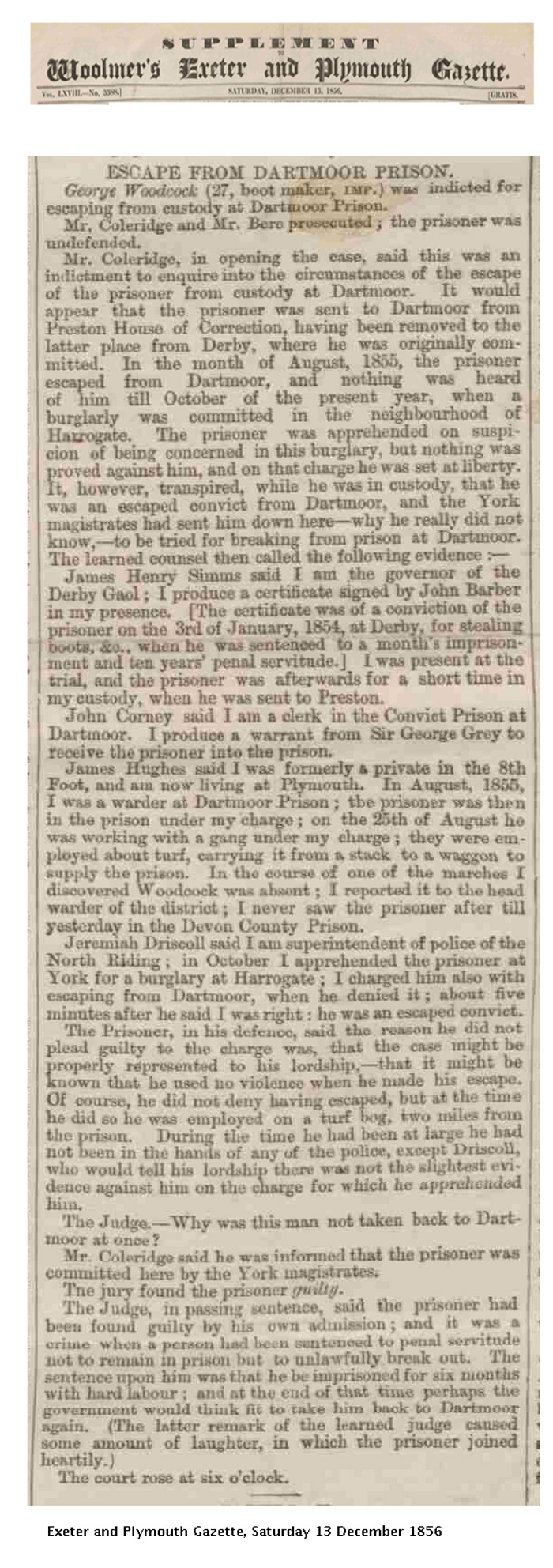
ESCAPE FROM DARTMOOR PRISON
George Woodcock (27, boot maker, IMP [?].) was indicted for escaping from custody at Dartmoor Prison.
Mr. Coleridge and Mr. Bere prosecuted; the prisoner was undefended.
Mr. Coleridge, in opening the case, said this was an indictment to enquire into the circumstances of the escape of the prisoner from custody at Dartmoor. It would appear that the prisoner was sent to Dartmoor from Preston House of Correction, having been removed to the latter place from Derby, where he was originally committed the month of August, 1855, the prisoner escaped from Dartmoor, and nothing was heard of him till October of the present year, when a burglarly was committed in the neighbourhood of Harrogate. The prisoner was apprehended on suspicion of being concerned in this burglary, but nothing was proved against him, and on that charge he was set at liberty. It, however, transpired, while he was in custody, that he was an escaped convict from Dartmoor, and the York magistrates had sent him down here - why he really did not know, - to be tried for breaking from prison at Dartmoor.
The learned counsel then called the following evidence:
James Henry Simms said I the governor of the Derby Gaol; I produce certificate signed by John Barber in my presence. [The certificate was of a conviction of the prisoner on the 3rd of January, 1854, at Derby, for stealing boots, &c., when he was sentenced to a month's imprisonment and ten years' penal servitude.] I was present the trial, and the prisoner was afterwards for short time in custody, when he was sent to Preston.
John Corney said I am a clerk the Convict Prison at Dartmoor. I produce a warrant from Sir George Grey to receive the prisoner into the prison.
James Hughes said I was formerly a private in the 8th Foot, and am now living Plymouth. In August, 1855, I was a warder Dartmoor Prison; the prisoner was then in the prison under my charge; on the 25th of August he was working with a gang under my charge; they were employed about turf, carrying it from stack to a waggon to supply the prison. In the course of one of the marches I discovered Woodcock was absent; I reported it to the head warder of the district; I never saw the prisoner after till yesterday in the Devon County Prison.
Jeremiah Driscoll said I am superintendent of police of the North Riding; in October I apprehended the prisoner at York for burglary Harrogate; I charged him also with escaping from Dartmoor, when he denied it; about five minutes after he said I was right: he was an escaped convict.
The Prisoner, in his defence, said the reason he did not plead guilty the charge was, that the case might be properly represented to his lordship, - that it might be known that he used violence when he made his escape. Of course, he did not deny having escaped, but at the tune he did so he was employed on a turf bog, two miles from the prison. During the time he had been at large he had not been in the hands of any of the police, except Driscoll, who would tell his lordship there was not the slightest evidence against him on the charge for which he apprehended him.
The Judge. - Why was this man not taken back to Dartmoor at once?
Mr. Coleridge said he was informed that the prisoner was committed here by the York magistrates.
The jury found the prisoner guilty.
The Judge, in passing sentence, said the prisoner had been found guilty by his own admission; and it was a crime when a person had been sentenced to penal servitude not to remain in prison but to unlawfully break out. The sentence upon him was that he imprisoned for six months with hard labour; and at the end that time perhaps the government would think fit take him back to Dartmoor again. (The latter remark the learned judge caused some amount of laughter, in which the prisoner joined heartily.)
The court rose at six o'clock.
[britishnewspaperarchive.co.uk/viewer/bl/0000267/18561213/050/0009]
The business of the Devon Winter Assizes commenced before Mr. Justice COLERIDGE on Friday forenoon, and terminated at eight o'clock ?? evening, his Lordship having tried no less than tweny-ii eass inthatabor tle....
All calendars appear (according to his Lordship) to have a distinguishing feature, and the characteristic of the present was the crime of burglary, which the learned Judge said, was evidently on the increase in this county; and in order to check it he should pass severe sentences on all cases that came before him.
In every case of conviction, we believe, his Lordship sentenced the prisoners to fifteen years' transportation, and six years' and four years' penal servitude. This, we hope, will have a repressive effect, and when we. get the rural police in full operation, we trust that the county of Devon will not be distinguished by such heinous offences as burglary and house-breaking.
"What to do with our convicts" is indeed a difficult question, some striking illustrations of which we also had at the assizes.
A ferocious lad, of only seventeen years of age, named MAY, alias RILEY, for some crime in the metropolis, is sentenced to four years' penal servitude.
He is sent to the convict prison at Dartmoor; he has not been there long before he attempts to murder ALEXANDER CAARICox, a warder, who appears to have discharged his duties in a humane and merciful spirit for RILEY confesses before the committing ta srate, that he had behaved to him like a father." Providentially, however, the spade (which is the weapon used) turns in the hand of the miscreant, and the flat instead of the edge descend with some force and injury upon the head of the paternal warder.
What earthly reason does the convict give for this murderous intent? Why, that "he has a natural dislike to prison officers, and he has made up his mind to take the life of one of them, if he is hung for it." For this attempt he is committed to the Devon County Gaol, where he developes his "principle of dislike," as we believe he calls it, "to prison officers," by all sorts of violent and extraordinary conduct, which sorely puzzles and disquiets the benevolent minds of the Governor and the Chaplain. He is ever and anon punished with three days in the black hole for his bad conduct, and is thereby tamed for awhile; soon, however, his mischievous and wicked propensities reappear, and the same diemal punishment is inflicted, and with the same effect.
Brought up for sentence before Mr. Justice COLERIDGE (as will be seen by our assize reports), he uses the moat violent imprecations and disgusting language, which is much too bad for publication. With the shocking scene fresh in our memories, the depraved youth appears to us more like a wild beast than a human being, as he listens unmoved and unimpressed to the mild and dignified language of the Judge; assails him with filthy words, and runs laughing from his presence.
We have another example in the case of WOODCOCK, some particulars of whose history we published a short time ago. He is an older and a much less repulsive-looking convict than the last; he is evidently a man of considerable natural abilities. He has acquired several languages in the course of his peregrinations; and from his appearance be would not be taken for a criminal. Moreover, he boasted before his Lordship that, although he had been concerned in a great many burglaries (we believe upwards of eighteen), he never perpetrated any violence on anybody. His offence was merely escaping from Dartmoor prison, for which he got six months' imprisonment, and after that he will have to go to Dartmoor again.
Exeter Flying Post, Thursday 18 December 1856
[britishnewspaperarchive.co.uk/viewer/bl/0000103/18561218/012/0005]
[britishnewspaperarchive.co.uk/viewer/bl/0000267/18561220/030/0006]
[George Woodcock]
[It] is a perfect mystery to me how any person holding a responsible position could ever reconcile it to his conscience to turn such a man loose into a ship with 269 other convicts, knowing there existed in that ship no sufficient appliances for the permanent safe custody of a dangerous person; and knowing also that no warder or officer in the ship had been forewarned or cautioned with respect to this man.
I may safely say that the crimes and outrages committed by this one man if divided amongst ten convicts, instead of being all accumulated upon one, would stamp each of the ten as desperadoes, utterly unfit for the purpose of colonisation. This man is known to have passed under feigned names and aliases to the number of at least 15 to 20, he has been traced and identified in no less than seventeen different prisons in England.
He has been guilty of violent conduct, murderous assaults upon the warders, attempts upon governors of prisons, breaking out of jail, and outrageous behaviour of every description so many times as to defy all attempts to record them all. He has become so madly and desperately furious that, for the safety of others, it has been found necessary to keep him lashed down hands and feet for upwards of a fortnight together.
This is the man who is sent to Western Australia in the face of the most distinct understanding that the best and most orderly prisoners are to be selected for transportation to this colony.
In addition to this he possesses far more than average ability, has considerable command of apt, forcible language, and great fluency of speech. He has been noted in the English prisons and has distinguished himself on board the Nile by his daring infidelity, and the bold blasphemous expressions which he makes use of. In fact if we could imagine any persons indulging a wish to do the greatest amount of injury possible to a ship's company and the inhabitants of a colony no more direct method could have been taken to carry this wish than to turn loose amongst them such a lend-like [?] criminal as this.
He had scarcely embarked in the ship before he commenced to prepare for further violence by picking the pocket of the warder who brought him off of his life-preserver... Happily, another prisoner took the weapon from him and gave it up to the authorities.
[Source: Letters written by Mathew Hale, the Bishop of Perth (Australia) from Bahia, Brazil, on the 3rd of November 1857, and later when approaching the coast of Western Australia on the 1st of January 1858, transcribed by Janice Hayes. Some paragraphing and date-captions added by PB to aid readability.
Caution to Brutal Husbands. - At the Perth Police Court, on Monday last, George Woodcock, a boot-maker, was charged before E. W. Landor, Esq., P.M., with brutally assaulting his wife, and was sentenced to three months' hard labor, and to receive two dozen lashes with the cat-'o-nine tails.
The Inquirer and Commercial News (Perth, WA: 1855 - 1901) Wednesday 19 January 1876 p 2 Article.
The Truant Clause. - At the Perth Police Court, on Saturday last, Mr. John Okely was summoned by the compulsory officer and fined 12s. and 3s. 6d. costs, for allowing his son Edward to be absent from the Perth Boys' School for eight weeks.
George Woodcock was fined 2s. 6d. and 3s. 6d. costs, for his sons Homer and Clarence's irregular attendance at the school.
Geo. Woodcock, a shoemaker, was charged with violently assaulting Mr G. Budd, the landlord of the No Place Inn, last evening.
Mr. Budd, who appeared, stated the circumstances of the assault, which if persisted in, would have secured for the prisoner a three months retreat, but in consideration of his wife and family did not wish to press the charge, and suggested to His Worship that a caution might have the effect of preventing a recurrence of the like again. His Worship severely commented upon the conduct of the prisoner, cautioned him not to appear again under a like charge and dismissed the charge.
The Western Australian Times (Perth, WA: 1874 - 1879) Friday 19 March 1875 p 3 Article.
Yesterday, a man named George Woodcock, in resisting his arrest by the police, opposite the City Hotel, had his leg broken in two places.
In the affray there were five other persons, all of whom were arrested. Woodcock was conveyed to the Hospital.
The Inquirer and Commercial News (Perth, WA: 1855 - 1901) Wednesday 23 July 1879 p 3 Advertising.
CITY POLICE COURT.
FRIDAY, April 25.
(Before Mr. James Cowan, J.P.).
George Woodcock was charged with having behaved in a disorderly manner in Murray-street on Wednesday last. The defendant denied the truth of the charge.
William Love deposed: On last Wednesday the defendant called at my hotel, and requested me to supply him with a glass of beer. I refused to do so, and told him that ' I did not want to have anything to do with' him. I then ordered him out of the bar, ? when he began to abuse me in the most dis graceful manner. He called me 'a - informer', and also 'a - policeman.' He repeated this language in the street after he had left my premises. He has abused me before.
Mr. Cowan: It is very evident, Woodcock, that you are a very badly behaved man. You are continually being brought up here for misconduct. It is a great pity that you will not keep away from drink, and try to support your family. You are simply good for nothing. You were charged here last January with a similar offence, when you received three months' imprisonment. This time I shall send you in again for an other three months, with hard labour.
The Defendant: Goodness gracious ! - Why, you have not let me even ask th&; witness a single question.
Mr. Cowan: Oh, you have nothing to ask him.
The Defendant: Yes I have, Sir. '
Mr. Cowan: Oh, no! you have not.
The Defendant: But you have not given me a chance to say a word in my defence I Mr. Cowan: You have no defence to make. .
The Defendant: Yes, but I have.
Mr. Cowan: No you have not. Let that man be removed.
The Defendant (holding fast to the front of the dock): Do you call this justice?
Mr. Cowan: Take him away.
The defendant was then removed, when he exclaimed, 'Good bye! and this is justice, I suppose !' .
A few minutes afterwards the prisoner's wife entered the Court and, addressing the Magistrate, said, 'And what am I to do with my eight children, now that you have sent their father to gaol?'.
Mr. Cowan: You are far better off with out him, I think. .
Mrs. Woodcock: I may as 'well go and throw them into the jetty, I suppose.'.
Mr. Cowan: Take that woman out. The woman then left the Court? f ana this concluded the morning's business. '.
The Daily News (Perth, WA: 1882 - 1950) Friday 25 April 1884 p 3 Article.
[later same day].
At the conclusion of the City Police Court proceedings this morning the man Woodcock, who has become somewhat notorious as a Police Court 'celebrity,' after receiving a sentence of three months' hard labor, was removed to the river-side lock-up previous to his removal to the prison. He had scarcely passed five minutes in the building, when, taking advantage of his being left without a guard for a moment, he scaled the wall and made off. 'Woodcock's little game,' however, was perceived by constable Connor, who gave the delinquent chase, and with much difficulty succeeded in re-capturing him.
The 'leg-bail' was of very short duration, and when re-arrested Woodcock resisted violently, and was with great difficulty again placed in the lock-up.
The Daily News (Perth, WA: 1882 - 1950) Friday 25 April 1884 p 3 Article.
The Inquirer and Commercial News (Perth, WA: 1855 - 1901) Wednesday 30 April 1884 p 3 Article.
George Woodcock gives evidence in defence
CITY POLICE COURT:.
MONDAY, September 8.
(Before the Police Magistrate.) Edward Lally was charged with having unlawfully assaulted a married woman named Elizabeth Jones, on the evening of Saturday. Jtetsb. The prisoner pleaded ' zzofc guilty.' ' ' .
Elizabeth Jones deposed:'I am the wife' of John Jones, who is a fitter. At between eight and nine o'clock on Saturday ' evening; I went to the Wellington Hotel to get some beer. I was trains to enter the house bv the main entrance-, and as I mounted the steps I saw several men standing on the verandah, of whom the prisoner was one.
When I was passing the men the prisoner caught hold of me behind in an indecent manner, whereupon. I at once swung round the jug I held in my hand, and hit him with it orr the head, I aid so in simply self-defence. As 1 was passing, on to the entrance-door the prisoner followed me, caught hold of me, and struck me on the left eye. I felt the blood running down my face as I fell to the floor. A man with a white speck in one of his eyes then picked me up. Miss Mew* told me it was Lally who had hit me j I went home with the beer ; and then went outside the house, when I met p.c. Gorman; I told him what had occurred j my husband was in bed at the time, rather the worse for drink. -When I was struck there was a lamp burning in the verandah, and the moon was shining brightly ; I am positive that the prisoner was the man who struck me. I don't know who the man was who picked me up. The black eye I now have was caused by the blow I received, as were also the scars I now have on my face.
The prisoner: I never insulted the woman in my life, your Honor ; Jim Kelly was the man who insulted the woman, she . then hit we over the left eye with her jug,. I put up my handkerchief, which was at once sopped with blood ; the police have the handkerchief in their possession now. After the woman hit me I followed her, and struck her in return.
Mr. Leake: I shall adjourn the further hearing of this case until Thursday next.
No! I see Woodcock here, so I shall call him, and hear what he has to say.
George Woodcock deposed: At about eight o'clock on Saturday evening I saw Mrs. Jones walking up the steps of the Wellington Hotel, when Kelly put his hand behind her in a very indecent manner. The woman then swung the jug round which she held in her hand, and struck the prisoner with it in the face. 'He then followed her, caught hold of her garments, and struck her a violent blow on the eye with his right fist. I told him it was a cowardly action for him to strike a woman.
He said it was Thomas Kelly who had struck her, but I told him he lied.- The woman was perfectly sober at the time. It was quite possible for her to have mistaken the prisoner for Kelly, and the two were standing close together at the time. The woman was most grossly insulted ; if she had been my wife, I should have slain Kelly to the ground.
Mr. Leake: You have given your evidence in a very manly and straightforward manner, Woodcock.
Peter Gorman said: I was on duty on Saturday night; at about a quarter to nine o'clock Mrs. Jones told me she had been assaulted at the Wellington Hotel, her face was bleeding at the timej just then Kelly passed us on his way home, he was walking very quickly.; I went with the woman to the Wellington Hotel, where she pointed out Lally, who was standing in the bar, as being the man who had assaulted her. I then arrested him, when he said, ' I struck the woman, but she hit me first in the face with a jng.' -Mr. Leake: There is no necessity for me to adjourn the case now, after hearing Woodcock's evidence. That man has given his evidence in the most admirable manner, for which he, considering the position he occupies, deserves the greatest credit. Here is a respectable woman going to an hotel . to o-et her suDuer beer, as she had a perfect right to do ; when she is first of all brutally insulted, and then most cruelly ill-treated.
I shall send you, Lally, to gaol for two months' with hard labour. ..
The Court then rose.
[Source: The Daily News (Perth, WA: 1882 - 1950), Friday 25 April 1884.]
A "great lover of decency"
PERTH POLICE COURT (Before the Police Magistrate.) FRIDAY, APRIL 17th.
GEORGE WOODCOCK, charged by Con- stable Dunne with having been drunk and disorderly in Murray street the day before, denied the accuracy of the constable's statement, which was corroborated by Constable Pollett, and called his son-in-law, a young man named Clarke, who deposed that the prisoner's disorderly appearance was caused by the manner in which he had been handled by the police after his arrest. Woodcock protested he was a great lover of decency, and hoped His Worship would not 'brook' the idea of his being guilty.
His Worship said it was hardly likely that the two constables would deliberately state what was false, and sentenced him to fourteen days imprisonment with hard labour.
[Source: The West Australian, (Perth, WA: 1879 - 1954) Saturday 18 April 1885 p 5 Article.
GW "deeply engaged in examining into the condition of the small pigs that were in the yard".
The "Christmas Supplement" at the City Police Court was a long one this morning, but his Worship was very lenient to the majority of the offenders. Six persons were cautioned, and two fined 5s, each for drunkenness. Three men who pleaded guilty to the heinous offence of sleeping in the open air were discharged, Mr. Leake evidently considering that the oppressive state of the weather afforded them some excuse for turning temporary vagrants.
George Woodcock was charged with being unlawfully on the premises of a gardener named William Wise. The prosecutor found the accused in his enclosed backyard at two o'clock in the morning of Christmas Eve; he had a dog under his arm, and was apparently deeply engaged in examining into the condition of the small pigs that were in the yard. In his defence Woodcook alleged that he had merely called upon Wise to ask him to purchase two cords of wood. Mr. Leake was of opinion that Woodcook should have called at a more suitable hour for business, and sent him to gaol for three months.
[It looks like "Homer Woodcock" and a young "George Woodcock" and a Nicholas Woodcock might well be his sons - and they appear in numerous court cases too. Yes, see mourners at their father's funeral in 1909 (below). "Homer" is often printed "Omer".].
This account was reprinted many years later - see below, 1913.
Other offences follow, often involving alcohol:
e.g. 8 nov 1887.
A VIOLENT DRUNKARD.
George Woodcock was charged with having been drunk in Wellington street the pre- vious day. When taken to the cells, he was very violent in his behaviour, and threatened to take the lives of the constables. Mr.
James sentenced him to seven days' imprisonment.
21 Jan 1888.
AT a special meeting of the City Council, on Friday week, tenders were opened for metalling a portion of Charles Street and for breaking a quantity of stone. The tenders for the Charles Street work were not considered satisfactory, and it was decided to advertise again. The tender of Mr. George Woodcock for breaking stones was accepted.
6 Sep 1888.
LARCENY.
GEORGE WOODCOCK, charged with the larceny of a cheque, was further remanded till Monday, the 10th inst.
LARCENY.
GEORGE WOODCOCK and THOMAS WHITE appeared, on remand, to answer a charge of stealing a cheque for £2 10s. 6d, signed by John Liddelow in favour of Thomas Shannon.
White admitted finding the cheque, and Woodcock pleaded not guilty.
The magistrate said that as the prisoner White had kept the cheque in his possession after finding it, instead of restoring it to the owner, larceny was inferred, and he would sentence him to six months imprisonment.
Woodcock was discharged.
13 sep 188.
TWO men, George Woodcock and Thomas White, were charged before the Police Magistrate on Monday morning with stealing a cheque for £2 10s. 6d. It appears that one of the prisoners, White, picked up the cheque, but never tried to find the owner. The magistrate, who stated that, in the eyes of the law, White was guilty of larceny, sentenced him to a term of six months' imprisonment. The other prisoner, against whom there was no evi dence to show of complicity in the offence, was discharged.
Elizabeth, wife of George Woodcock, living in Moore Street, appears as a witness in e.g. a case .
The Inquirer and Commercial News (Perth, WA: 1855 - 1901) Friday 18 October 1889 p 3 Article.
CRIMINAL SITTINGS.
(Before the Acting Chief Justice and Common Juries.) WEDNESDAY, DECEMBER 18TH.
The Court sat at 10 a.m.
ADMINISTERING WITH INTENT.
NICHOLAS WOODCOCK, a youth apparently about sixteen years of age, was indicted upon two separate counts with having, on the 20th of November last, feloniously and unlawfully administered a stupefying drug to one George Roberts, with intent to commit a felony.
The Attorney General prosecuted; the prisoner was defended by Mr. R. S. Haynes, and pleaded not guilty.
The facts of this case, as brought out for the Crown, will be well within the recollection of our readers, as they recently formed the subject of investigation in the Perth Police Court.
The prosecutor, a sawyer, came into town from the bush on the day in question, with between £18 and £20 in his possession.
He left a little more than £2 with a friend, and afterwards met the prisoner, whom he accompanied to a circus. They afterwards went to the Wellington Hotel, and the prosecutor called for drinks for himself, prisoner, and another man. He was served with ale for himself, and was about to drink it, when Mrs. Molloy, the wife of the landlord, took it from him, and told him net to drink it. It "appeared that the prisoner had been seen by Mrs. Milloy to put some dark stuff into the prosecutor's glass of beer, and she suspecting something wrong, prevented Roberts from drinking the liquor. She retained possession of it, but it was afterwards spilled.
The party then went into the bar, and Roberts called for more drinks. Mrs Molloy served them, and saw Woodcock take some dark stuff out of a tin box he had in his hand, rub it between his fingers, and then put his fingers into Roberts' beer. The prosecutor raised it to his lips, but she prevented him from dring much of it, telling him it was poisoned. She kept the glass too, and gave it to her husband the following morning, and he gave it to the police, who, afterwards, handed it over to Dr. Tratman, the Government Analyst, for analysis. .
Upon examining it, Dr. Tratman fonnd it had been drugged with tobacco* Mrs. Molloy ordered Woodcock off the premises, and after reply- ing rudely, he left. The prosecutor went away with him to the Governor Broome hotel, and then left that also, followed by the prisoner, and the next morning be found him- self a hundred yards past the Wellington hotel. He found his pocket torn, and missed about £7 of the money from bis person.
The medical evidence went to show that there were about ton grains of tobacco in though beer analysed, that it was a stupefying drug, and that unless the prosecutor actually drank the tobacco with the beer, he would not be stupefied by it. A very small quantity would not be sufficient to stupefy him.
Mr. Haynes, for the defence, said there was not one scintilla of evidence to shew that, even if the prisoner administered the tobacco, he did so with the intention of stupefying the prosecutor in order to rob him, and consequently, the ease fell to the ground for want of the evidence necessary to enable them to return a verdict of guilty.
The jury retired, and. after half an hour's deliberation, found the prisoner guilty. His Honour ordered the prisoner to be removed, saying be would pass sentence the following day.
Perth Police Court MONDAY, DECEMBER 30.
(Before Mr. Jas. Cowan, A.P.M.) George Woodcock, an elderly man, admitted having used obscene language within the hearing of the public on the 24th inst., and was ordered to pay 20s. or else go to gaol for a month.
1890.
George Woodcock was fined 10s. and costs for obscene language.
1892.
At the City Police-court to-day, George Woodcock was charged with disorderly conduct at the Railway Hotel, but was set at liberty.
7 Mar 1907.
Death of an Old Colonist. The death of another old colonist in the person of the late Mrs. Esther Woodcock, wife of Mr George Woodcock, has to be recorded. The deceased arrived in the State 46 years ago [PB i.e. 1861?], and has been a resident ever since. She leaves a grown up family of three daughters and five sons to mourn their loss. The funeral took place yesterday afternoon and was largely attended. The cortege moved from her late residence, Schafer street, Leederville. and proceeded to the Roman Catholic Cemetery. Karra katta. The Rev. Father T. Masterson officiated at the graveside. The pall bearers wore Messrs. D. Hardy, J. Jones. M. McArdle, and D. Rice. The chief mourners were Mr. George Woodcock (husband), Messrs. Omer, Nicholas, Raymond and George Woodcock (sons). Mrs. R S. Sampson and Miss Lottie Woodcock (daughters), Misses Florrie and Rita Woodcock (grand-daughters), Mr. R. S. Sampson (son-in-law), Mrs. O. Woodcock and Mrs. G. Woodcock (daughters-in-law).
A large number of wreaths and floral tributes, as well as numerous letters and telegrams of condolence, were received. The funeral arrangements were carried out by Messrs Bowra and O'Dea.
Western Mail (Perth, WA: 1885 - 1954), Saturday 9 March 1907, p.1.
Geraldton Express (WA), 3 May 1909:
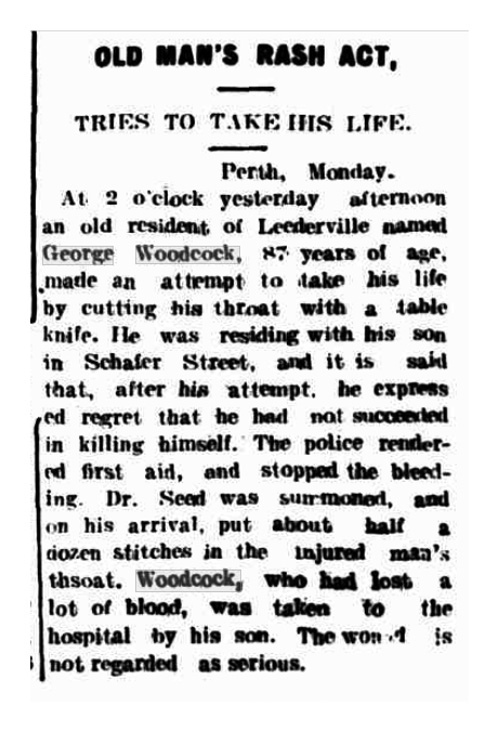
OLD MAN'S RASH ACT, TRIES TO TAKE HIS LIFE.
Perth. Monday.
At 2 o'clock yesterday afternoon an old resident of Leederville named George Woodcock, 87 years of age, made an attempt to take his life by cutting his throat with a table knife. He was residing with his son in Schafer Street, and it is said that, after his attempt, he expressed regret that he had not succeeded in killing himself. The police rendered first aid, and stopped the bleeding. Dr. Seed was summoned, and on his arrival, put about half a dozen stitches in the injured man's throat. Woodcock, who had lost a lot of blood, was taken to the hospital by his son. The wound is not regarded as serious.
[Source: Geraldton Express (WA), 3 May 1909 / trove.nla.gov.au/newspaper/article/210745132.]
The West Australian, 3 May 1909:
'ATTEMPTED SUICIDE AT LEEDERVILLE.
AN OCTOGENARIAN'S ACT.
At about 2 o'clock yesterday afternoon an old resident of Leederville named George Woodcock, 87 years of age, made an attempt on his life by cutting his throat with an old table-knife. He was residing with his son in Schafer-street, and it is said that after his attempt, he, expressed regret that:he had not suc ceeded in killing himself. The West Perth police rendered first aid and stopped the bleeding. Dr. Seed was summoned, and on his arrival put about half a-dozen stitches in the injured man's throat. Mr. Woodcock, who had lost a lot of blood, was then taken by his son to the Perth Public Hospital. The wound is not regarded as serious.
[Source: The West Australian, 3 May 1909 /trove.nla.gov.au/newspaper/article/26226993.]
George Woodcock died shortly afterwards, but whether it was after a further suicide attempt is not recorded:
18 may 1909 WOODCOCK. - fhT'Vrlcud3 of the late Mr. GEORGE WOODCOCK, sen., are respectfully Invited to follow his remains to the place of Interment, the Roman Catholic Cemetery, Karraknttu.
The Funeral is appointed to leave the residence of his son, Mr. Raymond Woodcock, 28- Troode-fitreot,- West Perth, at 2.43 \ o'clock TOMORROW (Wednesday) AFTERNOON, per road, Friends wishing to attend the funeral may proceed by the 3.30 train leaving Perth. ;- ?.
The West Australian, Thursday 20 May 1909, Family Notices:
20 May 1909.
The funeral of another very old colonist, in the person of the late Mr. George Woodcock, sen., took place yesterday afternoon, and was well attended. The deceased, who was born at Doncaster, England, had spent 61 years in the Australian States, 50 years of which were lived in Western Australia.
The cortege moved from the residence of his son, Mr. Raymond Woodcock, 28 Troode street, West Perth, and proceeded per road to the Roman Catholic Cemetery, Karrakatta, where the remains were interred, the Rev. Father O'Neill officiating at the grave side. The pall-bearers were Cr. W. Simpson, Messrs. J. Jones, M. McArdle, and J. J. Bennett. The chief mourners were Messrs. Omer [PB: Homer?], Raymond, and George Woodcock, sons; Mrs. R. L. Sampson, daughter; Misses Florrie and Rita Woodcock, grand-daughters; and Mr. R. L. Sampson, son-in-law.
A large number of wreaths and letters of sympathy were received. The funeral arrangements were carried out by Messrs. Bowra and O'Dea.
[Source: The West Australian, (Perth, WA: 1879 - 1954), Thursday 20 May 1909 / .]
[PB: Notice the anodyne "very old colonist". Where was he living in the other 11 years?]
The Daily News (Perth, WA: 1882 - 1950).
Mon 22 Mar 1920 Page 7 HAIR BY THE ROOTS.
HAIR BY THE MAN BUT MIGHT HAVE BEEN 'COMBINGS' WOMAN ACCUSES SISTER-~HM~.
LAW.
A BAD DOMESTIC MIX-UP.
In the Third City Court this morning, before Messrs. J. M. Lapsley and M. CDea, J'sJ?., Esther Ethel Samson was charged with having assaulted Martha Amelia Woodcock, at Leeder ville on the 13th inst Mrs. Samson, who pleaded 'not guilty,' was represented by Mr. Ackland, while Mr.
A. C. Braham appeared for the com plainant. * Mrs. Woodcock, sworn, stated that, on the 13th inst, in her home at Leed erville, her husband had brutally as saulted her, hitting her on the face, and dragging her along by the hair.
The quarrel eventuated from an ex pression used by witness to the defendant, Mrs. 'Samson, the sister of Mr.
Woodcock. Witness had called ' her 'an interfering old cat.' Woodcock, stated witness, had thereupon rushed at her (Mrs. Woodcock), upsetting a lamp on the floor, and seized her firmly by the hair. He then pushed her into an adjoining room with his arm under her throat, slowly strangling her. Witness, inspired by a sudden hope, had bitten him at this stage, thus regaining her liberty. Mr. Woodcock yelled 'She's bitten me,' attracting the attention of his sister, Mrs.
Samson, who rushed into the room shouting, 'You bit my brother; Til give you something to go on with.' Mrs. Samson then seized a handful of witness' hair, and tore it out by the roots. (The hair, found next morning on the scene of the assault, was pro duced in Court by the complainant, and examined by the rival solicitors.) Mrs. Samson had previously threaten ed witness. After seizing witness' hair, Mrs. Samson dealt her a blow on the left side of the face.
Mr. Ackland: You ask the Court to believe all this on your own testi mony, presumably, as 1 !iere was no one else present besides you, your husband, and your sister-in-law? Yes, of course I do; I am telling the truth.
What did she do to yon altogether? She hit me once.
Oh, but you said she pulled your hair out by the roots, didn't you? Yes, so she did, she had to do that to hit me.
Oh, I see, to get a good grip, is that it? Yes.
Well, on the contrary, did not Mrs Samson try to make peace between you and your husband? No, certainly not.
Complainant, on leaving the witness box, caused an unexpected commotion by swooning in a dead faint to the floor, where she lay at full length. Several minutes elapsed before she regained consciousness, with the aid of restoratives freely administered.
She was assisted out of the Court, and Mrs. Samson, the defendant, looking somewhat disconcerted, entered the witness-box, and refuted the story of the previous witness, stating that the quarrel between Mr. and Mrs. Woodcock, her brother and sister-in-law respectively, had commenced by the complainant telling her husband that she preferred another man, a Mr. Simonds, to him. Mrs. Woodcock had extended her face to her husband, asking him to 'give her a mark,' as she knew she had not sufficient grounds for separation otherwise. Witness had acted the part of peacemaker throughout the quarrel, and had never even touched Mrs. Woodcock.
Mf. Braham: What reason could Mrs. Woodcock have for coming into Court and telling these tales about you? Tin sure I don't know.
What did Mrs. Woodcock say to her husband? She persisted in saying she loved Mr. Braham better than him.
(Laughter in Court at witness's lapsus linguae.) .
Mr. Braham: I presume you mean Simonds? Yes.
George Woodcock substantiated his sister's statement that she had never at any time touched Mrs. Woodcock, and suggested that the hair (produced) was Mrs. Woodcock's 'combings.' .
Mr. Lapsley at this stage announced the Bench's decision to dismiss the case without costs.
CASE AGAINST HUSBAND.
The Bench then commenced the hearing of a case in which the complainant in the last case, Mrs. M. A.
Woodcock, claimed separation ' and maintenance from her husband, George Woodcock, on grounds of persistent cruelty. Woodcock, who pleaded not guilty to a charge of 'persistent cruelty to his lawful wife on March 13 and other dates,' was represented by Mr.
W- Dwyer. Mr. A. C. Braham con ducted proceedings for the complain ant.
Mr, Lapsley was of the opinion that the proceedings should be adjourned on account of the complainant's very shaky condition. The woman, how ever expressed a desire to continue the case, and was assisted into the wit ness-box. She recited a tale of persistent cruelty, her husband having, she alleged, once thrown a teapot of tea at her, on another occasion a burning lamp, and finally having blackened both her eyes and broken her glasses.
He had, she said, frequently threaten ed to shoot her, often punched her, and on several occasions locked her out of the house. During the last quarrel on March 13, she continued, he half strangled her, and blackened her eyes.
She had had six fainting fits since then. Previously to the occurrence she had never fainted in her life. She had always been afraid of her husband, in fact too afraid to leave him, as he threatened to shoot her if she did so.
She had known a man named Simonds for two years, but had never been in his company without his wife, except once in the daytime, and never at night Mr. Dwyer: Did you ever tell your husband you were going to live with Mr. Simonds, and that his name was too good to be in your husband's mouth? No, never. I have a dean conscience. Mrs. Samson once told me I'd better go and live with 'dirty old Simonds at Leederville.' The case was adjourned until Wednesday, 24th inst ?.
23 Mar 1920.
A Case Dismissed.- Ester Ethel Sampson was charged with having on March 13, unlawfully assaulted Martha Amelia Woodcock. Mr W.
H. Ackland appeared for the defendant and entered a plea of not guilty. Mr. A. C.
Braham appeared for the complainant. The case was dismissed without costs.
Separation and Maintenance.- Martha Amelia Woodcock applied for a judicial separation from her husband, George Woodcock, on the [?] entered a plea of not guilty. Mr. A. '.
Braham appeared for the complainant and Mr. W. Dwyer for the defendant. The case was part heard and adjourned to 2.15 p.m. on Wednesday March 25.
http://trove.nla.gov.au/newspaper/article/27678228.
23 March 1920 Martha Amelia Woodcock, at Leederville, on the 13th inst. Mrs. Samson, who pleaded 'not guilty,' was represented by Mr. Ackland, while Mr. A. C. Braham appeared for the complainant.
Mrs. Woodcock, sworn, stated that, on the 13th inst., in her home at Leederville; her husband had brutally assaulted her, hitting her on the face, and dragging her along by the hair.
The quarrel eventuated from an expression used by witness to the defendant, Mrs. Samson, the sister of Mr. Woodcock. Witness had called her 'an interfering old cat' Woodcock, stated witness, had thereupon rushed at her (Mrs. Woodcock), upsetting a lamp on the floor, and seized her firmly by the hair. He then pushed her into an adjoining room with his arm under her throat, slowly strangling her. Witness, inspired by a sudden hope, had bitten him at this stage, thus regaining her liberty. Mr. Woodcock yelled 'She's bitten me,' attracting the attention of his sister, Mrs Samson, who rushed into the room shouting, 'You bit my brother; I'll give you something to go on with.' Mrs. Samson then seized a handful of witness' hair, and tore it out by the roots. (The hair, found next morning on the scene of the assault, was produced in Court by the. complainant, and examined by the rival solicitors.) Mrs. Samson had previously threaten ed witness. After seizing witness' hair, Mrs. Samson dealt her a blow on the left side of the face.
Mr. Ackland: You ask the Court to believe all this on your own testimony, presumably, as there was no one else present besides you, your husband; and your sister-in-law? - Yes, of course I do; I am telling the truth.
What did she do to you altogether? - She hit me once.
1 .-?' Oh, but you said she pulled your hair out by the roots, didn't you? - Yes, so she did, she had to do that to bit me. .'-,'.
Oh. I see, to get a good grip, is that it? - Yes. . ????'?'?'.? Well, on the contrary, did not Mrs Samson try to make peace between you and your husband? - No, certainly not.
Complainant, on leaving the witness box, caused an unexpected commotion by swooning In a dead faint to the floor, where she lay at full length.
Several minutes elapsed before she regained consciousness, with the aid of restoratives freely administered.
She was assisted out of the Court, and Mrs. Samson, the defendant, looking somewhat disconcerted, entered the witness-box, and refuted the story of the previous witness, stating that the quarrel between Mr. and Mrs. Woodcock, her brother and sister-in-law respectively, had commenced by the complainant telling her husband that she preferred another man, a Mr. Simonds, to him. Mrs. Woodcock had extended her face to her husband, asking him to 'give her a mark,' as she knew she had. not sufficient grounds for separation otherwise. Witness had acted the part of peacemaker throughout the quarrel, and had never even touched Mrs. Woodcock.
Mr. Braham: What reason could Mrs'. Woodcock have for coming into' Court -and telling these tales about you? - I'm sure I don't know.
? What' did Mrs. Woodcock say to her husband? - She persisted in saying she loved Mr. Braham better than him.
(Laughter In Court at witness' lapsus linguae.) . ' ?? .
Mr. Braham: I presume you mean Simonds ? - Yes.
George Woodcock substantiated .his.
sisters statement that she had never at any time touched Mrs. Woodcock, and suggested that the hair (produced) was Mrs. Woodcock's 'combings.' ?Mr. Lapsley at this stage announced the Bench's decision to- dismiss the case, without costs.
CASE AGAINST HUSBAND.
The Bench then- commenced the hearing of a case 'in which the complainant in the last case, Mrs. M. A.
Woodcock, claimed separation arid maintenance from her husband, George Woodcock, on grounds of persistent cruelty. Woodcock, who pleaded not guilty to a charge of 'persistent cruelty to his lawful wife on March 13 and other . dates.' was represented by Mr
W Dwyer: Mr. A. C. Braham con ducted proceedings for the complain ant.
' Mr. Lapsley was of the opinion that the proceedings should be adjourned on account of the complainant's very shaky condition. The ? woman, how ever expressed a desire to continue the case, and was assisted into the wit ness-box. She recited a tale of persistent cruelty, her husband having, she alleged, once thrown a teapot of tea at her, on another occasion a burning lamp, and finally having blackened both her eyes and broken her glasses.
He had, she said, frequently threaten ed to shoot her, often punched' her, and on several occasions locked her out of though house. During the last quarrel, on March 13, she continued, he half strangled her, and blackened her eyes.
She had had 'six fainting fits since then. Previously to the occurrence she had never fainted in her life. She had always been afraid of her husband, in fact too afraid to leave him, as he threatened to shoot her if she did so.
She had known a man named Simonds for two years, but had never been in his company without his wife, except once in the daytime and never at night.
. Mr. Dwyer: Did you ever toll your husband you were going to live with Mr. Simonds, and that his name was too good to be in your husband's mouth? - No, never. I have a clean conscience. Mrs. Samson once told me I'd better go and live with 'dirty old Simonds at Leederville.' The case was adjourned until Wednesday. 2-lth inst.
[Source: trove.nla.gov.au/newspaper/article/79581850.]
George Woodcock's son, also called George.
'ONLY A LOVE TAP'
BUT WIFE'S EYES BLACKENED
ANOTHER SEPARATION AND MAINTENANCE CASE
The case in which Martha Amelia Woodcock applied for separation and maintenance from George Woodcock on grounds of persistent cruelty commenced in the City Court on Monday was continued in the Justices' Court this morning before Messrs. .7. M. Lapsley and M. O'Dea, .T.'sP. The defendant was represent ed by Mr. Walter Dwyer, and Mr. A.C. Braham conducted proceedings for the complainant.
J. C. Simonds, a married man, sworn, stated that on the 14th inst he saw Mrs. Woodcock, and observed that her left eye resembled a large blue-black jelly. Her other eye was also black, and her nose was scarred. He had seen her with prominent injuries on several previous occasions. Witness indignantly and emphatically denied the suggestion that his relations with Sirs-. Woodcock had at any time been of an improper character.
Mr. Dwyer (to witness): Did Woodcock go and see you in regard to his wife? - Yes.
On that occasion did you slam the door in his face? - Certainly not.
Did you know he objected to your relations with his wife? - No, I did not.
When he saw me he asked me to prevent his wife coming to ray hoiise. I referred the matter to my wife, as Mrs. Woodcock was her friend, and she stated that Mrs. Woodcock was at liberty to continue coming to though house as she knew nothing against her.
Christine Annie White, sister of complainant stated that she saw scars on her sister several times. On one occasion, about five years ago, witness had seen the defendant clutch his wife by the hair and fling her the en tire length of the 'kitchen. 'Last Wednesday, evening,' concluded witness, 'Mr. Woodcock told me and my brother that if the case went against him he would shoot his wife first, and then himself.'
Phillip Alfred White, In evidence, stated that he had advised his daughter, Mrs. Woodcock, to take action against her husband when he (witness) saw her terrible state on the morning of the 14th. On that occasion she fainted in his arms during the recital of her woes.
Mr. Dwyer, addressing the Bench, remarked that there was no corroborative evidence of persistent cruelty.
The wife of though defendant was the only person' who did, or could, s'ale that her injuries were received aa a result of her husband's; action.
Mrs. Woodcock did not leave the house on account of her husband's cruelty,' said Mr. Dwyer, 'but on account of the advice given her by her father.' ? The defendant, George Woodcock, denied all of Mrs. Woodcock's allegations, and remarked that his wife was in the habit of saying 'Tin going to ??live with the old pot,' meaning Simonds. Witness had never struck, beaten, or ill-treated his' wife in any way, until the 13th inst, when he merely gave her a 'little love tap with his: open hand.' - He suggested that any. scars she might at any time have had, were caused by friction between her and her mother or sister.
Joseph Bennett, sworn, stated that he had known the defendant for 14 years. Mrs. Woodcock had visited his house on the night of the 13th inst, but he had not noticed any scars on her.
Mr. Braham (to witness): You are pretty friendly with the -defendant? - Yes.
And willing to do your best for him in Court? - No, nothing which is not the truth.
- Do you think it is the proper thing for a man to beat his wife? You think it is beneficial to chastise her occasionally, do you? - I can't see what that's got to do with the case.
No, I suppose not Yoa beat your own wife occasionally, eh ? - I won't answer that question.
Esther Ethel Samson reiterated evidence given in the hearing of the case on Monday.
Mr. Braham (to witness): Dia you see the blow your brother struck at his wife on the ;L3th? - No, , the' light seemed to have gono out.
Oh, nonsense, the light did not go out till after the blow was struck. You know that. - I can assure you I'm tell ing. the truth. I'd much rather not be in though case at all.
Yes, naturally, and I suppose you would much rather you had not been, at your brother's house on the 13th - but you were there all the same. Did you see the blood on your sister in law? - No, she was on the floor, I did not look at her.
Oh, I see, you wouldn't even deign to look at her.
Mr. Braham, addressing the Bench, remarked that in all his experience he had never seen a case with stronger evidence of persistent cruelty. None of the defendant's statements, in his opinion, could be relied upon. His suggestion that he gave his wife two black eyes by a gentle love tap was manifestly absurd.
Mr. Lapsley announced the decision of the Bench to grant the separation, and ordered Woodcock to pay 22s 6d per week maintenance, with £3 10s costs.
[Source: trove.nla.gov.au/newspaper/article/79574368.]
The Daily News, 26 December 1913:
EARLY DAY ITEMS
From 'THE DAILY NEWS' of 1885 (DECEMBER 26)
CHRISTMAS IN PERTH 28 YEARS AGO.
The "Christmas Supplement" at the police court was a long one this morning, but his Worship was very lenient in the majority of cases. Six persons were cautioned, and two fined 5s. each for drunkenness. Three men pleaded guilty to the heinous offence of sleeping in the open air, and were dismissed, Mr. Leake evidently thinking that the oppressive state of the weather afforded them some excuse for turning temporary vagrants.
George Woodcock was charged with being illegally on the premises of a gardener named William Wise. In his defence Woodcock alleged that he had merely called upon Wise to ask him to purchase two cords of wood. Mr. Leake was of opinion that Woodcock should have called at a more suitable hour for busi ness, and sent him to gaol for three months.
[Source: trove.nla.gov.au/newspaper/article/80095539.]
The West Australian, (Perth, WA: 1879 - 1954) Monday 15 September 1952 p 28 Family Notices.
WOODCOCK: On Sept. 14, 1952, at Perth, George Woodcock, loved brother of Raymond Edward and Ethel Esther (Mrs. Sampson); aged 74 years.
R.I.P.
WOODCOCK (George): Passed away R.P.H., Sept. 14. dearly beloved brother of Ethel (Mrs. R. S. Sampson).
R.I.P.
WOODCOCK (George): Loved uncle of Rita (Mrs. Goodman, Melbourne), Irene (Mrs. Fits gerald. South Fremantle).
Stanley (S A.) and Leonard (Fremantle).
Requiescat in pace.
WOODCOCK (George): Loved uncle of George and Nettie, great-uncle of George. Stanley and Peter.
Ever remembered.
16 September 1952.
WOODCOCK: The Funeral of the late Mr. George Woodcock, of 213 James-st., Perth, formerly of the Perth City Council, is appointed to leave our Chapel, 664 Newcastle-st., Leederville, at 1.40 p.m. TODAY. arriving at the Roman Catholic Cemetery.
Karrakatta, at 2 p.m. A. J. PURSLOWE AND CO.
The West Australian, (Perth, WA: 1879 - 1954) Tuesday 16 September 1952 p 16 Family Notices.