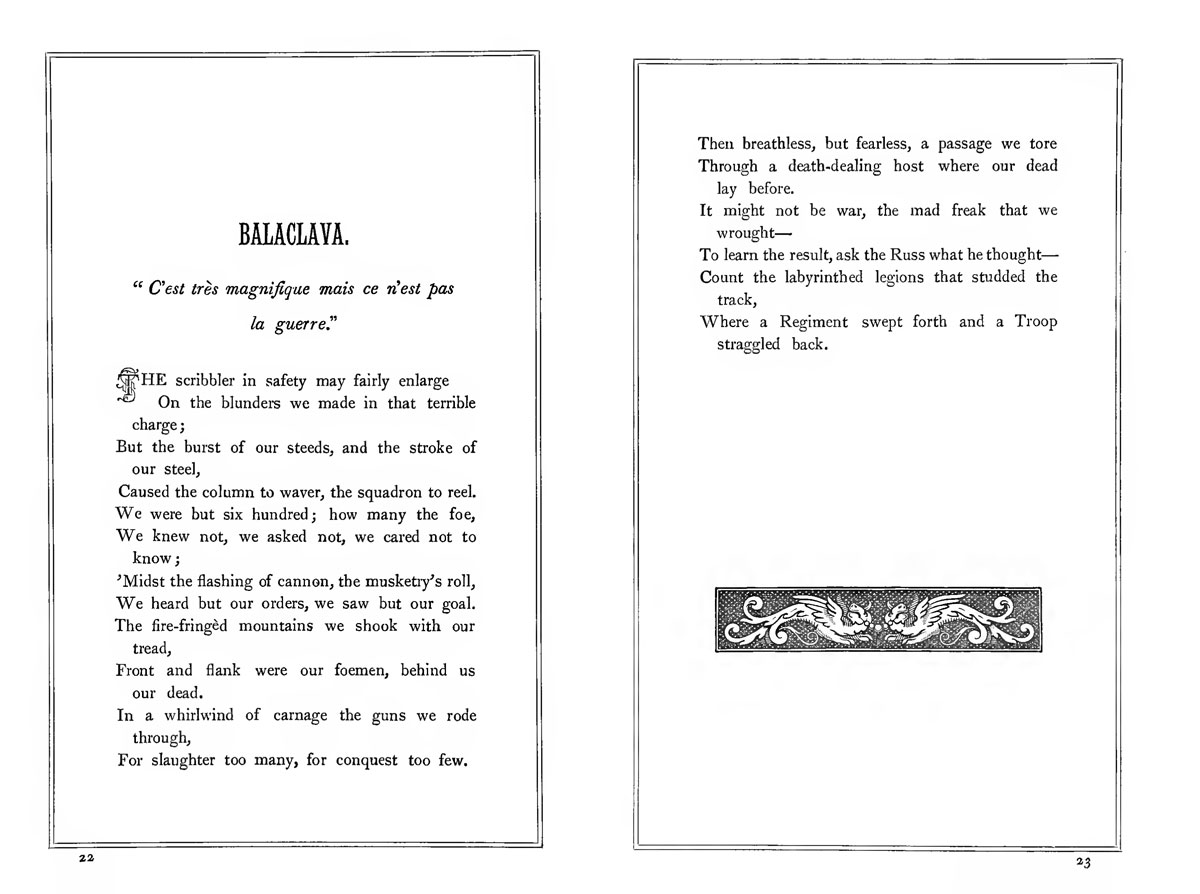
The scribbler in safety may fairly enlarge
On the blunders we made in that terrible
charge;
But the bursts of our steeds, and the stroke of
our steel
Caused the columns to waver, the squadrons to reel.
We were but six hundred; how many the foe,
We knew not, we asked not, we cared not to
know,
'Midst the flashing of cannon, the musketry's-roll,
We heard but our orders, we saw but our goal.
The fire-fringed mountains we shook with our
tread,
Front and flank were our foemen, behind us
our dead.
In a whirlwind of carnage, the guns we rode
through,
For slaughter too many, for conquest too few.
Then breathless, but fearless, a passage we tore
Through a death-dealing host where our dead
lay before.
It might not be war, the mad freak that we
wrought --
To learn the result, ask the Russ what he thought --
Count the labyrinthed legions that studded the
track,
Where a Regiment swept forth, and a Troop
straggled back.
From Richard Chandler, Rhymes for the Ranks (Soldiers' Songs & Sonnets), London, 1875. (Available online in various formats at https://archive.org/details/cu31924013461912 (accessed 25.5.2016).
[PB: The poem was recited at the Balaklava Anniversary Festival at the Alexandra Palace, 25 October, 1875. The following is taken from Douglas Austin's transcriptions from the Daily Telegraph (and possibly the ILN), which he published in 2004.]
Mrs. STIRLING, who was loudly cheered, said:
I am an actress, as perhaps some few of you may know - (laughter) - and I am much more used to speak in public the words of others than my own; but I feel that I should like, in my poor way, to say to you how proud I feel to find myself in the presence of so many brave men. (Cheers) Courage and bravery are qualities especially dear to us poor cowardly women (laughter) - and I feel my heart throb at this moment when I think of the impression which your gallantry and bravery mast have made on all our hearts.
I know at home it filled us with admiration - with pity - (cheers) - and with wonder, which have never decreased for twenty-one years, when, perhaps, some of you parted on that very field only to meet here again on this day - a day that will be for ever remembered in England as one on which was performed one of the greatest and brightest deeds in the annals of English history. (Great cheering.)
You know, gentlemen, what one of our distinguished allies said of this memorable charge, "C'est magnifique, mais ce n'est pas la guerre." On that text, I propose to recite to you two or three lines:
The scribbler in safety may fairly enlarge
On the blunders we made in that terrible charge;
But the bursts of our steeds and the stroke of our steel
Caused the columns to waver, the squadrons to reel:
(Cheers)
We were but six hundred; how many the foe, I
We knew not, we cared not, we asked not to know, (Cheers)
"Midst the flashing of cannon, the musketry's-roll.
We heard but our orders, we saw but our goal:
The fire-fringed mountains we shook with our tread
Front and flank were our foemen, behind us our dead;
'Midst a whirlwind of carnage the guns we rode through,
For slaughter too many, for conquest too few.
Then breathless, but fearless, a passage we tore
Through a death-dealing host where our dead lay before.
It might not be war, the mad freak that we wrought,
To learn the result, ask the Russ what he thought,
Count the labyrinth'd legions that studded the track
Where a regiment swept forth, and a troop straggled back.
(Loud and continued cheering.)
The CHAIRMAN:
After the eloquent address of Sir Edward Lee and the heart-stirring recitation of Mrs Stirling we must all get on our legs - I mean the survivors (Cheers) The men all stood whilst the toast was responded to.
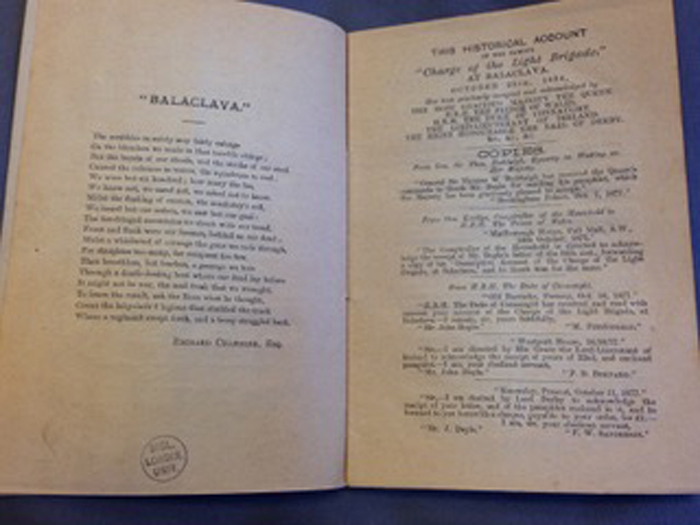
[PB: At least one of the editions of John Doyle's memoir A Descriptive Account..., (e.g. the one published in Leeds [date?], a copy of which is available in the Senate House, London) includes Chandler's poem.]
| New on the site | Search | Poetry and the Charge |