Added 8.2.2016.
IN PROGRESS - NOT FOR PUBLICATION
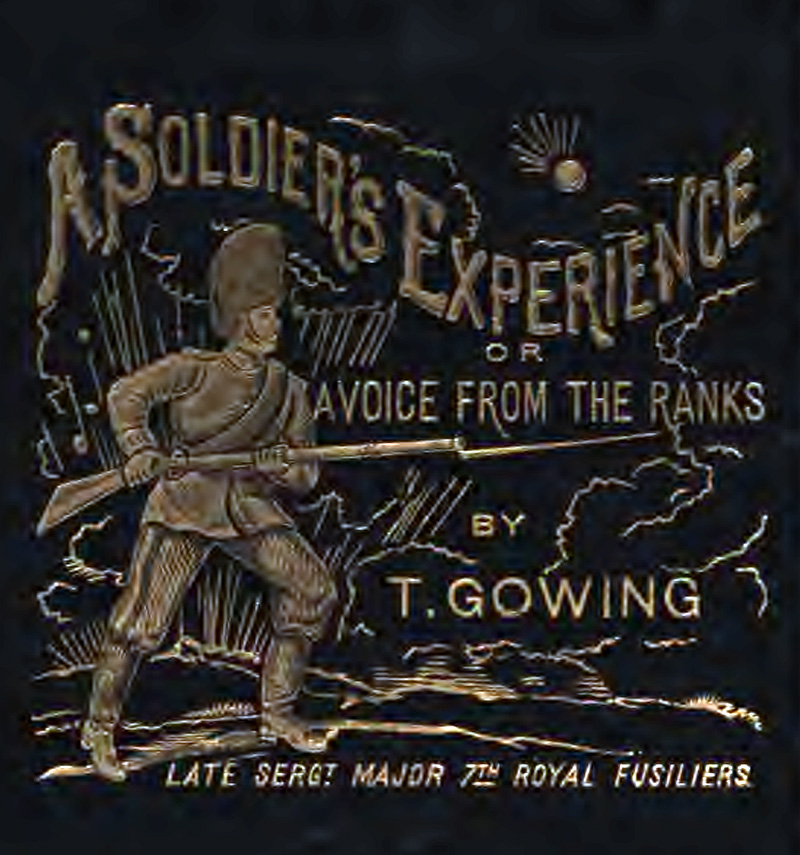
I have seen majestic nature in grandeur displayed,
With the hills and the valleys which the ocean hath made;
I've seen the eagle and vulture with pinions extended,
And battles so well fought that no hero could mend it.
I saw the Light Division leading the van
With their Allies, who also would die to a man
Before they would yield to an Autocrat's rule,
Or turn back on their march to Sebastopol.
I saw the Heights of Alma, on the 20th September,
There the maiden British army first faced the foe,
There the Russian bear, with all his ugly cubs,
Was taught to use his heels as fast as he could go.
I saw Inkermann's Heights, on that memorable foggy morn,
A name now respected by Britons not then born;
The odds were seven to one, but no desponding cry —
Remember the Heights of Alma, boys, we conquer or we die!
I've seen Inkermann's Heights and its Valleys of snow,
Where many a brave soldier a rooting did go,
In search of some fuel his breakfast to cook,
With a pick on his shoulder, and axe or bill-hook.
I've seen the Mamelon and the Malakoff tower,
When the grape shot and shell on our trenches did pour.
While Mars sat in triumph to test our renown,
And meet us with laurels as we stormed the great town.
I've seen the Quarantine Battery, Fort Paul, and the docks;
With the Bear and the Eagle contending for rocks,
And vultures in numbers near the Worrensoff road,
That once was the highway to the Russian's abode.
I've seen sorties and struggles by the Russians, 'tis true,
But their banners were stained by the Red, White and Blue,
We sent them some pills their system to cool,
Which worked them in thousands from Sebastopol. [248]
I've seen Lord Raglan, Pélissier, and their brilliant staff,
While the band of the 7th played "Larry O'Gaff;"
I've seen Lord Brown in the trenches, for war he was ripe,
Dressed as plain as a ploughman, with a little short pipe.
I've seen the great English battery upon the green hill,
Work with deadly precision the Russians to kill;
With terrific grandeur the balls they did fly,
Illuminating the heavens like stars in the sky.
I've seen Arabs, Frenchmen, and Bashi-Bazouks,
Russians made prisoners, and sad were their looks;
Their pitiful tales I've heard them unfold
Of the hardships they suffered from hunger and cold.
I've seen General Codrington on his charger so grey,
Riding out on the bills at the dawning of day,
With an eye like an eagle and a heart like a lion,
Inspecting the trenches where soldiers were dying.
On June the 7th I saw the Allies in action,
Their heroic deeds were the source of attraction;
They fought and fought bravely, their cause to maintain,
They took the great Mamelon, but thousands were slain.
On that 7th day of June I saw the English too.
Not far from their Allies, combat with the foe;
Their deeds were praiseworthy, they never did flinch,
They took the great Quarries and the Circular Trench.
On the 18th of June I saw that disastrous fight,
Led on by young Waller, Fitzclarence, and Wright;
When our Colonel got shot, the brave daring Yea,
And many were the victims of that bloody affray.
I've seen Kazatch Bay and the great combined fleet,
Where the French and the English each other did greet;
They mixed and they mingled, the ships and ship's crew,
The Blue, White, and Red, and the Red, White, and Blue.
I've seen those interesting and gay Vivandiers
March with their soldiers with smiles and with cheers;
I've seen them on horseback astride like a man,
To describe their attractions is more than I can.
I've seen the explosion of a French magazine,
With great loss to the Emperor and our lady the Queen;
It knocked down our huts and our tents it turned o'er,
And numbers of men were never seen more. [249]
Our troops were alarmed as the explosion it spread,
And for self-preservation from the camp they fled;
But Young Hope was active, and his part he played well,
As the missiles were flying, the round shot and shell.
Near the scene of excitement, on the top of the hill,
Stood the great magazine which they call the Windmill;
Had it once taken fire our loss had been great,
And Britain would have mourned her army's sad fate.
I've seen the brave Turner and his friend Major Peck,
Who sailed from old England to make an attack;
Though Boreas did buffet our weather-beaten screw,
She skipped o'er the billows with her Crimean-bound crew.
I've seen Monsieur Français, his eyes beaming with pride,
Take our young lads on the spree to drink his cognac;
I've seen the triangles to which men were fast tied.
While the drummers served fifty upon their bare back.
I've seen Balaclava, a magnificent sight,
With its cloud-covered castle high up on the right,
Once embellished by art, and built on the great rock,
A shelter for shipping and Nature's wild flock.
I've seen Balaclava by night and by day,
With its lofty rough mountains and foaming black sea —
The billows embracing the proud bosomed rock,
Where the porpoises sport and the seagulls do flock.
I've seen Balaclava all covered with snow,
On a cold winter's night when on sentry I'd go;
The scene it was lovely, the stars glittered bright,
Fair Luna was shining, Nature's mantle was white.
I saw the Valley of Death, where thousands lay low,
Not half of whom ever fell by the hands of the foe;
The causes are many, as well known to the State,
But I might give offence if the truth I relate.
I saw the Valley of Death, and going to the trenches,
I looked on the graves and thought of the wenches[14]
In silence lamenting some dear friend or brother,
I thought of the orphan and the heart-broken mother. [250]
I've seen the Valley of Death, the cross and the tomb,
O'er the graves of those heroes — oh, sad was their doom;
Where the wild dogs are prowling — what a horrible sight!
Where the carrion-crows gather, and owls screech by night.
I've seen the Valley of Death — but here I will not dwell,
It would take me too long my sad story to tell;
'Tis like some pandemonium — cursed region below —
Sometimes hot like a furnace, then covered with snow.
I've seen Colonel Wellesley, who had lately come here,
A man much respected by each bold Fusilier;
His discipline was gentle, his mind was serene,
A friend to the 7th, his country, and Queen.
I've heard that our Colonel will open a school,
To teach art and science near Sebastopol;
The soldiers to cipher, to write, and to read,
Then march to the north side the Russians to bleed.
The arts and the sciences, what wonderful things,
They open up coal-beds and artesian springs;
We are going to Cronstadt in scientific tubs,
To take the old bear and all his young cubs.
I've seen one rare thing — the right man in his right place,
One Sergeant Silvester, who has charge of the peace;
He is cock of the walk, and a gander 'mong geese;
He keeps down bad morals with his rural police.
The brave sons of Britain, they never did flinch
From the bullet-swept plains, or the cold bloody trench;
They have planted their standard — who dares pull it down?
In conjunction with France, in Sebastopol town.
And now, to conclude my short but truthful tale,
I've seen those kind sisters, and the famed Nightingale,
Attending the wounded on beds that were gory,
And this is the end of my Crimean story.
http://www.gutenberg.org/files/46989/46989-h/46989-h.htm#CHAPTER_II p.?
Is this the same version? http://gutenberg.polytechnic.edu.na/4/6/9/8/46989/46989-h/46989-h.htm (accessed 13.8.17)
PB: I chanced upon the following article, which starts with two verses of 'What have you seen in the Crimea?'. Its source was unknown to the author. The first verse is the same as Gowing and Crawford's, but they do not include the second verse, about Captain Martin:
The most soldier-like gentleman I ever did see,
Attached to the Seventh, upon the Crimea,
Is one Captain Martin, the pride of Yorkshire;
He crossed the Redan when the town was on fire!
Did G&C compose the poem? Is their's the only version, or was it shared "customised" among men in other regiments? Is it based on a prior song or poem pattern? Did Gowing omit this verse in his published version (for example, did he simply forget it?)) Like Martin/Marten G&C were in the 7th Royal Fusiliers, so the poem could still be theirs.
The Civic Presentation of a Ceremonial Sword to Captain Thomas Wright Marten
Marcia Gadd
Bradford Historical & Antiquarian Society, 2003
The brave sons of Britain, they never did flinch
From the scorching high hills or the cold flooded trench.
They have planted their standard - who dare pull it down? -
in conjunction with France in Sebastopol Town.
The most soldier-like gentleman I ever did see,
Attached to the Seventh, upon the Crimea,
Is one Captain Martin, the pride of Yorkshire;
He crossed the Redan when the town was on fire!
(Extract from 'What have you seen in the Crimea?' source unknown)
Captain (later Colonel) Thomas Marten of the 7th Royal Fusiliers was presented with an inscribed, jewelled ceremonial sword by thee town and people of Bradford at the St George's Hall on 23rd July 1856. This was to commemorate his bravery in the storming of the Redan at the siege of Sebastopol in June 1855 during the Crimean War. After all the Regiment's officers had been killed or wounded, he succeeded to the command of the regiment (aged 28), led it across the ramparts of the Redan and subsequently took it out of action. He afterwards bore a part in the duties of the trenches till the day Sebastopol fell.
On the evening of 23rd July 1856 more than seventy gentlemen sat down to a sumptuous banquet in the St George's Hall. The Mayor, William Murgatroyd presided. Some of those present were Mr R. Milligan, Mr William Garnett, Mr George Salt, Mr J.V. Godwin and Mr Delius (father of the composer, Frederick). A large number of elegantly dressed ladies were present after the dinner. The Bramley Brass Band played a variety of music during the dinner and afterwards. An eight course dinner was served which included turtle soup, haunch of venison, saddle of lamb, chicken with truffles, strawberry soufflé and ices. Several speeches were given, including one by Capt. Marten's uncle, General Marten, who had fought at Waterloo.
Capt. Marten had served five-and-a-half years in the Ceylon Rifles before transferring to the 7th Fusiliers. He received the Crimean Medal with clasp (for Sebastopol) and the Turkish Crimean Medal. He also served in the Indian North West Frontier War of 1863 for which he was awarded the Umbeyla Campaign Medal with clasp. After retiring from the army he farmed in Canada. He was the son of William Marten who was well known in Bradford's wool trade. The family lived at Undercliffe House (now demolished) and subsequently at Summerhill, Apperley Bridge. He died at Tottenham on 18th January 1893.
The inscription on the sword reads:
Sword presented to Capt. Marten
Presented to Captain Thomas Wright Marten, 7th Royal Fusiliers, by his Friends and fellow Townsmen, as a mark of their admiration for his dauntless bravery and good conduct during the siege of Sebastopol and in the final assault upon the Great Redan
Capt. Marten had two sons who also had distinguished careers. William Henry Russell Elliot Marten was private secretary and ADC to the Governor of British Honduras. Major Ellison Thomas Charles Newton Marten served in the 43rd Light Infantry, the Madras Light Cavalry and later served as an officer in the Egyptian Police Force.
Hilt of sword presented to Capt. Marten
The sword is now in the possession of Capt. Marten's great grandson who lives in Ealing, London.
A full account of the Presentation is to be found in the Bradford Observer for 24th July 1856.
Marcia Gadd is the great, great niece of Capt. Marten.
© 2003, Marcia Gadd and The Bradford Antiquary
[Source: First published in 2003 in volume 8, pp. 4-5, of the third series of The Bradford Antiquary, the journal of the Bradford Historical and Antiquarian Society. http://www.bradfordhistorical.org.uk/sword.html]