TO THE EDITOR OF THE TIMES.
Sir, With the exception of Eton and the Military Colleges, probably no school has sent so many brave officers into the Eastern Army as Rugby, and I send you a list of those who have obtained medals and clasps for their services in the Crimea.
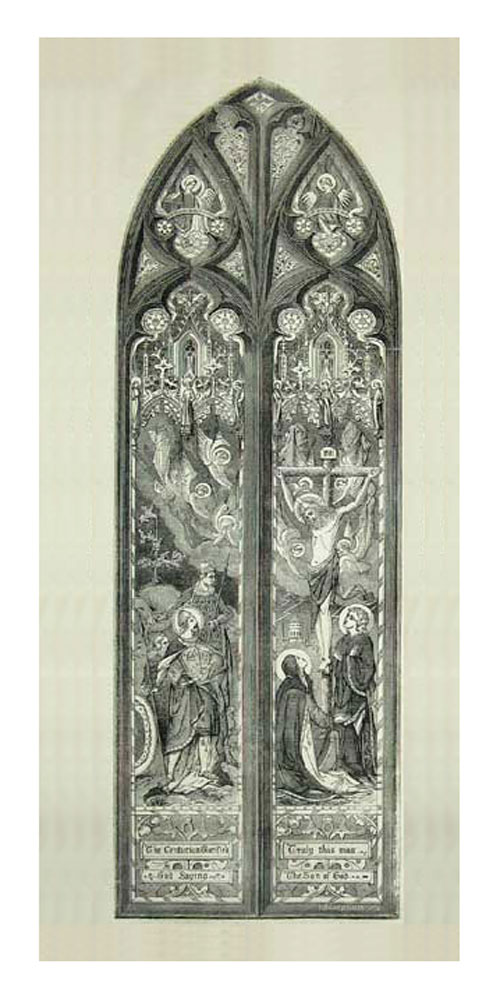
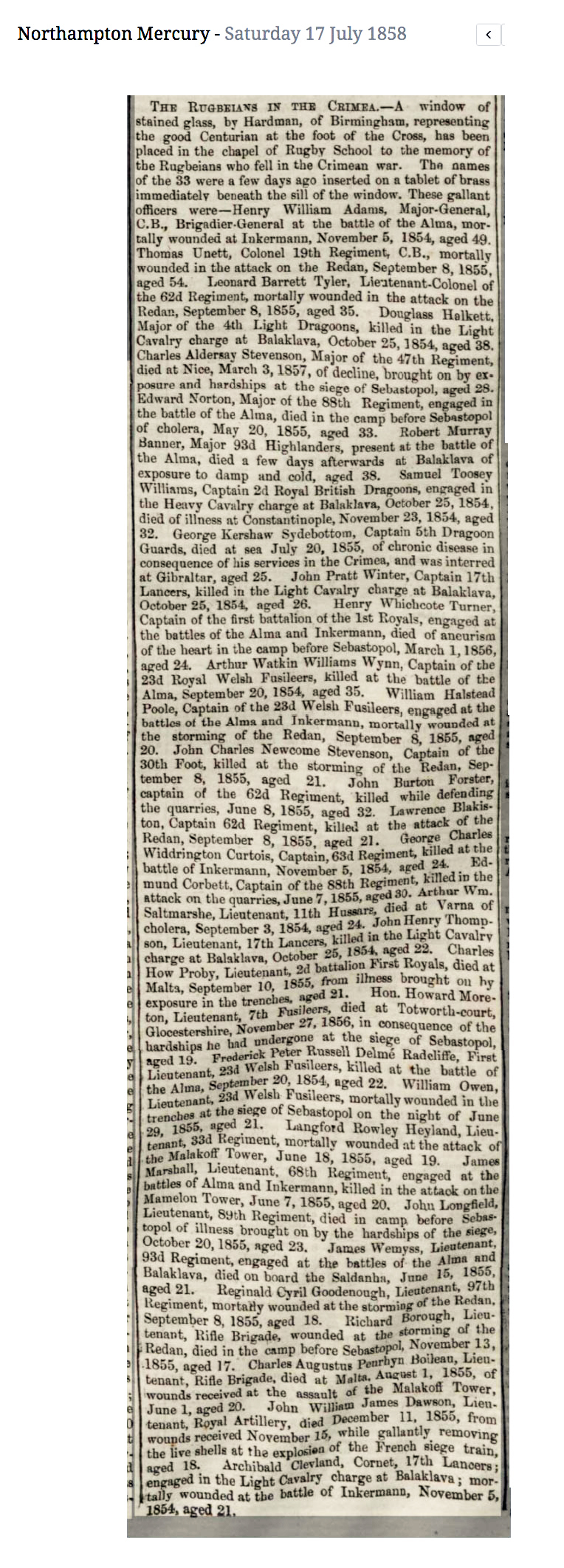
A window of painted glass is to be placed in the School Chapel to the memory of the 26 gallant Rugbeians who have fallen in action, or who have died from illness brought on by the hardships of the campaign:
H W. Adams, C.E., Major-General; the Alma, Sebastopol; died of wounds received at Inkernann.
Sir William Eyre, KC.B., Lieutenant-General Commanding 3d Division of Eastern Army; the Alma, Inkermann, wounded in the attack on the Redan, June 18.
Hon. Shirley, C.B., Brigadier-General, Lieutenant-Colonel 85th Foot; the Alma, Inkermann, Sebastopol attack on the Quarries, June 7.
J. Gunter, Cornet 1st Dragoon Guards; Crimean campaign, 1855.
R. Gunter, Captain 4th Royal Irish. Dragoon Guards; Crimean campaign, 1854.
W. T. Prentice, Captain 2d (Royal North British) Dragoons; Crimean. campaign, 1854.
L S. T. Williams, Captain 2d Royal North British Dragoons; Heavy Cavalry charge at Balaklava; died shortly afterwards at Constantinople.
R. R. Glynn, Lieutenant 8th (Royal Irish) Dragoons now Captain Rifle Brigade; the Alma, Light Cavalry charge at Balaklava, Inkermann, siege of Sebastopol.
E. Tompkinson, Captain 8th (Royal Irish) Dragoons; the Alma, Light Cavalry charge at Balaklava, Inkermann, Sebastopol.
G. C Clowes, Lieutenant 8th (Royal Irish) Dragoons; the Alma, Balaklava, where he was wounded and taken prisoner.
G. I. Goad, Lieutenant l3th Light Dragoons; the Alma, Balalaklava.
J. P. Winter, Captain 17th Lancers; the Alma; killed in action at Balaklava.
J. H. Thomson, Lieutenant 17th Lancers; Alma; killed in action at Balaklava.
A. Clevland, Cornet 17th Lancers; the Alma, Balkalava; died of wounds received at Inkermann.
H. H. Barber, Captain 17th Lancers; Crimean campaign 1855.
Sir James Fergusson, Bart., M.P., Captain Grenadier Guards; Alma, Sebastopol, wounded at Inkerman.
Hon. P. R. B. Feilding, Lieutenant-Colonel, Coldstream Guards; the Alma, Sebastopol; severely wounded at Inkermann.
R. H. Lord Bingham, Major, Coldstream Guards, aide-de-camp to Lord Lucan; at the Alma, Balaklava, and Inkernann.
Hon. W. C. W. Coke, Captain Scots Fusileer Guards; siege of Sebastopol; wounded in the trenches August, 1855.
H. W. Turner, Captain lst Royals; the Alma, Inkermann, siege of Sebastopol; died at Sebastopol.
T. J. Gregory, Captain 1st Royals; siege of Sebastopol, attack on the Malakhoff Tower, 1855.
C. Hurt, Captain lst Royals; the Alma, Inkermann, siege of Sebastopol.
C. H. Proby, Lieutenant, 1st Royals; siege of Sebastopol; died at Malta 1855.
F. W. Gore, Captain 3d Regiment; siege of Sebastopol, 1S55.
L. Sidebotham, Captain 3d Buffs; siege of Sebastopol, 1855.
M. H Dowbiggin, Major 4th Regiment; siege of Sebastopol, 1S54-5.
E. H Rose, Major 7th Regiment; the Alma, Sebastopol; severely wounded at lnkermann.
J. D. Bradley, Lieutenant 14th Regiment; siege of Sebastopol, 1855.
Thomas Unett, C.B., Colonel, Lieutenant-Colonel, 19th Regiment; the Alma, Inkermann; died of wounds received at the storming of Sebastopol September.
S. M. Molesworth, Lieutenant 19th Regiment; siege of Sebastopol; severely wounded at the storming September 8.
W J Legh, Captain 23d Regiment; Balaklava, Sebastopol, Inkerermann.
A. W. W. Wynne, Captain 23d Ryal Welsh Fusileers killed at Alma.
F. P. R. D. Radcliffe, Lieutenant 23d Regiment; killed at the Alma.
W. H. Pool, Captain 23d Regiment, the Alma and Inkermann; died of wounds received at the storming of Sebastopol, September S. [8?]
William Owen, Lieutenant 23d Regiment; died of wounds received in the trenches at Sebastopol, June 29, 1855.
H. D. Torrens, Captain 23d Regiment; the Alma, Sebastopol, wounded at Inkermann.
J. Duff, Captain 23d Regiment; siege of Sebastopol; taken prisoner at lnkermann.
F. D Hall Dare, Lieutenant 23d Regiment siege of Sebastopol, severely wounded at the storming, September 8.
F. Adams, C.B., Lieutenant-Colonel 28th Regiment: the Alma, Inkerman, siege of Sebastopol, attack on the Redan, June 8.
E. G. Hallewell, Lieutenant-Colonel, formerly Major 28th Regiment; the Alma, Balaklava, Inkerman, June 18.
R. H. Lindsell, Major 28th Reg at; Alma, Inkermann, siege of Sebastopol.
W. H. Robertson, Captain 50th Regiment; siege of Sebastopol.
G. Bayley, Lieutenant 31st Regiment Siege of Sebastopol.
J. R. Carr, Captain S3d Regiment; Alma, Inkermann, Sebastopol.
J. J. Greenwood, Lieutenant 33d Regiment; severely wounded at the Alma.
L. R. Heyland, Lieutenant 33d Regiment; died of wounds received at the Malakoff Tower, June 18.
A. Brooksbank, Captain 33rd Regiment; Sebastopol, attack on Malakhoff Tower, June 18.
C. Miligan, Captain 39th Regiment; siege of Sebastopol.
R. E. Carr, Captain 39th Regiment; siege of SebastopoL
H. S. Bushe, Captain 41st Regiment; Alma, Sebastopol; severely wounded at Inkermann.
G. P. Fitzroy, Lieutenant 41st Regiment, now Captain in the Coldstrearn Guards; the Alma, Sebastopol; severely wounded at Inkermann.
B. S. Hoskyns, Captain 44th Regiment; Alma, SebastopoL
H. Lawson, Lieutenant 46th Regiment; siege of Sebastopol.
J. C. Irby, Lieutenant 47th Regiment; Alma, Inkermann; severely wounded in the attack; on the Mamelon Tower, June 7.
R. E. C. Colthurst, Captain 48th Regiment; siege of Sebastopol, 185.
R. B. Poulden, Ensign 50th Regiment siege of Sebastopol, 1855.
A. G. Dickson, Captain 62d Regiment, now Captain 8th Hussars; siege of Sebastopol, 1855; the Quarries, June 8; attack on the Redan, June 18.
A. U. Wombwell, Captain 62d Regiment, now Captain 12th Lancers; siege of Sebastopol 1855; attack on the Quarries, June 7.
L. Blakiston, Lieutenant 62d Regiment; Sebastopol, 1854 killed in the attack on the Redan, Sept. S.
[?] W.B1. Davenport, Lieutenant, 62d Regiment; Sebastopol; severely wounded at the Redan, Sept. S. C. Sawyer, Lieutenant 62d Regiment; siege of SebatopoL
G. C. W. Curtois, Captain 63d Regiment Sebastopol; killed at the battle of Inkermann.
E. R F. Vicars, Lieutenant 68th Regiment; siege of Sebastopol.
J. Marshall, Lieutenant 68th Regiment the Alma, Sebastopol, Inkermaun; killed in the attack on the Mamelon Tower, June 7.
Hon. H. Harborde, Lieutenant, 71st Regiment; siege of Sebastopol, 1855.
C. H. S. Scott. Lieutenant 71st Regiment; siege of Sebastopol.
J. C. H. P. Callen, Lieutenant 71st Regiment; siege of Sebastol.
D. Buchanan, Captain 72d Regiment Sebastopol, attack on Malakhoff Tower, June 18.
W. M. C. Acton, Captain 77th Regiment; Alma, Inkermann, Siege of Sebastopol.
E. Norton, Major 88th Regiment; siege of Sebastopol; died in the Crimea.
E. Corbet, Captain 88th Regiment; siege of Sebastopol; killed on the 7th of June in an attack on the Quarries.
J. Longfield, Lieutenant 89th Regiment; siege of Sebastopol; died in the Crimea.
H. H. Crealock, Captain 90th Regiment; siege of Sebastopol; repulse of sortie, December 20; highly distinguished at the storming, September 8.
J. C. Rattray, Captain 90th Regiment; siege of Sebastopol severely wounded at the storming, September 8.
L.H. H. Irby, Lieutenant 90th Regiment; siege of Sebastopol.
H. H. Goodrich, Lieutenant 90th Regiment; siege of Sebastopol; severely wounded at the storming, September .
R. I. Banner, Major. 93d Highlanders; the Alma, killed shortly afterwards at Balaklava.
J. Weemyss, Lieutenant 93d Regiment; the Alma, Balaklava.
siege of Sebastopol; died in the Bosphorus. T. O. W. Ingram, Lieutenant-Colonel 97th Regiment; siege of Sebastopol, 1854-5.
R. C. Goodenough, Lientenant 97th Regiment; siege of Sebastopol; died of wounds received at the assault of the Malakhoff Tower.
R. Borough, Lieutenant, Rifle Brigade, wounded at Sebastopol, September 8th, died shortly afterwards.
C. A. P. Boileau, Lieutenant Rifle Brigade, siege of Sebastopol; died at Malta of wounds received on the 18th of June at the assault of the Malakhoff Tower.
C. J. Gibb, Captain Royal Engineers, siege of Sebastopol, 1854-5.
R. C. Longley, Lieutenant Royal Artillery, Alma, Balaklava, Sebastopol, Inkermann.
J. W. J. Dawson, Lieutenant Royal Artillery, died of wounds received at an explosion of artillery.
J. C. Dalrymple Hay, Captain Her Majesty's steamship Hannibal, 91 guns, engaged in blockading the harbour of Sebastopol, and in the expedition to the Sea of Azoff of 1855.
H. C. Glynn, Commander, RN., formerly Lieutenant of Her Majesty's ship Britannia, 120 guns, engaged the Naval Brigade, and in the attack on the batteries of Sebastopol, October 17.
I remain, Sir, your obedient servant,
AN OLD RUGBEIAN
[Source: The Times, Monday, May 19, 1856, p. 7, Column F, Issue 22371, transcribed by Tony Margrave [Newsletter info?]]
Author: Edward Meyrick Goulburn
Publisher: Crossley and Billington]
Year: 1856
http://www.archive.org/stream/bookrugbyschool00goulgoog/bookrugbyschool00goulgoog_djvu.txt
The next window of the series will be the westernmost on the north side; the Crimean Window, the work of the Messrs. Hardman, shortly to be erected as a memorial to the twenty-five Rugbeians who have fallen in the late war. The subject is The Confession of the Centurion, " Truly this was the Son of God; " and thus while we link their memories with that famous military confession of the faith, we do not break our series, but it reaches here its crowning point in the Crucifixion of our Lord.
A brazen tablet beneath will record the names of that our gallant little band, from the white-headed veteran general who entered our walls above half a century ago to the dearly remembered young boy from whom we had parted but a few months when he fell so bravely not in destroying men's lives but in saving them.
[PB: notice the window had not yet been installed at this time]
____________
See also
http://archive.org/stream/historyofrugbysc00rousuoft/historyofrugbysc00rousuoft_djvu.txt
Rugby School register
Michell, Arthur Tompson, 1853-1923
Volume: 2 Publisher: [S.l.: s.n.], 1901-1904
https://archive.org/details/rugbyschoolregis02rugbuoft
http://archive.org/stream/rugbyschoolregis02rugbuoft/rugbyschoolregis02rugbuoft_djvu.txt
__________
Saltmarshe, Arthur William, only son of Christopher Saltmarshe, Esq..
Middleton Lodge, Leeds, aged 13, August 24. Cotton [House]
Lieutenant, llth Hussars. Served in the Crimean War. Died at Varna, of cholera, 3 September, 1854.
______
Lord Bingham, Right Hon. George, son of the Right Hon. the Earl of Lucan, Laleham, Surrey, aged 13, May 8. School [House]
Lieutenant-Colonel, Coldstream Guards. Retired 1859. Aide-de-Camp to his father in the Crimean War, at the Battles of the Alma, Inkerman, and Balaclava. Brevet of Major. Medal with three Clasps. Knight of the Legion of Honour. Fifth Class Medjidie and Turkish Medal. M.P. for Co. Mayo, 1865-9. Succeeded his father as fourth EARL OF LUCAN, 1888. Of Laleham, Surrey.
___________
ENTRANCES IN AUGUST, 1844.
Winter, John Pratt, eldest son of Samuel Winter, Esq., Tulloghard, Trim, Ireland, aged 15, April 6. Congreve [House]
Captain, 17th Lancers. Engaged at the Battle of the Alma. Killed in the Balaclava Charge, 25 October, 1854, when leading the 2nd Squadron of his regiment close to the enemy's guns. His horse, severely wounded with grape shot, galloped back to the English lines.
________ ??
Gunter, Robert, soil of Robert Gunter, Esq., Earls' Court Lodge, Old Brompton, London, aged 14, November 3. Congreve [House]
Lieutenant-Colonel, 4th Royal Irish Dragoon Guards. Engaged at the Siege of Sebastopol, and in the Balaclava Charge. Medal. M.P. for Knaresborough, 1884, and for the Barkston Ash Division of Yorkshire, from 1885. Created a Baronet, 1901. Of The Grange, Wetherby, Yorks. Carlton Club.
_________
Winter, John Pratt, eldest son of Samuel Winter, Esq., Tulloghard, Trim, Ireland, aged 15, April 6. Congreve [House]
Captain, 17th Lancers. Engaged at the Battle of the Alma. Killed in the Balaclava Charge, 25 October, 1854, when leading the 2nd Squadron of his regiment close to the enemy's guns. His horse, severely wounded with grape shot, galloped back to the English lines.
___________
Goad?
Goad, George Maxwell, son of General Sir Thomas Bradford, G.O.B.
Hart well, Tunbridge Wells. School [House]
Lieutenant, 13th Light Dragoons. Present at the Battle of the Alma, and took part in the Balaclava Charge, when his horse was shot under him, and he himself severely injured. Medal and Clasps. Died 30 January, 1894.
_________
Clowes, George Gooch, fourth son of Colonel William Legh Clowes, Broughton Hall, Manchester, aged 13, January 16. School [House]
Major, 8th Hussars. Served in the Crimean War, at the Battles of the Alma and Balaclava, and Siege of Sebastopol. Wounded in the Balaclava Charge, and taken prisoner, 25 October, 1854. Served in Rajpootana, 1858-9, and present at the Capture of Kotah, Battle of Kotaria, and subsequent actions. Medals and Clasps. Died in London, 1899.
__________
Clevland, Colin Alexander, son of Mrs. Clevland, Tapeley Park, Devon, and the late Augustus Saltren Clevland, aged 16, May 10. Highton [House]
[Why "Archibald" Clevland, then?]
Cornet, 17th Lancers. Engaged in the Balaclava Charge, 25 October, 1854.
Killed at Inkerman, 5 November, 1854.
_________
EJBA
John Pratt WINTER.
His name appears on a large stained glass window which represents the good Centurion at the foot of the Cross and placed in the Chapel of Rugby School to the 33 "Old Boys" who fell in the Crimean War, as: John Pratt Winter, Captain, 17th Lancers, aged 26 years. Killed in the Light Cavalry Charge at Balaclava, Oct. 25th 1854.
Edward TOMKINSON. in vol 1?
JH THOMSON - "His name appears on a stained glass window representing the good Centurion at the foot of the Cross placed in the Chapel of Rugby School to the 33 "Old Boys" who fell in the Crimean War as:- John Henry Thomson, 17th Lancers, aged 22 years. Killed in the Light Cavalry Charge at Balaclava, Oct. 25th 1854."
PB: Is this a complete list?
H Bradby, Rugby (1900)
(London: Bell)
https://archive.org/stream/rugbyschool00braduoft/rugbyschool00braduoft_djvu.txt
In the Crimea the list of Rugby officers swells to seventy-two; those of them who fell there are commemorated in the Crimean window in the Chapel.
Notable amongst them were Thomas Unett (ent. 1814), who tossed with Colonel Wyndham as to whose column should lead the attack on the Redan, won, and was mortally wounded there; Sir William Eyre (ent. 1817), the "four-eyed chief" of the Kaffir war (so called because he wore spectacles), who led a Brigade in the Redan attack and handed over his command when wounded to an old schoolfellow, Frank Adams (ent. 1819). H. W. Adams, brother of the above, who commanded a Brigade and distinguished himself greatly at Inkerman and elsewhere, and others who shared in the cavalry charges at Balaclava and the various famous incidents of the war.
Of the young Rugbeians who fell in this war one of the most deeply lamented was A. Clevland (ent. 1849), wno survived the charge of the Light Brigade, killing single-handed three Cossacks who attacked him as he was returning on his wounded horse, but was killed by a shell at Inkerman; while few names are more worthy of remembrance than that of J. W. J. Dawson (ent. 1850), who, going straight from the School to the Crimea when only sixteen, lost his life in an heroic attempt to avert danger from some wounded under his charge; a siege-train had exploded, and Dawson, rushing in among the burning shells, began to carry them off, when one burst in his hands and wounded him mortally.
Serving in the blockade of Sebastopol by sea was J. C. D. Hay (ent. 1883), famous for his exploits against the Chinese Pirates in 1849, and m later years a Lord of the Admiralty.
Nor were Rugbeians wanting in the Mutiny. Chief among them was W. S. R. Hodson (ent. 1837), famous at school for his running, and in history as the organizer and leader of Hodson's Horse. His action in killing the three princes near Delhi has caused much contention, but his niche in the temple of fame is secure.
Then there was J. L. Vaughan (ent. 1833), constantly mentioned in despatches; H. A. Sarel (ent. 1839), who commanded the cavalry under Nicholson at Najuffghur and elsewhere, and was fourteen times mentioned in despatches; W. T. Johnson (ent. 1841), wounded at Inkerman, who commanded the small body of native cavalry in Havelock's relief of Lucknow with conspicuous success; H. S. Wilmot (ent. 1843), who won the Victoria Cross at Lucknow; H. S. Mitford (ent. 1851), recommended for the V.C.; J. C.
Gawler (ent. 1844), who had already done splendid work in the pacification of Kaffraria as chief of the so-called Auca-Gawler tribe; H. C. Wake, a civilian, who gallantly defended Arrah with a handful of men against 2, 000 mutineers. A window in the Chapel commemorates those who fell.
The military traditions have been well sustained in later years. W. Palliser (ent. 1845) was famous for his artillery inventions. H. H. Crealock (ent. 1843), well-known also as an artist, served through the Crimea and greatly distinguished himself in the attack on the Redan, being left there while Colonel Wyndham was bringing up fresh men; after seeing much other service he commanded a Brigade in the Zulu War, while his brother J. V. Crealock (ent. 1849), who was twice mentioned in despatches in the Mutiny, was military secretary to Lord Chelmsford. H. M. Bengough (ent. 1851) also served with distinction in the Zulu War.
H. M. Hozier, author of " The Seven Weeks' War " (ent. 1851), gained a name in the Abyssinian Campaign of 1868 and was accredited representative of the English Government for inspection of Military Matters in the Franco-Prussian War of 1870-71. Sir G. S. Arbuthnot (ent. 1833), a Crimean veteran, commanded the Burmese expedition of 1887, and Rugbeians have served with distinction in most of the various campaigns of the last thirty years, e.g., Sir C. S. B. Parsons (ent. 1869), who has done good service in Egypt under Lord Wolseley and Lord Kitchener, and Sir W. H. Meiklejohn, who commanded a Brigade in the Indian North-West Frontier War of 1897-8.
In the Crimea the list of Rugby officers swells to seventy-two; those of them who fell there are commemorated in the Crimean window in the Chapel.
Notable amongst them were Thomas Unett (ent. 1814), who tossed with Colonel Wyndham as to whose column should lead the attack on the Redan, won, and was mortally wounded there; Sir William Eyre (ent. 1817), the "four-eyed chief" of the Kaffir war (so called because he wore spectacles), who led a Brigade in the Redan attack and handed over his command when wounded to an old schoolfellow, Frank Adams (ent. 1819). H. W. Adams, brother of the above, who commanded a Brigade and distinguished himself greatly at Inkerman and elsewhere, and others who shared in the cavalry charges at Balaclava and the various famous incidents of the war.
Of the young Rugbeians who fell in this war one of the most deeply lamented was A. Clevland (ent. 1849), wno survived the charge of the Light Brigade, killing single-handed three Cossacks who attacked him as he was returning on his wounded horse, but was killed by a shell at Inkerman; while few names are more worthy of remembrance than that of J. W. J. Dawson (ent. 1850), who, going straight from the School to the Crimea when only sixteen, lost his life in an heroic attempt to avert danger from some wounded under his charge; a siege-train had exploded, and Dawson, rushing in among the burning shells, began to carry them off, when one burst in his hands and wounded him mortally.
Serving in the blockade of Sebastopol by sea was J. C. D. Hay (ent. 1883), famous for his exploits against the Chinese Pirates in 1849, and m later years a Lord of the Admiralty.
Nor were Rugbeians wanting in the Mutiny. Chief among them was W. S. R. Hodson (ent. 1837), famous at school for his running, and in history as the organizer and leader of Hodson's Horse. His action in killing the three princes near Delhi has caused much contention, but his niche in the temple of fame is secure.
Then there was J. L. Vaughan (ent. 1833), constantly mentioned in despatches; H. A. Sarel (ent. 1839), who commanded the cavalry under Nicholson at Najuffghur and elsewhere, and was fourteen times mentioned in despatches; W. T. Johnson (ent. 1841), wounded at Inkerman, who commanded the small body of native cavalry in Havelock's relief of Lucknow with conspicuous success; H. S. Wilmot (ent. 1843), who won the Victoria Cross at Lucknow; H. S. Mitford (ent. 1851), recommended for the V.C.; J. C. Gawler (ent. 1844), who had already done splendid work in the pacification of Kaffraria as chief of the so-called Auca-Gawler tribe; H. C. Wake, a civilian, who gallantly defended Arrah with a handful of men against 2,000 mutineers. A window in the Chapel commemorates those who fell.
The military traditions have been well sustained in later years. W. Palliser (ent. 1845) was famous for his artillery inventions. H. H. Crealock (ent. 1843), wellknown also as an artist, served through the Crimea and greatly distinguished himself in the attack on the Redan, being left there while Colonel Wyndham was bringing up fresh men; after seeing much other service he commanded a Brigade in the Zulu War, while his brother J. V. Crealock (ent. 1849), who was twice mentioned in despatches in the Mutiny, was military secretary to Lord Chelmsford. H. M. Bengough (ent. 1851) also served with distinction in the Zulu War.
H. M. Hozier, author of "The Seven Weeks' War" (ent. 1851), gained a name in the Abyssinian Campaign of 1868 and was accredited representative of the English Government for inspection of Military Matters in the Franco-Prussian War of 1870-71. Sir G. S.
Arbuthnot (ent. 1833), a Crimean veteran, commanded the Burmese expedition of 1887, and Rugbeians have served with distinction in most of the various campaigns of the last thirty years, e.g., Sir C. S. B. Parsons (ent. 1869), who has done good service in Egypt under Lord Wolseley and Lord Kitchener, and Sir W. H. Meiklejohn, who commanded a Brigade in the Indian North-West Frontier War of 1897-8.