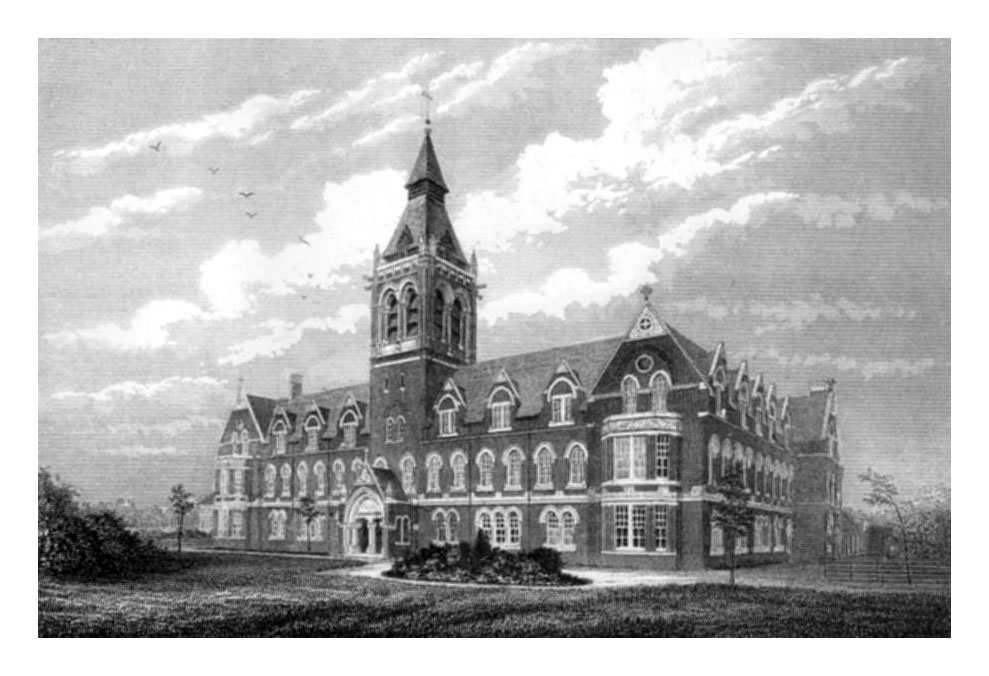
RVPA Boys
[Tower removed (after a fire?) date?]
[Tower removed (after a fire?) date?]
[PB: Must add something on the original Boys' School, on East Hill. Plus note several continued links Emanuel had with the Crimea, e.g. the first (and very durable) school "Serjeant" was a Crimea vet - is the Schoolkeeper still called the "Serjeant"?. See article in Emanuel Archive. BVS mentions a Crimea medal?]
[PB, 5.9.2019: I forgot I'd done this already, so re-scanned and re-ocr'd it. Needs a thorough edit.]
THE ROYAL VICTORIA PATRIOTIC ASYLUM FOR BOYS (1872-1882)
(i) The Royal Patriotic Fund
In 1854, when war broke out with Russia, a national appeal was made for funds for the relief of dependants of soldiers, sailors and marines 'who might be killed or might die on active service ' during the campaign in the Crimea. The response from the public was magnificent; money poured in from all parts of the world, and the. final total amounted to £1,471,375. Royal Commissioners were appointed to administer this Patriotic Fund, and Prince Albert became their first President*. Contributions were made towards the endowment of a number of schools, including Wellington College and the Royal Naval Female School (now the Royal School for Naval and Marine Officers' Daughters, Haslemere), but in addition to securing places for war orphans at existing schools the Commissioners decided to found and administer two schools of their own. These schools were subsequently built and were named the Royal Victoria Patriotic Asylums.
Land was purchased from Lord Spencer for £3,700 on 24th June, 1857, The fifty-two acres were described as "waste land".
[14]
On 11th July of the same year Queen Victoria laid the first stone of the Girls' School, which was completed, except for the infirmary, on 1st July, 1859: The projected Boys' School was not built yet, but the sum of £25,000 was set aside to accumulate for its endowment. It was originally intended that one hundred boys should be maintained and educated. By the end of 1870, however, the sum invested had reached the figure of £46,300 (most of it East India Debenture Loan), and it was in that year recommended to the Royal Commissioners by their Executive and Finance Committee that the new school should be designed to accommodate two hundred boys. This recommendation was accepted, partly on the grounds that much the same staff would suffice for two hundred boys as for one hundred (alas for schoolmasters!), and in the following year work was begun on the building that now houses Emanuel School.
There had been some discussion concerning the site. In 1868 the Executive and Finance Committee had made enquiries concerning a house called 'Fernside' near Balham Station, but they had decided after investigation not to recommend the purchase of the lease for the purpose of adapting the premises. Nor had they proceeded with the project of purchasing a house and land at Sheen.
At the meeting of the Royal Commissioners held at the Palace of Westminster on 23rd July, 1870, General Eyre's proposal that the new school should be built on the land belonging to the Girls' School had been countered by Sir John Pakington, who reminded his audience of 'the unfortunate circumstances which attended the Greenwich School for Girls from its proximity to the Boys' School'. (This piquant entry in the minutes is not further elaborated.) In the end it was decided that ' provided proper precautions were taken' there was no serious objection to building on the ground adjacent to the Girls' School, and Earl Grey's motion was carried unanimously that the Executive and Finance Committee should be empowered to make arrangements for building a school on the Royal Commissioners' land at Wandsworth.
* The Royal Commissioners were replaced in 1903 by the Royal Patriotic Fund Corporation, to the officers of which the writer owes a debt of gratitude for their courtesy in granting access to their records.
[15<]/p>
(ii) The Building of the School
The Executive and Finance Committee. after consulting the Lady Superintendent of the Girls' School and the Superintendent and Headmaster of the temporary Boys' School, decided to build a wall from the South-Western Railway to the London, Brighton. and South Coast Railway and to erect the new school on the ground so enclosed, thus giving the boys about 12 acres of the 52 purchased from Lord Spencer in 1857. Five architects were chosen to send in plans and designs, and after a close scrutiny those of Henry Saxon Snell were approved. Advertisement was made for builders' tenders, a limited selection of five being made from the applicants. The highest tender was £22.345; the lowest (£20.326) was accepted. and Mr. John T. Chappell contracted on 12th April
[14]
1871 to complete the work of constructing the main building, infirmary, boundary wall, and closets, etc., within eighteen months 'under a penalty.' It was decided that there should be no public ceremony, as in the case of the Girls' School, to mark the laying of the first stone.
In their Eleventh Report, dated 21st June 1872, the Royal Commissioners informed Her Majesty that the building operations had been carried on 'with considerable energy', and that the whole of the building, except for the Chapel. had been roofed in before Christmas 1871. They added that the internal finishing had progressed satisfactorily. and were confident that the whole school would be ready for occupation in September. The heating apparatus had been in daily use since 27th May 1872 to ensure that the walls would be thoroughly dry. The roads and playground were being laid out. .
It had been thought originally that the boys might attend services in the chapel of the Girls' School. but it was ultimately decided to provide them with a new chapel of their own by building over the dining-hall. The Royal Commissioners were informed that the cost (including internal fittings) would not exceed £800.
Mr. Chappell was as good as his word. The building was occupied in October 1872, and the Royal Commissioners comment in their Twelfth Report that it is 'admirably adapted for its purpose." This opinion was confirmed later by the Chief Inspector of the Local Government Board. who in his report on the two Asylums, dated 20th October 1874, on the occasion of an investigation into the sanitary conditions at both schools after an epidemic among the girls caused by the drinking of contaminated water, remarks that 'the buildings seem to me to be well placed and admirably planned, and, excepting some slight defects in detail... may be said to possess most of the arrangements necessary to secure comfort and health to the inmates. They are. in my opinion, a credit to the professional gentleman who designed them.'
The total cost, including the architect's fee and the salary of the clerk of works, was £32,682 1s. 2d. The larger Girls' School had cost more than double this amount (£71,818 7s. 7d.). The cost of the new building was met out of the General Fund. and the endowment fund for the boys was allowed to continue to accumulate. Furthermore, to prevent the new school's being burdened with an annual payment the Executive and Finance Committee had in 1871 redeemed for £714 lis. 6d. the Land Tax of the whole of the ground belonging to the Royal Commissioners at Wandsworth. But in spite of all the wise provision of thoughtful and careful men, the Boys' School was destined to encounter many difficulties in its short span of life.
[15]
Hopes and Setbacks
The School was occupied in October 1872, and at the end of the year the number of boys stood at 224. Prudent arrangements had been made for the future economy of the Asylum. The farm and garden were to supply vegetables; and it was intended that the girls should wash for the boys and the boys bake for the girls. The Secretary, appointed to manage both Asylums, took over the house of the Chaplain, who removed outside the grounds.
The new school started well. A band was formed and encouraged the Royal Commissioners in the hope that a number of boys would go into the regimental bands after leaving school. The Revd. A. R. Grant inspected the two Asylums in May, 1873, and reported that in the Upper Division of the Boys' School the reading was 'extremely good ', though in writing from dictation there was a falling-off after the First Class, and the standard of grammar was only 'very fair'. He remarked on the latter: 'I should like to see this made more a practical subject, and divested of technicality '. He concluded his report: ' Altogether the school is highly efficient, the boys evidently working with a will, and interested in what they
oO'.
In his report of the following year there was a sharper note. He observed 'a decided falling-off in the elementary subjects' in the Upper School, but thought this was partly due to the great influx of new boys and to shortage of teaching staff. (In most of the classes there were over forty boys.)
In 1875 fresh troubles were encountered. Not only were there many cases of contagious ophthalmia, that terrible scourge of the metropolitan pauper schools, but the Superintendent and Head master, Mr. Hullah, suffered a severe haemorrhage and was forced to retire on an allowance. His wife, too, was at this time incapacitated. by paralysis.
However, the School won a better report this year from the Revd. Grant, who considered that it was now in a 'settled state of efficiency'. He was particularly pleased with the standard of reading. In the First Class the examination was on the account of the wreck of the Schiller in The Times of the same morning, and no mistake was made, except in the German names, ' which, of course, I did not count'.
Were the boys well looked after? Probably yes, by the standards of the time. An extra blanket was allowed in severe weather to those boys who asked for it. The Chief Inspector to
[18]
the Local Government Board noted in October, 1874, that there was an abundance of warm water, carbolic soap and clean towels, 'the results being healthy, clean-skinned looking children'. Each boy had his own comb, hair and toothbrush. 'Lard and red precipitate ' were applied assiduously as a precaution against scald head. A few years later the boys were even provided with an additional room in the infirmary where they could have their chilblains dressed in the winter. There were warm baths as well as a swimming-bath.
Were the boys happy? That, alas, we shall never know beyond a peradventure. The proximity of the Girls' School on occasions encouraged the bolder spirits to make assignations. doubtless innocent, with the gentler sex, and we may hazard the guess that the inmates of the Asylum were sometimes lonely.
Mr. Hullah was succeeded as Superintendent by Mr. William Ridpath, formerly First Assistant Master. The clouds now began to settle round the Asylum. BYVS. (to be continued)
(iv) The Critical Years
During the year 1876 Canon Grant made two inspections of the Asylum. In May he noted an improvement .in Grammar; but in his second report he remarked that the teaching, though ' animated and intelligent ', was in some danger of being. too discursive. 'The aim and object of teaching the class may sometimes be sacrificed in this way to the interest and pleasure of an intellectual exercise on the part of the teacher'. This shrewd and pertinent observation was accompanied by a sharp criticism of the distribution of the teaching staff between the Upper and the Lower School. ' During the time of my visit, the School being at work, by my desire, as usual, that I might see its ordinary course, I could not find that Mr. Brand did anything at all; being not, in fact, required in the Upper School'.
Worse was to come. The inspection of 1877 revealed a further falling off in academic standards, class organisation and the attentiveness of the boys during lessons. The Revd. Grant did not mince his words. 'On the whole, the School is below what it ought to be, considering its advantages'. In the same year the Chaplain to the two Asylums, the Revd. John Kyle, was dismissed for embezzling offertory money. The report of the next year brought matters to a head. The persistent Revd. Grant stated flatly that the standard of teaching had 'deteriorated materially', that the pupil-teachers had suffered from a succession of incompetent masters, and that the School was failing. He made one concession: the halftime system had cur tailed the time spent in the classroom.
The Headmaster was alarmed, and decided to anticipate the inevitable inquiry. On 17th June he wrote to W. H. Mugford. the Secretary to the Royal Commissioners and the Executive and Finance Committee, expressing ' great regret and surprise' at the report. He referred to the difficulties caused by the changes of assistant masters during the previous eighteen months and to the absence of one for two months with a bad leg. He had always endeavoured to obtain the best masters; the last three men had been strongly recommended. Mr. Ridpath also thought that a strict adherence to the halftime system had been largely responsible for the poor results.
The storm passed, but its effects were lasting. And now another matter occupied the minds of the Royal Commissioners: the steady decline in the numbers of the boys. During 1874 the average number had been 316; at the end of 1879 there were only 144. As this reduction added to the proportionate cost of maintaining
[23]
the boys, it was proposed that admission should. be extended to include orphans of other soldiers, seamen and marines * who have lost, or hereafter lose, their lives in the service of the Crown. or by, or in consequence of, casualties sustained or disease contracted in the service of the Crown; regard being had to the character and services. of the father'. But it was now too late to save the Asylum.
The indefatigable Revd. Grant, made his last inspection on 6th and 7th May, 1879. His report was critical, but not severely so. On 1st January, 1880, both Asylums were placed under the Committee of the Privy Council for Education, and the services of the Canon were no longer needed. |
The boys were probably little affected during these years by the larger problems of the Asylum. Vivid glimpses of their life are given us in the Minute Book of the House Committee. The dietary scale is frequently mentioned; and the Medical Officer states his opinion in May, 1880, that its inadequacy is responsible for the 28 cases of scaldhead. As a result, the Committee resolve that boys over fourteen be given 8 ozs. of bread for breakfast and 8 ozs. at tea.
In November, 1879, the ' Bijou Musical and Dramatic Company' offer to give an Entertainment. The Committee, however, gravely observe that 'considering the general character of Dramatic Entertainments of a humorous nature, and the difficulty of making a selection suitable for a mixed audience of Boys and Girls of the ages in these Schools, [we] deem it prudent to decline this offer with thanks '.
One incident particularly disturbed the Committee. On the evening of Tuesday, 19th September, 1876 ('between a quarter to seven and ten minutes to eight o'clock') five girls were on the Boys' School ground talking to the boys. They were admitted through the windows by two of the young servants, Janet Bradford and Mary Jane Vickers. 'George S. Cray wrote the note to the girls; Michael Delohery and George Ward were the channels of communication'. The servants were sentenced to be dismissed, the girls to be sent home to their mothers. The boys who conveyed the notes were caned before the whole school.
There are occasional hints of excessive harshness. Mr. Ridpath was accused by a discharged kitchen-maid of severely punishing two boys on a Sunday evening; and he was cautioned at least twice by the Committee. But brutality does not appear to have been tolerated: in 1878 a master was dismissed for ill-treating a boy.
After leaving the Asylum, the boys entered different walks of life. An analysis of the various occupations pursued by boys who had left between 1873 and 1878 revealed that 89 were employed in Government service (including 29 sailors or marines and 34
[24]
soldiers) and 181 in other trades or professions (including 30 'schoolmasters or pupil teachers, clerks or writers'). But the roll of Old Boys was not destined to be a long one. : (The subject of the concluding article will be the negotiations leading to the sale of the Asylum to the Governors of the United Westminster (Endowed) Schools.)
(v) The North Surrey School District Board
In their Report of 1881 the Royal Commissioners informed Queen Victoria that the plan to complete the full endowment of the School to a total capacity of 200 boys would have to be abandoned if the other projects of the Fund were not to be thrown overboard. They advised the appropriation from the Boys' School endowment fund, standing at £69,000, of a sum of £35,855 to provide for the education of Roman Catholic orphans. This would leave the School with an endowment of £33,145, or an income of about £1,200 per annum, ' which would be available for the maintenance and education of orphan boys, so soon as the boys at present in the school have been properly provided for'.
The Royal Commissioners went on to declare that the sum chargeable for rates, taxes, and repairs was so large that it was impossible to run the School economically, even if a sufficient endowment for 100 boys could be obtained. The Executive and Finance Committee had therefore been directed to reduce expenditure with a view to closing the School before the end of the year. The Royal Commissioners add: 'Although all the Russian War children will have been provided for, and the future continuance of the School would be only for the benefit of the orphan boys of Your Majesty's Services who have no claims on the Patriotic Fund as originally formed, Your Majesty's Com missioners cannot conceal the regret they experience at the probability of being obliged to close the School'.
The main cause of the difficulties was the large sums paid annually for expenses over and above the estimated liabilities for
[15]
the cost of boys on the Fund. The Asylum had been built for 200 boys and the aim had been to provide a sufficient endowment for their support, but unfortunately the average cost per boy had been £24 - £30 instead of the estimated £17 10s. 0d., and further more valuations had ignored the new boys continually coming on the books. An endowment of at least £129,000 was needed to support 200 boys; and to attempt to carry on the School with anything under that number would soon prove to be a most extravagant arrangement owing to the great additional cost per head.
The Royal Commissioners therefore reluctantly recommended selling the School, unless some means could be found to increase the endowment or the School could be filled with paying pupils. Another suggestion was that the Government should take it over (Army children needed more school places than were available) or send 150 or 160 paying children to make up the numbers. But nothing came of these alternative proposals.
The amending Act of Parliament enabling the Royal Com missioners to sell the School and to apply a part of its endowment to the education of Roman Catholic children received the Royal Assent on 22nd August, 1881. Negotiations for the sale had already been begun by the Executive and Finance Committee. On 27th July the Committee approved a memorandum of acceptance, with one or two modifications, of the offer of the ' Home for Little Boys'. On 10th November, however, the Secretary was directed to write to the Home expressing the regret of the Committee that in consequence of ' insuperable difficulties ' the negotiations had to be discontinued. The Committee then recommended to the Royal Commissioners that other offers should be invited for the purchase of the School, and advertisements were accordingly inserted in several newspapers (The Times, The Daily News, The Daily Telegraph, The Daily Chronicle and The Standard). Finlaison, the Government Actuary, estimated the proceeds of the sale at £26,000. Notice was given that the use of the property was to be restricted to 'Charitable, Educational, or Public purposes', and that the Asylum would not be sold for use as a hospital for infectious diseases, nor the land for speculative building. Lord Chelmsford had unsuccessfully opposed these ' prohibitive stipulations '.
As a result of the advertisement two offers were received, one of £20,000 from the Board of Management of the North Surrey School District (Anerley), the other of £22,000 from the Governors of the United Westminster (Endowed) Schools. (It is interesting to note that this was not the first time the Executive and Finance Committee had heard from the Governors. At their meeting on 13th April, 1881, a letter had been read 'stating that the Committee of that School [Emanuel Hospital] had decided on not
[16]
hiring temporary premises '.) It was resolved that a letter should be written to each of the Governing Bodies requesting them to reconsider their offers. The United Westminster Governors replied by offering £27,500. The North Surrey Board offered £27,000, and 'and, should that be less than any other offer, £500 more than any other Tender received, not exceeding £29,500'. After some discussion it was decided unanimously to recommend to the Royal Commissioners that the offer of the Board, considered as £28,000, should be accepted.
(vi) The Newcomer from Westminster
_ At their meeting on 9th February, 1882, the Royal Commissioners were considering the recommendation of the Executive and Finance Committee that the Asylum should be sold to the Board of Management of the North Surrey School District when a letter from the Governors of the United Westminster Schools was suddenly brought into the room. It was opened and found to contain an offer of £32,000. The Commissioners were embarrassed. The question was discussed whether they were debarred by the previous action of their Committee from considering this new and unexpected offer. They decided they were not. It was thereupon resolved to inform the North Surrey Board that an offer had been made ' considerably in excess of the sum of £30,000, and to enquire what was the highest bid the Board was prepared to make. The cautious Commissioners also decided to write to the United Westminster Governors asking if £32,000 was their maximum offer, and to advise them that a letter had been sent to the North Surrey Board informing the Board that a considerably higher offer than theirs had been received but not disclosing the amount of this offer. The advertisement for the sale of the Asylum was to be repeated in the newspapers and 16th February was fixed as the latest date for the final consideration of tenders. The proposal was unanimously adopted that the Executive and Finance Committee should be empowered to accept the highest offer; but if the offers were of equal
[17]
amount that of the Board of Management of the North Surrey School District should be accepted.
At the meeting of the Committee on 16th February a letter from the North Surrey Board was read withdrawing from the negotiations, and after consideration it was resolved to accept the offer of the United Westminster Governors. The following draft of the letter to be written to the Governors was agreed upon: 'I am instructed by the Executive and Finance Committee to acknowledge the receipt of your letter of this day's date, and I am to acquaint you that they are empowered by the Royal Commissioners to accept the offer contained in your letter of the 9th instant of £32,000 for the purchase of the Boys' School premises, together with the fittings and fixtures enumerated in your letter of the 16th of January, and the Executive Committee hereby acquaint you of their acceptance of that offer.
*... The Committee are prepared to include such of the essential furniture and effects as would be suitable for the purposes of the Governors... (They) regret that there should have been any misconception with respect to the cost of the Building, but they have directed their Secretary to show to you the books in this office by which it will be seen that the stated cost of the Building of between £32,000 and £33,000 does not include the furniture: and further that that amount does not include the Land, the Cottages, the Gymnasium, and some other charges. They will be glad for you to make any extracts from the Books you think desirable... (and) request that the sanction of the Charity Commissioners may be obtained as speedily as possible.'
On 2nd June the Royal Commissioners empowered the Chair man of the Executive and Finance Committee to sign the contract for the sale on their behalf. They further resolved to inform the Official Trustees of this authorisation and to request them to sign the contract deed, when prepared. The Commissioners agreed to promise the United Westminster Governors ' not to sell the land of the Girls' School between that School and the Boys' School boundary for speculative building purposes'. The sale did not, apparently include the boundary wall between the two institutions, which remained the property of the Royal Patriotic Fund. (The Girls' School retained the use of the 4in. waterpipe for a rental of 1/ per annum payable to the United Westminster Governors: Emanuel School obtained the 2in. pipe.)
On 14th July it was reported to the Committee that arrangements had been made for the sale of the Asylum to be completed on the 26th, but on 1st August the legal documents were still not. ready. It was on 26th August that the conveyance deed was at last handed to the Solicitor to the Governors and cheques received in exchange for two separate amounts of £31,000 and £1,000, which were paid into the Bank of England.
[18]
Section 2 of the Patriotic Fund Act, 1881, had laid it down that the purchaser of the Boys' School should not ' inquire into the legality of the sale or into the application of the purchase money, or be responsible for the non-application or mis-application thereof '.
We hear once more of the North Surrey School Board. In May, 1884, the Royal Commissioners were informed that applications had been received from the Board ' first for the purchase of a portion of the Land of the Royal Victoria Patriotic Asylum (for Girls) and later for the purchase of the Asylum and land'. But the Executive and Finance Committee were against the sale of Asylum or land, and in this view the Commissioners concurred.
During the last two years of its existence the Boys' School had been in a flourishing academic state. The Report of 1881 had stated that the School was in excellent discipline and had made a 'remarkably good' examination. The copybook writing in the lower standard was the only weak point to which attention was called. In the next year's Report, H.M. Inspector declared ' Both the discipline and the instruction reflect the greatest credit on the teachers '.
But nothing now could save the Asylum. On 14th December, 1881, the boys were addressed in the dining-hall by the Chairman of the Committee, Earl Nelson, and a parting supper was authorised for them, 'with the amusement of a Magic Lantern'. A few months later, as we have seen, the Asylum had disappeared for ever, its place taken by a migrant from Westminster.
B.V.S.
[PB: From Emanuel School Archive. Six articles by BVS [Bernard Slater?]. Text needs tidying up, and pdfs of the 6 original articles need adding to the EJBA.]
Emanuel School Archive [add info]
BVS (Bernard Victor Slater), The Royal Victoria Patriotic Asylum for Boys (1872-1882), first published in 6 parts in The Portcullis (Emanuel School magazine), dates?, pdf.
Check also The History of Emanuel School, 1594-1964, by C. Wilfrid Scott-Giles and Bernard V Slater [1966?]