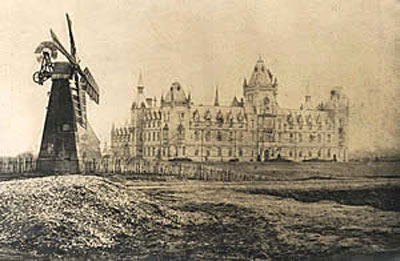
Royal Victoria Patriotic Asylum for Girls, photograph c.1865.
PB: The windmill in the foreground still exists, though without sails. Erected in 1837 to pump water back into an ornamental lake (The "Black Sea") from the adjoining London and Southampton Railway cutting. The "Black Sea" is marked as such on maps from [date?].
Check if there's anything further in e.g. wikipedia.org/wiki/Wandsworth_Common_Windmill.
(Click on image to enlarge)
The money for building the Asylum came from the Patriotic Fund, which was set up by a Royal Commission, issued on 7 October 1854. The Prince Consort was the chairman of the Commission and the object of the Fund was to collect money for the relief of the dependants of the soldiers, sailors and marines who were killed in the Crimean War.
The incompetence of the British military command in the Crimea ensured that there was no shortage of widows and orphans in need of charity. W.H. Russell's reports in "The Times" informed the public of the acute suffering of the British troops; Florence Nightingale's work added an element of romance to the situation and Tennyson fed the flame with his "Charge of the Light Brigade". All in all, the country was in an ecstasy of patriotism.
In this climate of opinion it is not surprising that the public's response to the appeal was both rapid and generous. The Commissioners were able to distribute relief within a month of the promulgation of the Fund (1).
The money came from all over the world. Most of it originated in England but over £300, 000 came from the British Possessions and £30, 000 from foreign countries. Before seven months had elapsed, the Commissioners were able to announce that they had collected over one million pounds. The final figure was to be nearly one and a half million (2). That sounds a large sum even today. From the weekly allowance already quoted it will be seen that it was a vast fortune then.
The fortune proved an embarrassment. The Commissioners increased the weekly allowance twice. They also distributed money to those officers and their dependants who could demonstrate a need for assistance. In spite of these measures a surplus remained and this was therefore appropriated by Act of Parliament in order to build the Royal Victoria Patriotic Asylum (3).
The Asylum was intended for the "Education and Training of Three Hundred Orphan Daughters of soldiers, Seamen and Marines who perished in the Russian War, and for those who hereafter may require like succour" (4).
A large site on Wandsworth Common was acquired from the Lord of the Manor - Earl Spencer. In fact he certainly had no right to sell common land but this had not then been fully established in law. Besides, it is doubtful if anyone would then have objected to the use of common land for a purpose which commanded much overwhelming public support.
The foundation stone was laid by Queen Victoria on 11 July 1857. It was evidently a splendid occasion which was attended by a great number of people. The "Illustrated London News" printed a long description of the event (5) but the Queen's own account is far more succinct and evocative:
"Many people there. The Archbishop read a Prayer, after which Albert, as head of the Commission, read a long Address, to which I responded. Then, the stone was laid, Bands playing and guns firing, and we returned as we came.
May this good work, which is to bear my name, prosper." (6)
The building which rose in response to this encouragement was built by Mr George Myers of Belvedere Road, Lambeth. His accepted tender was £31, 337. The bricks came from Suffolk and the stone from Yorkshire (7). It is humbling to learn that the huge building was completed in less than two years. The result was judged to be 'bold, picturesque and effective' by the "Building News". Problems only became apparent later. These derived 'from the size of the building and its peculiar construction and arrangements' which made it 'a most expensive one to manage and keep in repair' (8). Further details are unfortunately not available.
The architect of the Asylum was Major Rohde Hawkins. Very little is known about him. He is mentioned in the "Dictionary of National Biography" and "The Builder" published an obituary notice on 6 December 1884. He was born at Nutfield, near Reigate in Surrey, on 4 February 1821, the third son of Edward and Elizabeth Hawkins (9). His somewhat unusual christian name derived from his maternal grandfather (10).
Rohde Hawkins was presumably born into prosperous circumstances and was educated at Charterhouse in Finsbury. He was there from June 1831 to May 1837 (11). After acquiring practical knowledge in Thomas Cubitt's building empire, he travelled to Asia Minor in 1844 and set up as an architect on his return.
In 1848, Hawkins designed Swarcliffe Hall (near Birstwith in Yorkshire) for Frederick Greenwood, whose daughter Mary he married in 1853. He did further work in the area between 1856 and 1879. His first building in London was Hunt's Hall, a large brick building in the Guy's Hospital complex, designed in 1853 (12).
Apart from the Royal Victoria Patriotic Asylum, he designed two churches in the metropolis, St Paul, Burdett Road, Bow in 1858 (13) and St Michael, Star Street, Paddington in 1860-1 (14), both of which were destroyed in the Blitz.
From 1 April 1854 until his death on 19 October 1884, Rohde Hawkins was Architect to the Committee of the Council on Education, which was concerned inter alia with the scientific principles of school construction. His obituary notice in "The Builder" closed with this tribute: 'he was both a skilful artist and a thorough English gentleman'.
Reverting to the history of the Asylum, the first inmates were received on 1 July 1859. Initially there were 150 and the full complement of 300 was not reached until an infirmary (which has since been demolished) had been completed.
In January 1862 one of the inmates was burned to death while in the second of two days solitary confinement in the superintendent's bathroom. Disciplinary methods were strict in the Victorian period so two days of solitary confinement for "insubordination" may not have been unusual.
More revealing of the school's running in its early days is the fact that, although the girl's screams were heard by some of the other inmates, they were so in awe of the teachers that none dared to call for help. One predictable result of the girl's unfortunate death is that she is said to haunt the building and particularly the central tower in which the bathroom was located.
The girls' education was directed to preparing them for domestic service. This had an advantageous effect on the institution's running expenses since all cleaning, cooking and laundering was performed by the inmates and consequently so staff were employed. Conventional schooling tended to occupy an increasing part of the curriculum as time passed and eventually training in the domestic arts was confined to those inmates above school-leaving age.
Around the building was a farm which was supposed to make the Asylum nearly self-sufficient. In fact this was never really possible. Common land is frequently unproductive, and Wandsworth Common was no exception, and the farm tended to lose money (15). The farmland was gradually cut off and developed in a curiously uncoordinated fashion. The Asylum was first dispossessed of land in order to build a similar institution for boys. This orphanage soon ran into financial trouble and in 1883 the buildings were bought by Emanuel School, which still occupies them.
In 1914 the Asylum changed its name and function. For some time before the First World War a plan had existed on paper for the creation of four Territorial Force General Hospitals in London. In accordance with this plan, on the declaration of war on 4 August, the Asylum became the third London General Hospital. The next day about 20 employees of Messrs. Hitchcock, Williams and Co., a City drapery firm, arrived at first light to turn the orphanage into a hospital. The school was on holiday at the time and so one of the first tasks of the hospital's first day was to number hundreds of pairs of boots so that they could be returned to their owners. On their return, the inmates were accommodated in nearby houses.
Although the difficulties of running a school under these circumstances must have been great, they were small compared with those involved in turning the Asylum unto a hospital - particularly since, by an administrative error, the hospital was initially supplied from the field general hospital supplies list. The equipment therefore included oil lamps and entrenching tools but not beds.
As the war dragged on, the hospital overflowed the main building into numerous hutments and eventually accommodated 1800 patients (16). The patients were brought by train from the ports in the south-west on a line which passes in a cutting just 100 yards from the front of the building. The gradient of the side of the cutting was reduced so that the wounded men could be carried up the slope from the trains to the hospital.
After the war, the school reoccupied the Asylum and remained in it until, at the time of the Munich crisis in 1938, it was necessary to evacuate to temporary premises in Wales. This time, the orphan school did not return to Wandsworth but settled instead at Badwell Park, Essendon, Herts. It remained there until its closure on 8 July 1972 (17). It is a happy fact that it was closed not for lack of money but for lack of orphans.
References
1. First Report of the Royal Commissioners of the Patriotic Fund, 10 May 1855
2. Third Report of the Royal Commissioners, 28 July 1862
3. Ibid.
4. Part of the inscription on the trowel with which the Queen laid the foundation of the RVPA. Quoted in the Illustrated London News, 1 August 1857
5. 25 July 1857, p.98
6. Queen Victoria's Journal for 11 July 1857. (Quoted with permission of the Librarian of the Royal Archives, Windsor Castle)
7. Building News, 5 March and 8 October 1858, pp.236 and 998 respectively
8. Eighth Report of the Royal Commissioners of the Patriotic Fund, July 1869
9. Nutfield Parish Baptismal Register, Surrey Record Office, Kingston
10. Dictionary of National Biography
11. Information supplied by the Register of the Charterhouse
12. N. Pevsner, The Buildings of England: London 1952, vol.2, p.401
13. B. Clarke, Parish Churches of London 1966, p.160
14. Ibid. pp.117-8
15. Eighth Report, July 1869
16. "A Great War Hospital and How it Came into Being", Lt Col. M.E. Bruce Porter, from "Happy - Though Wounded." Country Life
17. Programme of the closing-down ceremony
Scott MacRobert, The Wandsworth Historian, No.9
© Wandsworth Historical Society