Month? 1855: VT coxes a Life Guards' rowing boat to defeat in a race at Windsor.
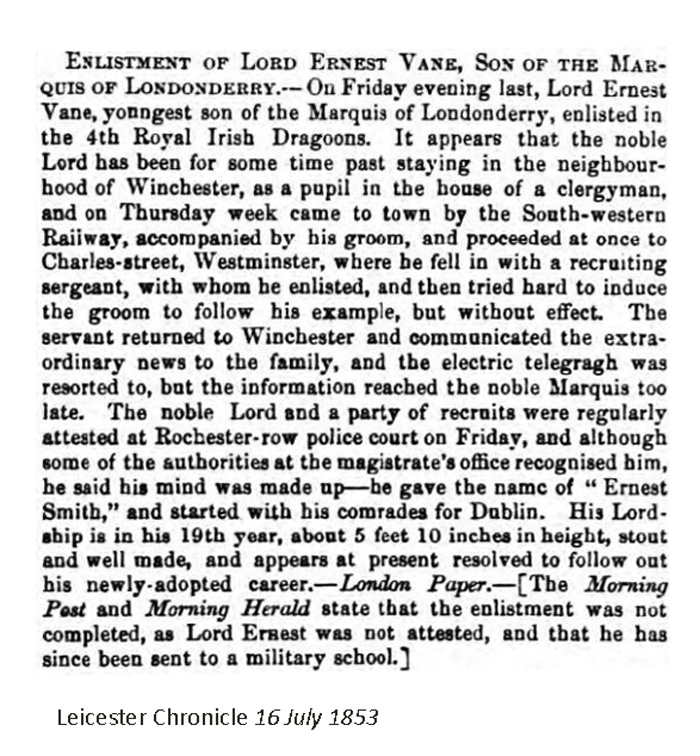
The race took place near Windsor at much the same time as the infamous "fracas in the Windsor Theatre" (below). It is interesting that EVT was the cox - which suggests he might have been small and light (though this is unlikely given it was the Light Guards? Also, WL has found that Vane was [in July 1853] described as "about 5 feet ten inches in height, stout and well-made...". I'm sure I've seen references somewhere to his father being 5 feet tall. But I think this was a violently polemical comment).
ETV's was very much the favourite crew, yet: "Only for a few strokes were the boats together, when unfortunately Lord Vane somehow steered his boat on the shallows, and grounded." I wonder which boat EVT backed?
WL comments in an email: "What a beautifully written piece, gradually building up to a crescendo with talk of smooth waters and pretty riverbanks and then all of a sudden, the downfall of the favourites and the ubiquitous Dead March in Saul."
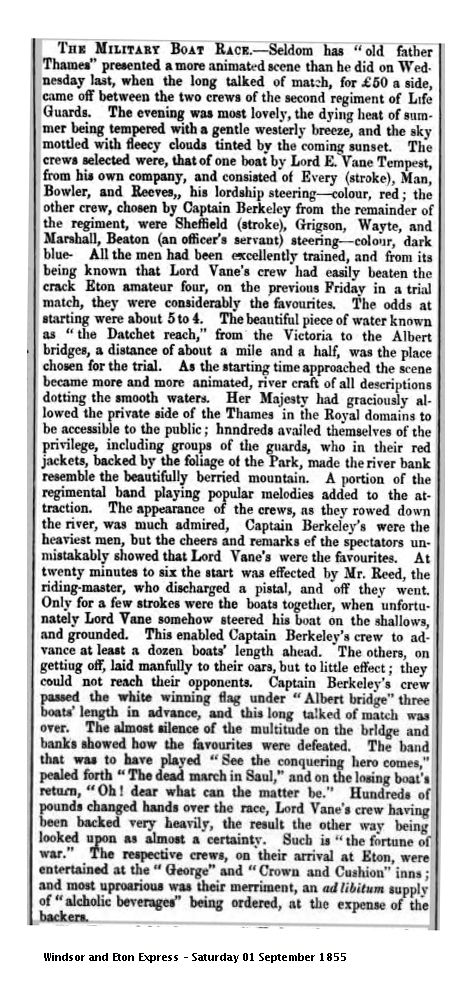
Windsor and Eton Express, The Military Boat Race, 1 September 1855:
(Click on image to enlarge)
The Military Boat Race
Seldom has "old father Thames" presented more animated scene than he did on Wednesday last, when the long talked of match, for £50 a side, came off between the two crews of the second regiment of Life Guards. The evening was most lovely, the dying heat of summer being tempered with a gentle westerly breeze, and the sky mottled with fleecy clouds tinted by the coming sunset. The crews selected were, that of one boat Lord E. Vane Tempest, from his own company, and consisted of Every (stroke), Man, Bowler, and Reeves, his lordship steering - colour, red; the other crew, chosen by Captain Berkeley from the remainder of the regiment, were Sheffield (stroke), Grigson, Wayte, and Marshall, Beaton (an officer's servant) steering - colour, dark blue. All the men had been excellently trained, and from its being known that Lord Vane's crew had easily beaten the crack Eton amateur four, on the previous Friday in a trial match, they were considerably the favourites. The odds at starting were about 5 to 4.
The beautiful piece of water known as the Datchet reach," from the Victoria to the Albert bridges, a distance of about a mile and a half, was the place chosen for the trial. As the starting time approached the scene became more and more animated, river craft of all descriptions dotting the smooth waters. Her Majesty had graciously allowed the private side of the Thames in the Royal domains to be accessible to the public; hundreds availed themselves of the privilege, including groups of the guards, who in their red jackets, backed by the foliage of the Park, made the river bank resemble the beautifully berried mountain. A portion of the regimental band playing popular melodies added to the attraction.
The appearance of the crews, as they rowed down the river, was much admired. Captain Berkeley's were the heaviest men, but the cheers and remarks ef the spectators unmistakably showed that Lord Vane's were the favourites. At twenty minutes to six the start was effected by Mr. Reed, the riding-master, who discharged a pistol, and off they went.
Only for a few strokes were the boats together, when unfortunately Lord Vane somehow steered his boat on the shallows, and grounded. This enabled Captain Berkeley's crew to advance at least a dozen boats' length ahead. The others, on getting off, laid manfully to their oars, but to little effect; they could not reach their opponents. Captain Berkeley's crew passed the white winning flag under "Albert bridge" three boats' length in advance, and this long talked of match was over. The almost silence of the multitude on the bridge and banks showed how the favourites were defeated.
The band that was to have played "See the conquering hero comes," pealed forth "The dead march in Saul," and on the losing boat's return, "Oh! dear what can the matter be." Hundreds of pounds changed hands over the race, Lord Vane's crew having been backed very heavily, the result the other way being looked upon as almost a certainty. Such is "the fortune of war."
The respective crews, on their arrival at Eton, were entertained at the "George" and "Crown and Cushion" inns; and most uproarious was their merriment, an ad libitum supply of alcoholic beverages" being ordered, at the expense of the backers.
https://www.britishnewspaperarchive.co.uk/viewer/bl/0000413/18550901/045/0004
1856: Cashiered for bullying Cornet Ames.
1856: Court of Enquiry into his bullying of Cornet Ames.
[ADD a summary or TM's account, or good newspaper article, or similar.]
LINK TO TONY MARGRAVE ACCOUNT
David Scott Daniell, the historian of the 4ths, is more generous to Vane Tempest and co. than e.g. The Times, in that he treats it is little more than "horseplay" inevitable among "youngsters". Such beheaviour was normally tolerated by senior officers because of its useful function of socialising young officers in the ways of the regiment, and of toughening them up. "Most youngsters", he claims, "submitted with good grace and thrived in the hard school":
It is the nature of youth to be turbulent and the high spirits of the cornets were looked upon with tolerant amusement by senior officers. Lord George Paget often refers to his cornets as though they were amiable and entertaining puppy-dogs. The junior officers took themselves very seriously, and it was the custom to "knock the corners" off new-comers to the regiment with the ruthless cruelty of the young. If a new officer would not conform to the customs of the regiment the others made him do so or drove him from their midst by making his life a misery.
The rough-and-ready system of toughening up young officers by the rule of the pack was obviously liable to lead to excesses, and the sentences of informal subalterns' court-martial were sometimes degrading to the victim and could be brutal. The Times heard about an incident which occurred in the 4th Light Dragoons in 1854.* Cornet Thomas Ames apparently made himself un-popular with the other cornets by his unwillingness to share in what he considered to be unnecessary extravagances in the Mess.
He was held down in a chair and forcibly fed with pap, with frequent slaps "to stimulate the powers of deglutition." His moustaches were then mutilated.
As a result three officers were deprived of their swords, pending an inquiry. In an angry leading article The Times demanded, "Why allow wealthy and titled libertines to bully a young man of different disposition out of a regiment, and thus ruin his military career for ever?" One of the three officers, Lord Ernest Vane Tempest, made the affair seem almost reasonable in a letter he wrote to The Times:
"Cornet Ames dined on the night in question at mess when nothing that could be constructed into an insult was addressed by me to him, although his peculiar English and his mispronunciation of the letter 'h' produced some remarks in joke which caused a great deal of laughter.... I remarked that his whisker wanted trimming, and a pair of scissors being brought I cut off some of one whisker."
Lord Vane Tempest did not say how much he cut off "one whisker," nor, it seems, did he consider it anything other than a kindly service done to oblige a friend. His protestations were of no avail, for shortly afterwards he had to forfeit his commission.
Fortunately he soon became "inclined towards the Church," in which his family had livings in gift.
Horseplay and tagging among subalterns is as natural as it is among schoolboys and undergraduates, and when the narrow boundary which separates it from bullying is not crossed it can be beneficial to a young man's character. There are many legends in the regiment of indignities inflicted on young officers, even on some who later became very distinguished members of the regiment indeed. Most youngsters submitted with good grace and thrived in the hard school.
* This story is given in Gallant Gentlemen, A portrait of the British Officer, by E.S. Turner (Michael Joseph, 1956).
[Source: David Scott Daniell, 4th Hussar: The Story of the 4th Queen's Own Hussars, 1685 - 1958, (Aldershot: Gale & Polden, 1959), pp.159-60.]
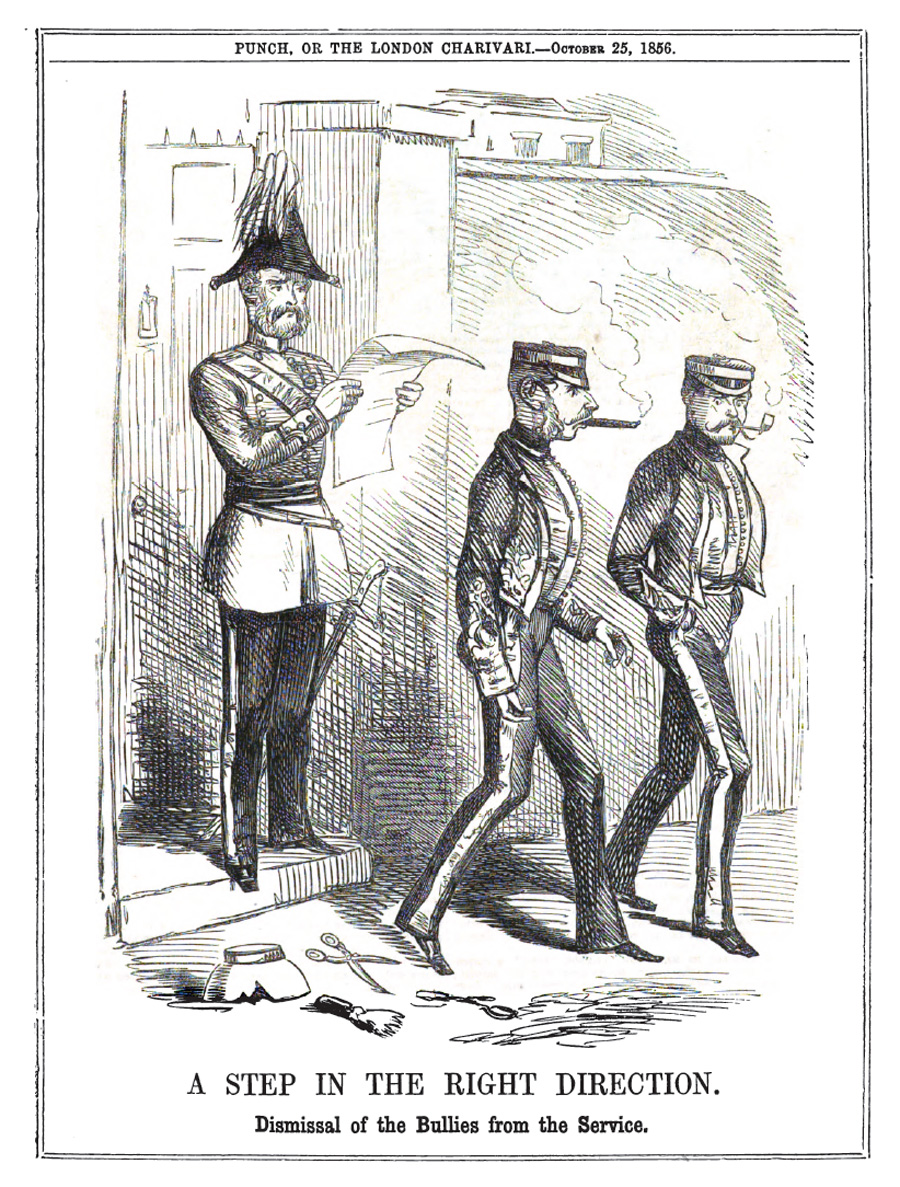
"A step in the right direction. Dismissal of the bullies from the service", Punch, 25th October 1856. EVT and William J Birt were cashiered for bullying Cornet Thomas H Ames.
This is the only likeness of Vane Tempest that I know of. (Presumably he is the character in front, with the pointed face and receding chin, smoking a prodigious cigar - emblematic of aristocratic degeneracy.). Notice the [scissors and shaving brush? "whisker?" and broken bowl? at their feet], and the date (the second anniversary of the Charge). [I recall it's a relatively large - full page? - image.]
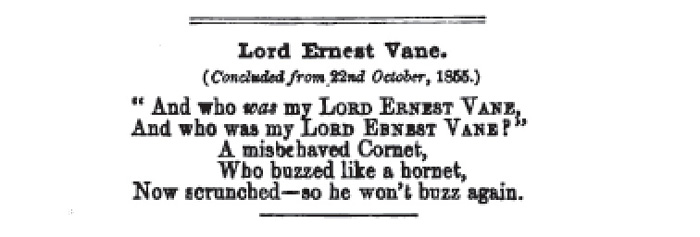
"He won't buzz again." This verse appeared elsewhere in the same? edition of Punch, with the phrase "Concluded from 22nd October 1855".
(Click on image to enlarge)
/div>
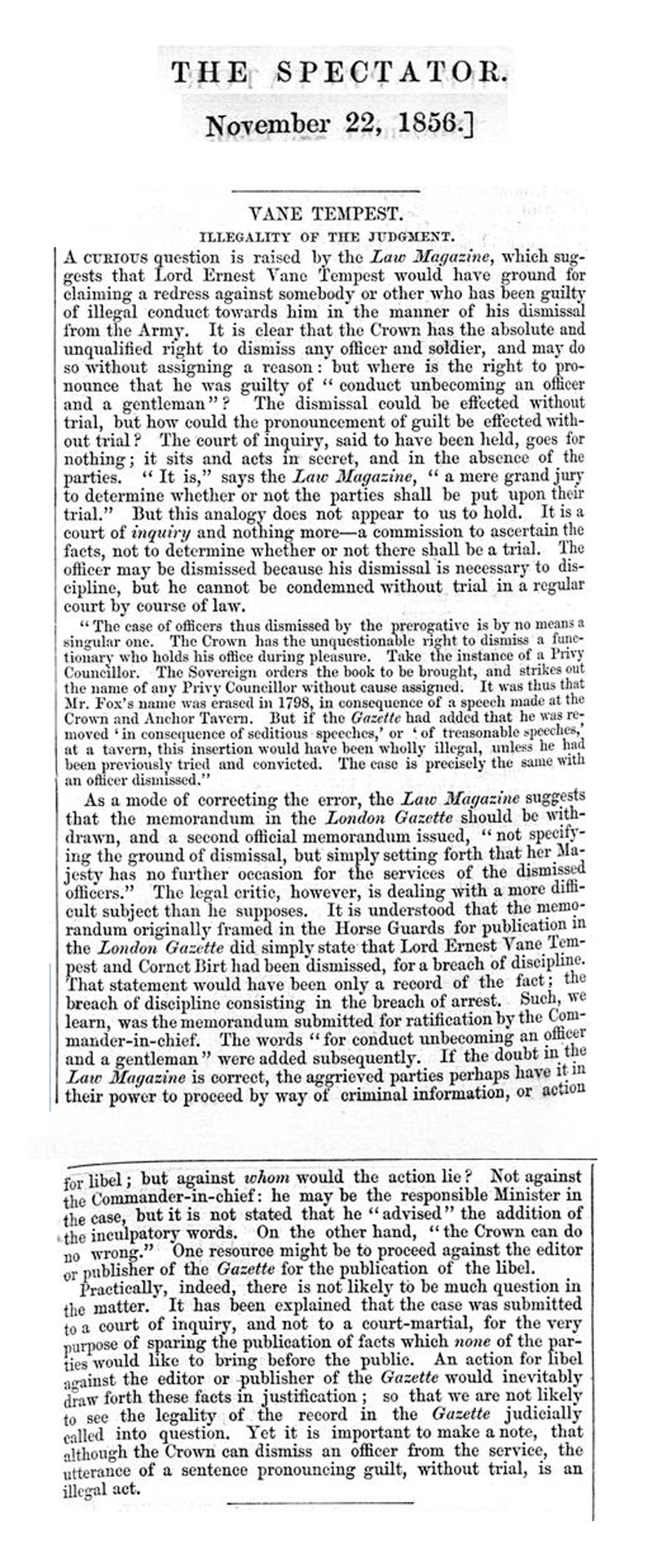
Illegality of judgment? [If useful, explain.]
[PB: EVT and friends were dismissed not by a court martial but by a [military? regimental?] enquiry. Such enquiries seem to have been held in lesser regard, and many assumed a whitewash was likely (see some of the newspaper articles concerning the case). There are refs to Hardinge decrying bullying - wasn't he EVT's godfather?]
tempest_illegality_of_judgment_Spectator_22nov1856.jpg
(Click on image to enlarge)
LINK TO SPECTATOR ARTICLE, 22 NOV 1856
A note on EVT's victim, Thomas Harling Ames.
Wendy Leahy has researched Thomas Harling Ames's life in some detail. He was born 18.5.1834 in Marylebone, the son of a "Gentleman" (described as an "Upholsterer" in the 1851 Census). He purchased a cornetcy in the the 4th Light Dragoons in June 1856, but exchanged out of the regiment in December the same year, and sold his commission in the following month.
THA became a brewer and retailer of beer but his business ventures did not thrive and he was soon declared a bankrupt. He married Leonora Orsini, born in Milan, Italy, in 1864. They had a daughter, Florence, and a son, Thomas.
His father died in the Richmond Union Workhouse in 1881, at which time THA's daughter, then 11 [acc. to the 1871 Census she would have been 12 or 13], was in the Holy Trinity Girls Orphanage in Bletchingly, Rotherfield, Sussex.
[About 1860 the Duchess of Leeds bought the property for the purpose of founding an orphanage for girls and presented it to the Roman Catholic Church, see e.g. http://theweald.org/P2.asp?PId=Ro.BltchO. Pugin was the architect. PB: Some sources say that Holy Trinity was the boys' orphanage (at Mayfield), the girls' orphanage being St Michael's (near Mark Cross). See e.g. http://www.thepuginsociety.co.uk/institutional-buildings.html. However, the NA refers to Holy Trinity Orphanage for Girls.]
In 1891 Leonora, 44, and Florence, 22, were described as as "Type Writers", "neither employer nor employed" - does this mean unemployed? I am not sure from WL's notes when THA died [? 1st quarter 1897. If so, where was he in the meanwhile, and what was he doing? CHECK.].
September 1856: knocked down Sarah Kenton while driving his rig to a race meeting at Lewes (Sussex).
Margrave writes, EVT:
"...knocked down Sarah Kenton (1856) while driving his rig which was 'decidedly "fast" in character' en route to a race meeting at Lewes (Sussex) (1856) - he did at least allow her £1 a week, besides securing to her good medical attendance (A fact of this nature deserves publicity)"
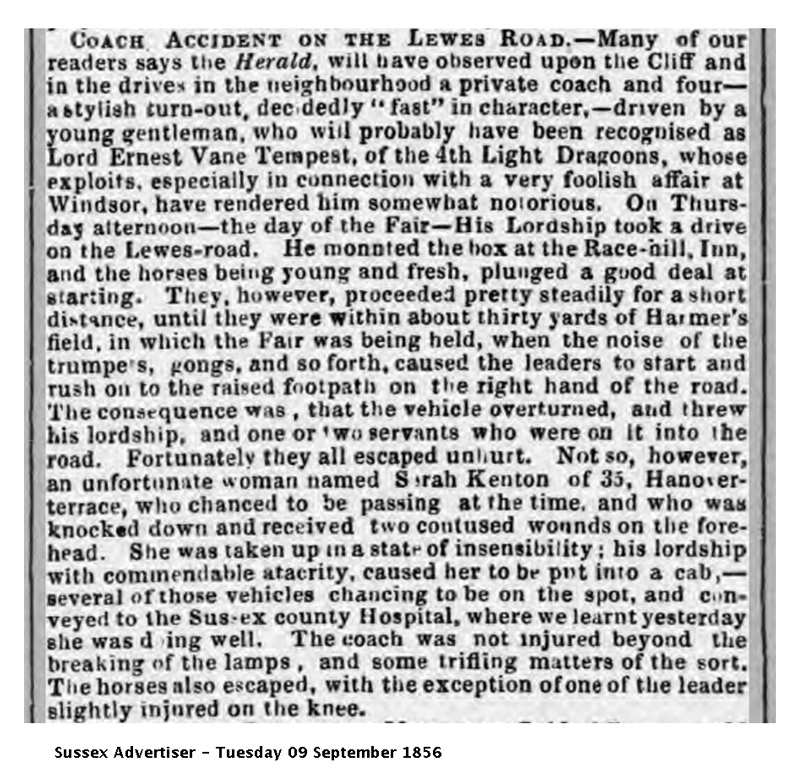
(Click on image to enlarge)
Sussex Advertiser, Tuesday 9 September 1856
Coach Accident on the Lewes Road
Many of our readers says the Herald, will have observed upon the Cliff and in the drives in the neighbourhood private coach and four - a stylish turn-out, decdedly "fast" in character - driven by a young gentleman, who will probably have been recognised as Lord Ernest Vane Tempest, of the 4th Light Dragoons, whose exploits, especially in connection with very foolish affair at Windsor, have rendered him somewhat notorious.
On Thursday afternoon - the day of the Fair - His Lordship took a drive on the Lewes-road. He monnted the hex at the Race-hill, Inn, and the horses being young and fresh, plunged a good deal at starting. They, however, proceeded pretty steadily for a short distance, until they were within about thirty yards of Haimer's field, in which the Fair was being held, when the noise of the trumpes, pongs, and so forth, caused the leaders to start and rush on to the raised footpath on the right hand of the road. The consequence was, that the vehicle overturned, and threw his lordship, and one or 'wo servants who were on it into the road. Fortunately they all escaped unhurt.
Not so, however, an unfortunate woman named Sarah Kenton of 35, Hanover terrace, who chanced to be passing at the time, and who was knocked down and received two contused wounds on the forehead. She was taken up in a state of insensibility; his lordship, with commendable alacrity, caused her to put into a cab, several of those vehicles chancing to be on the spot, and conveyed to the Sussex county Hospital, where we learnt yesterday she was doing well.
The coach was not injured beyond the breaking of the lamps, and some trifling matters of the sort. The horses also escaped, with the exception of one of the leader slightly injured on the knee.
[Source: https://www.britishnewspaperarchive.co.uk/viewer/bl/0000257/18560909/024/0005]
Brighton Gazette, Thursday 11 September 1856:
Lord Ernest Vane Tempest.
As this rather notorious young gentleman, officer of the 4th Dragoons was driving coach and four along the Lewes Road Thursday, the day of the fair, the horses started the sound of the gongs, and rushing on the raised footpath I overturned the vehicle, throwing His Lordship and servants into the road, but who all escaped unhurt. A poor woman named Kenton however, who was passing at the time was knocked down, and received two contused wounds on the forehead. She was taken to the Hospital, where she is doing well. Lord Tempest caused the poor woman to be placed in cab, and remounting the box drove off in his four-in-hand.
[Source: https://www.britishnewspaperarchive.co.uk/viewer/bl/0000938/18560911/088/0005 .]
TM says VT paid her off at £1 a week, but I have not found any articles suggesting that. CHECK.
Year: Travels to the US and joins ? Army as "[Captain?] Charles Stewart".
Wendy, 1.1.2015:
Many thanks for the latest three clippings. I don't think I'd seen the one about the shooting incident in 1871. Extraordinary! Vane Tempest really warrants a book all to himself!
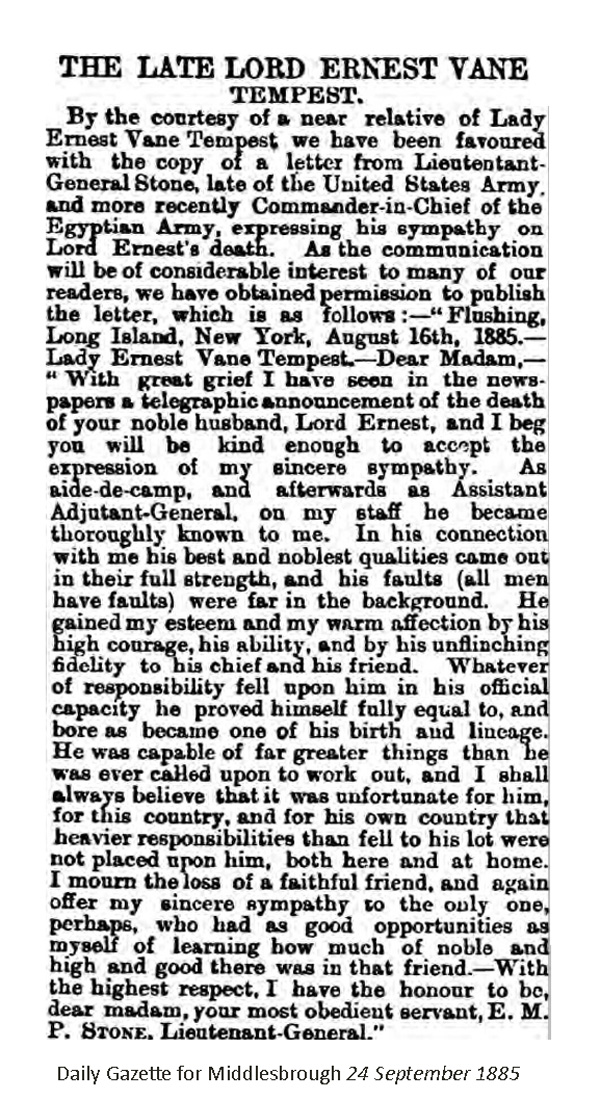
And Jim will love the letter from General Stone. That is really interesting, and seems to show that Stone was fully aware of VT's chequered past. They obviously had a very close and trusting partnership during their time together. Would you be able to let me know the newspaper titles and dates for the 1871 and 1885 items? I have so many clippings it's a nightmare to keep track of them all if they're not labelled and filed exactly.
Incidentally there is a curious line of testimony in the 1871 court case... one of the witnesses, Mary Ann Ingram, states out of the blue that she is 'married to a black man.' It doesn't seem to be connected with the case. I wonder where her husband was from, and why did she feel compelled to tell the court?
I'm afraid I don't have anything more on Francis Young at the moment, apart from what Jim has given us.
Wendy, date?
Vane's main cohort [?] in the persecution of Ames, William Birt, was also rejuvenated [PB restored? re-?] partially in order to allow him to serve in the militia.
ADD JIM MORGAN'S INFO ON "CHARLES STEWART"
1862: American Civil War - fights with Captain Young.
[PB: What might this have been about? What is meant by "weapons of Nature's own providing" - fists?]
Wendy, 22.12.2015
Lord Vane Tempest Turning-Up Again -
Lord Earnest [sic] Vane Tempest in America -
In a letter from Boston we read: 'There was a brisk fight in General Banks's command the other day. One of our officers, a Captain Young, who had been dismissed from the service for improper conduct, saw fit, for what reason I know not, to make an assault on Captain Stewart, Assistant Adjutant-General, a gentleman better known in England as Lord (?Ernest) Vane Tempest. Captain Stewart took the matter with coolness, and inflicted fearful 'punishment' upon the assailant, with weapons of Nature's own providing, polishing him off most artistically.
The coming up of the Provost General put a stop to the little affair, and well for poor Young too, for found that he had met with an old hand. The American verdict is, that Captain Stewart served Captain Young right; for, if the latter had any ground of complaint against a gentleman, who has so handsomely volunteered into our army, and whom we have found a valuable friend, he should have had resort to the mode that is customary with gentlemen, and which is more proper in military circles than it is among civilians. As it was, he got the worst of it, and in such full measure, that it is not probably he will try the 'rough' manner of proceeding again in a hurry. - Letter from Boston.
[Wendy:
As reported in the Sheffield and Rotherham Independent Supplement, Saturday 8 February 1862, Dundee Courier and Daily Argus, Friday 14 February 1862, and the Hull Packet and East Riding, Friday 21 February 1862.]
1862: Returns to England (October)
Wendy, date?
New York Times, 21 October 1862
General City News
Personal: Lord Ernest Vane Tempest, better known as Capt. Charles Stewart, will leave today en route for home. Capt. Stewart has been in the United States service since the opening of the war. When Gen. Stone was appointed to his command Capt. Stewart was made his Adjutant-General, in which capacity he discharged with credit the onerous duties assigned him. His conduct at the battle of Ball's Bluff merited and received the personal thanks of Gen. McClennan, then Commander-in-Chief. At the time of Gen. Stone's removal, believing that officer to be unjustly dealt with, and unwilling to serve under another, he resigned his commission, and although tendered the Coloncy of one of our finest infantry regiments, declined continuing in the service.
1864: His death announced, somewhat prematurely
Wendy, date?
An interesting snippet here, which shows how rumours can be infiltrated into the press and no doubt picked up and perpetuated:
The Cork Examiner, 2 June 1864
The death of General Stuart during the engagement with Sheridan is a severe loss to the Confederates. His successes with his famous cavalry have been of no small service to the cause which he adopted. General Stuart is supposed to be no other than the Lord Ernest Vane Tempest. - Shipping Gazette.
WHEN OUTLAWED?
WHEN LET OFF?
1869: Marries Mary Townshend Hutchinson (date)
LINK TO WEDDING
>
Jan Q 1869
Married Mary Townshend Hutchinson, c.21, born c.1848, Howden House, Norton, Co. Durham, Jan 1848?. Her father was Thomas Hutchinson, Iron Merchant [1861 Census] born Stockton on Tees, Mother Elizabeth E[?], born Helston, Cornwall.
A glamorous event [add articles or links]. Notice the ceremony is carried ut by EVT's brother-in-law Revd Law, from whom ETV fled to join up in 1853.
His best men was (I assume) William Edward Dowdeswell, MP for West Worcestershire (1866 - 1876)?, captain of Worcestershire Yeomanry Cavalry. (See e.g. Wikipedia: William Edward Dowdeswell
Children in the new school in ? [built by his mother?] is given the day off.
The couple honeymoon at Seaham Hall.
Seaham Hall Wikipedia: Seaham Hall.
ADD one or possibly two good newspaper accounts.
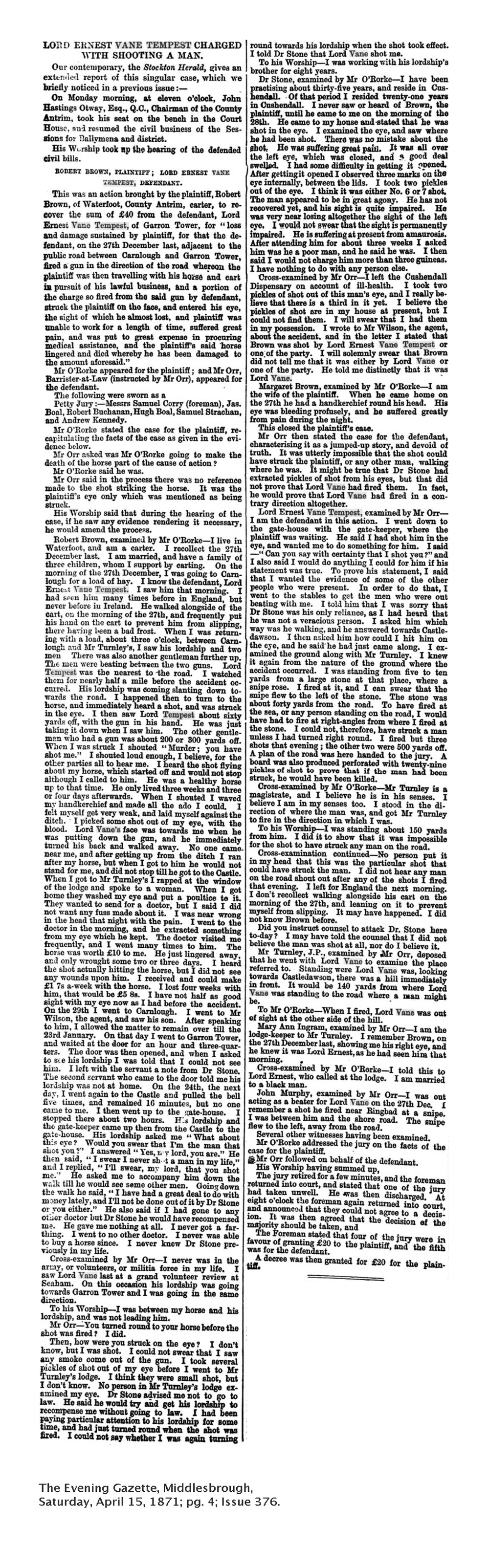
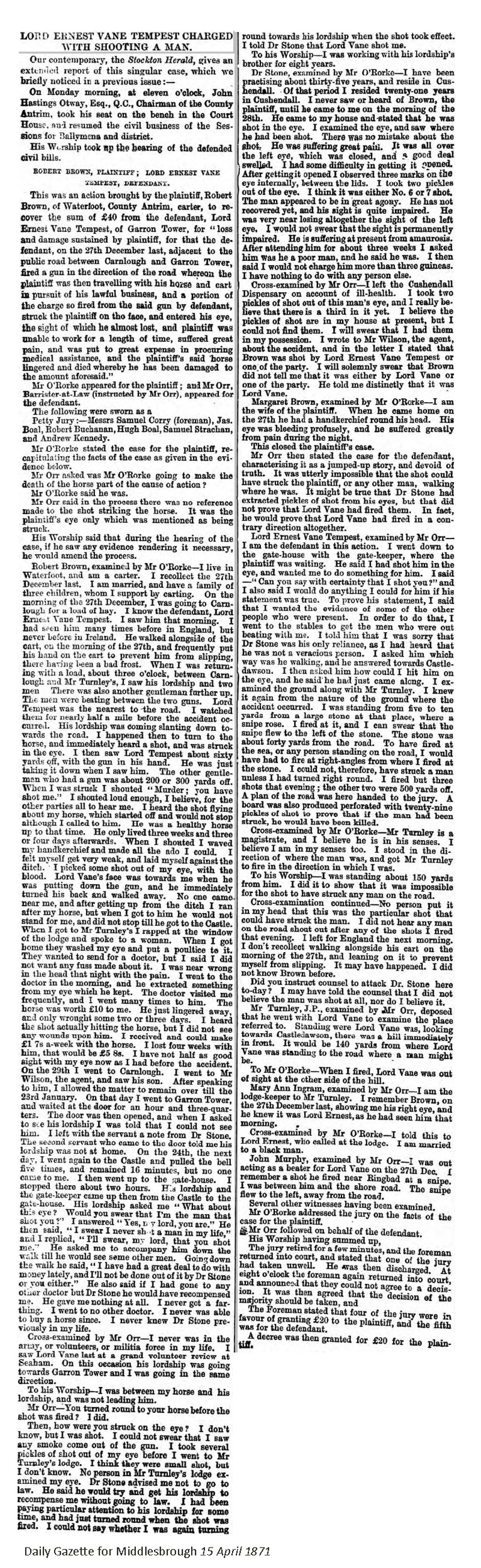
1870-71: "Lord Ernest Vane Tempest charged with shooting a man":
[Summary of case needs development: On 27 December 1870 a carter, Robert Brown, of Waterfoot, Co. Antrim, who was travelling on a public road between Carnlough and Garron Tower in a horse and cart [they are close - ? miles.] , was shot in the eye and nearly lost his sight. His horse bolted and died shortly after. RB brought an action against EVT, who was out shooting grouse near to the road on the day. RB claimed it was definitely EVT who shot him. He said he recognised EVT, whom he had seen many times before, though never in Ireland. He had seen EVT last at a grand volunteer review at Seaham. EVT said in court that he had never shot a man. EVT said he left for England the day after the shoot. [RB said he spoke to EVT some days later.] [These and other facts related in the account are odd, aren't they?] EVT claimed the doctor who had treated RB was lying. The jury could not reach a unanimous decision, but the judge accepted the majority view to grant £20 to RB.]
[EVT's son Charles was born in Co. Antrim in early February 1871, so the VTs must have been over in Ireland [staying full time at at Garron Tower, where the shooting must have taken place? Or Mountstewart? [how far is Mountstewart from GT?] for the birth. This action was heard in April 1871.]
"Lord Ernest Vane Tempest charged with shooting a man", Evening Gazette, Middlesbrough, 15 April 1871.
(Click on image to enlarge)
"Lord Ernest Vane Tempest charged with shooting a man", Daily Gazette for Middlesbrough, 15 April 1871.
Cutting kindly provided by Wendy Leahy.
(Click on image to enlarge)
1871: Birth of son, Charles Henry
Son: Charles Henry Vane Tempest, 1871 - 1899, Birth 22/2/1871, IRELAND, Death 20/2/1899, Stockton, C. Durham.
[NB: Distinguish hom from another Charles VT born around this time - a future Marquess?]
1877: "Unquestionably the most startling scandal of the season" - the NYT reports the elopement of Lady Vane Tempest.
In 1877 [exact date?] the New York Times reported that Lady Vane Tempest had eloped with "a great friend of the Prince of Wales", a Mr Hungerford.
The story was picked up around the world and reproduced more or less verbatim. The pretext was that the story was "illustrative of the unhealthy tone of aristocratic life in the metropolis":
LINK TO WRONG LADY VT
1868: Stands for Parliament as a Conservative, but loses.
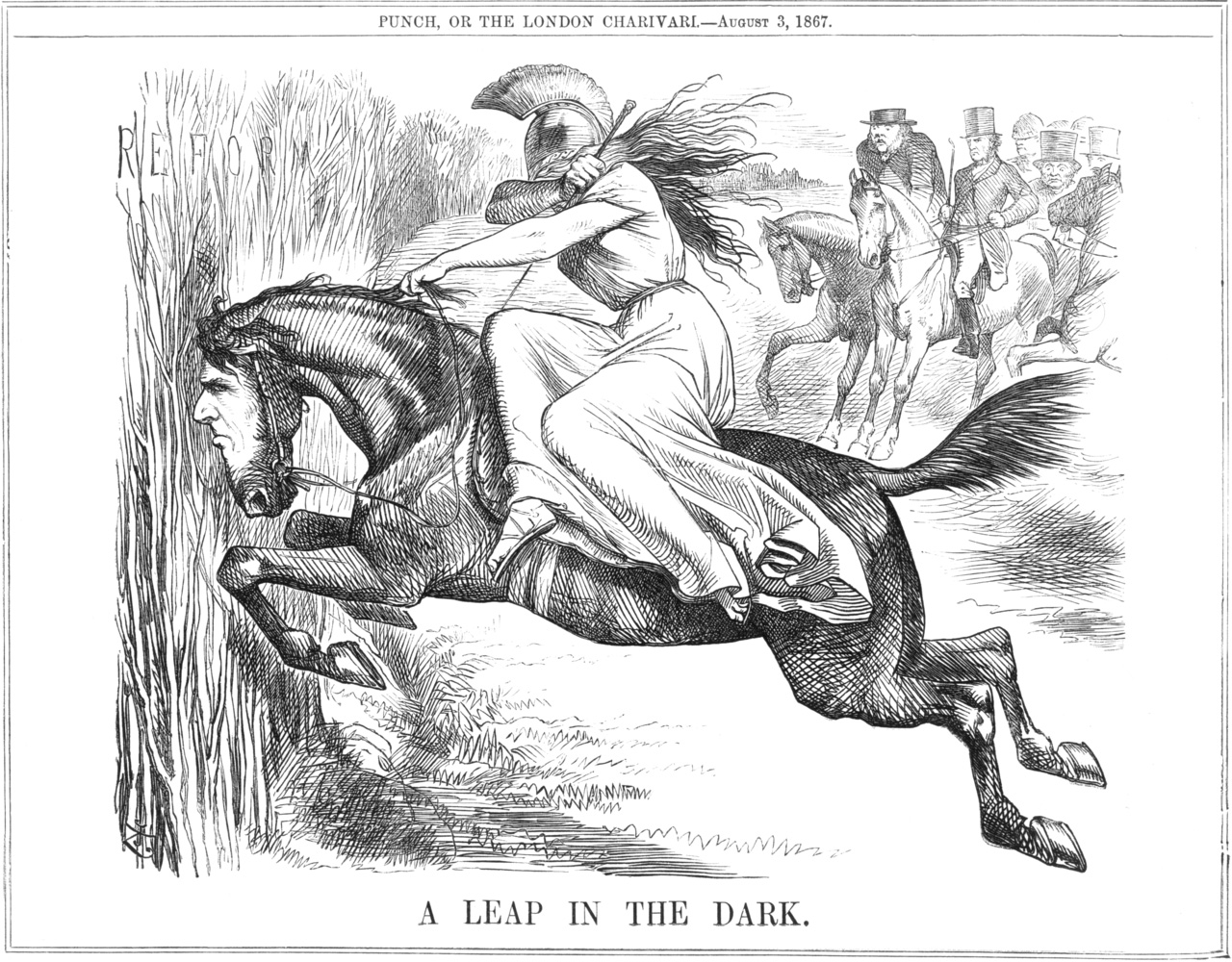
The Second Reform Act (1867), brought in by Disraeli's Conservative Government, extended the franchise to all adult men - but only if they could pass a property qualification (if they owned land or paid more than £? in rent a year. The electorate roughly doubled from one million to two million [but still the majority of adult men were excluded?]. And a number of new constituencies were created [most of them in towns and cities, including Stockton?]. Many commentators saw these changes as a risk, as this Punch cartoon shows:
Electoral Reform in the mid-1860s shown as "A Leap in the Dark", Punch, 3 August 1867.
Notice a fearful Britannia hides her eyes, while John Bull and various landed gentlemen on thoroughbred horses look on aghast.
(Click on image to enlarge)
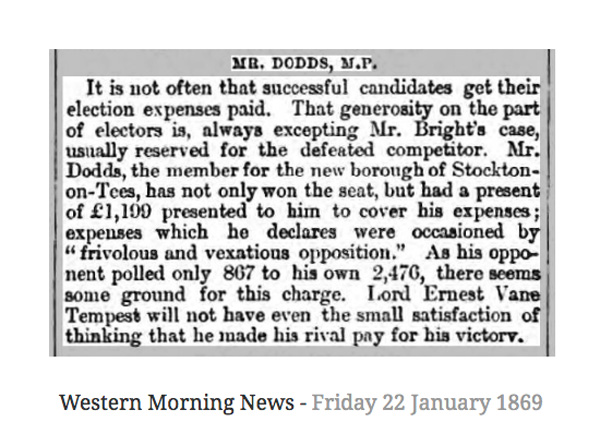
Ernest Vane Tempest, who stood as a Conservative candidate for Stockton, close to where he lived, lost to the Liberal party's Mr Dodds by a margin of three to one. The newly enfranchised seem not have shown particular gratitude to the Conservatives, and the 1868 election saw a large increase in Liberal seats in Parliament. [Why did he have to pay Dodds, who accused of Tempest of "frivolous and vexatious opposition", his election expenses?]
Loses election
(Click on image to enlarge)
Western Morning News - Friday 22 January 1869
MB. DODDS, M.P. It is not often that successful candidates get their election expenses paid. That generosity on the part of electors is, always excepting Mr. Bright's case, usually resented for the defeated competitor. Mr. Dodds, the member for the new borough of Stockton-on-Tees, has not only won the seat, but had a present of £1,190 presented him to cover his expenses; expenses which he declares were occasioned by frivolous and vexatious opposition." As his opponent polled only 867 to his own 2,476, there seems some ground for this charge. Lord Ernest Vane Tempest will not have even the small satisfaction of thinking that he made his rival pay for his victory.
https://www.britishnewspaperarchive.co.uk/viewer/bl/0000329/18690122/055/000
[Needs editing.]
Stamford Mercury - Friday 22 January 1869
On Tuesday night there was a great political demonstration [at?] Stockton, on the occasion of the Liberals . the new Parliamentary borough entertaining their first 1 representative, Mr. Joseph Dodds, a banquet, and presenting him with the handsome sum of 1200 [?], the amount the expenses which he incurred during the contest with Lord Ernest Vane Tempest, whom he defeated by a great majority.
https://www.britishnewspaperarchive.co.uk/viewer/bl/0000237/18690122/002/0004
[PB: Perhaps NOT their child. Check.]
1871: Birth of their son, Charles Henry Vane Tempest (22 Feb 1871?)
Born Glenarm, Antrim, Ireland (?) [Glenarm is near ? TOWER, I think]
Where was he in 1881? He was not with his parents.
According to Ancestry.com, he married in 18?, and died in ?.
1881 Census
2, Grosvenor Terrace, Scarborough, Yorkshire [?]
Ernest [?] Tempest, head, Married, 45, Marquis's Younger Son, born London.
Lady Tempest, Wife, 33, Wife of ditto, born ?, Co, Durham [?]
Also a cook and two maids, all born Yorkshire.
[Grosvenor Terrace may be part of Grosvenor Crescent, which still stands. Were they having a seaside holiday? (Probably not - WL says they were living there.) At the time of his death in 1885 he was living at "Filey House". I have not been able to identify either. Follow up. ]
[1861 Census https://www.ancestry.co.uk/interactive/8767/DRURG9_3691_3696-0754/12320515?backurl=https://www.ancestry.co.uk/family-tree/person/tree/67238973/person/36546581152/facts/citation/223508114272/edit/record]
1885: Death (14 August)
Lord Vane Tempest died aged 49 on August 14, 1885, and was buried on the 18th of August at St James Churchyard, Thorpe Thewles, Grindon, Durham, England.
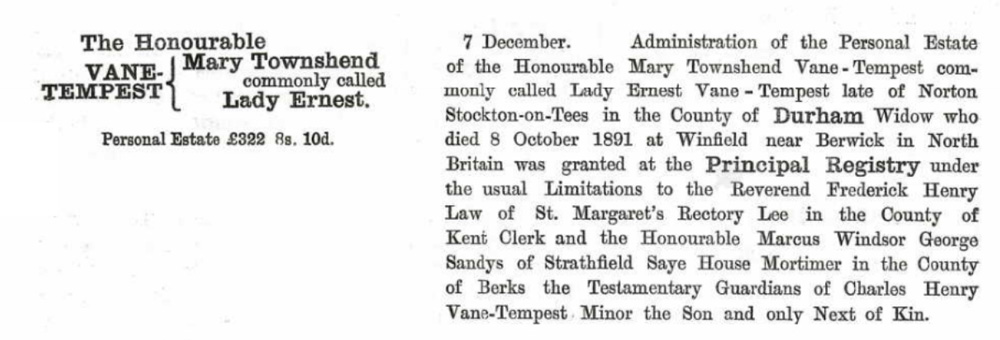
His wife survived only a further 6 years, and was also buried at St James's, 13 October 1891, still only aged 44.
[PB: I have not been able to find anything about any memorial to them at St James's. And why so young? Get death certificates?]
Wendy, date:
Details of VT's burial [and his wife's]
St James Churchyard, Thorpe Thewles, Grindon, Durham, England
Vane Tempest, Ernest McDonnell, bur. 18 Aug 1885, age: 49y
Vane Tempest, Mary Townsend, bur. 13 Oct 1891, age: 44y
http://www.interment.net/data/eng/durham/stjames_thorpe/james.htm
http://www.thorpe-thewles.org.uk/St%20James%20Thorpe%20Thewles%20Grave%20Stone%20Survey%20-%20Summary.htm
Location: https://www.google.co.uk/maps/place/St+James+Cl,+Thorpe+Thewles,+Stockton-on-Tees+TS21+3LH/@54.6050542,-1.3856671,16z/data=!4m5!3m4!1s0x487e8e009ed05a71:0x5b32ecec96400821!8m2!3d54.6055486!4d-1.3827395
VT's death was announced by The Times:
OBITUARY
Lord Ernest McDonnell Vane-Tempest, son of the third Marquis of Londonderry, died at Scarborough yesterday. He was born in 1836, and served for a short time in the 2d Life Guards and the 4th Light Dragoons. Quitting England during the Civil War in America, he served in the Federal army under the name of Colonel Stewart, and was present at many of the engagements on the banks of the Potomac. In 1867 he became a Volunteer in the 2d Durham Artillery, and in 1868 he contested the borough of Stockton-on-Tees in the Conservative interest. (14)
General ? Stone, his commanding officer in the US, wrote to ?, telling of his ...
[General Stone to...etc.]
[WL]
(Click on image to enlarge)
[Transcribe General Stone's letter.]
Solicitors' announcement [what exactly is this notice in law?]:
Lord ERNEST McDONNELL VANE TEMPEST, Deceased.
Pursuant to the Statute 22 and 23 Victoria, chapter 35, entitled "An Act to further amend the Law of Property, and to relieve Trustees."
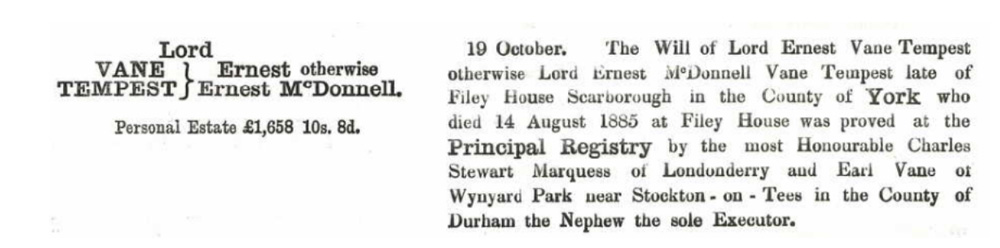
NOTICE is hereby given, that all creditors and other persons having any debts, claims, and demands upon or against the estate of the Honourable Ernest McDonnell Vane Tempest, deceased, late of Filey House, Scarborough, in the county of York, and commonly called Lord Ernest Vane Tempest (who died on the 14th day of August, 1885, and whose will was proved on the 19th day of October, 1885, in the Principal Registry of the Probate Division of Her Majesty's High Court of Justice by the executor therein named), are requested to send particulars, in writing, of their respective debts, claims, and demands to us the undersigned, the Solicitors for the said executor, on or before the 26th day of February, 1886, after which date the said executor will proceed to deal with the assets of the deceased, having regard only to the debts, claims, and demands of which he shall have had notice.
Dated this 26th day of January, 1886.
STRETTON and BILLIARD, 75, Cornhill, E.C.,
Solicitors for the said Executor.
Probate was granted in ?. VT's personal estate was relatively small - just £1658 10s 8d. (Six years later, his wife's personal estate was even smaller - £322 8s 10d.)
EVT Probate, 1885, and for his wife Mary, 1891
(Click on image to enlarge)
Further information
[VT's name has continued to be heard, always as an example of a "bad aristocrat"...]
Otago Witness (New Zealand), 29th September 1909:
"The Last Outlaw
A Noble Delinquent
Otago Witness (New Zealand), 29th September 1909.
(Click on image to enlarge)
[Needs edit...]
THE LAST OUTLAW.
A NOBLE DELINQUENT.
Sentences of outlawry are to this day on ordinary occurrence in Scottish criminal procedure, but in England such penalties are now practically unknown (says the Daily Express). Some interest, therefore, attaches to the story of the last English "outlaw," as recalled by Mr Frederick Hugh Short, the principal clerk of the Crown Office, in his evidence before the Departmental Committee on Coroners.
The outlaw in question was Lord Ernest Vane Tempest, uncle of the present Marquess of Londonderry, who died in 1885. He was outlawed in 1857 as a result of a rule made absolute in the old Court of Queen's Bench, which sat at Westminster. The rule was not, however, carried out.
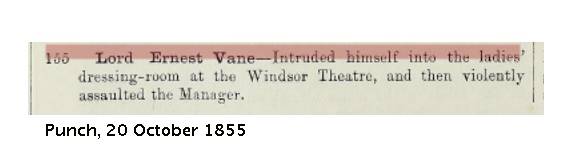
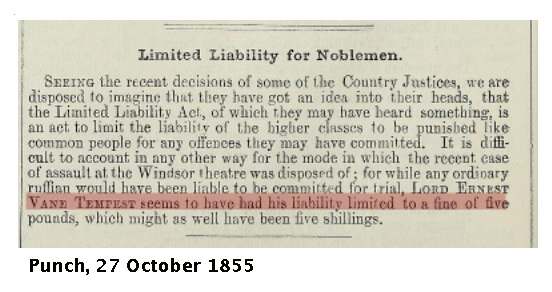
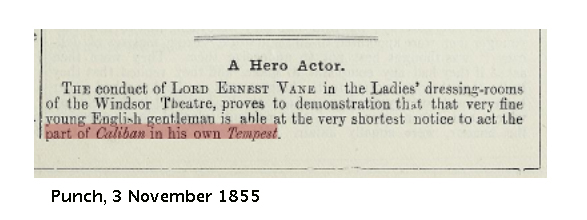
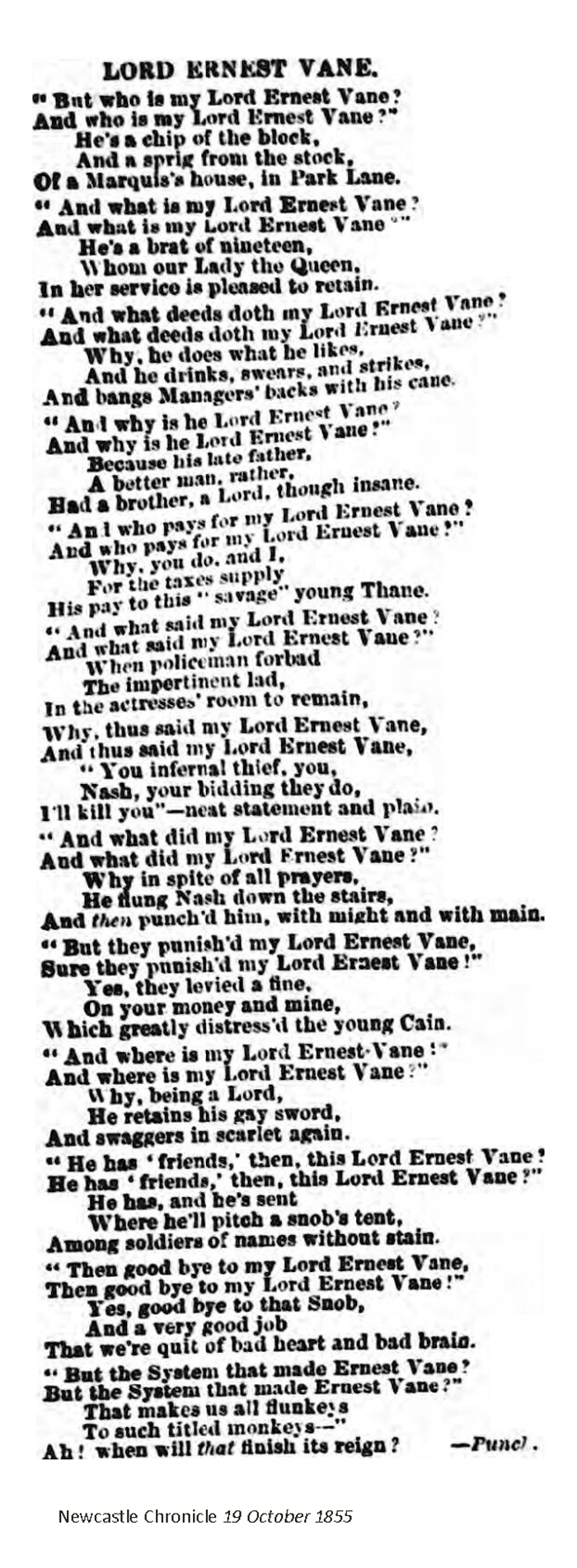
Lord Ernest had several purple patches in his career. He was convicted in 1854 of an assault upon the manager of the Windsor Theatre, and ordered to pay £5 [check]. Later, £25 [?] damages were awarded against him in an action for trespass in connection with the same incident. Then, in 1856, he was the principal figure in a scandal which shocked Brighton. He was an officer of the 4th Light Dragoons, stationed at Brighton. Together with Captain Burt and Cornet Winstanley he played pranks upon his brother officers, which led to a court-martial, and their dismissal from the regiment and the army for conduct "unbecoming officers and gentlemen."
- Old-time "Rag" -
It appeared from the evidence given at the court-martial that the three young sparks - Lord Ernest being the leader - objected to some young officers who refused to take part in the extravagant behaviour of Lord Ernest and his friends. A "rag" was organised, and one young officer of a highly respectable clergyman's family was taken out of bed and treated exactly like a child. He was "smacked," tied up with a bib, and fed like a baby. Afterwards, to crown the indignity, he was placed in a fountain in his nightshirt.
Another young officer named Ames, son of a gentleman living at Regent's park, was hauled out of bed, and one side of his face shaved of whiskers. His bed was put in water and the furniture broken up
Young Ames slept the night on the floor, and in the morning reported the conduct of the three officers to the colonel, who ordered an inquiry.
- Dismissed the Army -
Lord Ernest and his two wild companions were placed under close arrest, and later dismissed the army.
His behaviour scandalised the staid Victorian gentry, and Lord Ernest was advised to go in for the Church and redeem his character by accepting one of the many livings in the gift of the Londonderry family. Such, however, was not tho fate of the young man, for on November 21, 1856, two months after he had been dismissed from the army, application was made to the old Queen's Bench, sitting at Westminster, for a rule nisi calling upon Lord Ernest Vane Tempest to show cause why a criminal information should not be filed against him for assault on Cornet Ames, the young officer who endured the onesided shave. It appeared that on October 31 Lord Ernest was at Brighton, near the Dorset Gardens, where Ames was talking to a lady. Lord Ernest went up to Ames, spat in his face, and called him a blackguard and coward. Ames did nothing at the time, but placed the matter in the hands of his solicitor.
The court granted the rule, and the erring young member of the Londonderry family fled the country. It was not until June 12, 1857, that another application was made to the court for the rule to be made absolute.
- Sentence Set Aside -
This was owing to the fact that Lord Ernest had come back to the country, but was living in the Dowager Lady Londonderry's house in Park lane, and the officers of the court were unable to serve him with notice of the rule.
Under the old Queen's Bench procedure Lord Ernest was outlawed, but the outlawry was afterwards set aside.
He left the country and proceeded to America. and is said to have fought in the Civil War. He afterwards returned home, and subsequently married and settled down near Stockton.
[As recently as 2017, in a review of a substantial book on the history of the British aristocracy, VT's delinquencies are picked out for particular attention/revulsion/derision as a ...As a model of bad upper class behaviour, his reputation continues [to...], as here, in the 2017 Financial Times review:]
"...the blue bloods in James s narrative spend more time behaving badly than conducting themselves well. Admirable peers, such as the 7th Earl of Findlater, who funded a free health service for his tenants and labourers, are outnumbered by brutal medieval ruffians and later delinquents such as Lord Ernest Vane-Tempest, who beat up a fellow officer of the 4th Hussars because of his peculiar English and pronunciation of the letter 'h'."
[Source: Harry Eyres, review of Aristocrats: Power, Grace and Decadence - Britain s Great Ruling Classes from 1066 to the Present, by Lawrence James (https://www.ft.com/content/79a57cc0-9362-11de-b146-00144feabdc0, accessed 25.11.2017).]
To follow up
Notice the local pub is called "The Vane Arms".
http://www.thorpe-thewles.org.uk/vane%20arms%202.htm
http://www.thorpe-thewles.org.uk/Gallery.htm
Local History Society: Enquiry about Hutchinson Family of Thorpe Thewles (any connection?)
http://pub16.bravenet.com/forum/static/show.php?usernum=1318671680&frmid=394&msgid=1064666&cmd=show
V detailed account of William Cassidi, Vicar, who was closely connected with the Londonderry family at nearby Wynyard Hall.
http://pub16.bravenet.com/forum/static/show.php?usernum=1318671680&frmid=394&msgid=1069543&cmd=show
PB asked was Winston Churchill influenced to join the 4LD by knowing his relative, EVT was in the regiment?
Tony Margrave, date
I wonder if V-T ever met W. Churchill? WC was born 1874 and V-T died 1885 so there was a window of opportunity and the family connection via his elder sister, just 3 generations, was reasonably close.
Wendy, date?
Yes, I guess it is reasonably possible that WC met VT, although he would have only been a young lad and might not have much memory of it. And of course only a little while later WC was also serving time as a young officer in the 4ths... Better by far, a 4th Hussar!
Tony Margrave, date?
He was even related to Winston Churchill. The connection was sister Lady Frances Anne Emily Vane, who married John Winston Spencer-Churchill, 7th Duke of Marlborough. He was father to Lord Randolph Henry Spencer-Churchill, who was father to Winston Churchill. Did Vane-Tempest and Churchill ever meet? They might have done. Churchill was born in 1874 and Vane-Tempest died in 1885. They had an eleven years window of opportunity.
References & acknowledgements
Tony Margrave's footnotes and references
Notes and sources
1.Debrett's Peerage, Baronetage, Knightage, and Companionage, 1882, page 412
2.The London Gazette, Oct 9, 1855, p. 3721, April 21, 1854, p. 1253 & Oct 9, 1855, p. 3721 and Muster Rolls, 4th Lt Dragoons, WO12/660, Regimental rolls, April 1, 1855 to March 31, 1856 7 & WO12/659, Regimental rolls, April 1, 1856 to March 31, 1857. HMS Assistance left Scutari May 4, 1854 and sailing via Malta (May 10th) & Gibraltar (May 19th) it arrived at Spithead May 23, 1854 & disembarked the regiment at Portsmouth on May 24, 1856. The Times, May 15, 1856, p. 5, column D, May 24, 1856, p. 12, column B & June 2, 1856, p. 10, column A.
3.The London Gazette, October 17, 1856, page. See also The Times, October 18, 1856, page 4, column E.
4.The Times on October 9, 1856, page 6, column E.
5.The Times, Oct 13, 1856, page 10, column A.
6.The Times, October 14, page 6, column B.
7.The Times, October 17, 1856, page 9, column D.
8.The Times, October 18, 1855, page 7, column F.
9.The Times, October 18, 1856, page 6, column E.
10.The Times, October 28, 1856, page 10, column A..
11.Debrett's Peerage, Baronetage, Knightage, and Companionage, 1882, page 412 & The Times, August 15, 1885, page 7, column A. Francis B Heitman's Historical Register and Dictionary of the United States Army, from its organisation, September 29, 1879 to March 2, 1903, lists all Federal officers down to date of publication (1903) but no oficer by the name of Stewart, can reliably be related to Vane Tempest.
12.The London Gazette, September 14, 1867, page 6053. Entries in The London Gazette, show he served with the 2nd Durham Artillery Volunteers from Sept 7, 1867 to Sept 23, 1876, holding the ranks of Captain, Sept 7, 1867, Maj., Jan 11, 1868, and Lt Col, June 24, 1869. He resigned, Sept 23, 1876. (See The London Gazette, on or about these dates)
13.This same report also surfaced in the Southland Times, New Zealand, September 27, 1877, under the title ANOTHER SCANDAL. Elsewhere also I guess.
14.The Times, August 15, 1885, page 7, column A. Probate to his will was granted on October 19, 1885, The London Gazette, Jan 29, 1886, p. 471.
Links and other sources
Howden Hall, Howden House:
http://placenames.org.uk/browse/mads/epns-deep-83-d-mappedname-000920
http://placenames.org.uk/browse/mads/epns-deep-83-d-mappedname-000920
Ancestry Trees:
https://search.ancestry.co.uk/cgi-bin/sse.dll?rank=1&db=pubmembertrees&gsfn=Ernest+McDonnell&gsln=Vane+Tempest&msddy=1885
Google: "wynyard hall ernest vane tempest"
https://en.wikipedia.org/wiki/Norton,_County_Durham
http://www.british-history.ac.uk/vch/durham/vol3/pp304-315
Ancestry record here.]
https://www.ancestry.co.uk/family-tree/person/tree/67238973/person/36546569888?ssrc=