IN PROGRESS — NOT FOR PUBLICATION
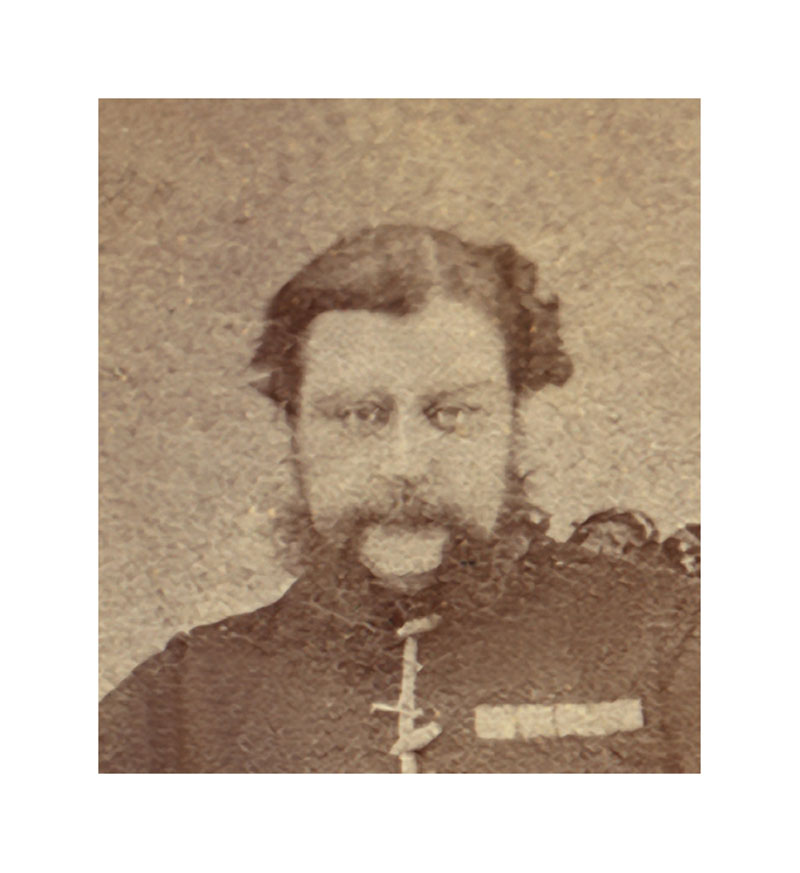
Born in the parish of St. Marylebone, London c.1825.
According to his marriage certificate (1856), his father, also William Waterson, was a soldier. No further information has yet been found.
Enlisted at London on the 27th of December 1843. [PB: Wendy Leahy also records 25 December 1843.]
Age: 18.
Height: 5' 8". [WL records 5' 7" and 5/8".]
Trade: Labourer.
Appearance: Fresh complexion. Hazel eyes. Brown hair.
From Private to Corporal: 13th of October 1848.
Corporal to Sergeant: 1st of June 1851.
Appointed to Troop Sergeant Major on the 25th of October 1854.
[PB: In 1856, TSM Waterson gave evidence in a court in Brighton in a case brought by Colonel Drury Lowe, commanding the 4th Light Dragoons, against a pawnbroker, a Mr Lyons, who had accepted a medal from Private John Baker of the regiment, "contrary to the provision of the Mutiny Act, by which the defendant had rendered himself liable to a penalty of £20." Baker and another soldier had pawned their medals (the Crimean Medal with a Sebastopol clasp).]

William Waterson, a Crimean veteran, stated as follows: I am troop Sergeant Major of the 4th Light Dragoons, which are now stationed at Brighton. Private John Baker of the same regiment is now in Court. Baker was absent without leave on the 2nd of July, and on examining his things during his absence, I discovered that they were deficient of his Crimean medal.
When he returned on the 3rd of July I saw him in the guard room, and in consequence of some conversation which I had with him, I communicated with Colonel Lowe who directed me to go to Mr Lyons' Shop in the New Road, where I saw Baker's medal pledged for 6s. I have the duplicate [i.e. receipt] which was given to me by Baker, and which corresponded with the ticket on the medal...
The medals are worn on one particular jacket. I did not miss Baker's medal till I examined his things on the 2nd July. I had not observed that he had not worn his medal for nearly six weeks. I do not think I could have missed it from parade, unless he wore another person's medal. We only wear the ribbon in undress."
Baker was in military custody awaiting court martial. He was asked whether he would know his medal if saw it again, and said he would because "I scratched my name on it with a pin".
Baker had scratched his name on the medal with a pin because "the medals were not marked yet, the Government not having time to do them."
Addressing the bench, Colonel Lowe fulminated against Baker and other "blackguards":
This Baker was one of the blackguards who had pawned his medal. He wears it (added the gallant Colonel) for a few months service, and struts about with it as if he had gone through the campaign, and then not having the pride to keep it as he ought to have done, he sells it in order to get beer, and to disgrace himself...
The misfortunate is that a great many blackguards have enlisted lately in the service, and we want to deprive these fellows of the means of disposing of their medals for the purpose of indulging in their drunken propensities. I have no ill feeling whatever against Mr Lyons, whom I do not know, on bringing this case forward, but I do it solely... on public grounds to prevent these fellows from selling their medals.
The magistrates were clearly sympathetic:
The Mayor [one of the magistrates] — It would have served Baker right if he had been turned out of the regiment.
Colonel Low — If he had been in the Crimea, he would have been flogged.
The Mayor — For a man to receive a regard of merit and disgrace himself in that way. One would naturally suppose that it would be the last thing he would part with.
Colonel Lowe — There will always be some black sheep in a flock. (A laugh.) And I am sorry to say that some medals have been stolen.
The Pawnbroker was fined three times the value of the medal, plus 1s for the offence and costs. The expectation was that nobody in future would be able to plead ignorance of the law concerning the pawning of medals. "The parties then left the Court, the man Baker in custody of a sergeant of the 4th Dragoons."
Baker himself was tried by a Regimental Court-martial at Brighton on the 12th of July 1856 for "Breaking out of barracks" and "Pawning his medal". He was sentenced to 84 days' imprisonment, with hard labour. He was confined in Lewes Gaol from the 6th of December 1856 to the 16th of May 1857, and discharged directly from Gaol, "consequent upon the Reduction of the Regiment", on the 17th of May 1857. His "Conduct and character" were given as "Indifferent." All previous service to be "forfeited by his conviction for desertion."
Marriage: Sergeant-Major William Waterson married Miss Mary Ann Austen, of Canterbury, on 26 October 1856 at St Margaret's Church, Canterbury.
A son, named William after his father and grandfather, was born in Beer Cart Lane, Canterbury, on 2nd March 1858.
Promoted to Regimental Sergeant Major on the 1st of September 1858.
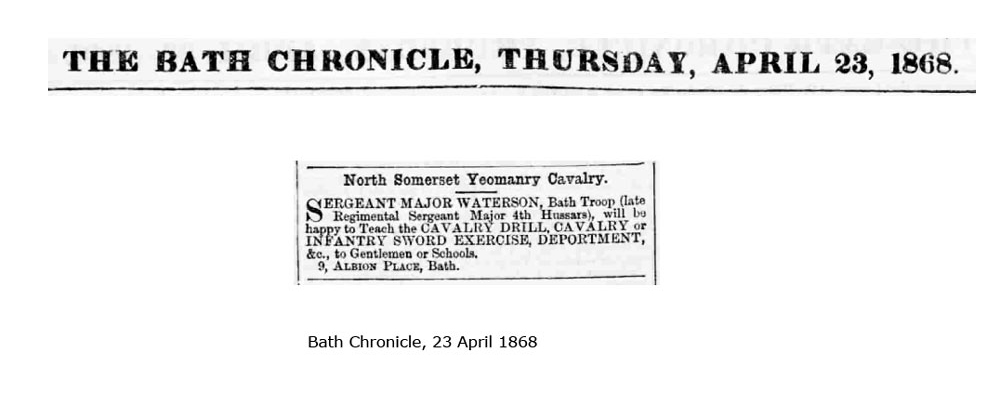
"On Command" to the Somerset Yeomanry from 1st August 1867.
[PB: Wendy Leahy includes a number of other dates.]
1843: Private
1854: Troop Sergeant Major
1864: Regimental Sergeant Major
1867: Regimental Sergeant Major
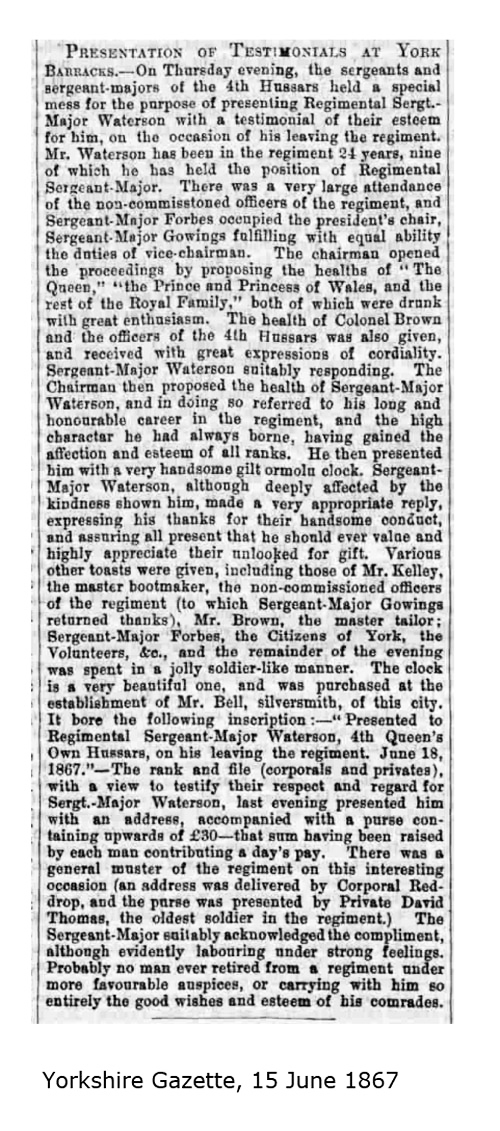
Discharged from Canterbury on the 14th of January 1868: "Free, to pension after having completed 24 years' service."
Served 24 years 19 days.
In Turkey and the Crimea: 1 year 10 months.
Conduct: "very good".
In possession of one Good Conduct badge when promoted and would now have had five.
Aged 43 years 1 month on discharge.
Awarded a pension of 2/6d. per day. To live at Bath after discharge.
Never entered in the Regimental Defaulters' book. Never tried by Court-martial.
Documents confirm the award of the Crimean medal with four clasps, Turkish Medal, Sardinian War Medal and the Long Service & Good Conduct medal with a gratuity of £5.
Entitled to the Crimean medal with clasps for Alma, Balaclava, Inkerman and Sebastopol.
Awarded the Sardinian War Medal. The citation for this stated:
"Displayed very gallant conduct in the action at Balaklava in the Light Cavalry charge, particularly in the retreat of the regiment after they had sabred the artillery men at their guns."
Awarded the Long Service & Good Conduct medal, 22nd of February 1863 [NM: 1865].
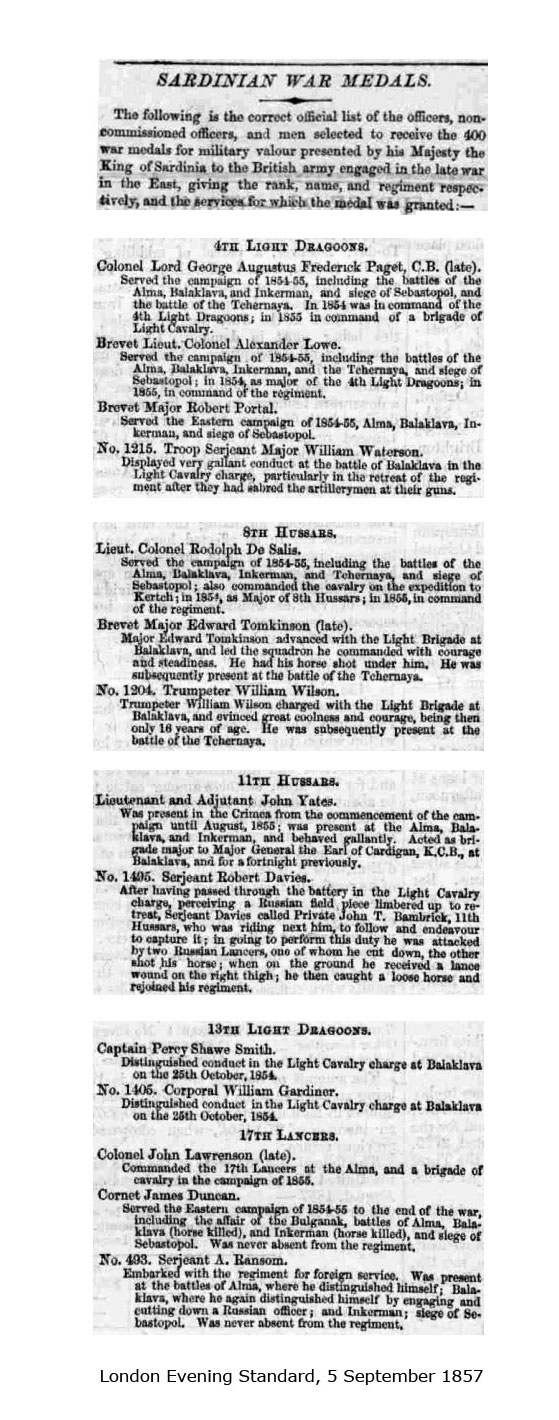
"No. 1215 Troop Sergeant Major William Waterson. Displayed very gallant conduct in the action at Balaklava in the Light Cavalry charge, particularly in the retreat of the regiment after they had sabred the artillery men at their guns."

Nick Miller writes: "My best estimate, based on the apparent ages of the children, and the fact that he appears to be wearing four medal ribbons (i.e. British Crimean, Turkish Crimean, Sardinian and LSGC), is that it was taken around 1865-6, either in Dundalk or Edinburgh. Don't be misled by the 'Norwich' thing — yes it was taken in Norwich, but it's a photograph of an earlier photograph that was taken somewhere else. You can tell that because you can see signs of creasing that was in the original photograph, but is not physically present in the later one."

MARRIAGES. Waterson-Austen — Oct. 26 [1856], at St Margaret's Church, Canterbury. Mr. William Waterson, Sergeant-Major, 4th Dragoons, Brighton, to Miss Mary Ann Austen, of Canterbury. [Kentish Gazette, 28 October 1856 (Nick Miller).]
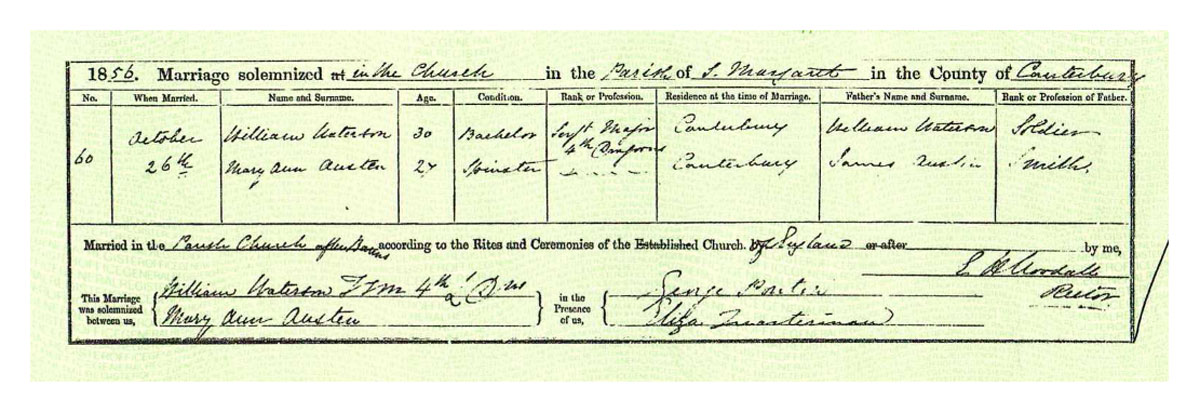
On 26th October 1856, at the Parish Church of St Margaret, Canterbury, after banns, William Waterson, aged 30, Bachelor, Troop Sergeant Major 4th Dragoons, living in Canterbury, married Mary Ann Austen, 27, Spinster, no occupation shown, living in Canterbury. His father's name was recorded as William Waterson, Soldier, hers as James Austen, Smith. [Source: Copy of GRO Marriage Certificate, made 5 December 2002; provided by Nick Miller.]
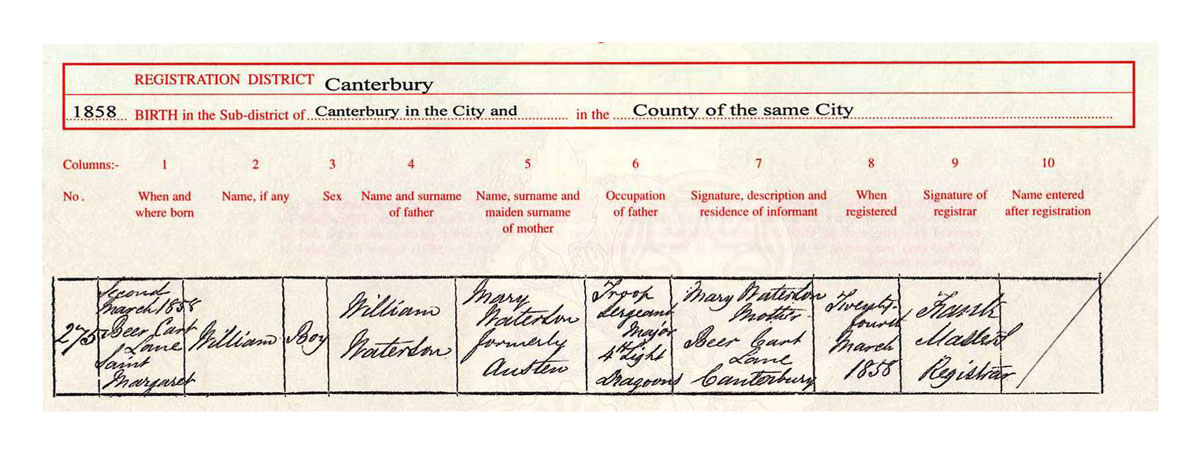
Birth in the Sub-district of Canterbury in the City, Second March 1858, Beer Cart Lane, Canterbury, William, Boy, Father's name William Waterson, Occupation Troop Sergeant Major 4th Light Dragoons, Mother's name Mary Waterson formerly Austen, Informant Mary Waterson Mother, Beer Cart Lane, Canterbury, Registered Twenty-fourth March 1858. [Source: Copy, provided Nick Miller.]
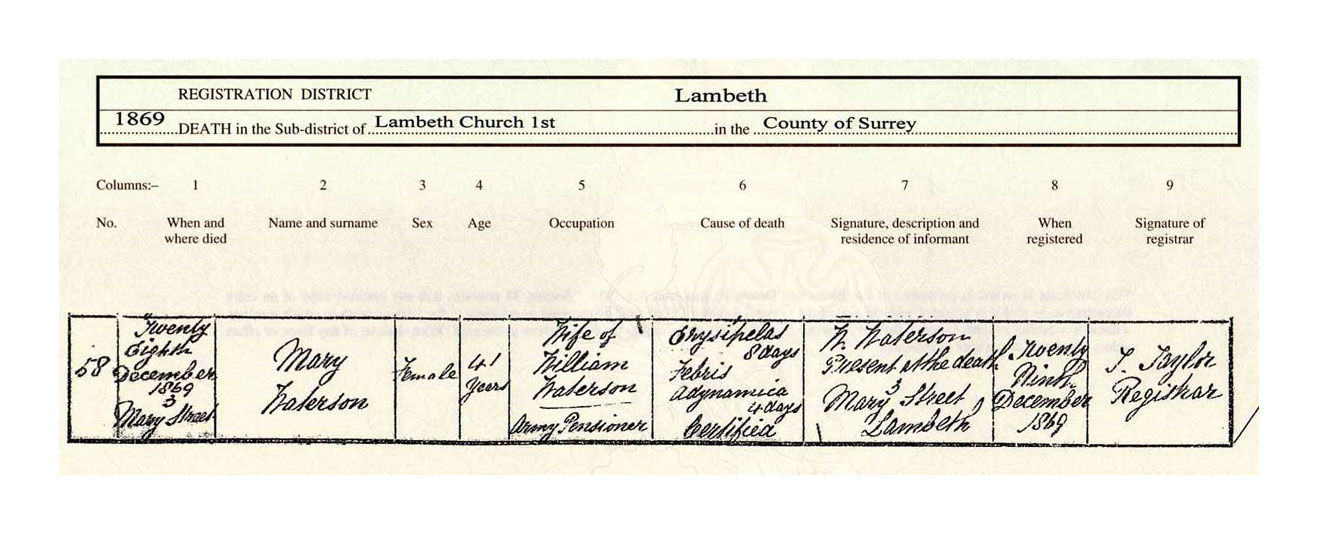
Died in the West London Pension District on the 6th of February 1871.
William Waterson died in the Charing Cross Hospital and was buried in the Commissionaires' Ground at Brookwood Cemetery, Woking, on the 14th of February 1871, aged 45 years. The service was conducted by the Revd. F. Owston. However, nothing can be found from the Corps of Commissionaires' records to show just when he joined.
Death registered
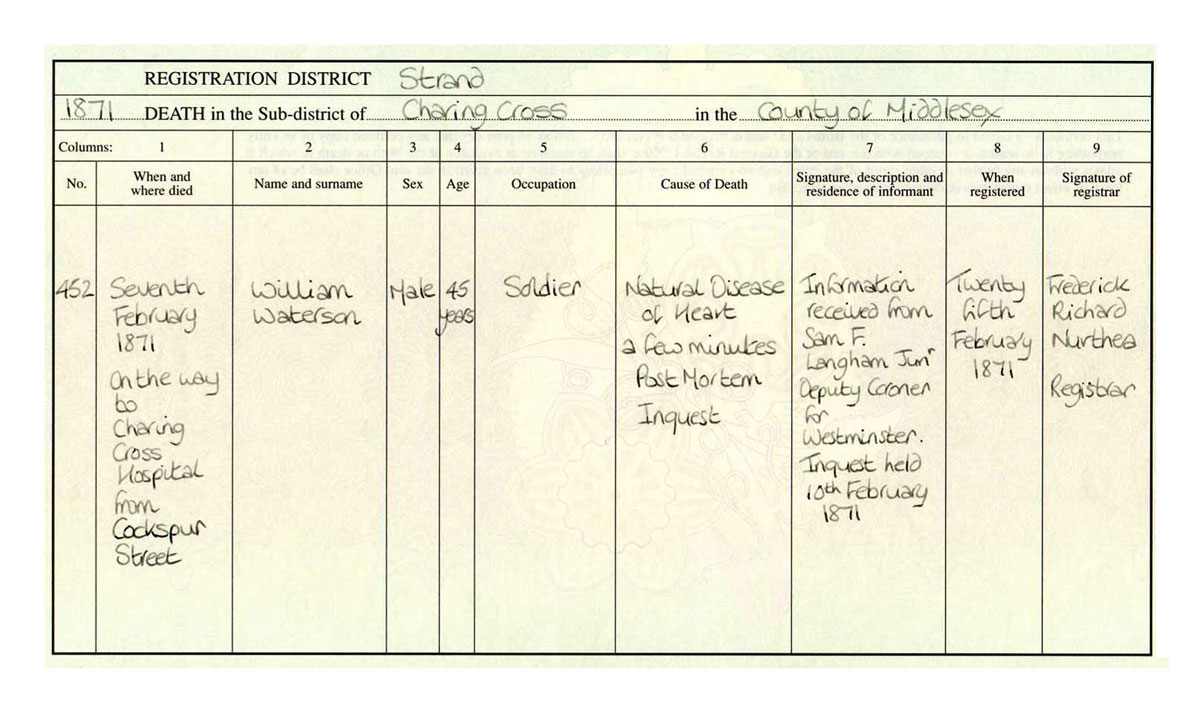
The St. Catherine's House records shows him as dying in the Strand District of London during the January-March quarter of 1871, aged 45 years.
Nick Miller:
You will note from the William Waterson death certificate that there was a post-mortem inquest. I have a copy of the inquest: the original is held in the Muniments Room at Westminster Abbey. Here's a transcription of the notes taken at the inquest by Deputy Coroner Samuel Frederick Langham:
"Information of witnesses taken this tenth day of February 1871 at St Martin's Vestry Hall situate in St Martin's Place in the Parish Of St Martin-In-The-Fields before Charles St Clare Bedford Esquire, her majesty's coroner for the said City and Liberty, by Samuel Frederick Langham Esquire, his deputy, touching the death of William Waterson then and there lying dead as follows.
"Wm Waterson, 68 Romney St Westminster, Telegraph Boy, being sworn saith that deceased William Waterson was my father, 68 Romney Street, soldier, he was 45 years of age. The last time I saw him alive was 11 o'clock last Monday at the Foreign Office, he complained of a rash over him — he had not been unwell since — I came home on Monday night at ½ past 10 and found him out — he sometimes complained of pains round the heart.
"Frank Grant 135, a PC, being sworn saith — On Tuesday morning at 1:50 in the morning I was on duty in Cockspur St — I found deceased lying under the window of No 20 — I spoke to him and asked what was the matter — he said 'All right, I shall be all right again in 5 mins' — I asked him where he lived — he said Westminster. He commenced shaking all over his body — he put his hand to his head and said 'Oh my poor head' and fell down — I sent for a constable and took him to Charing Cross Hospital, the doctor came directly and pronounced him dead.
"Samuel Silverthorn Noakes, House Physician at Charing Cross Hospital, being sworn saith I saw deceased on his admission about ¼ past 2, he was dead — body was warm — nothing externally to account for death — I have made a post-mortem examination, I found disease of the heart, liver and kidneys — brain was healthy — heart was large, pale and fatty — deceased died from disease of the heart.
"Verdict: Natural death from disease of the heart."
[Source: The inquest notes are held in the Muniments Room at Westminster Abbey (transcript by Nick Miller).]
EJB: The Corps of Commissionaires' Burial Plot in Brookwood Cemetery comprises roughly three-quarters of an acre. There are only some 50 or so stones, the earliest seen being dated in 1906, but none to men who would have been in the Crimea with the Light Brigade. There is also a memorial relating to its use by the Corps and of its founder. (See photographs of the Burial Plot area and of the memorial itself in the 4th Hussar file.)
Nick Miller:
"I have confirmed that William Waterson was indeed buried at Brookwood on 14 Feb 1871 — it's in the Brookwood Cemetery records held at Surrey Archives in Woking. Those records don't however make any reference to the precise grave location — apparently the records that would have given this were destroyed by enemy bombing during World War Two.
I believe the Commissionaires' Ground information is probably good, though, and I'm assuming it came originally from Mrs Hurst? I've had a trawl through a fair amount of the Corps of Commissionaires archive, which is rather random and has been deposited at London Metropolitan Archives, and so far found no reference to William Waterson.
I can also confirm that there's definitely no memorial in the Commissionaires' Ground at Brookwood. The fact that the last time his son saw him was 'at the Foreign Office' is obviously highly suggestive."
According to a descendant, Mrs Hurst [see Further information, below], William Waterson was married on the 26th of October 1856 at St. Margaret's, Canterbury, and the couple had two sons, Charles and William.
The RMA records (see below) show his wife's name as Mary Ann. She is believed to have died some time before 1870.
According to Mrs Hurst, William was born on the 2nd of March 1858 (this does not agree with the age shown on entering the Royal Military Asylum), and died in December 1912 at Southend-on-Sea.
William Waterson [son][??] Charles Waterson was born at Cahir, Ireland, on the 23rd of May 1862. Mrs Hurst said all trace of him was lost in 1910.
A son, Charles, entered the Royal Military Asylum (also known as The Duke of York's School) at Chelsea on the 15th of June 1870, aged 8 years and one month. His father was shown as "Still alive," and his mother, Mary Ann, as "Dead".
He enlisted into the 4th Hussars (as No. 1517) at Canterbury on the 24th of June 1876, "By Special Authority of Horse Guards" at the age of 14 years.
He attained the age of 15 years and on to "Man's Pay" on the 27th of June 1877 (see his presumed, date of birth according to the family) and was sent to Kneller Hall on the 17th of June 1878.
Although still serving in 1887, no records are available about him after this period. His conduct during his service was not very good, being almost continually in trouble of some degree.
In 1980, EJB corresponded with William Waterson's great-grand-daughter, a Mrs. Hurst, who was living in Hounslow. His notes say that she had his Army Pay-book.
According to her information William Waterson was married on the 26th of October 1856 at St. Margaret's, Canterbury. Two sons were said to have been born of this marriage, Charles, born on the 2nd of March 1858 (this does not agree with the age shown on entering the Royal Military Asylum), who died in December 1912 at Southend-on-Sea, and William, born at Cahir, Ireland, on the 23rd of May 1862, of whom all trace was lost in 1910.
[PB: EJB records Mrs Hurst's name as "Mrs Muret". Nick Miller: "The surname is actually 'Hurst'. I assume the confusion arose when transcribing hand-written notes: if you read an 'M' instead of an 'H', and an 'e' instead of an 's', 'Hurst' magically transforms into 'Muret'! Anyway, I've met her and she does indeed have his original pay-book, which I've handled, but thus far have not managed to get a scanned copy of."]
Wendy Leahy's Shadows of Time website includes a page on William Waterson. She cites TNA sources WO/12/653, WO/12/668, WO/12/671, WO/23/62.
The editors would like to thank Nick Miller, William Waterson's great-great-grandson, for contacting the archive in December 2015. He has provided an enormous amount of information, copies of documents, and a fine photograph which have greatly enhanced this entry.