Service
"Deserted" on the 15th of December 1842 and rejoined the regiment on the 15th of January 1843.
Tried by a Regimental Court-martial, imprisoned from the 19th of January — 1st of April 1843, and to forfeit all previous service.
In connection with this forfeiture a letter was sent from "Horse Guards, 15th January 1856:
"[To:] Colonel Bonham, Commanding the Cavalry Depot, Brighton.
Sir, — In reply to your letter of the 15th inst., relative to the restoration of the forfeited service of 579 Private John Duggan, 17th Lancers, I have to acquaint you that the name of this soldier has been submitted to the Deputy Secretary of War preparatory to the submission of the same to the Queen for the grant of the boon in question. As soon as Private Duggan's services are restored, no time will be lost in apprising him of the fact.
I have, etc,
R. P. Douglas, AAG."
Lost service to be allowed to reckon towards pension, vide War Office Authority, dated 22nd of March 1856. Total of 3 years 350 days.
Sent money from the Crimea to his wife Mary (no address shown).
Sent to Scutari on the 26th of October 1854 after being wounded-in-action at Balaclava.
Invalided to England aboard the "City of Norwich" on the 3rd of March 1855 and at the Chatham Invalid Depot from the 31st of March.
Tried by a District Court-martial on the 31st of December 1855 for "habitual drunkenness" and awarded four months' imprisonment with hard labour and stoppage of 1d. per day for two years. One month of the prison sentence was remitted.
Discharge & pension
Discharged at Brighton on the 21st of April 1856, as "Rendered unfit for further service from a gun-shot wound in the left elbow by which the action of the joint is permanently lost".
Served 17 years 1 day, to count. In Turkey and the Crimea: 1 year.
Conduct: "A good soldier." In possession of three Good Conduct badges.
Pension increased to 1/6d per day following a Medical Board held on the 16th of April 1864.
Pension details to the 31st of August 1881.
Life after service
(Click on image to enlarge)
1861 Census
Gatehouse, Euxton Hall, Lancs.
The 1861 Census shows him as a "Chelsea Pensioner, late 17th Lancers", aged 45, with his wife Mary, 44, born Ireland.
Euxton Hall was the ancestral seat of the Anderton family who had been there since the 15th Century. The main Hall had been rebuilt c. 1850. Its occupant at this time, who Duggan would have worked for, was William Ince Anderton, 35, "Gentleman, Late 17th Lancers", whose son of the same name later served in the Grenadier Guards.
[PB, June 2014: The Hall, partly demolished, is now a private hospital, but it seems the gatehouse may still be there, possibly named "Bottom Lodge". A Wikipedia article on Euxton (accessed 15.4.2017) says:
The hall had three lodge houses, one at the bottom of Chapel Brow, one at main gates of Euxton Park on Wigan Road and one on Dawber's Lane which is now much extended and known as Dower House.
In 2014 there was a photograph of a gatehouse here: flickr.com/photos/larfin_out_loud/14067077014 (accessed 4.6.14 — link did not work 14.4.2017)]
At some point, John Duggan returned to his birthplace. According to an obituary:
After being discharged on pension he returned to Drogheda, and was employed for some time under C. McCauseland, Esq., as a porter in the Belfast Bank. A vacancy having occurred in the office of the sexton at St. Peter's, he was appointed and held it to his death.
Death & burial
Died on 22nd of March 1881 at Drogheda.
From the Army and Navy Gazette, April 1881:
"17th Lancers — "Private John Duggan, late sexton of St. Peter's Church at Drogheda, died on the 22nd of March 1881. A handsome white marble headstone was erected to his memory on the north side of the churchyard. The headstone bears the regimental badge, encircled by an olive wreath, a ribbon below bearing the words — 25th of October 1854."
[Image from Pinterest, 26.12.2017. Substitute or add EJB image. Curiously, the person whose pin this was commented that John Duggan "was a survivor of the Battle of Boyne".]
(Click on image to enlarge)
(There is a photograph of his gravestone in the 17th Lancer file. By 1995, Many of the leaded insert figures and lettering had fallen out.)
[PB, December 2017: It is interesting how the skull-and-cross-bones motif, ?badge of the 17th Lancers, resonates with the symbol of mortality once widely seen on headstones (though largely in earlier centuries).]
His tombstone bears the inscription:
"Sacred to the memory of John Duggan, who died at Drogheda, 22nd of March 1881, aged 67 years. Late Private 17th Lancers, and Sexton of St. Peter's Church, Drogheda. He fought in the battles of the Alma, Inkerman, Sebastopol and Balaklava."
Two texts from the Second Epistle to Timothy follow:
"I know whom I have believed." 2 Timothy 1-12
"I have fought a good fight, I have finished my course, I have kept the faith." 2 Timothy 4-7.
See copy of his obituary and funeral report taken from the Drogheda Conservative for the 26th of March 1881 in the 17th Lancer file.
Extract from the Drogheda Argus, Saturday, 26th of March 1881:
"Death of a Balaclava Man — The number of survivors of those who rode in and out of the jaws of death in the famous charge at Balaclava, has been further reduced by the death of Mr. John Duggan, sexton of St. Peter's Protestant Church, Drogheda, which took place on Tuesday last. Mr. Duggan, who was a native of Drogheda, served in the 17th Lancers and was with his troop when the fatal order which 'Someone has blundered. Forward the Light Brigade' — precipitated the gallant six hundred in that desperate charge, right upon the Russian batteries.
Duggan did not come scathless out of it. A lance thrust pierced his bridle arm, through which it dropped powerless to his side. He also received a couple of sabre cuts and his bridle rein was cut by bullets. To his good steed he owed it that he was brought back within the lines of the Allied army and lived to tell the tale.
After being discharged on pension he returned to Drogheda, and was employed for some time under C. McCauseland, Esq., as a porter in the Belfast Bank. A vacancy having occurred in the office of the sexton at St. Peter's, he was appointed and held it to his death.
He was a very retiring and mild-mannered man, and rather belied the character of the traditional old soldier, a boaster of the dangers he had passed through. If skilfully drawn out however — and it required tact to do it, for he modestly avoided any allusion to the historic charge, in which he was a living actor — his eye would kindle as the panorama of the field of Balaclava passed again before his vision and he rehearsed its incidents. The wound from the lance thrust never healed properly and helped to wear down a constitution never strong.
Although well on in years, he stood straight as a lance-shaft, till within the past few months, when his health completely failed him.
The interment took place at St. Peter's Churchyard on Saturday last."
Belfast News Letter, 24 March 1881:
Belfast News Letter, 24 March 1881.
(Click on image to enlarge)
Further information
[RM: Extract from the Southport Visitor, June 17th 1858:
VISIT OF THE LANCASHIRE HUSSARS TO SOUTHPORT.
Southport during the past week has been under, 'military occupation' albeit far more lively than is usually understood by that expression. On Saturday last at 4pm under the command of Sir Robert GERARD Bart of Garswood they entered the town for the accustomed, 8 days drill.
"The corps consist of three troops, one in Ashton-in-Makerfield, one in St Helens and the other Liverpool, they number about 150. The head quarters are at the Victoria Hotel, the Liverpool [C Troop] under Capt LOCH are stationed at the Scarsbrick Arms, host Mr STOCKER, the band at the Bold Arms, the remainder of the men billeted at various inns. Sir Robert, belonged to the, 'Regulars', and has the advantage of soldiers who have, 'seen some service'.
"The Regimental Sgt Major SHIRLEY, served in the 11th Hussars, Sgt Major HALL in the Enniskillens, Sgt DAPPLYN in the Royal Dragoons, Sgt HOGAN in the 6th Carabineers, Cpl DUGGAN served 18yrs in the army and has a Crimean medal with clasps for, Alma, Balaklava and Sebastopol, he was wounded in the Balaklava charge."
Additionally, Duggan is listed as a Corporal serving in "B" Troop, the men from this troop living around Ashton in Makerfield.]
Medals at auction 4 July 2019
Morton & Eden July 4, 2019 LOT 1396.
"A Crimean War 'Light Brigade' Pair attributed to Private John Duggan", Morton & Eden auction, 4 July 2019, Lot 1396.
(Click on image to enlarge)
A Crimean War Light Brigade Pair attributed to Private John Duggan, 17th Lancers, who was severely wounded during the Charge of the Light Brigade on 25 October 1854, comprising: Crimea, 1854-56, 4 clasps, Alma, Balaklava, Inkermann, Sebastopol, with silver top bar and old length of ribbon (John Duggan. Private. 17 Lancers.), erased and renamed in an elegant running script; Turkish Crimea, 1855-56, Sardinian issue, unnamed as issued; Pair loose, toned, edge nicks and minor bruises, otherwise nearly very fine (2)
Estimate: £300-500. SOLD £1,000.
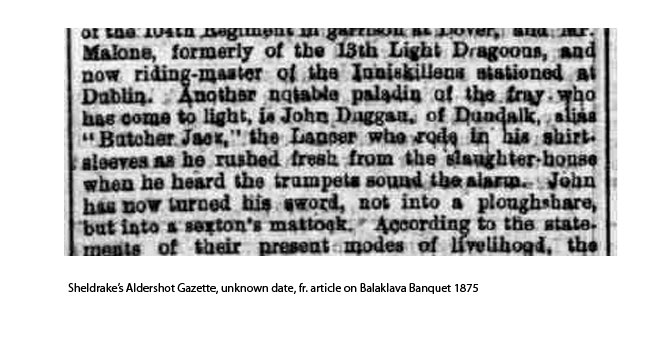
579 Private John Duggan was born c.1814, and is mentioned in the Book Honour the Light Brigade by Lummis and Wynn, who state that he enlisted for service on the 31st of December 1838, and that he was severely wounded in the charge of the Light Brigade on 25 October 1854. He was sent to the hospital in Scutari on 26 October 1854, and then was sufficiently recovered to return back to England the following year on 2 May 1855. He is entitled to a 3-clasp medal, and was a member of the Balaclava Commemoration Society in 1879. He died in Drogheda, Ireland on 22 March 1881, at the age of 67, and was buried in the churchyard of St Peter's Church, Drogheda (where he had been the Sexton).
"He is noted in the article 'Irishmen in the Light Brigade, Balaklava, 1854' (The Irish Sword, Vol.XII, 1975-6) as being one of fifteen other ranks (and two officers) from Ireland who served with the 17th Lancers and took part in the charge."
He is possibly related to William Duggan, 17th Lancers, who enlisted on the same day and has the subsequent regimental number (580).
Sold with an old envelope from C. C. Allen & Son, Watchmakers & Jewellers, 57 & 59 South Street, Chichester.
[PB: I am indebted to Tony Margrave for this information. Personal correspondence, 10 July 2019. The original url was here (accessed 10.7.2019).]