LIVES OF THE LIGHT BRIGADE
The E.J. Boys Archive
Added 14.9.11. Minor edits 8.4.14, 23.5.14. Graphic article added 28.9.15.
IN PROGRESS — NOT FOR PUBLICATION
416, Sergeant Henry JOY — 17th Lancers
Birth & early life
Born at Ripon, Yorkshire, c.1819.
He entered the Royal Military Asylum, Chelsea, on the 4th of March 1825, at the age of six years and 6 months. His father is shown as James Joy, a Private in the 1st Life Guards, and his mother as Mary Joy. Both parents were shown as "Alive" at this time.
James Joy
His father, James Joy, had enlisted into the 1st Life Guards, Regimental No. 20, at Harrogate on the 24th of August 1810, at the age of 18 years.
Born at Pately, Yorkshire, he was 5'10" in height, with a fair complexion, blue eyes and fair hair. His trade was that of a miller.
He was discharged on the 18th of September 1838, as being:
"unfit for any further service in consequence of rheumatism of very long standing. Contracted in the service and not attributable to any vice, neglect, design, or of his intemperance."
Conduct: "that of a good and efficient soldier. Seldom in hospital, trustworthy and sober."
Served 22 years 36 days, to count.
Unable to write — had to make his mark.
Served with the regiment in the Peninsula, the Netherlands and France and was present at Waterloo, where he was slightly wounded in the right thumb.
Received the medal for Waterloo and also the Military General Service medal with clasp for Toulouse.
Awarded a pension of 1/3d. per day.
Lived in the London Pension District after discharge, and this was where he died on the 3rd of March 1870.
Enlistment
Enlisted at Dublin on the 13th of May 1833.
Age: 14 (according to the muster rolls), but by his documents 15 years 1 month.
Height: 4' 9".
Trade: Musician.
Service
Joined the Regimental Band from the Royal Military Asylum on the 17th of May 1833.
From Private to Trumpeter: 2nd of April 1838.
Promoted to Trumpet-Major on the 22nd of May 1847.
In charge of the Band at the funeral of the Duke of Wellington. 128 N.C.O.s and men had represented the Regiment, being paid 1/- per man extra on that day.
Orderly Trumpeter to the Earl of Lucan during the Crimean campaign. He had two horses shot under him during the Charge of the Heavy Brigade and was slightly wounded.
"Henry Joy, 17th Lancers, relates:
I was trumpet major of the cavalry division, commanded by General Lucan. On the morning of the 25th October, 1854, as General Lucan and his staff were riding down the plain, all of a sudden some rifles were discharged at us, unfortunately killing Captain the Honourable Walter Charteris, aide-de-camp to the Earl of Lucan. After proceeding some short distance further we witnessed the blowing up of a Turkish redoubt. The Earl of Lucan got wounded in the foot, while several officers, who had come to join the staff, were also slightly hurt. Shortly afterwards Captain Nolan brought the order from Lord Raglan to General Lucan that the Light Brigade was to immediately attack and prevent the enemy from taking the guns. His lordship said that it was impossible, and that he had no supports or guns near him to assist in the attack; but Captain Nolan still persisted in the instructions that he had received. The Earl of Cardigan was then sent for, and to him was given the order. In the meantime the Earl of Lucan had sent Captain Walker, aide-de-camp, to the officers of the heavy cavalry, commanding them to bring up the Heavy Brigade in support as quickly as possible, which was done, and they came in position in line on the same ground as that from which the Light Brigade had just charged down the valley. Some time afterwards Captain Lockwood, aide-de-camp to the Earl of Cardigan, rode up to me in a state of great excitement, without his busby, asking if I had seen Lord Cardigan. I replied, "Yes; he has just passed me," and I pointed in the direction which he had taken. The captain rode away, and I never saw that officer again. On the day following the charge I went down the valley with a flag of truce to General Liprandi, the Russian general in command."
[PB: acc to Douglas Austin the ILN version was reprinted from the D Telegraph)
HENRY JOY ACCOUNT IN ILN & DT 1875.doc
Transcript by Roy Dutton (who seems to have copied it from DJA)
Check this version against DJS's 2004 transcript in Balaklava Anniversary at Alexandra Palace 2 Oct 1875 p.22.]
After the battle he was sent (with
Captain Edward Fellowes, 11th Hussars) to the Russian lines with a flag of truce and brought before General Liprandi.
Sent money from the Crimea to his wife, Jane, living in Hounslow, London.
Removed to Duty Sergeant and was sent to the Depot at Canterbury when the regiment went to India, 1st of October 1857.
Discharge & pension
Discharged from Maidstone on the 21st of April 1860, at "Own request, after 24 years' service".
Service to count, 24 years 9 days. In Turkey and the Crimea: 2 years.
Aged 42 years 1 month on discharge. (As he is said to have had 28 years' total service altogether, his muster roll age on enlistment would seem to have been the correct one.)
Medals
Entitled to the Crimean medal with clasps for Alma, Balaclava, Inkerman and Sebastopol, and the Turkish medal.
Documents confirm the award of the Distinguished Conduct, Crimean, Turkish, and Long Service medals.
Awarded the Distinguished Conduct Medal, having been recommended for it on the 19th of January 1855. He also received a gratuity of £15, but it is not known under what circumstances.
Awarded the Long Service & Good Conduct medal on the 31st of October 1857.
NAM: Medal group awarded to Trumpet-Major Henry Joy, 17th Light Dragoons (Lancers), 1855.
Henry Joy's medals, NAM.
(Click on image to enlarge)
Born in Ripon, Yorkshire, Henry Joy was the son of James Joy, a private in the 1st Life Guards, who had served in the Peninsular (1808-1814) and at Waterloo (1815). Henry entered the Royal Military Asylum at Chelsea in 1825 at the age of six and in 1833 he enlisted in the 17th Light Dragoons (Lancers) as a musician in the regimental band, becoming a trumpeter in 1838. Promoted trumpet-major in 1847, he was in charge of the band at the funeral of the Duke of Wellington in 1852.
Appointed Orderly Trumpeter to the Earl of Lucan in the Crimea, he rode in the Charge of the Heavy Brigade where he had two horses shot under him and was slightly wounded. He died in 1893. In addition to the Distinguished Conduct Medal (DCM), Joy was awarded the Crimea War Medal 1854-56, Long Service and Good Conduct Medal, Army, 1857 and Turkish Crimean War Medal. Sadly, the exact circumstances of the award of his DCM are not recorded.
The Crimean War (1854-1856) highlighted the need for an award for other ranks and non-commissioned officers, which could be made exclusively for acts of gallantry in action. As a result the Distinguished Conduct Medal was instituted in December 1854.
NAM Accession Number: NAM. 1963-10-51-1
Acknowledgement: Donated by the Royal United Service Institution
Copyright/Ownership: National Army Museum, London
Location: National Army Museum, Study collection
Object URL: https://collection.nam.ac.uk/detail.php?acc=1963-10-51-1
[Accessed 29.4.2018.]
Further detailed medal information archived.
Commemorations
Attended the Banquet held at the Alexandra Palace, Muswell Hill, London, on the anniversary of Balaclava, 25th of October 1875.
A member of the Balaclava Commemoration Society in 1877 but not on the 1879 revised listing. He was later refused membership on the grounds that he had not ridden in the Charge of the Light Brigade.
[Check the above dates, which appear to contradict.]
Likenesses
Portrait of Henry Joy in the Illustrated London News, 30th October 1875.
(Click on image to enlarge)
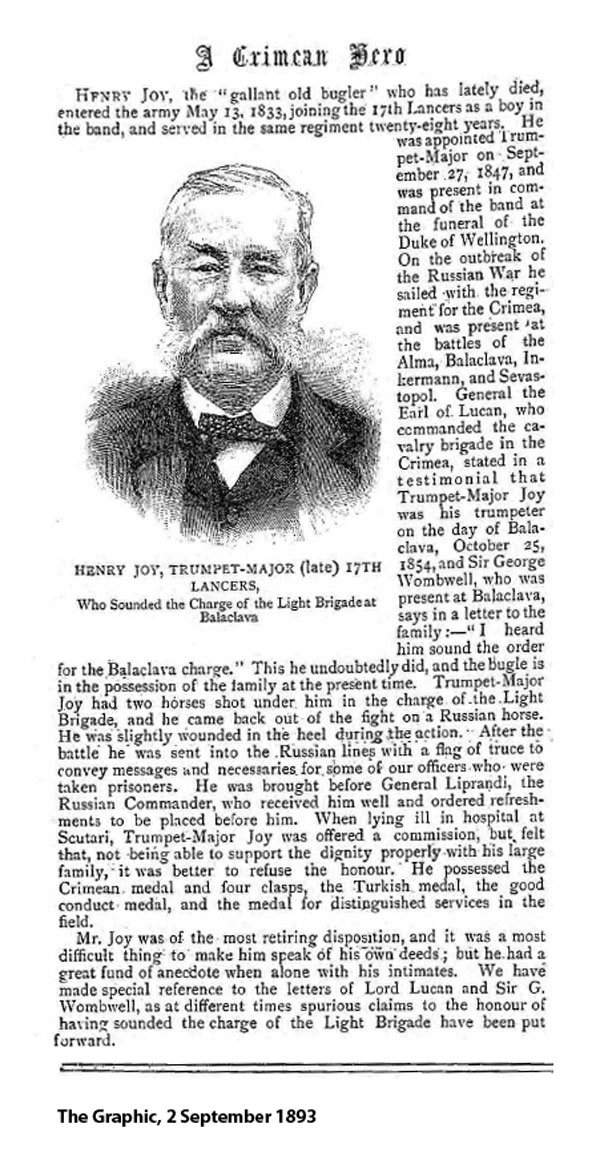
Line portrait in The Graphic, 2 September 1893
(Click on image to enlarge)
"The late Trumpet-Major Henry Joy, who sounded the Charge of the Light Brigade. Illustration for The Illustrated London News, 9 April 1898."
This was reproduced in an issue of Look and Learn, possibly in the 1960s. In 2018, it was available online in the Look and Learn Picture Library, hence the watermark. [FOR REFERENCE ONLY — NOT TO BE PUBLISHED.]
(Click on image to enlarge)
[RM: There are two photographs of Henry Joy in the National Army Museum archives. One is a portrait that shows him in undress uniform, wearing his medals, supposedly taken around 1856 but as he is wearing a Turkish Crimea medal this could not have been so and must date post-1860. The other is a family full-length picture taken in later life is with his wife and, possibly, a son. PB: DO WE HAVE COPIES IN THE ARCHIVE?]
Life after service
To live at 4, Smart's Terrace, Addington Park, London, on discharge.
1861 Census
4, Smart's Terrace, Lambeth.
Henry Joy, 42 Messenger, Chelsea Pensioner, born Ripon.
Jane, 31, Hounslow.
Five children shown: Amy 10, Beatrice 8, Bertha 6, Emma 2 & Jenny 8 months.
1871 Census
50, Millman Street, St Pancras, Marylebone.
Henry Joy, 52, Messenger, Ripon.
Jane, 42 Hounslow.
Ten children shown: Amy, 20, Bertha, 16, Jenny, 11, Emma, 9, Marian, 8, James, 6, Henry, 5, Grace, 3, Amelia, 2, & Beatrice, 19.
1881 Census
Commander-in-Chief's Office Building, St Martin's in the Fields Parish
The 1881 Census shows him as a Messenger, War Office, aged 62, born in Ripon, Yorkshire, with his wife, Jane, aged 52, born in London.
Six children are shown: the eldest daughter, Emma, a Female Accountant; a daughter, Maria, living at home; two sons, James and Henry, Junior Clerks; and two other children, Grace and Herbert, Scholars.
1891 Census
3, Bank Street, Chiswick.
Henry Joy, 72, Army Pensioner.
Jane, 62.
James G, 25.
Grace A 22.
Herbert, 18.
Death & burial
Died on the 17th of January 1893 at 3, Bank Buildings, High Street, Chiswick, aged 74 years. A messenger at the War Office, he left his personal estate of £313 to his widow, Jane.
Death registered
Henry Joy, aged 74 years, September Quarter 1893, Brentford.
He was interred in the Burial ground of the parish church of St Nicholas, Chiswick, where there is a marble cross over his grave. This was paid for by the officers of the regiment.

[PB: Photograph from the St Nicholas website. The caption reads "[T]he last resting-place of Henry Joy, the trumpeter who sounded the 'Charge of the Light Brigade', who died in 1893." (Accessed 5th October 2011)]
Article about Henry Joy, in The Graphic, that appeared shortly after his death.
(Click on image to enlarge)
The Army Chaplain's Baptismal Registers at St. Catherine's House show two daughters (besides the son shown in the photograph with his parents) were born to Henry Joy and his wife (name not shown): Amy, born in Dublin in 1849, and Harriet H., born at Canterbury in 1851.
Extract from Jackson's Woolwich Journal, 1st of September 1883:
"17th Lancers — In the grave-yard of Chiswick Parish Church on the 19th of August were conveyed to their last resting-place the remains of Henry Joy. Joy, as the Staff Trumpeter to Lord Raglan [sic] sounded the advance for the famous Balaclava Charge. The coffin, which was of polished oak, bore the inscription, "Henry Joy. Died Thursday, August 17th 1893, in his 75th year." The Revd. N.W.T. Dale, of Chiswick, officiated. The mourners included the two sons and four daughters of the deceased."
One of his sons is also commemorated on his gravestone:
"Henry Charles Joy, Royal Garrison Artillery, 4th son of Jane and Henry Joy. He died at St. George's, Bermuda [part of the "U" and "D" are missing] on the 2nd of December 1894, aged 28."
(There are more photographs of the grave in the 17th Lancer file. Also photographs of Henry Joy, his wife and son, and of his bugle and decorations.)
Further information
Henry Joy's Bugle, NAM.
(Click on image to enlarge)
In 1906 his bugle and medals were sent by Mrs Joy to Debenham and Storr's sale-rooms and were there sold to a Mr. T.G. Middlebrook for the sum of 750 guineas. On the 30th of January 1908 they were again sold in the same sale-rooms to Mr. W. Astor, who later presented them to the R.U.S.I Museum in Whitehall, both being shown in an official catalogue of the Museum published in 1906.
Lummis and Wynn state that his group of medals and his bugle are now in the National Army Museum at Chelsea, but the Guide to the Regimental Museum at Belvoir Castle lists a bugle as being one of the items on display there.
The bugle is engraved, "Presented by the Colonel of the 17th Lancers to Trumpet-Major H. Joy, on which the Balaclava Charge was sounded on October 25th, 1854." This, and the other transactions, aroused strong protests, and many letters on the subject were written to the newspapers. Prominent amongst these was W.H. Pennington of the 11th Hussars, who denied that the charge was ever sounded and copies of the letters he wrote may be seen in the 11th Hussar file.
The Balaclava Centenary number of the White Lancer and Vedette tells a slightly different story:
"The officers of the 17th were anxious to obtain from Joy his bugle, so they had made in Dublin an exact copy in silver which they intended to present to Joy in exchange or his brass one. The Trumpet-Major however preferred to keep his own and so, on his death, it entered the auction rooms. The bugle was bought by Mr Middlebrook, the owner of a public house in Regent's Park, along with Joy's medals. Mr Middlebrook bequeathed the bugle to the Regiment, but on his death his executors once more put it up for sale and it was bought by the Royal United Services Institute and is now in their Museum at Whitehall. Fortunately the Regiment still has the silver replica, a battered but much-loved memorial of the Charge."
Accompanying the article was a picture entitled "The silver replica of Trumpet-Major Joy's bugle." (See copy of this in the 17th Lancer files.)
Extract from the United Services Gazette, 27th of February 1908:
"The bugle that was sold about a fortnight ago for £300 is unquestionably the instrument on which Lord Lucan's trumpeter sounded the "Charge" for the Heavy Brigade, but there is also no proof whatever that the order to charge was conveyed through it to the Light Brigade.
Facts prove to the contrary, for at the court-martial of its commander, Lord Lucan, the then Captain Robert White — afterwards General Sir Robert White — gave evidence that beyond the order to "Trot", none other was given by Lord Cardigan to his trumpeter, who was an 8th Hussar man, and had Lord Lucan ordered his trumpeter — the original owner of the bugle just sold — to sound the "Charge", the fact would have come out at the proceedings.
Moreover, it was not until twenty years after that he claimed to have sounded the charge for the Light Brigade. His claim was altogether repudiated by his regiment, and further, he was not permitted to attend the Balaclava Dinners, as he had taken no part in the disastrous charge."
Joy's role was to continue to be misunderstood. From the Daily Express, 13th of October 1954:
"A letter has been sent to the Editor referring to a news-item concerning a reference to Lord Lucan. This is of particular interest to me, as my own grand-father, the late Trumpet-Major Henry Joy of the 17th Lancers, sounded the immortal Charge of the Light Brigade. I am one of the surviving grand-daughters who are proud to be descendants of this Balaclava hero.
Elizabeth Webster,
Twickenham Road,
Isleworth, Middlesex."
Herbert Arthur Joy [son]
On the closure of the RUSM in 1966, all of the items in it were disposed of, either by transfer to other museums or outright sale. With Henry Joy's group of medals in the National Army Museum are also those of one of Henry Joy's sons, Herbert Arthur Joy:
Herbert Arthur Joy was born in St. Pancras, Middlesex, and enlisted as No. 15924 into the R.A.M.C. at Aldershot on the 15th of July 1901 for a "Term of one year, unless the War in South Africa last longer than one year in which case you will be detained until it is over." To serve with the Imperial Yeomanry Hospital Staff. He was then 27 years 8 months of age, 5' 10" in height, with a fresh complexion, brown eyes, dark brown hair. He was by trade a "Sick Attendant".
He was tattooed with a fowl and a "Death's Head and Glory" on his right arm, and clasped hands on the left.
He served in South Africa from the 5th of September 1910 until being Discharged, "on the termination of his engagement", on the 15th of August 1902. His rank was shown as that of a Private. His next of kin were named as his mother, Jane, 60, Wandsworth Bridge Road, London, and his elder brother, James George, of 78, Iffley Road, Hammersmith, London.
Queen's South Africa medal, 1899-1902, with clasps for Cape Colony, Orange Free State, Transvaal, and South Africa, 1901. King's South Africa medal. 1901-02, clasps for South Africa 1901 and South Africa 1902. Edward VII Coronation medal 1902. Canadian Army Discharge Badge (circa 1918).
He does not appear on the roll of those awarded the Coronation medal of 1902 and no explanation can be given for the Canadian Army Discharge Badge, unless he emigrated there and served during the First World War.
[Further detailed medal information archived]
Further information
1901 Census
60. Wandsworth Bridge Road, Fulham.
Jane Joy [wife], 72, widow, grandmother, born Hounslow.
1911 Census
24, Canning Road, Teddington.
Jane Joy, mother, 81, widow, Old Age Pensioner, born Hounslow.
She was living with her widowed daughter Amy, 61, born Dublin.
[Note:] N.B. married 63 years, 13 children born alive, 6 still living.
Death registered
Jane Joy, aged 85, March Quarter 1915, Brentford.
Henry Joy's Bugle, 17th Light Dragoons (Lancers), 1854.
The National Army Museum holds a number of items relating to Henry Joy, including his bugle. Search the NAM archive: Joy.
Henry Joy's Bugle, NAM.
(Click on image to enlarge)
Bugle, 17th Light Dragoons (Lancers), 1854.
This bugle was used by Trumpet-Major Henry Joy of the 17th Light Dragoons (Lancers) during the Crimean War (1854-1856). As Orderly Trumpeter to Lord Lucan at the Battle of Balaklava on 25 October 1854, Joy used this bugle to sound the Charge for the Heavy Brigade, in which he rode. Five years after his death his bugle was sold at auction and achieved the considerable price of 750 guineas, largely because it was believed that it was also used to sound the Charge of the Light Brigade. It was sold again in 1898 and subsequently donated to the Royal United Service Institution.
NAM Accession Number: NAM. 1963-10-190-1
Copyright/Ownership: National Army Museum, London
Location: National Army Museum, Battle gallery
Object URL: https://collection.nam.ac.uk/detail.php?acc=1963-10-190-1
Michael Turner, The Charge of the Light Brigade & Trumpet Major Henry Joy of the Heavy Brigade 1818-1893: A Personal View by Great Great Grandson Michael Everett Turner
September 2020: Draft saved as a pdf
[PB: Add notes about email correspondence with MT at this time.]
References & acknowledgements
Death registration and additional Census information for 1861, 1871, 1891, 1901 & 1911 kindly provided by Chris Poole.