
Born on the 6th of March 1821, the son of George Henry Wyld, of Compton House, Compton Bassett, and Tewkesbury Court, Deputy Lieutenant of Wiltshire, Chief Usher of the Court of the Exchequer.
His father had assumed the name of Walker Heneage on the 20th of August 1817, in accordance with the will of his great aunt.
His mother was Harriet Sarah, the daughter of William Webber, Esq., of Binfield Lodge, Berkshire.
Educated at Eton and Christ Church College, Oxford.
Cornet in the 8th Hussars: 19th of August 1851.

Lieutenant, 8th Hussars: 3rd of September 1854.
Captain, 8th Hussars: 12th of May 1857.
Brevet-Major, 8th Hussars: 20th of July 1858.
Major, 8th Hussars: 16th of November 1860.
[PB: In the following letters it is not always clear where the letter above finishes and the one below it starts e.g. where the Park Street address belongs. Check.]
Copies of various letters sent relating to his entering the service and of the purchase of commissions:
"British Hotel
13th June 1851.
Dear Lord Fitzroy,
The Duke of Beaufort has asked me to enclose the name of Mr. Heneage, — he is a very nice fellow and his father and mother would be greatly obliged if you would be pleased if he could be placed in some Light Cavalry`(Hussars if possible) Regiment likely to remain for some time to come on the Home Establishment,
Believe me, Dear Lord Fitzroy with Rose's love,
Yours most sincerely,
Francis Lovell."
This letter was replied to on the same day to the effect that he would be placed on a list of candidates:
"Hounslow Barracks,
July 3rd. 1851.
My Lord,
Should your Lordship have either of the vacant Cornetcies in the 8th Hussars still at your disposal, I should esteem it a great favour if you would recommend Mr Clement Heneage (whose name I understand is on the Commander-in-Chief's list of candidates) to the favourable consideration of His Grace for one of the vacancies.
His parents and friends are most anxious that he would come to the 8th and I am equally desirous myself of having him in the Regiment.
I am sure your Lordship will accede to my request and to pardon the liberty I have taken in asking it.
I have the honour to be, my Lord,
Your most obedient Servant,
Frederick G. Shewell,
Lt. Col. Commg. 8th Hussars."
9 Park Street,
Grosvenor Square.
July 5th.
My Lord,
I wish to take an early opportunity of thanking you for your kindness to my son in granting him a commission in the 8th Hussars if he passes his examination on the 4th of August as I understand from Mr. Atherton Smith
I also wished to ask your Lordship if anything further is necessary than that he should present himself at Sandhurst on the 4th of August, which I have no doubt he will be able to do
I remain,
Your Lordship's obedient servant,
G.H. Walker Heneage.
Castle Hill House,
Reading,
July 8th 1851.
My Lord
I beg to acknowledge the receipt of your Lordship's letter of the 7th inst. forwarded to me by my father. I have also to express my readiness to attend the examination at the Royal Military College, at Sandhurst on the 5th of August [sic]) next.
I have be honour to be, my Lord.
Your most obedient servant.
Clement Walker Heneage.
To Major General Sir Charles Yorke.
Craig's Court.
26th April 1857.
Sir,
We have the honour to report for the information of His Royal Highness the General Commanding-in-Chief that the sum of £2035 has been lodged in our hands for the purchase of a Troop for Lieut. C.W. Heneage, 8th Hussars.
We have the honour to be, Sir,
Your most obedient Servants,
Coutts and Co,
To Major General Sir Charles Yorke.
United Services Club,
London
Sept. 20th 1860.
Sir,
I have the honour to enclose the accompanying request of Major Edward Phillips of the Regiment under my command for permission to retire from the Service by the sale of his commission. I beg to recommend in succession the following names for promotion by purchase.
Capt. and Brevet Major C. W. Heneage, VC,
Lieutenant Parry De Winton
Cornet Edward Pulleyne,
who are all senior in their respective ranks for purchase and eminently qualified for promotion. Major Phillips and Brevet Major Heneage are now on leave in England and Lt. De Winton and Cornet Pulleyn are doing duty with the Regiment in India,
I have the honour to be Sir,
Your obedient servant,
Rodolph De Salis.
Lt. Col. & Col. Commanding 8th Hussars.
To the Military Secretary, Horse Guards.
Craig's Court.
23rd October 1860,
Sir,
We have the honour to report for the information of His Royal Highness the General Commanding-in-Chief that the sum of £1350 has been lodged in our hands for the purchase of a Majority for Lieut. C. W.Heneage, 8th Hussars.
We have the honour to be Sir,
Your most obedient Servants.
Coutts and Co,
Maj. General W. F. Forster. KH.

[PB: CWH retired from the Army in the following year.
Major Heneage served in the Eastern campaign of 1854-55, including the battles of the Alma, Balaclava, Inkerman, Siege and fall of Sebastopol and with the detachment of the regiment under Lt. Colonel De Salis in the Expedition to Kertch on the 22nd of May 1855. (Medal and four Clasps.)
He served in Rajpootana and Central India in 1858-59 and was present at the capture of Kotah, re-occupation of Chundaree, battle of Kotah-ke-Serai, capture of Gwalior and Powree, battle of Sindwaho, and the actions of Koorwye and Naharghuru.
At Gwalior he commanded a squadron of the 8th Hussars which made a sudden and successful raid upon the enemy's camp in which the Ranee of Jhansi was killed and several guns captured. For this he received the Victoria Cross. (Brevet of Major, Medal and Clasp.)
Entitled to the Crimean medal with clasps for Alma, Balaclava, Inkerman and Sebastopol, the Turkish Medal and the Indian Mutiny Medal with clasp for Central India.
Victoria Cross
London Gazette, 28 January 1859:

The V.C. citation stated:
"With 1584 Joseph Ward, 1298 George Hollis and 861 John Pearson was selected for the Victoria Cross by his companions in the gallant charge made by a squadron of the regiment at Gwalior on the 17th of June 1858 when, supported by a division of the Bombay Horse Artillery and her Majesty's 95th Regiment, they routed the enemy, who were advancing upon Brigadier Smith's positions, charging into two batteries, capturing and bringing into the camp two of the enemy's guns under a heavy and converging fire from the fort and the town."
This was the first instance of a warrant for the award of the V.C. being so applied, and was done at Colonel de Salis's request. His V.C. and other medals, together with a miniature portrait, are now (1982) known to be in the possession of his great-grandson, living in Godalming, Surrey. His Victoria Cross was sent to General Sir Henry Somerset, K.C..B. on the 18th of June 1859 and Heneage was probably decorated with it by him.
[Not so, it being returned to England, the accompanying letter (dated the 23rd of November 1859) stating that he "having been prevented from being publicly presented to him through illness", it (and also another intended for George Hollis) the latter being invalided back to England.]
(He was invalided home from India with guinea-worm — a parasite affecting particularly the feet and legs, causing sores.)
The following letter appeared in The Standard, Wednesday, June 17th 1896:
"Sir, It is now 38 years since that memorable day that those who took part in it, the 17th June 1858, at Gwalior, Brigadier Smith's Brigade, comprising two squadrons and headquarters, 8th Hussars, 95th Regiment, Colonel Blake's Bombay H.A. 1st Bombay Lancers (Native) and the 10th Bombay Infantry, after a long night's march, were attacked early in the morning at Katahka Seria, a few miles from Gwalior.
Brigadier Smith's Brigade drove the enemy in front of them under a burning sun (of 147 degrees in the shade) and about three o'clock in the afternoon the Brigadier then ordered a Cavalry charge, when one squadron of the 8th Hussars, under the command of Captain (now Major) Heneage, V.C. (under a heavy cross-fire of the muskets and guns from the front and fortress) made a brilliant charge against a large body of Cavalry and Infantry led by the Ranee of Jhansia and Tantia Topee.
Four guns were captured and several spiked, the enemy's camp fired and the Ranee of Jhansia was killed.
Four V.C.s were given for that action and as no one man was entitled to it more than any other the men were selected and balloted for.
Maharajah Scindia was very anxious (and offered) to give a star (similar to that of 1843) but our government would not accept the offer.
Surely it is not too late to give a decoration to the remaining few who took part in that five days hard fighting and put to death that cruel woman, the Ranee of Jhansia, who was the cause of so many of our country-men, women, and children, being massacred.
Charles Dawes, Sergeant, 8th (K.R.I.) Hussars."

The similarity of the pose in the painted full-length portrait with the one in the photograph below suggests the artist may have worked from the photograph — possibly while CWH was in India? Ntice that both show CWH in front of painted backdrops.
[PB, 2018: Alas, I have not found any further photographs of CWH, but on Maull & Polyblank, see e.g.
1881 Census
Compton House, Compton Bassett, Wiltshire
The 1881 Census shows him as aged 50 years, born at Compton Bassett, a Late Major, 8th Hussars and J. P. for Wiltshire, with his wife Henrietta V., 50, born at Singleton, Gloucestershire, and three children, aged from 10 to 3 years.
Eleven domestic staff of various categories were employed.
Clement Walker Heneage died suddenly at Compton House on the 8th of December 1901 and was buried beneath a brass tablet in the nave of St. Swithin's church at Compton Bassett.
From the Wiltshire Times, 14th and 21st of December 1901:
"Death of Major Heneage, V.C. A Balaclava Hero. — The death took place in a very sudden manner on Monday evening at Compton Bassett House, of Major Clement Walker Heneage, V.C. who had reached the age of 71.
Up until that day the deceased gentleman had been about as usual and the state of his health was not such as to occasion any anxiety to his friends.
He had been attended by Dr. Smith Batten, his chief complaint being attacks of gout.
On Monday at mid-day he joined the family for lunch as normal and then retired to his study, where he reclined on a sofa. He was seen by a footman, who entered the room at dusk, and appeared to be asleep, but later Mrs. Heneage entered the room and found her husband in a comatose state.
Mr Hickson, the butler, was summoned and brandy was administered without result and soon after Major Heneage passed peacefully away.
More than a quarter of a century has passed since Major Heneage took up his residence at Compton House, and while in the outer world he will be remembered for the brilliant career he passed in the Army, the inhabitants of Compton Bassett amongst whom he has become such a familiar figure will cherish his memory as a kind-hearted English gentleman, who in a quiet unostentatious way desired above all to live amongst his own people and to promote the happiness and welfare of those about him.
The esteem in which he was held by the villagers was evidenced on Monday when news of his death became known, in the many expressions of regret heard on all sides, and the suddenness with which the sad event happened caused a painful impression in the village.
It became known between six and seven o'clock. The bell-ringers had gone to the church, which adjoins the house, for the purpose of ringing a peal, and scarcely had the bells rung out than they were stopped, because (as it was first announced) the Major was ill, and when this disquieting news was soon after supplemented by that announcing his death, quite a gloom was cast over the village.
Major Heneage was the son of Mr. Good Conduct Walker Heneage, sometime M..P. for Devizes, and was born on March 5 1831, and after being at Christ Church, Oxford, for some time, he, in July 1851, entered the Army as a Cornet.
Three years later he was promoted to Lieutenant, and in 1856 became a Captain.
At the outbreak of the Crimean War he proceeded with his regiment, the 8th Hussars, to the front, and went through the engagements of the Alma, Inkerman, the siege of Sebastopol, and rode in the famous Balaclava Charge, escaping unhurt in all.
He was sent with the Expedition to Ketch and was present at its capture, and was at and the capture of Chat and in 1858-59.
In connection with the latter, Major Heneage was the proud possessor of the Victoria Cross. It was awarded, according to an Army Order dated the 17th June 1858, by Sir Henry Hugh Rose, then commanding the Central India Field Force, for a gallant charge made by a squadron of the regiment at Gwalior when, supported by a division of the Bombay Horse Artillery and H.M.'s 95th Regiment, they routed the enemy, who were advancing on Brigadier Smith's positions, charging through the rebel camp into two batteries, and capturing and bringing into their camp two of the enemy's guns, under a converging fire from the fort and town.
The coveted distinction of the Victoria Cross is, of course, all the more honoured when it is conferred upon some personal act of valour, yet in this case the fact is that it was unanimously voted to Major Heneage shows that his personal bravery must have been very conspicuous, and that his popularity amongst his brother officers very great. In 1865 the late Major married Henrietta Letitia Victoria, third daughter of the late Mr Hussey Vivian, of Singleton, Glamorgan.
For a time Major Heneage had resided at Beacon Court, near Christchurch, and in 1868 he retired from the Army with the rank of Major. Upon the death of his father in 1873 he came into the possession of the estate at Compton Bassett, and also became Lord of the Manor, but it was not until 1877 that he took up his residence there. Compton House is a fine stone mansion nestling under the Wiltshire hills, and stands in an extensive and finely wooded park, the land on the estate being about 13,000 acres.
On settling down at Compton he devoted himself to a quiet country-life and took a great pride and interest in the estate and rural pursuits. Like his father before him, he was a magistrate, and was a regular attender at the Calne Bench.
On the death of the Revd. Canon Goddard he was elected by his brother magistrates as chairman of the Bench, and proved himself a man possessing sound judgement and a just administrator of the law in the cases in which he was called upon to adjudicate.
In 1887 he served the office of High Sheriff of the county, but beyond this and his stated magisterial duties he took but little part in public affairs.
He was the patron of two livings, Sutton Veay, near Warminster, and Lyneham.
He leaves a widow, one daughter (Miss Alice Heneage), and four sons, Captain Godfrey Heneage (who now succeeds to the property) and was born in 1863, Commander Heneage, R.N., Mr. Claud Heneage, who now holds an appointment in the Lord Chancellor's Office, and Mr. J. Vivian Heneage.
Captain Godfrey Heneage and Commander Heneage have both emulated their father's military ardour and prowess, and have served with distinction in the different branches of the service to which they belong.
Captain Heneage is one of the most popular officers in the Grenadier Guards and is at present engaged to be married. The bride-elect is the only daughter of Lady Saville by her first marriage with Mr. Helyar, of Coker Court, Somerset. Captain Heneage served in the South African War until a serious attack of enteric fever obliged him to retire, invalided.
The projected wedding, which was fixed for January 20th will now, it is expected, be either postponed or take place quietly. Commander Heneage is attached to H.M.S "Nyobe," which formed one of the escort at the recent homecoming of the Prince and Princess of Wales. He was shut up in Ladysmith, and has been specially mentioned for deeds of valour.
Last year Major Heneage had the pleasure of welcoming both his sons home from the front, and the following extract from the public address then presented will show the appreciation of the services to King and Country by the two gallant young officers: Compton Bassett has been placed by this and other campaigns in a position both interesting and enviable, and although we deplore the necessity of war we are justly proud of your ardour.
In Captain Heneage and yourself, Major Heneage has given the army a soldier and the navy a sailor, each of whom has emulated his father in enthusiasm and devotion to duty, and the names of Alma, Balaclava, Inkerman, Sebastopol, Kertch, Gwalior, with the Victoria Cross, of Belmont, Graspan, Modder, Magersfontein and of Ladysmith, and its defence by the Naval Brigade of H.M.S. "Powerful," are the several links in the chain of illustrious deeds...
With reference to the death of Major Heneage, Dr. Smith Batten is able to certify as to its cause, and an inquest is deemed unnecessary.
The village of Compton Bassett was anciently the lordship of the illustrious family of the Bassetts, from whom this and several other neighbouring places obtained the adjunct of their names. Having been converted to the Crown in the reign of Edward the Third, it was given by that monarch to his son, Edward, Earl of Cambridge. Compton House stands on very elevated ground and can be seen at a distance of 35 miles.
It contains many good rooms and some valuable pictures. Amongst the latter is a fine old portrait of the Countess of Richmond by Vandyke, and a battle place of Burgoyne. The form of the house is oblong squares, and it is built chiefly with soft chalk-stone, but the principal front has been renewed with brick. Immediately behind the house is an extensive plantation wood."
[Add photograph of the house?]
The late Major Heneage; The Funeral.
The funeral of the late Major Heneage, whose death we reported in our last issue, took place on Friday, the interment being made in the family vault in the church, which adjoins the house. The ceremony was fixed for three o'clock and by that time a large congregation had assembled.
The remains were enclosed in a coffin made from oak grown on the estate, with brass furniture, and was constructed by workmen on the estate. The cortege left the house by the front entrance, the coffin being borne by estate workers, all of whom had been for many years in the service of the family.
The coffin itself was covered with the Union Jack, which had been lent from H.M.S. "Niobe," of which Mr. Algernon Heneage was Commander, and above this emblem of national patriotism were placed several beautiful wreaths.
[Then follows a list of mourners, both family (amongst whom is mentioned General Sir William Mussenden, a friend of the late Major, to whom he acted as best man at his marriage) and tenantry.]
The cortege was met at the gate by the Rector (the Revd. V.F. Ransome) and the surpliced choir, and as soon as they reached the church the hymn, "Peace, Perfect peace," was sung.
The 90th Psalm was then chanted and after the lesson, the Rector, who performed the whole of the service himself, read the committal prayers, during which the body was lowered into the vault, which is situated at the west end of the church, and opens into the central aisle.
After the Benediction, the organist played the Dead March in "Saul."
After the ceremony Mr. Hicks (the house-steward) descended into the vault and placed on the coffin wreaths from Mrs. and Miss Heneage the latter bearing the words "In loving memory, from Alice." and Mr. W.A. Cook (head-gardener) performed a like sad duty for and on behalf of all five children and that from the servants, which bore the words: "From his household, to One of the Few."
The coffin bore the inscription: "Clement Walker-Heneage. Born March 6th 1831 — Died December 9th. 1901."
[PB: Does new quote start here? Check.]
At the Calne Petty Sessions on Friday before proceeding with the business of the day, Mr. H. Herbert Smith, who presided, on behalf on himself and his brother magistrates said they deeply deplored the sad death of Major Heneage, who for so many years had acted as chairman of that Bench.
They had all experienced the great urbanity and courtesy that he had shown, not only to his colleagues on the Bench and the officers of the Court, but also to those who had any business to transact in the Court.
He felt it would be difficult to replace the deceased in the discharge of the arduous duties he carried out in such an exemplary manner. The sympathy of the Bench was also extended to his widow and all the family in their bereavement.
The Clerk, on behalf of the officers of the Court, Mr. Henly, a solicitor practising in the Court, and Superintendent Daly, on behalf of the Police, all expressed their deep regret at Major Heneage's death and referred to the great kindness, courtesy and consideration he had always extended to them, and the desire he had always shown to temper justice with mercy."
He, and some of his greater family, are buried beneath the aisle of St. Swithin's Church at Compton Bassett, Wiltshire.

The brass plate marking the entrance to the vault is approximately 3 feet by 2 feet 6 inches. The inscription on it states:
"In a vault under this stone are interred Alan Walker-Heneage, who died 3 Aug. 1828, aged 2 years. George Heneage Walker-Heneage, who died 21 September 1875, aged 76 years, Father of the above, and also of Clement Walker-Heneage, who died 9 Dec. 1901, aged 70 years."
There are three windows in the church dedicated to family members.
The one facing south has the wording:
[Add photographs.]
"This window was erected by Alice Walker-Heneage as a thank-offering for the preservation of her two brothers Clement and Michael, in the Crimean campaign of 1854-55."
[Michael Walker-Heneage served in the Coldstream Guards as a Lieutenant and as a Captain during the Crimean campaign. He was also present at Balaclava, Inkerman and the Siege of Sebastopol. Awarded the 5th Class Order of the Medjidie.]
There are two windows on the north side, the first of which is inscribed:
"This window was erected to the beloved memory of George Heneage Walker-Heneage by his widow and children. September 24th 1875."
The other:


"To the glory of God and the beloved memory of Major Clement Walker-Heneage, V.C. 8th Hussars. Born March 6th 1831 — Fell asleep, December 9th 1901. 'The souls of the righteous are in the hands of God.'"
The children born into his family were:
"Godfrey Clement, born 17th May 1868. Major, late Grenadier Guards, D.S.O. M.V.O.
John Vivian, born 27th May 1869.
Algernon, born 4th February 1871, Rear Admiral R.N. C.B. M.V.O.
Claud, born 24th April 1875, B.A. Barrister-at-Law.
Alice Dulcie, born 18th August 1877.
Three letters, written from the Crimea and Ismid between June and November 1855, basically of a private family nature and addressed to "Dear Mimsy" (clearly a pet name for his mother), were sold from the collection of Crimean War Correspondence put together by Dr. Kelly Tighe at a Spinks/Christie's auction on the 14th of October 1997.
That from Ismid compared the vast difference in the climate there to what had been experienced in the Crimea itself, and asked the family not to send out any more warm clothing.
The only reference to any campaign service was that:
"The inhabitants have all deserted Kertch, as they think that the playful Turks will commit all kinds of atrocities on them directly the English and French have gone."
More on the Expedition to Kertch, 1855.
[PB, Jan, 2015: I know of two letters that have come up for auction since 1997, though I cannot say whether they were from among the three cited above — presumably not, as both contain significant information about developments in the campaign, which EJB says were lacking in the three letters auctioned in 1997. ]
One, to his mother ("Mimsy") dated 13 August 1855 describes Clutterbuck's forthcoming marriage as "about the least probable event in his life", but no specific reason is given (perhaps he could have expected his mother to know why). The letter, which is affectionately gossipy in tone, also discusses the strength of the Cavalry, and his disdain for George Paget. Both Clutterbuck and Heneage were educated at Eton College, and Calne is only about 10 miles from Clutterbuck's home near Chippenham, so the families may have known each other well.]
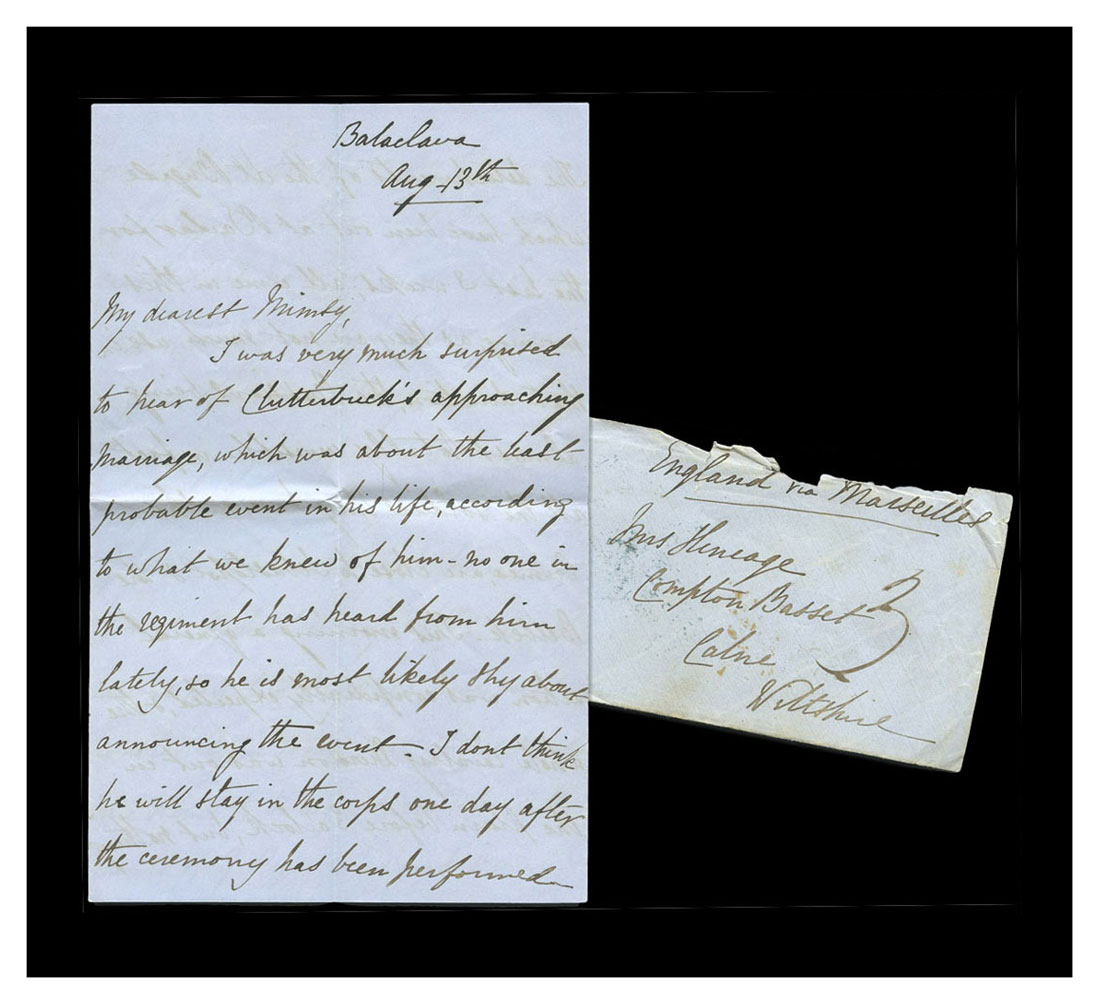
Balaclava
Aug 13th [1855]
My dearest Mimsy
I was very much surprised to hear of Clutterbuck's approaching marriage, which was about the least probable event in his life, according to what we knew of him — no one in the regiment has heard from him lately, so he is most likely shy about announcing the event. I don't think he will stay in the corps one day after the ceremony has been performed —
The detachments of the Lt. Brigade which have been out at Baidar for the last 3 weeks, all came in this morning, as they are not much use in that direction, the Russians being almost totally invisible — in fact all the soldiers they have in the Crimea, are close to Sebastopol & the Belbek.
This morning a general action was confidently expected, & the whole Cavalry Division was out in the plain before 3 o'clock, but nothing came off, so I suppose the Russians will try some other day.
The English cavalry are now an immense force — this morning we were between three & four thousand strong, a most imposing mass of men & horses — & if we had had a go at the Russians, I think they would have been sorry for it. Michael [his brother, in the Coldstream Guards] is very well & flourishing, he was here two days ago, & we meet constantly in some part of the camps.
There seems to be a great row about the merits of G. Paget, & his good service pension — he certainly does not deserve it near so much as heaps of other Colonels do, particularly as he is such a noted bad soldier — If he writes any answer to those letters in the Times, which he most likely has done by this time, it will be great sport — as that facetious paper will probably favour him with an article written in their best & most severe style —
Love to all at Compton.
Believe me dearest Mimsy
Yr. most affecte.
Clement.
[Source: Lot 589, DNW auction, 18th September 2014, http://www.dnw.co.uk/auction-archive/catalogue-archive/lot.php?department=Medals&lot_id=103081 (accessed 18.1.2015).
The DNW catalogue entry reads:
An original Crimea War letter from Lieutenant Clement Heneage, 8th Hussars, who survived the Charge of the Light Brigade and went on to win the V.C. in the Indian Mutiny, ink, four sides on a single folded sheet of blue paper, dated 'Aug. 13th' at Balaklava, with related envelope addressed to his mother, 'Mrs. Heneage, Compton Basset, Calne, Wiltshire', this with notation 'England via Marseilles' and three official stamps to reverse, including British Army Post Office 'AU 18 1855'."
Footnote
Clement Walker Heneage was born at Compton Basset, Wiltshire, in March 1831, the son of George Walker Heneage, the M.P. for Devizes.
Appointed a Cornet in the 8th Hussars in August 1851, he was advanced to Lieutenant in September 1854, and rode in the Charge of the Light Brigade at Balaklava, in addition to being present at Alma, Inkermann and the operations before Sebastopol (Medal & 4 clasps; Turkish Medal).
Having then returned to England, the 8th Hussars were embarked for India in October 1857, and it was June of the following year that Heneage, now a Captain, won the V.C. for his part in an action at Gwalior, three other members of the regiment sharing the same distinction on the same occasion:
Selected for the Victoria Cross by their companions. In the gallant charge made by a squadron of the regiment at Gwalior on 17 June 1858, when, supported by a division of the Bombay Horse Artillery, and H.M's 95th Regiment, they routed the enemy, who were advancing against Brigadier Smith's position, charged through the rebel camp into two batteries, capturing and brining into their camp two of the enemy's guns, under a heavy and converging fire from the fort of the town' (London Gazette 26 January 1859, refers).
Also given the Brevet of Major, and awarded the Indian Mutiny Medal with 'Central India' clasp, Heneage attained the substantive rank of Major in November 1860, and retired in 1868. A High Sheriff for Wiltshire, he died at Compton House, Compton Basset, in December 1901.]
A few days later, just after the battle of Tchernaya, Heneage wrote jubilantly to "Pipsy", his father:
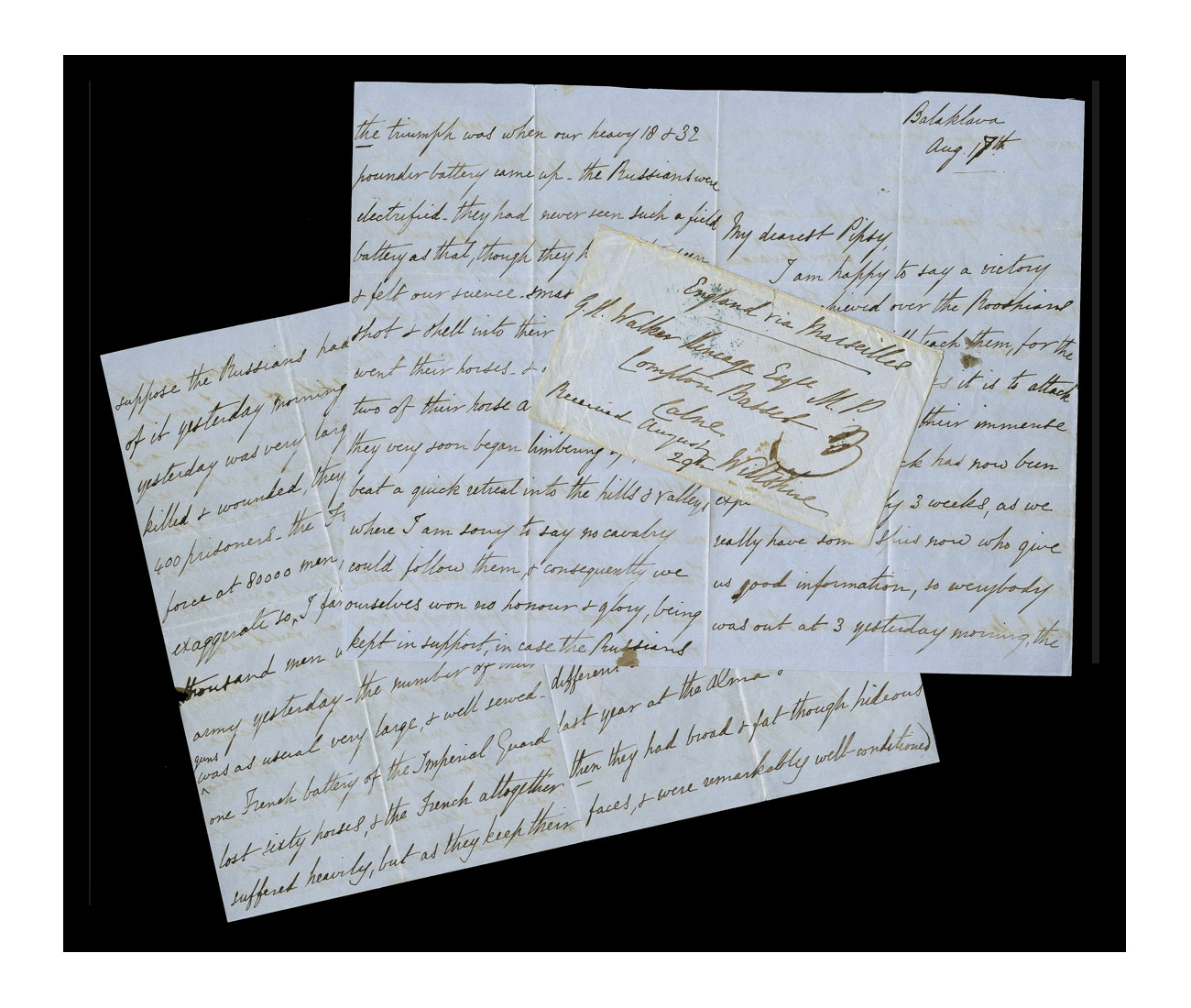
Balaklava
Aug. 17th
My dearest Pipsy
I am happy to say a victory has been achieved over the Rooshians yesterday, which will teach them, for the second time, how useless it is to attack our positions with their immense columns — the attack has now been expected for nearly 3 weeks, as we really have some spies now who give us good information, so everybody was out at 3 yesterday morning ...
The fight began about half an hour before sunrise, & was signalled from the Sardinians near Tchorqoun by a couple of rockets ... the Russians came on in tremendous force & crossed the river in two places, by pontoons, & also made a furious attack on the old bridge, which however was strongly fortified — however they got easily over by the pontoons, as the French let them come on close up to them, in fact they waited too long, for the Russians succeeded in driving them back nearly to their camp. But they soon rallied &, with the Sardines, drove them over & into the river, in which they took several hundred prisoners ...
but the triumph was when our 18 & 32 pounder battery came up — the Russians were electrified — they had never seen such a battery as that, though they had often seen & felt our science. Smash went the big shot & shell into their columns — down went their horses — & one shot knocked two of their horse artillery guns to shivers — they very soon began limbering up, & as usual beat a quick retreat into the hills & valleys ... & a great licking our Allies gave the Rooshians —
they were quite a different set of men to what we saw last year at the Alma & other battles — the fellows I saw yesterday were the most miserable crew of vagabonds I ever saw — their faces all withered & pinched up, as if they were going through a process of starvation — their clothing filthy & all in rags & tatters — & all sober, a thing unknown in Russian warfare, so I suppose the supply of saki as well as of other provisions, is run out ...
[Source: Lot 258, DNW auction, 10th December 2014, http://www.dnw.co.uk/auction-archive/catalogue-archive/lot.php?department=Medals&lot_id=105152 (accessed 18.1.2015).]
The DNW catalogue entry reads:
"An original Crimea War letter from Lieutenant Clement Heneage, 8th Hussars, who survived the Charge of Light Brigade and went on to win the V.C. in the Indian Mutiny, ink, eight sides on two folded sheets of blue paper, dated 'Aug. 17th', at Balaklava, with related envelope addressed to his father, 'G. H. Walker Heneage, Esqre., M.P., Compton Basset, Calne, Wiltshire', and additional ink inscription, 'England via Marseilles' and 'Received August 29th', two British Army Post Office official green coloured stamps to reverse for August 1855.
The letter describes the battle of Tchernaya..."
Captain Clement Walker Heneage, V.C.
Born in Compton Bassett, Wiltshire 6th March 1831, Clement Walker Heneage was the son of George Heneage Walker Heneage (the Member of Parliament for Devizes) and his wife Harriet. Educated at Eton and Christchurch College Oxford, he was gazetted into the 8th King's Royal Irish Hussars as a Cornet on 10th August 1851. On 3rd September 1854, he became a Lieutenant, with which rank he rode in the Charge of the Light Brigade. He served throughout the Crimean War, being present at the Battles of Alma, Inkerman and Tchermaya, as well as the action at Mackenzie's Farm, the siege of Sebastopol and the Kertch Expedition.
Heneage was a man of strong opinions. Writing after the Crimean War about the recriminations and accusations concerning the loss of the Light Brigade, he had little doubt where the blame lay, observing "It is wonderful to observe the way that fool the "British public" kicks a man directly he is down, as in the instance of unlucky Lucan. I always hated him, and so did the whole Cavalry Division, but for heaven's sake let a man have fair play here is this unfortunate man catching it over the head and ears, merely because he obeyed an order given by the thick headed Raglan through his still more stupid Q.M. (quartermaster) General Airey, who is about the worst of the whole headquarters staff".
After his return from the Crimea he was promoted to Captain on 12th May 1857, and once more set out on campaign, this time sailing for India with the Regiment from Cork on the S.S. Great Britain in October 1857. With the rebel leader, the Rhani of Jhansi, safe within the stronghold of Gwalior, the opposing force under Major General Sir Hugh Rose took up position on the plain below the town. Heneage commanded a squadron of 8th Hussars who surprised the enemy with a flanking attack, catching them unawares. "There was no pretence of resistance any longer except from a slight, fully armed figure that was helplessly whirled along in this cataract of men and horses. Again and again this one leader, gesticulating and vociferating, attempted to stem the torrent of routed rebels, but all in vain. There was no possibility of holding up the broken Mahrattas, and at last a chance shot struck down, across his horse's neck, this one champion of the retreating force. A moment later the swaying figure was overtaken, and one stroke from a Hussar's sabre ended the whole matter. There was no time to halt, for the victory had to be pressed home but as the Squadron returned, it was discovered that it was the Rhani of Jhansi herself who had thus ended her meteoric career".
The citation for the Victoria Cross appeared in the London Gazette of 26th January 1859. It reads: "Selected for the Victoria Cross by their companions. In the gallant charge made by a Squadron of the Regiment at Gwalior on 17th June 1858, when supported by a division of the Bombay Horse Artillery, and Her Majesty's 95th Regiment, they routed the enemy, who were advancing against Brigadier Smith's position, charged through the rebel camp into two batteries, capturing and bringing fire from the fort and town." (Field Force Orders by Major General Sir Hugh Henry Rose, G.C.B. Commanding Central India Field Force, dated Camp Gwalior 28th June 1858).
He took the rank of Brevet Major on 20th July 1858, and on 16th November 1860, purchased the rank of Major in place of Major Edward Phillips who retired by sale of Commission. He retired from the Army by the sale of his own Commission on 20th July 1868.
On 7th December 1865, at St Paul's Church Sketty, South Wales, he married Henrietta Letitia Victoria Vivian the daughter of the MP for Swansea. Their children were Godfrey Clement Walker (born 17th May 1868) later Major Grenadier Guards, D.S.O., M.V.O. John Vivian Walker (born 27th May 1869) Algernon Walker (born 4th February 1871) later Rear Admiral, Royal Navy C.B., M.V.O. Claud Walker (born 24th April 1875) later Barrister at Law Aline Dulcie Walker (born 18th August 1877). Clement Walker Heneage, V.C. died at Compton Bassett House, Compton Bassett, Wiltshire on 9th December 1901 aged 70 years, 9 months.
Besides his Victoria Cross, Heneage was awarded the Crimea Medal with clasps for Alma, Balaklava, Inkerman and Sebastopol the Turkish Crimea Medal and the Indian Mutiny Medal with the clasp for Central India.
[Source: ?: QRIH Victoria Crosses[add more info]].]
To follow up...
[PB notes to self: "Crider quotes a description of Reilly, Heneage, Poore and others p.197. Also in more detail p.164."
Also references to CWH in several letters etc in the "Accounts&Letters" database: Jenyns, Loy-Smith, Rawlins, Phillips. See also Dutton p.82.
There was an obituary in The Times, 11 December 1901.]
"On his retirement from the army, Major Heneage and his family were living at Beacon Lodge, a large house near Highcliffe cliff-top and due south of the present Hinton Oak pub on Lymington Road, but it is not known for exactly how long they were living there...Algernon, the son born at Beacon Lodge in 1871, himself went on to a distinguished service career, but unlike his father his was in the Royal Navy."