
Alexander's Toy Soldiers: British Crimea (accessed August 2016. However, there was no specific reference to AC when I checked again in May 2017.)
Born at Tapely Park, Westleigh, near Bideford, Devonshire, on the 16th of May 1833, the only son of Colonel Augustus Saltren Willett and his wife Margaret Caroline, eldest daughter of John Palmer Chichester, of Arlington Court, near Barnstaple, Devon. His parents had married in 1830. He had two sisters, Agnes Hamilton and Caroline Chichester.
[PB: There were numerous connections with India. For example both his [great?] uncle Augustus Clevland, and his father, also Augustus, had spent time there. There is considerably more on his family here.]
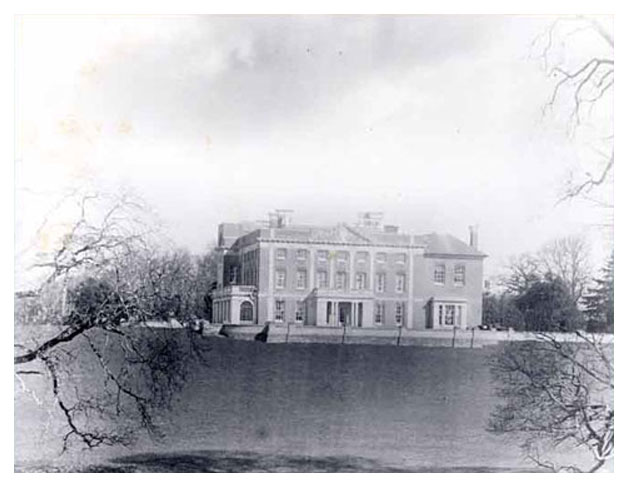
[PB: Was it brick-fronted when Archibald Clevland lived there? I think not. Added late C19 in the Queen Anne style?]
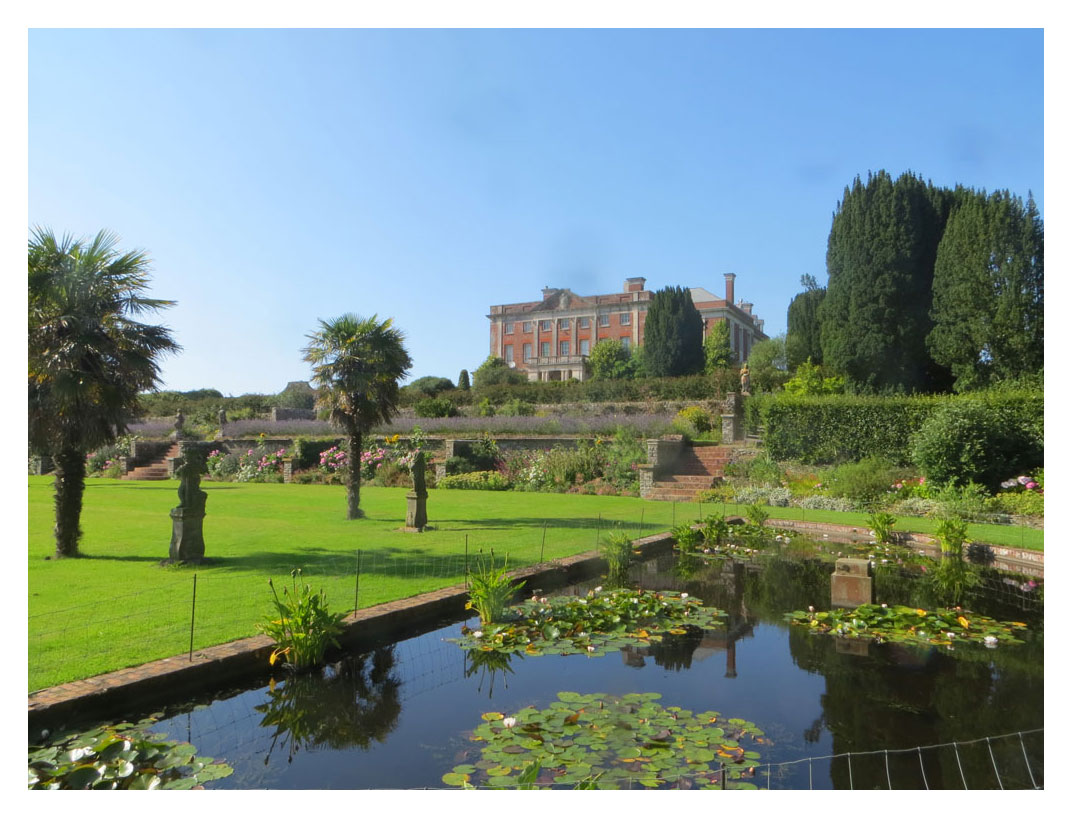
Educated at Rugby School [dates?].
[PB: One account (Ryan, Our Heroes, below) reports he "was educated at Rugby school under the Rev. J. Collins, of Chudleigh, near Exeter." Significance?
See also below, on Rugby's Chapel and Centurion Window.]
There is a tablet to the memory of his father, Augustus Clevland (died 1849, aged 68), that refers to Archibald as his heir. (In fact, it was the two unnamed daughters who inherited.)

The style of the memorial may reveal something of the emotional environment in the home. Archibald was 16 at the time of his father's death. [PB: See my further notes on this memorial here.]
Sacred to the memory of AUGUSTUS CLEVLAND of Tapley in this parish, Lieutenant Colonel of the North Devon Militia and Deputy Lieutenant of the county of Devon. Died July 5th 1849 aged 68.
He married June 1830 Margaret Caroline, daughter of Colonel Chichester of Arlington Court in this county, by whom he left issue Archibald, his heir, and two daughters.

Notice the reference to Archibald as his heir, and two unnamed daughters. British Listed Buildings: "Augustus Clevland, 1849. Weeping maiden under a willow, by M W Johnson of New Road, London."

[The main east-end windows above the altar at St John, Instow, are also dedicated to Augustus Clevland.]
Cornet in the 7th Dragoon Guards: 23rd of November 1852 [aged 19].
[PB: He took the place of Fitzroy Maclean, who had transferred to the 13th Light Dragoons.]

Cornet in the 17th Lancers: 22nd of April 1853.

Succeeding to a large fortune at the age of 21 [PB: May 1854, his father having died in 1849], he is said to have contemplated selling out of the Army when war came, but decided to go to the Crimea with the regiment.
From the North Devon Journal, 11th of May 1854:
The 'Squire of Tapley.
This being the day when Archibald Clevland, Esq., attained his majority, every respect was paid, in this town, to the new Lord of the Manor. Flags floated over the shipping, and were suspended from the establishment of Lee and Son, and others. The day was beautifully fine, and the loud and frequent report of artillery did not fail to remind us of the sterner duties in which Mr. Clevland is expected to take part, against the Russians; he being one of the officers now on duty in the East. May God spare his life, and bring him back to his friends and townsmen in health and safety, crowned thick with laurels, newly won from the battle-field!
[Source: North Devon Journal, 11th of May 1854 (http://www.britishnewspaperarchive.co.uk/viewer/bl/0000328/18540511/030/0008). [PB]]
AC went out to Constantinople on HMS Ganges, and on the Eveline to the Crimea.
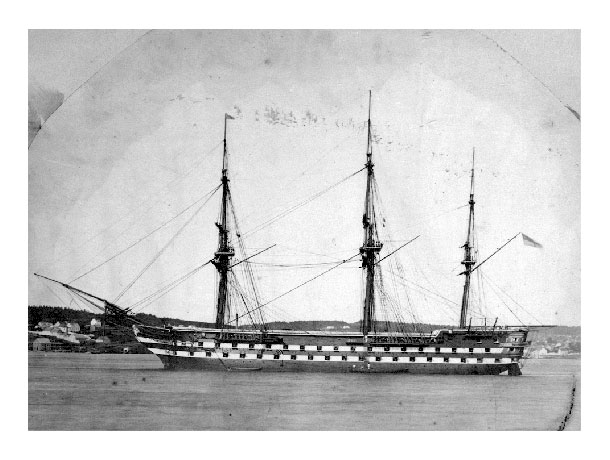
AC travelled to Constantinople on the Ganges (April 19 — May 20, 1854) with Capt J P Winter, Lt Learmouth, & Cornet Wombwell. And then on to Varna on the Eveline (June 2 — 3, 1854) with Capt R P Winter, Lt Learmouth, Cornet Wombwell, & Paymaster Stephenson. [Source: Tony Margrave, 2012, based on articles in The Times.]
EJB:
Between the 18th and the 25th of April 1854 four service troops, comprising a total of 20 officers (including Staff) and 294 other ranks, embarked at Portsmouth in five sailing ships, the Eveline, Pride of the Ocean, Ganges, Blundell, and the Edmundsbury. Passages had taken from twenty-three days to five weeks. All arrived at Constantinople by the end of May. Twenty-six horses, but no men, had died on the voyage.
[PB, June 2017, added a passage from DH Parry about the arrival in the Dardenelles.]
It is said that while waiting the arrival of the tugs, Captain Winter and Cornet Cleveland [sic] were rowed ashore in a boat, and, making a bet who would land first, both jumped over in shallow water and splashed their way towards the beach, Winter, a very tall man, winning, and so enjoying the honour of being the first of the Cavalry Brigade to touch Turkish ground. Alas! neither of them was destined to set foot on English soil again! [p.203]
On the 2nd of June the regiment sailed for Varna and was there made part of the Light Brigade under Lord Cardigan. Twelve men died of cholera during this stay, and two more on the voyage to the Crimea [ship?], which was commenced on the 2nd and 3rd of September. Their numbers showed a serious falling off on landing, being reduced to a total of 247 of all ranks.
[The rest of EJB's summary is here.]
Tony Margrave, 2012, based on articles in The Times and other sources. AC is named only twice: as going to Constantinople on the Ganges (April 19 — May 20, 1854) with Capt J P Winter, Lt Learmouth, & Cornet Wombwell. And on the Eveline to Varna (June 2 — 3, 1854) with Capt R P Winter, Lt Learmouth, Cornet Wombwell, & Paymaster Stephenson.
D.H. Parry, who describes him as "a young man of grand physique, and very popular with both officers and men", singles him out.
The sadly diminished Light Brigade was ordered up to support the French cavalry at Inkerman, and the 17th had three casualties to report — one man killed, another wounded, and Cornet Cleveland [Clevland] struck in the side by a shell splinter, from the effects of which he died next morning.
He was only twenty-two, a fine young fellow of grand physique, the only son of a Waterloo officer of the Inniskilling Dragoons, and nephew to Major Willett, of the 17th. Succeeding to a large fortune at twenty-one, he was contemplating selling out, when the war came, and he went to the front instead, very popular with the officers and men of the regiment.
At Balaclava his horse was hit twice before he reached the battery, and while Cleveland was engaging a dismounted gunner the animal was run through the leg, and could hardly be brought to a trot.
Three Cossacks attacked him, thus handicapped, but he wounded the first, received a lance thrust through his cartouch box, and a prod in the ribs from the third, which bruised him, coming out otherwise unhurt, only to fall a few days later in that useless advance of our Light Brigade which we owed to the express solicitation of the French general.
[Source: D.H. ParryThe Death or Glory Boys (1900?, 1903 edition), pp.223-4.]
Rode as serre-file in the Charge at Balaclava. [Serre-file — officer placed in the rearmost file of soldiers in a troop.]
The following letter, written by AC to a relative on the day following the Charge, vividly describes the part he played:
"Balaclava, Oct. 26th 1854,
My dear Uncle,
We were yesterday attacked in our rear by the Russians. They had 15,000 infantry, 5,000 cavalry, and about ten guns. Early in the morning firing had commenced upon the Turks; it lasted about two hours, when they cut like cowards and their guns were taken. The Russian cavalry then advanced.
The Heavy Cavalry charged and drove them back, the Russians did not fight more than ten minutes; they must be awful cowards. The Light Cavalry was then on a hill as a reserve and could not get down in time to pursue, which was fortunate for them, as few would have escaped.
Some little time after this, Lord Raglan, who had been told the wrong position of the guns that had been captured, ordered the Light Cavalry to charge and retake them. We had our orders and we had to obey them, although we saw it was a forlorn hope, and not one of us expected to return. There never was such a charge on record.
Accordingly we formed up into two lines, first, the 13th and the 17th Lancers, second, the 4th, 8th, and 11th. We were drawn up at the end of the valley, the guns being at the other; on each side of the valley was rising ground — on our right, batteries of some twenty guns, on our left, batteries of six guns, and these were flanked by cavalry. Infantry and rifles were also formed on our right.
We had to go over a mile-and-half of ground before we could reach the guns. Directly we advanced they had all commenced firing, and so did the infantry when we were within a hundred yards of them. I must tell you the guns we charged were twelve-pounders, so you can imagine the way we were mown down by the cross-fire.
As we reached the guns a hussar regiment, 800-strong, retreated, so we could only succeed in cutting down the gunners, as having no support it was an impossibility to take a man, let alone a gun.
We pursued the cavalry as far as we could to a river, when they suddenly turned on us. At that time there were not more than twenty of our men together. Imagine our surprise in returning, to find a regiment of Lancers, one of Hussars and another of Cossacks, formed up in our rear. We rallied as many men as we could — and then with a right British cheer, rode straight through them and most of us got back to our lines.
My horse was wounded in the leg and side before I reached the guns — and in attacking a dismounted gunner, who, to prevent me from cutting him down, ran his sword into my horse's leg — and it was with the greatest difficulty that I could get a trot out of him, but with the help of God, I managed to get myself back, but not without fighting, as you may suppose.
When I had fought myself well through, and thought myself safe, three Cossacks seeing, I suppose, the disabled state of my horse came after me. I guarded the first fellow's point, and gave him a slight point, and he went on. The next ran his lance through my pouch-box, which is of silver, and so saved me. The third caught me in the ribs, the point broke the skin.
So you will see from this little tale that I have had a lucky escape. I had, before that, other fortunate escapes of being cut down — only I was too sharp for them. My revolver was of great use to me.
The 17th Lancers went into the battle 145 strong. When we mustered, we had only 30 horses not wounded, 99 were killed, 79 men killed and wounded; seven out of ten officers killed and wounded. We have now only three officers. Thank God, I am one. The 13th went in 125 strong and only mustered 29 horses.
In the Light Brigade I hear there were 24 officers killed and wounded. I have been obliged to destroy my horse, poor beast. He had a large piece of shell in his side, and a ball in his right leg. We still have a large force of Russians in our rear, but we do not fear them.
Believe me,
Your affectionate nephew,
Archibald Clevland.
17th Lancers."
[PB: Source? Is the published letter from the D Telegraph? ILN? Check it matches DJA's transcription. Was it published elsewhere as well? ]
[PB: But see the original letter, before editorial amendment, which is rather different. This appears to be an edited, polished version, which differs significantly from the (image of the) original displayed at Tapeley, transcribed here.]

It is shown more clearly and transcribed here.
Photograph: PB, August 2016.
Having survived the Charge, Archibald Clevland was mortally wounded in action at Inkerman [5th of November, 10 days later], having been struck in the side by a shell splinter — from the effects of which he died the next morning. He was brought off the field of battle by the brothers O'Hara].
[PB: 600 Denis O'Hara, and 716 James O'Hara. But what about 1004 Thomas Morley 17L, who describes the situation in his Memoirs, and William Barker 17L [ADD RELEVANT BITS, INCLUDING ILLUSTRATION IN MORLEY (below)].]
Sergeant-Major William Barker, 17th Lancers:
Owing to the heavy losses sustained by our regiment in the Balaclava Charge, we were only able to muster fifty men and horses for the battle of Inkerman, with Sir Godfrey Morgan in command. We were placed in the brush-wood, in a hollow, on the heights of Inkerman, ready for any emergency in case the Guards were broken.
It was here that Cornet Cleveland [Clevland] and six or more other brave young men fell, by the explosion of a very heavy shell from the Russian shipping in the harbour. I saw it take the ground at about thirty yards in front of the troop, when it exploded directly underneath where I was sitting.
After the battle was over, we encamped near the celebrated windmill, so well known to all Crimean campaigners. It was in this place that both men and horses suffered so much from want of water, and it was here that the Commissariat issued the unroasted coffee and mouldy biscuit, when fuel could not be got at any price.
[Source? Personal reminiscences. There is a copy in the Texts, Accounts & Letters database, but specify its origin. [PB]]
James Nunnerley, 17th Lancers:
"[A] shell from the Russian shipping fell in front of them and penetrated the ground about three feet, after which it exploded, tearing up everything about it, and wounding Cornet Clevland — who died next day, and was buried beneath a stone wall — about a hundred yards from the place where he fell."
[Source: "Memoirs" — add full ref.]
In a letter to his brother dated December 20, Sergeant William Garland, 17th Lancers, wrote: "The 17th Lancers lost a very fine young officer named Cleaveland [sic]"
William Howard Russell:
Our cavalry, the remnant of the Light Brigade, were moved into a position where it was hoped they might be of service, but they were too few to attempt anything, and lost several horses and men. Cornet Cleveland, was struck by a piece of shell and expired.
[Source: William Howard Russell, The British Expedition to the Crimea, 1877, section on Inkerman (ch.3, p140 — 176). [PB]]
[PB: Find and check a brief reference in Gibson, Memoirs of the Brave.]
Sergeant Major George Smith of the 11th Hussars records in his "Memoirs" that a few days after the battle of Inkerman a sergeant of the regiment had gone to Balaclava for stores and the Sergeant Major's boots being worn out he had given him some money to purchase the best pair possible and not to mind the price:
"The pair purchased became the envy of all, they nearly coming up to my knees. Little did I know who they had belonged to, for it was not until the following summer that I was accidentally looking inside, to discover the name of the officer who had the forethought to provide himself with such boots before leaving home.
He was the only officer of cavalry that was killed at Inkerman, Cornet Clevland, of the 17th Lancers.
At the time of first wearing them the Colonel was one of the first to remark on the boots, saying, 'Where did you get those boots, Sergeant-Major?'
I replied, 'Sergeant Gutteridge bought them in Balaclava yesterday, Colonel.'
'Send for Sergeant Gutteridge.'
On being interrogated by the Colonel he said he met with a man who offered them for sale, but he did not know the man and did not see any other boots for sale."
[Source: add.]
Campaign service
Cornet Clevland served the Eastern campaign of 1854, including the battles of the Alma, Balaclava (horse wounded), Inkerman and the Siege of Sebastopol. (Medal and Clasps.)
Entitled to the Crimean medal with clasps for Alma, Balaclava, Inkerman and Sebastopol, and the Turkish Medal.
In 1982, EJB wrote that "there is is a small draped obelisk [pillar?] memorial in Tapely Park consisting of a stone base, some 4 feet high, surmounted by a female figure resting her head on her forearm. The inscription records that this was placed on a site chosen by Archibald Clevland as a young man. Whether this is the pillar erected by local inhabitants previously known to have been in the Park, but said to have fallen down, cannot be confirmed."
[PB: In fact they are different. The pillar erected by public subscription, now partly destroyed, was very much larger. See below, on "The Tapeley Obelisk". The smaller memorial, with a grieving woman, is also discussed below ("Mourning woman, Tapeley Park).
See below.
Archibald Clevland died of wounds received at the battle of Inkerman, on the 6th of November 1854 (see above).
An inscription on the tablet in St Peter's, Westleigh (shown and discussed in detail below), states that he was buried on Cathcart's Hill. However, he is not recorded as such by Colborne and Brine in their The Last of the Brave.
A large obelisk to his memory was erected at Tapeley by the inhabitants of North Devon, on a hilltop overlooking the Taw? estuary, with a more private memorial in the grounds. A number of substantial memorial tablets and windows were placed in local churches (in Westleigh and Instow) by his mother and sisters. He was also commemorated at Rugby School, and in several poems.
[PB: It might be worth looking for how Biblical ideas recur in many of the articles and memorials, particularly blood sacrifice and the gift of an only son "so that others might live".]

An inscription on the tablet in St Peter's, Westleigh, states that AC was buried on Cathcart's Hill. However, he is not recorded as such by Colborne and Brine in their The Last of the Brave, and James Nunnerley is explicit that "Cornet Clevland...was buried beneath a stone wall about a hundred yards from where he fell" (Memoirs, p.?). (See also Edward Capern's poem (below)).

[Locate the source. Also the newspaper behind the image, which looks interesting. Simposn revisited the Crimea in 1869. When does this (rather eerie) image date from? See e.g.
In 1982, EJB wrote that "there is is a small draped obelisk [pillar?] memorial in Tapely Park consisting of a stone base, some 4 feet high, surmounted by a female figure resting her head on her forearm. The inscription records that this was placed on a site chosen by Archibald Clevland as a young man. Whether this is the pillar erected by local inhabitants previously known to have been in the Park, but said to have fallen down, cannot be confirmed."
[PB: In fact they are different. The pillar erected by public subscription, now partly destroyed, was very much larger. See immediately below, on "The Tapeley Obelisk". The smaller memorial, with a grieving woman, is also discussed below ("Mourning woman, Tapeley Park).
Campaign service
Cornet Clevland served the Eastern campaign of 1854, including the battles of the Alma, Balaclava (horse wounded), Inkerman and the Siege of Sebastopol. (Medal and Clasps.)

[PB: I have not been able to find an image of the obelisk before it was destroyed. Check the Tapeley Gardens website, which has a number of images (accessed 28.7.15) and the comment:
In 1856 a monument was erected to Archibald Clevland in the field on the seaward side of the house with a 50ft obelisk rising from it. The obelisk was destroyed by lightning in 1933 during a freak thunderstorm when, according to a local newspaper, blocks of granite were thrown 100 feet into the air and the iron rails twisted.
PB: In 1879, his obelisk memorial was noted in a tourist guide to the area:
INSTOW
From A Handbook for Travellers in Devonshire (9th ed.), London, J. Murray. (1879)
3 1/2m. Instow Quay Stat., a small but rising watering-place (Pop. 647), situated at the junction of the Taw and the Torridge. It has a view of the sea, of Lundy Island, the Barnstaple Bar, the sands of Braunton Burrows, Northam Tower, commonly called Chanter's Folly, as built by a person of that name, and of the busy fishing village of Appledore. (There is a ferry from Instow to Appledore, whence the walk across Northam Burrows to Westward Ho (about 2 1/2m., see post) is not unpleasant. From Westward Ho you may reach Bideford by omnibus, and thence return by rail to Instow). Good boating and sea fishing are to be had from Instow.
A pleasant road leads from Instow Quay along the shore of the river, passing Tapeley Park (W.L. Christie, esq.); notice obelisk in front of the house, in memory of Cornet Clevland, 17th Lancers, killed at Inkermann).
[Source: Transcribed by Brian Randell, 18 July 1999, and posted on the Genuki webste: http://www.genuki.org.uk/big/eng/DEV/Instow/InstowMurray1879.]
[PB Add quotes about the Clevland obelisk, e.g. from the Devon Gazetteer, 1878-9?]
More generally, see e.g. Wikipedia: Obelisks. Why an obelisk? What were the particular associations for AC's mother et al (and indeed for the constructors of William Morris's obelisk at Hatherleigh)? They're very visible, and always placed on commanding/ prominent positions. But other associations?
The proximate cause is likely to have been the completion in 1854 of the Wellington Memorial in nearby Somerset (begun 1817, with work interrupted by lack of funds and a lightning strike). Why was an obelisk chosen for there?
According to the Wikipedia entry:]the foundation stone was laid by Lord Somerville in 1817. By 1818 the column was 47 feet (14 m) high but all funds had been spent. Another appeal raised further funds, and the column was raised to 121 feet (37 m) by 1820. It was damaged in 1846 when it was struck by lightning.
Construction restarted after the Duke's death, and was completed in 1854 by Henry Goodridge. The monument's design was inspired by an Egyptian obelisk, but in the shape of the type of bayonet used by Wellington's armies, with funds raised from local subscribers to commemorate his achievements. The initial designs envisaged a cast iron statue of the Duke on the top of the column with more statues on the plinth, but these were never built.
[EJB: 1982] It is now known that there is a small draped obelisk memorial in Tapely Park consisting of a stone base, some 4 feet high, surmounted by a female figure resting her head on her forearm. The inscription records that this was placed on a site chosen by Archibald Clevland as a young man. Whether this is the pillar erected by local inhabitants previously known to have been in the Park, but said to have fallen down, cannot be confirmed.
[PB: The pillar erected by public subscription, now partly destroyed, was very much larger. See above.
I have not been able to find the inscription that says Archibald himself selected the site, which is by a small stream-fed lake in a glade deep in (what is now, and may have been then) a wooded valley. (Check but I dimly recall the garden historian Rosemary Lauder says it was AC's father who introduced the wooded garden.) It is certainly a very "romantic" location.
Both husband and son are named on sides of the plinth. Presumably the mourning woman depicts or at least personifies Augustus's wife / Archibald's mother. How does the figure relate to the prostrate woman on the Augustus tablet in St Peter's, Westleigh [?]. Are they her personified as Niobe? Photographs: PB, August 2016.]


Forgive, blest shade, the tributary tear,
That mourns thy exit from a world like this;
Forgive the wish that would have kept thee here,
And stayed thy progress to the realms of bliss. [CHECK]

Archibald
His only son
5th November 1854 [CHECK]
This is the opening stanza of a poem by Anne Steele, c.1770, that appeared in a number of mid-19th century hymnals including Ellen Courtauld's Psalms, Hymns, &c,, 1853. See e.g. http://www.hymnary.org/text/forgive_blest_shade_the_tributary_tear for more. Check who it is dedicated to — Archibald or his father Augustus? both?]
Find my notes on how this was set to music and widely sung in "Glees" — three-part (or four-part) harmony. I wonder if there is some allusion to this in the choice of quotation for the weeping woman memorial — the mother, father, son, singing together?]
It was set to music by John Wall Callcott (1766 — 1821), who is synonymous with the Glee, that quintessentially English unaccompanied sentimental part-song. It is a Sacred, part-song originally sung a cappella.
It continues:
No more confined to grov'ling scenes of night —
No more a tenant pent in mortal clay;
Now should we rather hail thy glorious flight,
And trace thy journey to the realms of day.
Forgive, blest shade, the tributary tear,
That mourns thy exit from a world like this;
Forgive the wish that would have kept thee here,
And stayed thy progress to the realms of Bliss.
[PB: Having viewed and photographed the original (August 2015), I have corrected the punctuation.

[PB, June 2017: I suddenly realised I had been looking at the texts at the base of the windows (about who the windows were dedicated to, who had them installed, what AC had done), but had not looked at all at what the windows depicted. And when I did, I found it quite hard to make sense of them. My photographs too were not as helpful as they might have been because I had focused (literally) on the texts at the base. If I cannot find better photographs (and do far I haven't found any), I will have to return to take new photographs e.g. of text in upper parts of the windows, some of which are obscured by glazing bars.
[The British Listed Buildings listinbg is not helpful: "C19 stained glass to eight of the windows, including early C19 glass ... east end of north aisle to Archibald Clevland who died at Inkerman, 1854." Notice there is no reference to the subject matter of the window.]
Check what the windows represent. Mary above? God as a King? Jesus? Holding or cloaking a long-haired almost feminine young man. Highly coloured decorated Gothic interior. Behind, a far view across to blue mountains.] Text in upper left window? "He [...?] withal of a beautiful countenance [?]"
[The images are probably scenes from the life of David (in Samuel and Kings). So, 1 Samuel 16:12 So he [?] sent for him and had him brought in. He was ... And he sent, and brought him in. Now he was ruddy, and withal of a beautiful countenance, and goodly to look to. And the LORD said, Arise, anoint him: for this ...
See biblehub.com/1_samuel/16-12.htm KJV http://biblehub.com/kjv/1_samuel/16.htm CHECK LARGER IMAGES. See also https://en.wikipedia.org/wiki/David. David is holding a crook — he was initially I think a shepherd [CHECK] Hence good with a slingshot v Goliath. Were sheep important around Tapley? Notice the handbag.]
What resonated? David is a warrior. Smites a lot of Philistines (and others). Check bit about Absalom — words to effect I would have died myself to save him..., which may have resonated. David and Goliath. David was one of the worthies studied by would-be knights (Wikipedia). David retakes Jerusalem [which must have had Crimea-associations).

"A memorial by his Sisters to Archibald Clevland
A beloved and only Brother. Cornet in the 17th Lancers." [Check what the window represents.]

[Source: Detail from memorial stained glass window to Archibald Clevland (https://en.wikipedia.org/wiki/John_Clevland_(1734%E2%80%931817). Photograph and image enhancement by Lobsterthermidor, October 2014. This is such a good photograph I wonder if the photographer has others of the window, and can be contacted?]

A soldier [wh] is being dressed in armour by God [?] the shepherd's crook lies on the floor. The Clevland crest [a hare?] and motto? "Fortuna Audates Juvat ?" ["Fortune favours the brave"]
Text? "...armed..."

"Who fell at the Battle of Inkerman on the 5th Day of December 1854"
The maker's name and date, faint text: Left: Wm Warrington Right: London 1856.
On William Warrington, see:

A kneeling woman in grey prays
Death of David: 1 Kings 2.http://biblehub.com/kjv/1_kings/2.htm
Text above (indistinct): "she [?] was a widow"?
Text below (indistinct): "...man of all ...?"?

"In his 22nd Year and was buried at Cathcart Hill in the Crimea"
Text in the sash or band on an angel above "? she was a widow?" And "I? man of all ?"
NB There is also text in the two small lights above. Legible?


The tablet to his memory erected by his mother in St Peter's, Westleigh, bears the inscription:
"Sacred to the immortal memory of Archibald Clevland, Esq., of Tapeley Park, Cornet in the 17th Lancers, who died November 6th 1854, aged 21. He was present at the battle of the Alma, and on the flank march to Balaclava his troop was ordered to charge the Russian Rear-Guard at MacKenzie's Farm, where they took several prisoners and a quantity of baggage.
Short as had been his career, it was full of honour and renown and will long continue a cherished subject of regret and admiration to all who know him. The outward form and manly beauty of his person bespoke the whole qualities of the mind and spirit within, he possessed a courage beyond his years. Dauntless and undismayed which bore him safe and unharmed by the Almighty's Providence, through the fearful and desperate charge of the Light Brigade at Balaclava. (A charge such as the history of this or any other country does not record.)
His conduct and character in the several stations of private life no less justly endeared him to the remembrance of all.
To his servants or dependants he was never known to utter a hasty or needless complaint, to his friends and associates his deportment was ever generous, kind and unassuming and while his sisters amply shared a valued brother's love, a widowed mother's care, her deep and undying affection, received (to her) the best reward of filial duty, all that could or ought to human claims be given, the best and purest, the first and last emotion of his heart.
This noble and brave "young hero" of Balaclava fell mortally wounded at Inkerman by the bursting of one of the enemy's shells which struck him in the side; he died the morning after the battle and exchanged his well-earned crown of laurel for a crown of glory.
He was buried with funeral honours on Cathcart's Hill, near Sebastopol, lamented by all that knew him, the men of his troop shedding tears of deep sorrow over his honoured remains. To his dear memory his most afflicted and bereaved Mother has erected this monument and recommends the imitation of his virtues to his descendants for ever.
'The wicked flee where no man pursueth but the righteous as bold as a lion.' Proverbs. Chapter 1 Verse 28."
[PB: Check the transcription.]
From a contemporary newspaper report (unknown source):
"A sculptured mural monument of large size to the memory of the late Archibald Clevland, Esq., who fell at Inkerman, November 5th 1854, is just completed by Mr. Physick, sculptor, of Allsop Terrace, Baker Street, London, and is to be erected in Devonshire.
It consists of a descriptive tablet surmounted by a coat of arms over which some drapery is tastefully thrown and below are the helmet, sword belt and other accoutrements worn by the deceased when he fell, the whole is placed upon black marble and is very carefully and beautifully executed."
[PB: William Physick? Find examples of his work. This mural monument is in St peter's, Westleigh.]
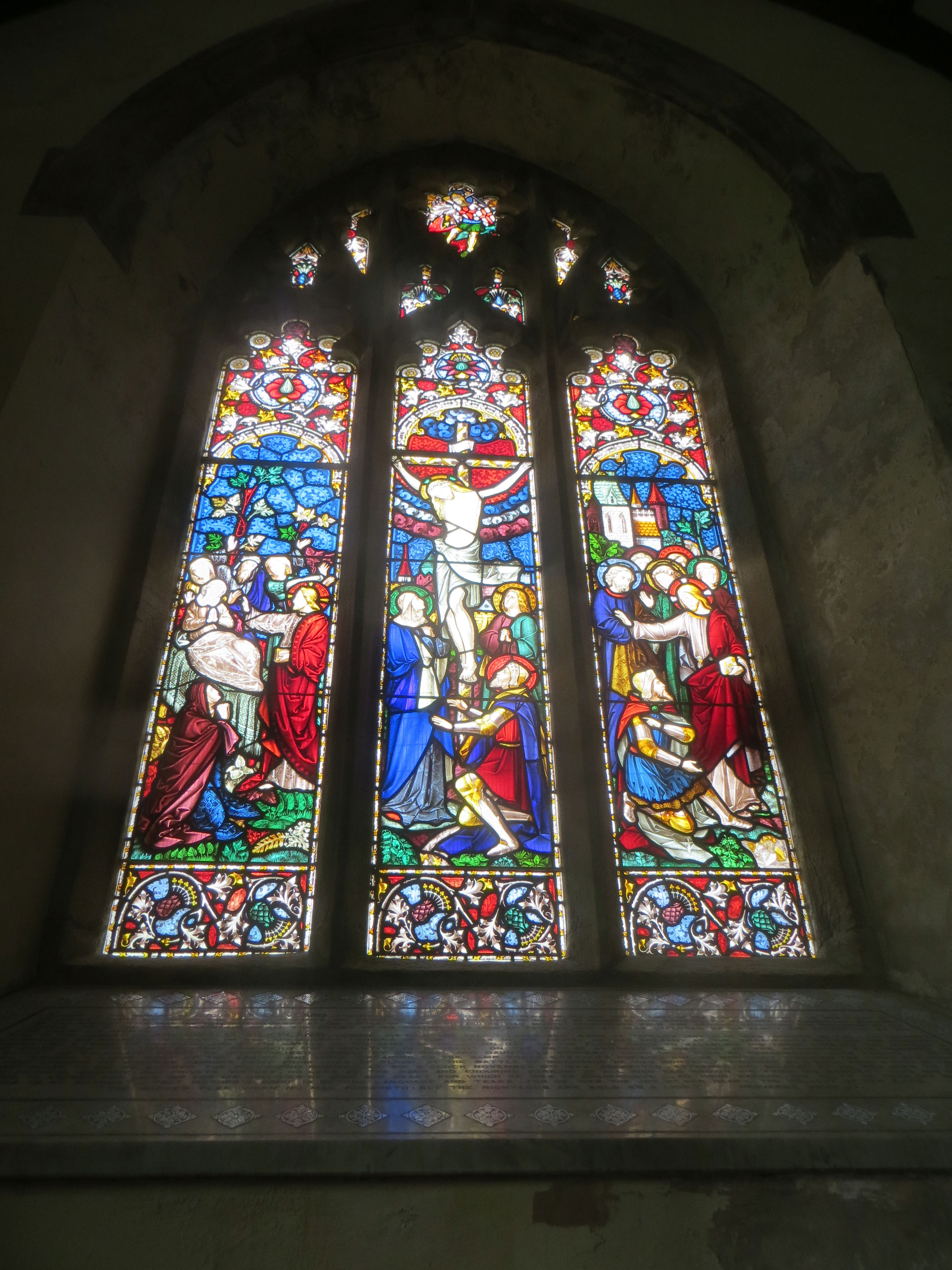
(The view of this window is now grievously impeded by e.g. a more recent screen, a large organ, cupboards, spare furniture, and assorted cleaning equipment.)
TO DO: describe the stained glass, which appears to display scenes with a clear military association — in this case the Good Centurion (middle and right). The left window with a kneeling Mary, also representing Clevland's mother? Notice there is no text on the windows (unlike at St Peter Westleigh). Also the emblematic thistles at the bottom. A symbol of pain, and/or the Clevland Scottish ancestry?
Very surprising, and only visible on close inspection: At the very top, a small but vigorous St George slaying the Dragon, with its multiple associations with the war in the East.
More generally, have a look throughout at the possible implication that Mrs Clevland positions herself throughout as Mary, Augustus as her God, and Archibald as their "only begotten son" who has died for the sake of the world.
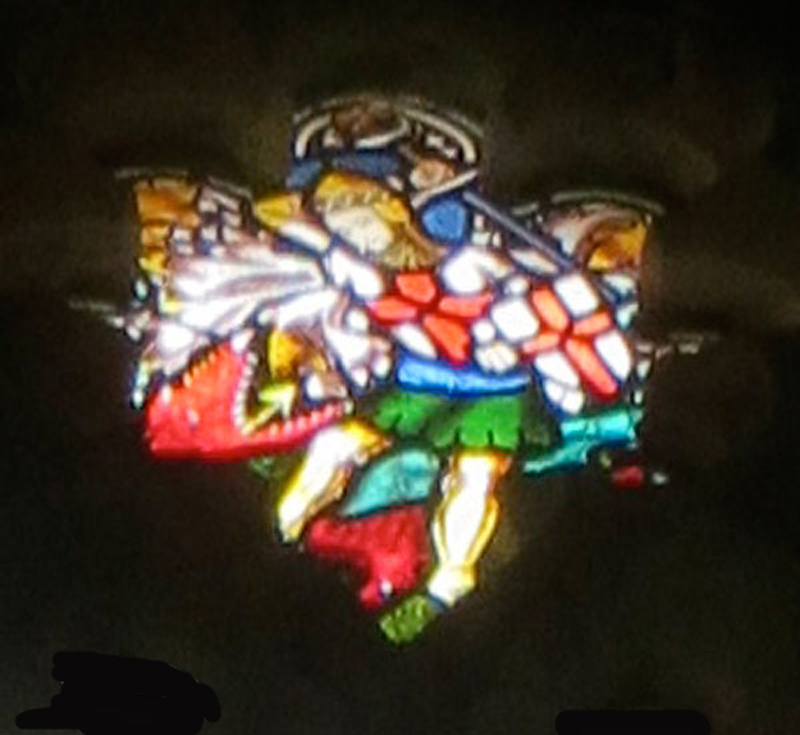
(Photograph: PB, June 2017)
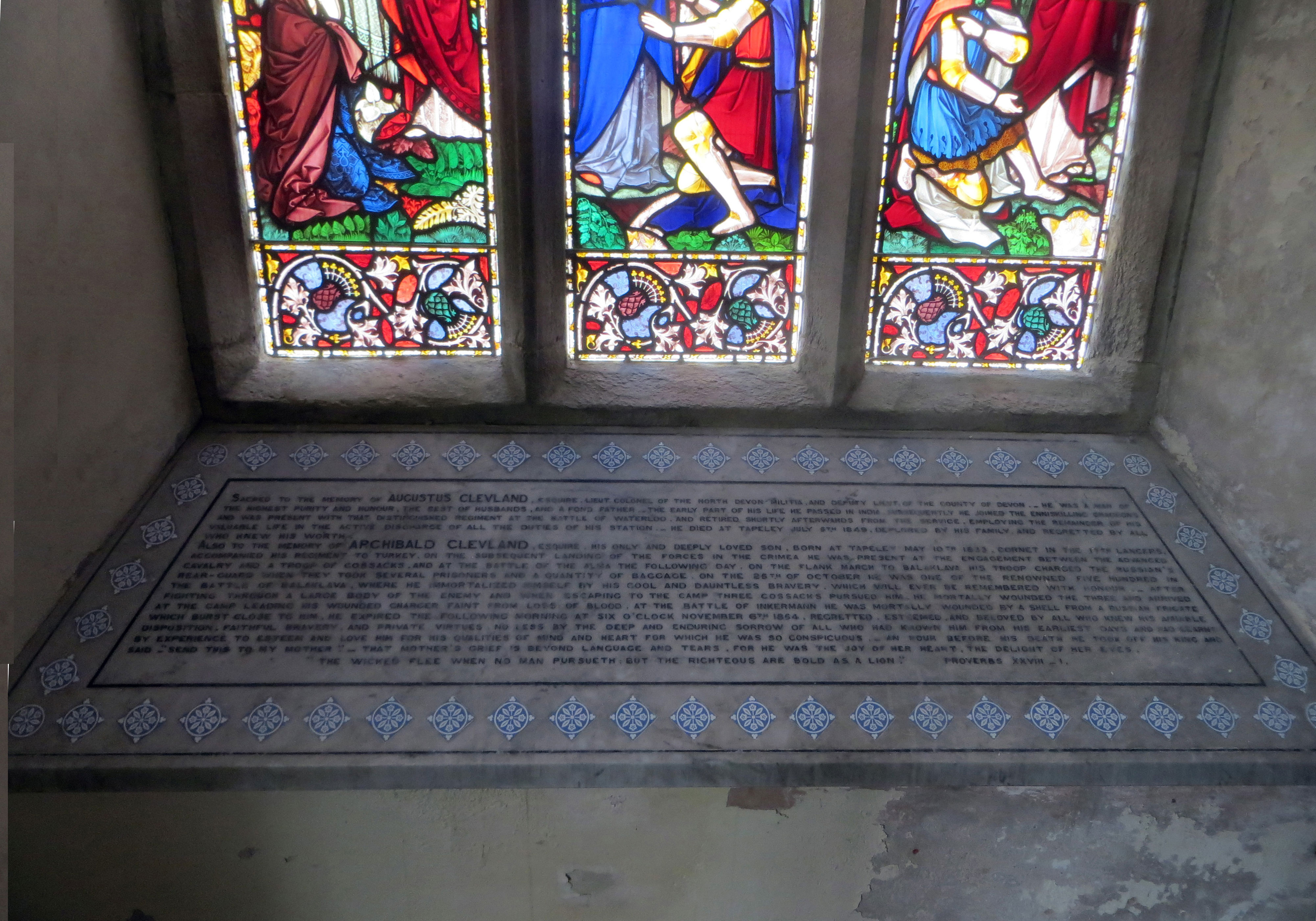
The memorial text is incised into the angled sill. (Photograph: PB, June 2017)
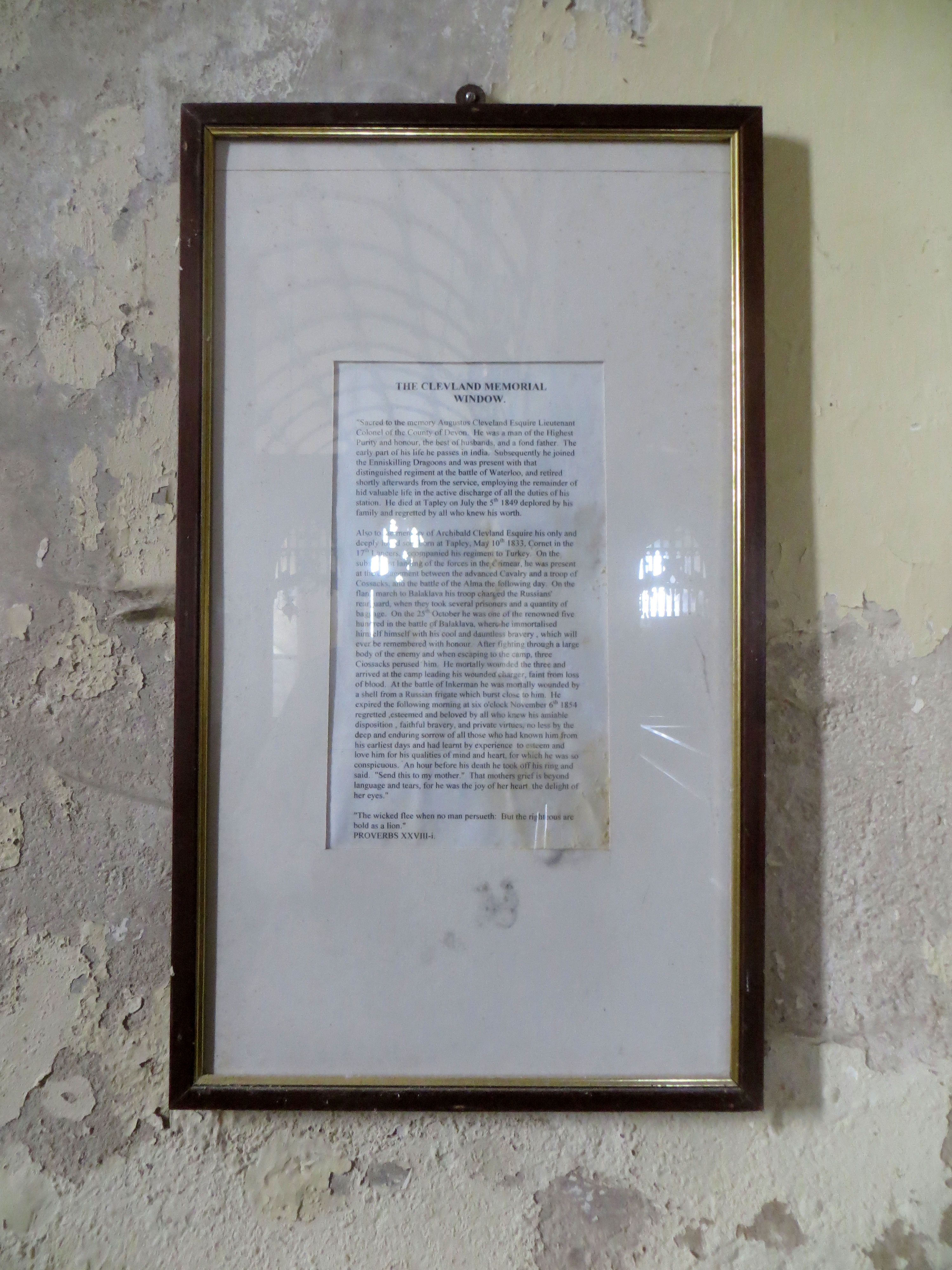
The transcription is not accurate. For example, the framed transcription below the window refers to "The Cleveland Window". This is puzzling because the incised text, which names him as "Clevland" twice, is perfectly clear.

http://www.iwm.org.uk/memorials/item/memorial/25611
Inscription
SACRED TO THE MEMORY OF
AUGUSTUS CLEVLAND , ESQUIRE, LIEUT. COLONEL OF THE NORTH DEVON MILITIA, AND DEPUTY LIEUT. OF THE COUNTY OF DEVON. _ HE WAS A MAN OF/ THE HIGHEST PURITY AND HONOUR, THE BEST OF HUSBANDS AND A FOND FATHER. _ THE EARLY PART OF HIS LIFE HE PASSED IN INDIA. SUBSEQUENTLY HE JOINED THE ENNISKILLING DRAGOONS/
AND WAS PRESENT WITH THAT DISTINGUISHED REGIMENT AT THE BATTLE OF WATERLOO, AND RETIRED SHORTLY AFTERWARDS FROM THE SERVICE, EMPLOYING THE REMAINDER OF HIS/
VALUABLE LIFE IN THE ACTIVE DISCHARGE OF ALL THE DUTIES OF HIS STATION. _ HE DIED AT TAPELEY JULY 5TH 1849, DEPLORED BY HIS FAMILY AND REGRETTED BY ALL/
WHO KNEW HIS WORTH./
ALSO TO THE MEMORY OF
ARCHIBALD CLEVLAND , ESQUIRE, HIS ONLY AND DEEPLY LOVED SON, BORN AT TAPELEY MAY 10TH 1833, CORNET IN THE 17TH LANCERS,/ACCOMPANIED HIS REGIMENT TO TURKEY. ON THE SUBSEQUENT LANDING OF THE FORCES IN THE CRIMEA HE WAS PRESENT AT THE ENGAGEMENT BETWEEN THE ADVANCED/
CAVALRY AND A TROOP OF COSSACKS, AND AT THE BATTLE OF THE ALMA THE FOLLOWING DAY, ON THE FLANK MARCH TO BALAKLAVA, HIS TROOP CHARGED THE RUSSIAN'S/
REAR-GUARD, WHEN THEY TOOK SEVERAL PRISONERS AND A QUANTITY OF BAGGAGE. ON THE 25TH OCTOBER HE WAS ONE OF THE RENOWED FIVE HUNDRED IN/
THE BATTLE OF BALAKLAVA, WHERE HE IMMORTALIZED HIMSELF BY HIS COOL AND DAUNTLESS BRAVERY, WHICH WILL EVER BE REMEMBERED WITH HONOUR. _ AFTER/
FIGHTING THROUGH A LARGE BODY OF THE ENEMY AND WHEN ESCAPING TO THE CAMP THREE COSSACKS PURSUED HIM. HE MORTALLY WOUNDED THE THREE AND ARRIVED/
AT THE CAMP LEADING HIS WOUNDED CHARGER FAINT FROM LOSS OF BLOOD. AT THE BATTLE OF INKERMANN HE WAS MORTALLY WOUNDED BY A SHELL FROM A RUSSIAN FRIGATE/
WHICH BURST CLOSE TO HIM. HE EXPIRED THE FOLLOWING MORNING AT SIX O'CLOCK NOVEMBER 6TH 1854, REGRETTED, ESTEEMED, AND BELOVED BY ALL WHO KNEW HIS AMIABLE/
DISPOSITION, FAITHFUL BRAVERY, AND PRIVATE VIRTUES, NO LESS BY THE DEEP AND ENDURING SORROW OF ALL WHO HAD KNOWN HIM FROM HIS EARLIEST DAYS AND HAD LEARNT
BY EXPERIENCE TO ESTEEM AND LOVE HIM FOR HIS QUALITIES OF MIND AND HEART FOR WHICH HE WAS CONSPICUOUS. _ AN HOUR BEFORE HIS DEATH HE TOOK OFF HIS RING AND/
SAID — "SEND THIS TO MY MOTHER." _ THAT MOTHER'S GRIEF IS BEYOND LANGUAGE AND TEARS, FOR HE WAS THE JOY OF HER HEART, THE DELIGHT OF HER EYES.
"THE WICKED FLEE WHEN NO MAN PURSUETH : BUT THE RIGHTEOUS ARE BOLD AS A LION." PROVERBS XXVIII — I.
[PB, June 2017: I have corrected the transcription above (as best I can). The IWM website misplaces line breaks and follows the mis-spelling "Cleveland" in the framed typescript below the window.]

His name appears on a [PB: brass tablet near?] the stained glass window representing the good Centurion at the foot of the Cross placed in the Chapel of Rugby School to the 33 "Old Boys" who fell in the Crimean War:
Archibald Cleveland. Cornet, 17th Lancers. Engaged in the Light Cavalry Charge at Balaclava. Mortally wounded at the battle of Inkerman, Nov. 5th 1854, aged 21 years.
[PB: The wording appears to vary in different accounts. Notice incidentally that 8? Light Brigade officers who died in the Crimea were from Rugby School. Most died in the Charge.]
Gavin Hughes & Jonathan Trigg, Remembering the Charge of the Light Brigade:
[Archibald Clevland] is commemorated by way of a Bible which is held in the Pickwell Chapel of St George's Church, Georgeham, also in Devon. This is inscribed
"This bible was presented by Caroline Dene to Georgeham Church in remembrance of her father The Reverend Francis Hole (Rector 1831 — 1866) and her brothers Rev Thomas Hole and Rev Francis Hole Rectors (1869 — 1871) This bible was originally given to her husband Henry Dene by Mrs Clevland of Tapley Park North Devon as a memento of her son and his great friend Archibald Clevland a colonel (or cornet?) in the 17th Lancers who after taking part in the Charge of the Light Brigade at Balaclava was killed at Inkerman on the 5th day of November 1854." (Harris 2001).
[PB: AC was indeed a cornet, not a colonel. Note that Hughes and Trigg assume the correct spelling is "Cleveland".]
CHECK REFS
Harris, B 2001 The Hole Family of Georgeham Parish, Devon: a brief history. Georgeham PCC: Georgeham. This is available online at Genuki: GeorgehamHoleFamily.
[Source: Gavin Hughes & Jonathan Trigg, "Remembering the Charge of the Light Brigade: Its Commemoration, War Memorials and Memory", in [add the reference] Koninklijke Brill NV, Leiden, 2008, 39-58.]
[PB: Georgeham is about 10 miles due north of Tapeley (though longer by road, via Barnstap;e), quite close to Arlington Court. Links to Georgeham to follow up. Only the first reference mentions the Clevland Bible.]
- http://www.genuki.org.uk/big/eng/DEV/Georgeham/GeorgehamHoleFamily
- http://www.britishlistedbuildings.co.uk/101107755-church-of-st-george-georgeham#.WTvD04W3Jjg
- http://www.genuki.org.uk/big/eng/DEV/Georgeham/GeorgehamChurch
- https://en.wikipedia.org/wiki/Pickwell,_Devon
- http://www.georgehamparishcouncil.gov.uk/parish-history/
An eulogy of some 22 verses, "To an only son", was written and presented to his mother.
[PB: A long poem was written about his life and death, THE YOUNG HERO, or The Home, Life & Brilliant Military Career of Archibald Clevland, Esq., of Tapeley Park, Instow, North Devon, Cornet, 17th Lancers, by T.P. Bell (1862). A short extract follows. There is a copy in the Poetry section of this site, here.]
Lo! Brave Clevland! comes: — See Devonia's Pride!
With his reeking sword — with his bleeding side —
Now, list to the Russians! — how loud they rave!
Like to spirits loosed from hell's deepest cave —
They've lost The Young Hero! — his brav'ry now,
Like a gleaming halo around his brow;
Kindles the last flame in their savage hearts —
See! three fiendish Cossacks, like death — wing'd darts,
Fly around him now — but, his arm, we know,
Is able to lay each Cossack alow! —
Round his fav'rite steed — behold the Cossacks now! —
One, his charger's head holds, and breathes a vow;
And one, a moment, lifts his powerless lance;
Then falls quick adown 'neath brave Clevland's glance;
With his up — lifted sword — still wet with blood —
He cuts down the third and fords the red flood —
Up — up — he comes — thank God! he's safe — I ken —
Rejoice, O England! for such daring men!
[PB: Edward Capern's The Fall of the Brave was included in full in the Rules of the Balaclava Commemoration Society (1879?).]
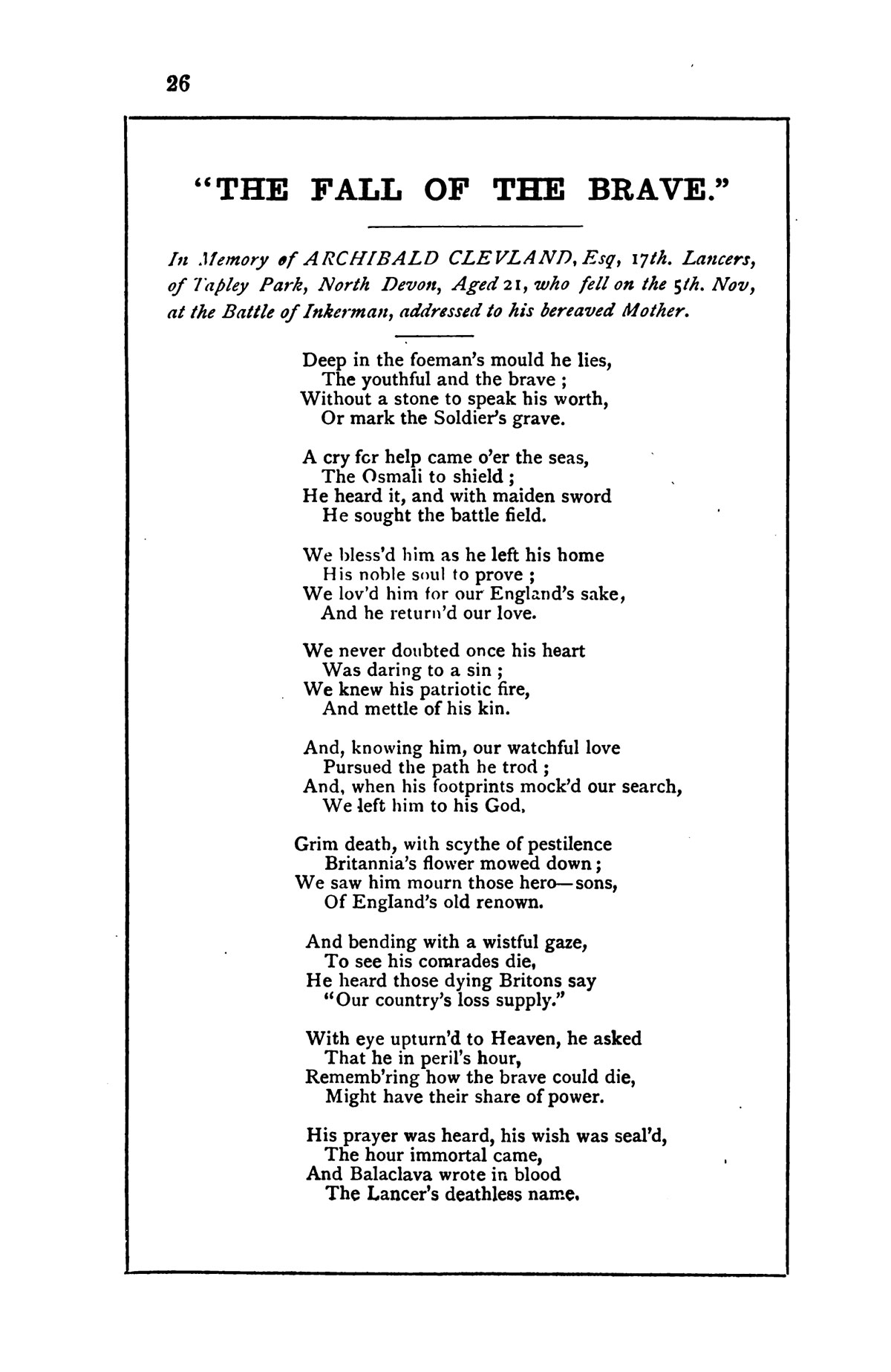
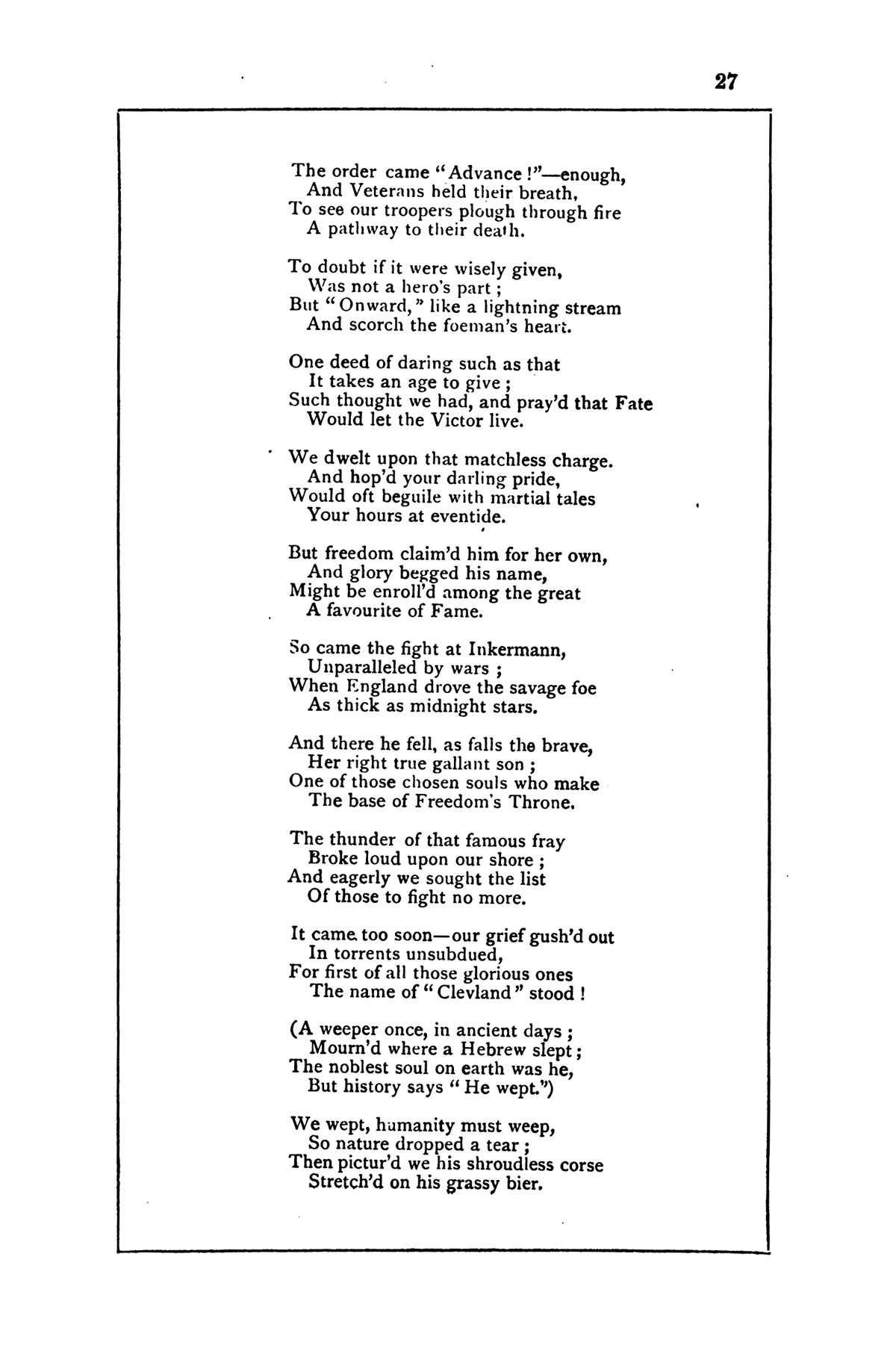
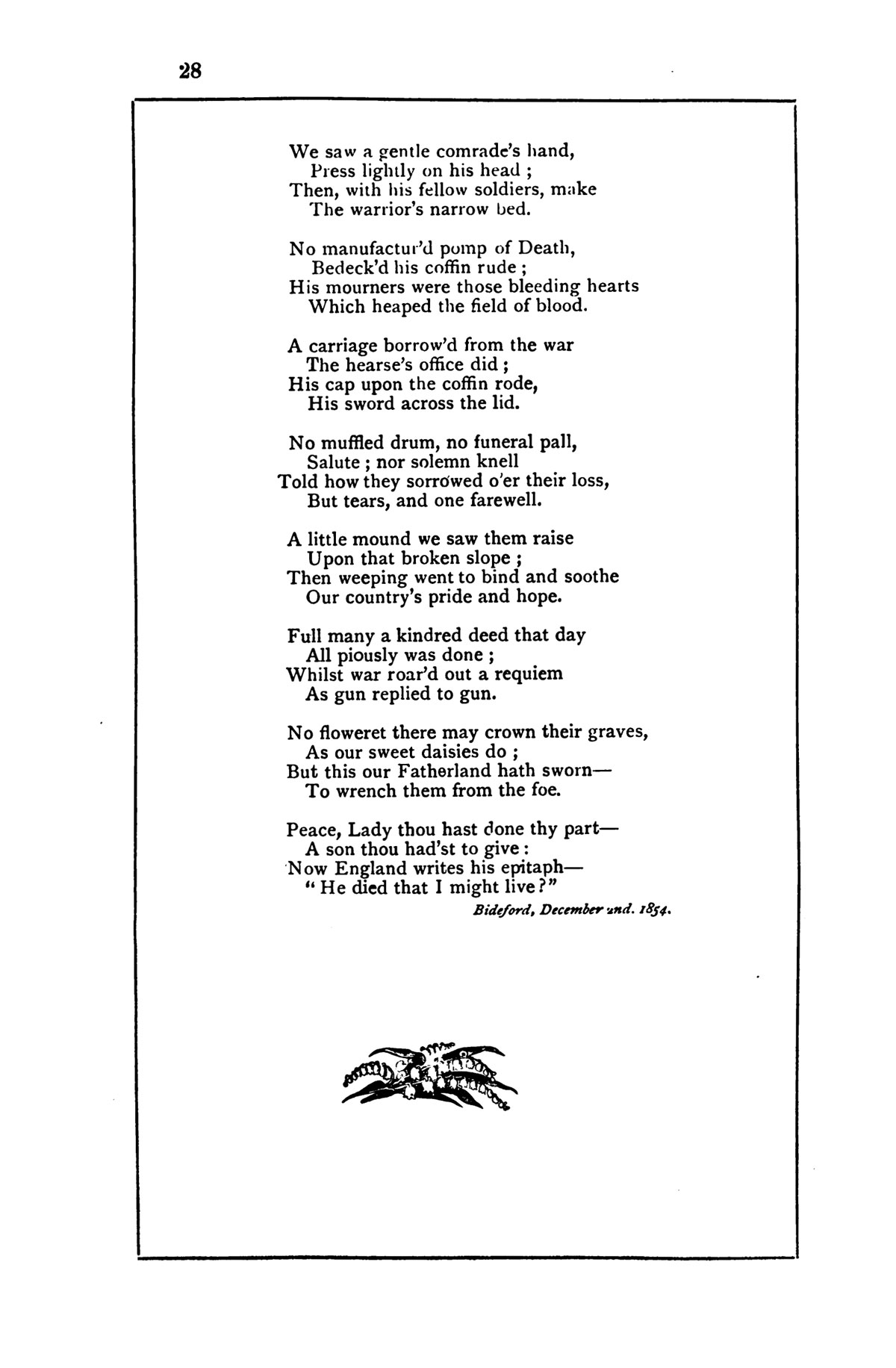
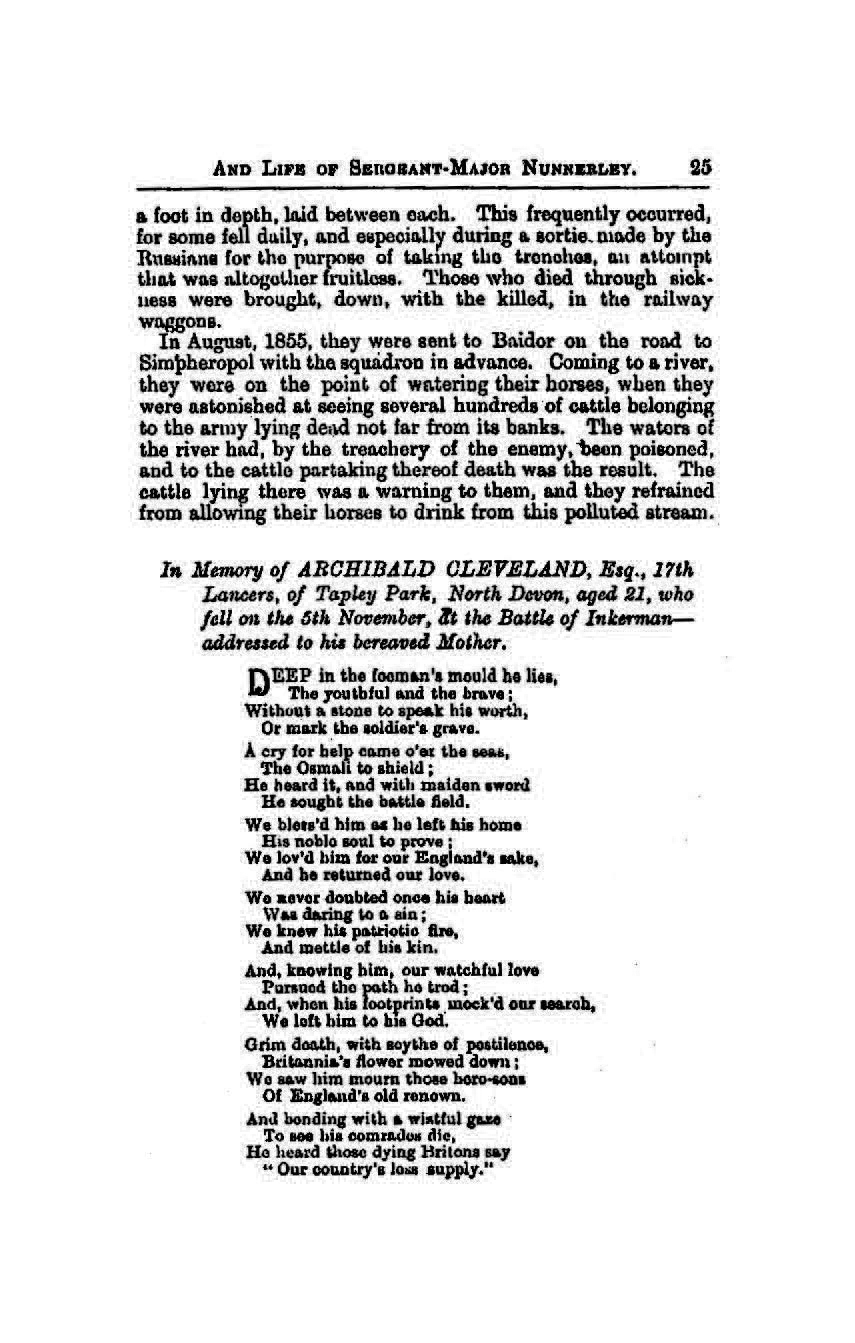
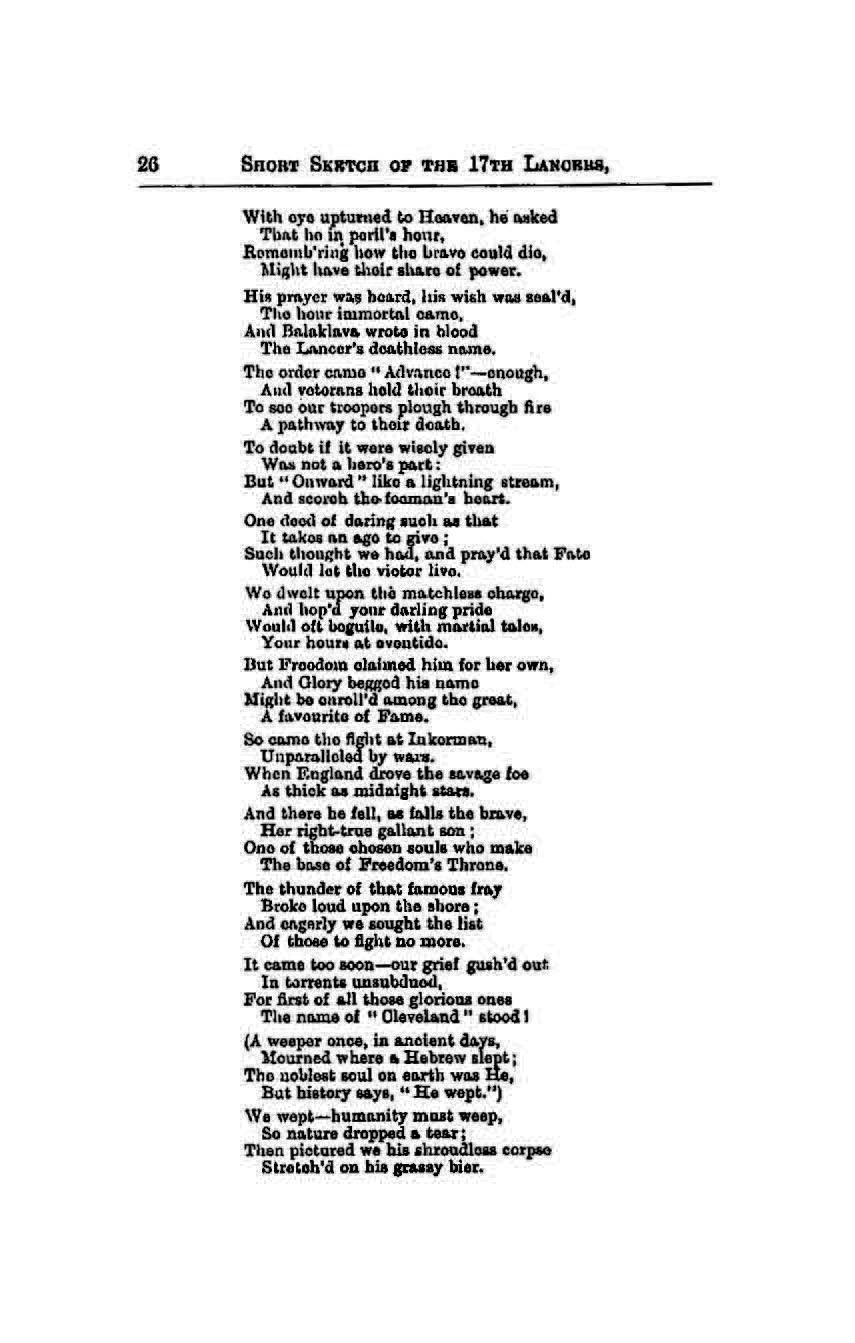
Notice the stark opening verse, which states that Archibald Clevland is buried abroad "without a stone to speak his worth, Or mark the Soldier's grave." The various memorials to him in Westleigh, Instow and Tapely were clearly intended to go some way to putting that right.
The poem ends with a detailed description of his burial: "his shroudless corse stretched on his grassy bier...No manufactured pomp of death bedecked his coffin rude...A carriage borrowed from the war The bearer's office did...No muffled drum, no funeral pall...a little mound we saw them raise upon that broken slope", and so on.
[PB: James Nunnerley includes Capern's poem in his 1892 memoir, again without attribution. Clevland is named as "Cleveland".]
[PB: Add info. about source etc. Isn't it rather like the bronze relief on Morris Obelisk at nearby Hatherleigh? A Christ-like deposition scene? Note the blood dripping from his side.]

[After the Charge, the] sadly diminished Light Brigade was ordered up to support the French cavalry at Inkerman, and the 17th had three casualties to report — one man killed, another wounded, and Cornet Cleveland struck in the side by a shell splinter, from the effects of which he died next morning.
He was only twenty-two, a fine young fellow of grand physique, the only son of a Waterloo officer of the Inniskilling Dragoons, and nephew to Major Willett, of the 17th. Succeeding to a large fortune at twenty- one, he was contemplating selling out, when the war came, and he went to the front instead, very popular with the officers and men of the regiment.
At Balaclava his horse was hit twice before he reached the battery, and while Cleveland was engaging a dismounted gunner the animal was run through the leg, and could hardly be brought to a trot.
Three Cossacks attacked him, thus handicapped, but he wounded the first, received a lance thrust through his cartouch box, and a prod in the ribs from the third, which bruised him, coming out otherwise unhurt, only to fall a few days later in that useless advance of our Light Brigade which we owed to the express solicitation of the French general.
[Source: D.H. Parry, The Death or Glory Boys: The Story of the 17th Lancers 1759-1903 (1903), pp.223-4.]
[184]
CORNET ARCHIBALD CLEVLAND, 17th LANCERS.
THIS noble and gallant young man, who fell at Inkermann, was the only son of the late Augustus Clevland, Esq of Tapley Park, Barnstaple, Colonel of the North Devon Militia, formerly an officer in the Inniskelling Dragoons, and who was present with that distinguished regiment at the battle of Waterloo. Cornet Clevland was born on the 10th of May, 1833, and was educated at Rugby school under the Rev. J. Collins, of Chudleigh, near Exeter. He entered the army in November, 1852, and sailed from Portsmouth with his troop the 18th of April, 1854, on board the Ganges.
Cornet Clevland being of an iron constitution, enjoyed perfect health the whole time he was in the East, not knowing even an hour's illness. He was present at the battle of the Alma; and, on the flank march to Balaklava, the troop he was in was ordered to charge the Russian rear-guard, when they took several prisoners and a quantity of baggage.
His gallant and cool bravery in the immortal charge at Balaklava was most conspicuous. His horse was twice wounded before he reached the guns; and in attacking a dismounted gunner, before he had time to cut him down, the enemy ran his sword through his horse's leg, and it was with the greatest exertion he could get him to trot. In this state he was attacked by three Cossacks; he guarded the first fellow's point, and wounded him; the second ran his lance through his pouch-box, and the third caught him in the ribs, but, the point being broken off, only bruised his side.
Cornet Clevland was a young man of more than ordinary intelligence and promise, and by his engaging manners and manly appearance had won for himself, during his short career, a large amount of affectionate interest and regard. He was beloved by his brother officers; the men in his troop were deeply attached to him, and many a heartfelt tear of sorrow was shed over his remains by those who had so shortly before faced with him the cannon's mouth.
A pillar to his memory is about being erected, by the people of his native county, in the ground of his domain, as a lasting monument to departed worth and their county's "Young Hero."
Cornet Clevland, at his death, had just entered his 22nd year. When he attained twenty-one, he came into possession of a princely estate, and had taken steps for retiring from the service. Finding, however, his country preparing to go to war, he determined to stand by her, and therefore abandoned his intention of disposing of his commission. This generous and patriotic devotion on his part was well known at Barnstaple, and hence was his fall the source of deeper sorrow and affliction to all who, knowing him, loved him as one whose arm wielded for his Sovereign a sword worthy of the cause in which it was engaged.
This young hero of Balaklava received his death-wound at Inkermann by the bursting of one of the enemy's shells, a piece of which struck him in the side. He died the morning after the battle, leaving behind him the character of as brave a soldier and as good a Christian as ever graced the service of his Queen. He was the only son of a mother who adored him, and who says, "My darling son never
[185]
wrote to me of any danger to which he had been exposed, fearing to make me unhappy." Many consolatory communications have been received by that mother. There is one, tribute however, to the brave son's memory, from the pen of a poor man, which, as it not only speaks the estimation in which the deceased officer was held by his neighbours, but will in after years, when these memoirs are sure to be read with interest as records of bravery, be looked upon as an evidence of the popularity of the war we are now engaged in, the author appends:
Deep in the foeman's mould he lies,
The youthful and the brave;
Without a stone to speak his worth,
Or mark the soldier's grave.
A cry for help came o'er the seas,
The Osmanli to shield;
He heard it, and with maiden sword
He sought the battle-field.
We blessed him as he left his home,
His noble soul to prove;
We loved him for our England's sake,
And he returned our love.
We never doubted once his heart
Was daring to a sin;
We knew his patriotic fire,
And metal of his kin.
And, knowing him, our watchful love
Pursued the path he trod;
And, when his footprints mocked our search,
We left him to his God.
Grim Death, with scythe of pestilence,
Britannia's flower mowed down;
We saw him mourn those hero-sons
Of England's old renown.
And, bending with a wistful gaze
To see his comrades die,
He heard those dying Britons say —
Our country's loss supply.'
With eye upturned to Heaven, he asked
That he in peril's hour,
Remembering how the brave could die,
Might have their share of power.
His prayer was heard, his wish was sealed,
The hour immortal came,
And Balaklava wrote in blood
The Lancer's deathless name!
The order came, 'Advance!' — enough:
And veterans held their breath
To see our troopers plough through fire
A pathway to their death.
To doubt if it were wisely given
Was not a hero's part;
But 'Onward!' like a lightning-stream,
And scorch the foeman's heart.
One deed of daring such as that
It takes an age to give;
Such thought we h , and prayed that Fate
Would et the victor live.
We dwelt upon that matchless charge,
And hope your darling pride
Would oft beguile with martial tales
Your hours at eventide.
But Freedom claimed him for her own,
And Glory begged his name
Might be enrolled among the great-
favourite of Fame.
80 came the fight at Inkermann,
Unparalleled in wars;
When England drove the savage foe
As thick as midnight stars.
And there he fell, as falls the brave,
Her right true gallant son;
One of those chosen souls who make
The base of Freedom's throne.
The thunders of that famous fray
Broke loud upon our shore;
And eagerly we sought the list
Of those to fight no more.
It came too soon — our grief gushed out
In torrents unsubdued,
For first of all those glorious ones
The name of 'CLEVLAND' stood!
(A weeper once, in ancient days,
Mourned where a Hebrew slept;
The noblest soul on earth was fie,
But history says 'He wept.')
We wept, Humanity must weep,
So Nature dropped a tear;
Then pictured we his shroudless corse
Stretched on his grassy bier.
We saw a glentle comrade's hand
Press hi tly on his head;
Then, with his fellow-soldiers, make
The warrior's narrow bed.
[187]
No manufactured pomp of death
Bedecked his coffin rude;
His mourners were those bleeding hearts
Which heaped the field of blood. [?]
A carriage borrowed from the war
The bearer's office did;
His cap upon the coffin rode.
His sword across the lid.
No muffled drum, no funeral pall,
Salute, nor solemn knell,
Told how they sorrowed o'er their loss,
But tears, and one farewell.
A little mound we saw them raise
Upon that broken slope;
Then weeping went to bind and soothe
Our country's pride and hope.
Full many a kindred deed that day
All piously was done;
Whilst war roared out a requiem
As gun replied to gun.
No floweret there may crown their graves
As our sweet daisies do;
But this our Fatherland hath sworn —
To wrench them from the foe.
Peace, Lady, thou hast done thy part —
A son thou hadst to give:
Now England writes his epitaph —
He died that I might live.'
EDWARD CAPERN
Bideford, December 2nd, 1854.
[PB: Source: add. Link to Poetry pages.]
PB: Edward Capern, widely known as the "Postman Poet".
https://en.wikipedia.org/wiki/Edward_Capern
https://en.wikisource.org/wiki/1911_Encyclop%C3%A6dia_Britannica/Capern,_Edward
https://en.wikisource.org/wiki/Capern,_Edward_%28DNB01%29
http://www.lerwill-life.org.uk/history/postpoet.htm
His Crimean medal, cap, message pouch, kerchief and his last letter home are said to be preserved under a high glass dome in Tapely House. [Is it possible to find photographs?]
[PB: See Wikipedia: Tapeley, and the Tapeley Gardens website, both of which have images (accessed 28.7.15).]
Archibald Clevland (1833-1854), of Tapeley, only son, a cornet in the 17th Lancers, who died aged 21 at the Battle of Inkerman, having just one month before been one of the few officers who survived the Charge of the Light Brigade. He died unmarried and without progeny, and was therefore the last of the Clevland (and Saltren-Willett) family. Several monuments exist to his memory, including an elaborate sculpted and inscribed marble mural monument and a large stained glass window in Westleigh Church, and two monuments in the grounds of Tapeley Park, namely a 50-foot high obelisk (destroyed by lightning in 1933, with only the base remaining [50]), and a statue erected near the lake by his mother, in the form of a mourning lady,[51] with base inscribed as follows: [52]
Forgive, blest shade, the tributary tear,
That mourns thy exit from a world like this;
Forgive the wish that would have kept thee here,
And stayed thy progress to the realms of Bliss.[PB: Having viewed and photographed the original (August 2015), I have corrected the punctuation. It is the opening stanza of a poem by Anne Steele, c.1770, that appeared in a number of mid-19th century hymnals including Ellen Courtauld's Psalms, Hymns, &c,, 1853. See e.g. http://www.hymnary.org/text/forgive_blest_shade_the_tributary_tear for more. Who is it dedicated to — Archibald or his father Augustus?]
[PB: Find my notes on how this was set to music and widely sung in "Glees" — three-part (or four-part) harmony. I wonder if there is some allusion to this in the choice of quotation for the weeping woman memorial — the mother, father, son, singing together?]

At an auction sale held by Wallis and Wallis on the 24th of April 1990 an item said to relate to him was offered as Item 227. This was "A horse's hoof made into a desk trophy, with a plated top bearing the inscription "From the Charger of Cornet Archibald Clevland, 17 Lcrs. Presented to his family from his friends. Druid, 1854 Balaclava Charge.", with carrying ring, also engraved at edge, "Rowland Ward and Co, Naturalists, 166 Piccadilly, London. With horse shoe shaped base. Note: There is no provenance to this lot, but is sold with copy of "Honour the Light Brigade, etc."
PB: In 1879, his obelisk memorial was noted in a tourist guide to the area:
INSTOW
From A Handbook for Travellers in Devonshire (9th ed.), London, J. Murray. (1879)
3 1/2m. Instow Quay Stat., a small but rising watering-place (Pop. 647), situated at the junction of the Taw and the Torridge. It has a view of the sea, of Lundy Island, the Barnstaple Bar, the sands of Braunton Burrows, Northam Tower, commonly called Chanter's Folly, as built by a person of that name, and of the busy fishing village of Appledore. (There is a ferry from Instow to Appledore, whence the walk across Northam Burrows to Westward Ho (about 2 1/2m., see post) is not unpleasant. From Westward Ho you may reach Bideford by omnibus, and thence return by rail to Instow). Good boating and sea fishing are to be had from Instow.
A pleasant road leads from Instow Quay along the shore of the river, passing Tapeley Park (W.L. Christie, esq.); notice obelisk in front of the house, in memory of Cornet Clevland, 17th Lancers, killed at Inkermann).
[Source: Transcribed by Brian Randell, 18 Jul 1999, and posted on the Genuki webste: http://www.genuki.org.uk/big/eng/DEV/Instow/InstowMurray1879.]
PB: Gavin Hughes & Jonathan Trigg, in their substantial article on COLB memorials and and commemorations, refer to him as "Cleveland", and place scare quotes around all references to "Clevland".
As Natalie Houston (2001; 354ff) has demonstrated, the CLB became a spectacle for the British public, one which was originally a matter of pride in the sacrifice of the Charge in the early days of public enthusiasm for the war. This mood is reflected in a number of the memorials of the period...
[T]here is a memorial to Cornet Archibald Cleveland, 17th Lancers, at St John's Church, Instow (Devon) which well epitomises Houston's observations.
Cleveland had survived the CLB only to be fatally wounded at the Battle of Inkerman on 5 November, but the memorial inscription is very long and detailed, giving his brief military career whilst on active service in the Crimea. Of extreme relevance here is that two sentences refer to Inkerman and his death from a shell fragment; three refer to his part in the CLB:
HE WAS ONE OF THE RENOWNED FIVE HUNDRED [sic] IN THE/ BATTLE OF BALAKLAVA, WHERE HE IMMORTALISED HIMSELF BY HIS COOL AND DAUNTLESS BRAVERY, WHICH WILL EVER BE REMEMBERED WITH HONOUR.
AFTER FIGHTING THROUGH A LARGE BODY OF THE ENEMY AND WHEN/ ESCAPING TO THE CAMP, THREE COSSACKS PURSUED HIM. HE MORTALLY WOUNDED THE THREE AND ARRIVED AT THE CAMP LEADING HIS WOUNDED CHARGER, FAINT FROM LOSS OF BLOOD.
In addition to this, he is commemorated by way of a Bible which is held in the Pickwell Chapel of St George's Church, Georgeham, also in Devon. This is inscribed
"This bible was presented by Caroline Dene to Georgeham Church in remembrance of her father The Reverend Francis Hole (Rector 1831 — 1866) and her brothers Rev Thomas Hole and Rev Francis Hole Rectors (1869 — 1871) This bible was originally given to her husband Henry Dene by Mrs Clevland [sic] of Tapley Park North Devon as a memento of her son and his great friend Archibald Clevland [sic] a colonel (or cornet?) in the 17th Lancers who after taking part in the Charge of the Light Brigade at Balaclava was killed at Inkerman on the 5th day of November 1854." (Harris 2001).
[PB: Note the "[sic]"s supplied by Hughes and Trigg — Clevland is in fact the correct spelling, and should replace their "Cleveland" above.]
CHECK REF
Gavin Hughes & Jonathan Trigg, Remembering the Charge of the Light Brigade: Its Commemoration, War Memorials and Memory [more?]
Koninklijke Brill NV, Leiden, 2008, 39-58.
Harris, B 2001 The Hole Family of Georgeham Parish, Devon: a brief history. Georgeham PCC: Georgeham.
Houston, N M 2001 'Reading the Victorian Souvenir: sonnets and photographs of the Crimean War', Yale Journal of Criticism, vol. 14, no. 2 (Fall 2001), pp. 353 — 83.
[PB: It is curious how Archibald Clevland's death has been inserted into very diverse discourses. As here, an assessment of the possible environmental impact of a windfarm to be erected near Tapeley (2014).]
Obelisk 800m W of Tapeley Park, Westleigh English Heritage Building ID: 98847, GV II Obelisk. Mid C19. Square stone rubble base with battered walls and projecting corner buttresses. Granite coping above and stepped ashlar base to former needle destroyed by lightning in 1933. Erected in memory of Archibald Cleveland killed in the Crimea on 6th November 1854. Listing NGR: SS4724329160.
...Augustus Clevland inherited the property in the early C19 and was responsible for developing the lake and woodland garden in the valley north of the house in the 1840s (inscription on monument). Augustus Clevland's son, Archibald, died aged twenty-one at Inkerman (1854), and in 1855 the estate passed to William Christie, who was married to the Clevland heiress.
[Source: S. Walls, E. Wapshott, D. Laing-Trengove, Land at Eastleigh Barton, Eastleigh, Westleigh Parish, Devon: Results of a Geophysical Survey, Walkover Survery & Historic Visual Impact Assessment, Southwest Archaeology, Report No. 140424, 24/04/2014. Pdf online here (accessed 31.5.2017)].
[PB: There is further information in the record of AC's servant 1155 James Ryan, 17th Lancers. Ryan, who was born in Ireland, came to live in North Devon after the Crimea.
In its obituary for JR, dated 24 July 1890, the North Devon Journal reported that:
Private Ryan had the painful duty of bringing home to the bereaved mother the regimentals, etc. of her son, and also his charger, which had carried him safely in and out of the "jaws of death" at Balaclava. Ryan had such an affection for his late master that he never again left the neighbourhood of his home.
When Ryan left the army he was not quite forty years of age and meeting a suitable partner in one of the servants at Tapely House he married her and took up residence at Westleigh and where he had lived ever since. He was, at the time of his death at the age of 73, in receipt of a respectable pension."
James Ryan is buried at St Peter's, Westleigh. There is a headstone.]