Commemorations
[PB: NEEDS FURTHER WORK.]
Both he and 1353 William Pearson signed the testimonial to TH Roberts in 1897.

1283 [1282?] William Pearson's signature on the 1897 Roberts Address.
[CHECK REG. NO!]
Born in the parish of St. John's, Preston, Lancashire, the son of William and Mary Pearson. He was baptised there on the 28th of March 1825.
Enlisted at Manchester on the 6th of July 1846.
Age: 20 years 6 months.
Height: 5' 7".
Trade: Warehouse-man.
From Private to Corporal: 24th of May 1852.
Entitled, according to the medal rolls, to the Crimean medal with clasps for Alma, Inkerman and Sebastopol — but he is not shown for Balaclava.
However, there is nothing recorded on the muster rolls for the October-December quarter of 1854 to indicate that he was anywhere other than with the regiment in the field at this time.
"Confined", 1st of August 1856, and reduced to Private by a Regimental Court-martial on the 2nd of August 1856.
Discharged from Dublin on the 3rd of November 1860.
"Free, with right of registry for a deferred pension upon reaching the age of 50 years."
Served 14 years 117 days.
Conduct: "good".
In possession of two Good Conduct badges.
From the Chelsea Hospital Registers:
"Service registered for deferred pension and that upon reaching the age of 50 years on the 9th of January 1876 he would be entitled to apply for admission to the Pension List."
He is shown in WO/131/28 as "receiving a pension of 4d. per day from the 18th of July 1876."
Entitled, according to the medal rolls, to the Crimean medal with clasps for Alma, Inkerman and Sebastopol — but he is not shown for Balaclava.
However, there is nothing recorded on the muster rolls for the October-December quarter of 1854 to indicate that he was anywhere other than with the regiment in the field at this time.
There is also some confusion in the regimental number on these rolls. Corporal William Pearson is shown as No. 1282 and also as No. 1383. Although he is not shown as being entitled to the Balaclava clasp he was allowed to be present (or he invited himself) at the Fleet Street offices of T.H. Roberts for the Jubilee celebrations in June 1897 and signed the testimonial given to Mr. Roberts on that occasion. He then gave his Regimental No. as 1282.
Only 1353 William Pearson, 4th Light Dragoons (of Kendal), who also signed the testimonial, is shown as having been invited. (See also copy of the testimonial signatures in the "Memoirs" file.) Comparison of the signatures shows that it was 1353 William Pearson who signed the Loyal Address to the Queen in 1887.
See the record of 1353 William Pearson, 4th Light Dragoons for full record of the possibility of 1283 William Pearson's medals being sold at Sotheby's in August of 1971 and now in the Town Museum at Penrith, Cumberland.
He [who?] never appears to have been a member of the Balaclava Commemoration Society nor to have attended any of the veterans' known functions. There is a "William Pearson" shown on the revised list of members (1879) of the Society, but no numbers are shown, and it has always been assumed that this was 1353 William Pearson, 4th Light Dragoons.
At the time of his having applied for the deferred pension he stated that he was living at 14, Ambrose Place, off Latimer Road, Liverpool.
His physical description was given as 5' 8" in height, with a fresh complexion, grey eyes and auburn hair. He had served 14 years and one month, being in Turkey and the Crimea 1 year 10 months, his conduct and character were "very good," and was, when discharged, in possession of two Good Conduct badges.
Not recorded by Lummis and Wynn.
See also record of 1353 William Pearson, 4th Light Dragoons in the 4th Hussar files for a possible photograph of his medals and details on the medals, thought to be his, which are now in the Penrith Museum.
[PB: NEEDS FURTHER WORK.]
Both he and 1353 William Pearson signed the testimonial to TH Roberts in 1897.
[CHECK REG. NO!]
Death registered
Frances Annie Betts [daughter], aged 17, March Quarter 1877, Liverpool.
1891 Census
83 Westminster Road, Kirkdale, Liverpool.
William Pearson, 65, Army Pensioner, born Preston.
Mary A. Pearson, 60, born Mortimer's Cross, Hereford.
Annie Day, 31, daughter, born Dublin.
Two nieces are also shown: Florence, 4, and Nora, 2.
1 boarder is also shown.
1901 Census
8, Thurlow Street, Liverpool.
William Pearson, 75, Hall Keeper at Empire Theatre, born Preston.
Mary Ann Pearson, 68, House Keeper, Born Herefordshire.
Deaths registered
Mary Ann Pearson [wife], aged 72, December Quarter 1902, W. Derby.
William Pearson, 78, December Quarter 1903, W. Derby.
Died on the 27th of November 1903 at the home of his daughter in Stanley Road, Bootle, Liverpool.
Extract from the Liverpool Daily Post, 1st of December 1903:
Funeral of a Balaclava Hero
The remains were interred yesterday in Smithdown Road Cemetery of William Pearson, ex-Sergeant of the 4th Queen's Own Light Dragoons. The deceased, who was in his 80th year, joined the Army in 1846 and retired in 1860 with the rank of Sergeant [sic]. He held the Crimean medal with four clasps; Sebastopol, Inkerman, Balaclava [sic] and the Alma and also the Turkish medal.
He was one of the few men who came alive through the Balaclava Charge and often in his later years fought his battles over again with his friends and acquaintances.
Since his retirement from the Army he had been connected with the theatrical profession, and for the past eight years was hall-keeper at the door of the Empire Theatre.
He died on Friday last at the home of his daughter — after a short illness. At the cemetery, the coffin, upon which were placed the tunic, forage cap, and sword of the deceased, with the Union Jack over, was carried to the grave by Ptes Robinson, Noakes, Naggs, Wilson and Craggs of the 1st D.G. [Dragon Guards] and Mr. T. Edwards, a Crimean veteran of the 11th P.O.A. Hussars. [A list of relatives and members of the staff of the Empire Theatre who attended follows.]"
[PB: Notice the reference to the Empire Theatre.]
[PB: I am puzzled. EJB's notes say that WP's name does not appear on the family headstone, yet the photograph in the archive appears to show his name as the husband or father of the three women named, but not that he himself was buried there. Perhaps nobody acted to arrange the addition of his mame? Notice also the absence of any reference to the Charge or indeed to his military service in general. ]
He was buried in the Smithdown Road (Toxteth) Cemetery in Section N. Grave No. 316 C/E. The erected family gravestone does not have his name on it but only commemorates "Mercy Pearson, wife of William, died 4th of June 1871, aged 49 years 10 months. — Frances A. Betts, daughter of the above, died 15th January 1877, aged 18 years — Mary A. Pearson, wife of William, who died 3 December 1902, aged 72 years."
There is a photograph of this stone in the 4th Hussar file.

Photograph probably EJB, unknown date. There are reflections in the photograph that suggest he may have photographed the original when it was still mounted in a frame behind glass.
[PB: I tried unsuccessfully to decipher the text but fortunately, thanks to the efforts of Robert and Rose Anderson, there is now a fine transcription online. Does it suggest that William Pearson had two wives, the first of whom was named Mercy, who died in 1871, and the second Mary, died 1902?]
G 16 PEARSON, BETTS. (C.N.316)
Large upright sand-stone, small round top, lowered curved shoulders.
In loving memory / of / Mercy, / wife of William PEARSON, / who died 4th June 1871, / aged 49 years & 10 months. / Also Mary A. PEARSON, / wife of W. PEARSON, / who died 3rd Dec. 1902, aged 72 years. / Her end was peace. / Also Frances A. BETTS, / daughter of the above, / who died 15th Jan. 1877, aged 18 years.
[Source: Toxteth Park Cemetery Inscriptions (Robert & Rose Anderson): G 16 Pearson, Betts (C.N.316).
[CP: The T.H. Roberts Financial Statements for the Year Endings 1903 and 1911 show a William Pearson, 4th Light Dragoons, was buried by this Fund, £4-5-0, December 5th 1903. Since the EJBA records show a William Pearson died on 27th November, and was buried on the 30th of November, 1 week previous, I suggest this is one and the same person: 1283 William Pearson.]
Additional death registrations, and Census information for 1891 and 1901, kindly provided by Chris Poole.
[PB, December 2015]
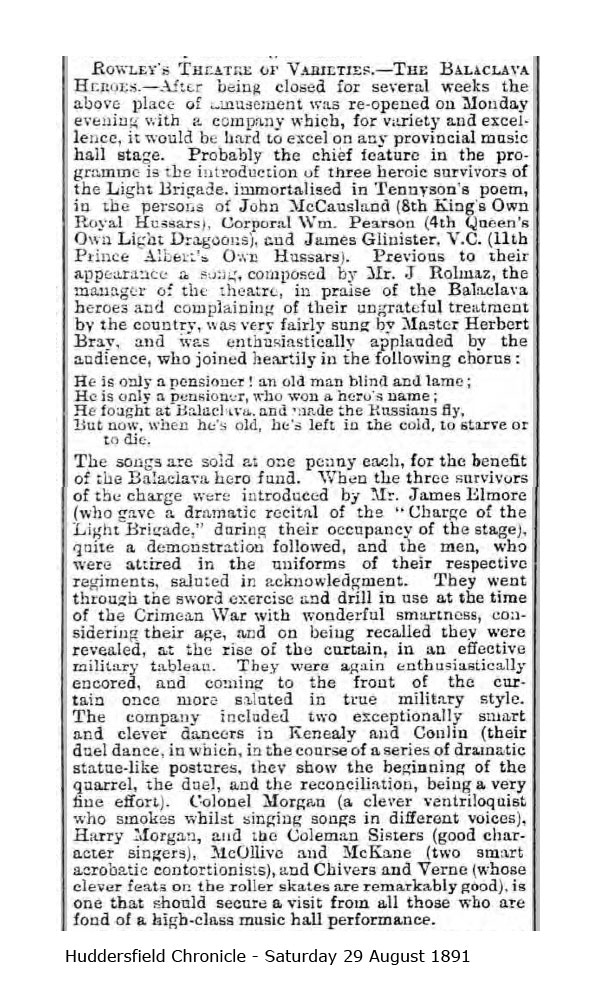
Rowley's Theatre of Varieties. — The Balaclava Heroes. —
After being closed for several weeks the above place of amusement was re-opened on Monday evening with a company which, for variety and excellence, it would be hard to excel on any provincial music hall stage. Probably the chief feature in the programme is the introduction of three heroic survivors of the Light Brigade, immortalised in Tennyson's poem, in the persons of John McCausland (8th King's Own Royal Hussars, Corporal Wm. Pearson (4th Queen's Own Light Dragoons), and James Glinister [Glanister], V.C. (11th Prince Albert's Own Hussars).
Previous to their appearance a song, composed by Mr. J Rolmaz, the manager of the theatre, in praise of the Balaclava heroes and complaining of their ungrateful treatment by the country, was very fairly sung by Master Herbert Bray, and was enthusiastically applauded by the audience, who joined heartily in the following chorus:
He is only a pensioner ! an old man blind and lame;
He is only a pensioner, who won a hero's name;
He fought at Balaclava, and made the Russians fly,
But now, when he's old, he's left in the cold, to starve or to die.The songs are sold at one penny each, for the benefit of the Balaclava hero fund.
When the three survivors of the charge were introduced by Mr. James Elmore (who gave a dramatic recital of the " Charge of the Light Brigade," during their occupancy of the stage), quite a demonstration followed, and the men, who were attired in the uniforms of their respective regiments, saluted in acknowledgment. They went through the sword exercise and drill in use at the time of the Crimean War with wonderful smartness, considering their age, and on being recalled they were revealed, at the rise of the curtain, in an effective military tableau. They were again enthusiastically encored, and coming to the front of the curtain once more saluted in true military style.
The company included two exceptionally smart and clever dancers in Kenealy and Conliu (their duel dance, in which, in the course of a series of dramatic statue-like postures, they show the beginning of the quarrel, the duel, and the reconciliation, being a very fine effort). Colonel Morgan (a clever ventriloquist who smokes whilst singing songs in different voices), Harry Morgan, and the Coleman Sisters (good character singers), McOllive and McKane (two smart acrobatic contortionists), and Chivers and Verne (whose clever feats on the roller skates are remarkably good), is one that should secure a visit from all those who are fond of a high-class music hall performance.
[Source: Huddersfield Chronicle, 29 August 1891, http://www.britishnewspaperarchive.co.uk/viewer/bl/0000167/18910829/046/0005 (accessed 5.12.15).]
The significance of this event is briefly discussed on the Arthur Lloyd: Music Hall and Theatre History website.
Rowley also tapped into wider, more national themes. This was most dramatically demonstrated in July 1891 when the theatre re-opened after a break of several weeks. A 'company which, for variety and excellence [was] hard to excel on any provincial stage' was assembled but the highlight was 'the introduction of three heroic survivors of the Light Brigade, immortalized in Tennyson's poem'.
Rolmaz, a song-writer best known for 'Where did you get that hat?' (See Note 1) wrote a special song praising the Balaclava heroes and sung that night by Master Herbert Bray. The song combined patriotism and sentimentality, as the opening verse shows:
He's only a pensioner! an old man blind and lame;
He's only a pensioner! who won a hero's name;
He fought at Balaclava and made the Russians fly,
But now when he's old, he's left in the cold, to starve or to die.
The sheet music was sold for 1d., for the benefit of the Balaclava Heroes Fund (Huddersfield Chronicle, 13th July 1891).